



When To File An Amended Tax Return: Deadlines & Reasons
You filed your tax return, hit submit, and then realized something was wrong. Maybe you forgot to report freelance income, missed a valuable deduction, or received a corrected W-2 after the fact. Knowing when to file an amended tax return can mean the difference between claiming a refund you're owed and leaving money on the table, or worse, facing IRS penalties down the road.
The good news is that the IRS allows taxpayers to correct mistakes on previously filed returns using Form 1040-X. But not every error requires an amendment, and there are strict deadlines you need to follow. Understanding which situations call for an amended return, and which ones the IRS will fix automatically, helps you avoid unnecessary paperwork while staying compliant.
This guide breaks down the specific reasons you might need to amend, the deadlines that apply to your situation, and how to determine if you're eligible. At TaxesToday, our CTEC-certified tax preparers have helped hundreds of clients navigate amended returns, from simple corrections to complex back-tax filings. Whether you're dealing with a missed 1099 form or reconsidering your filing status, you'll find the answers you need to move forward with confidence.
Amended return basics you need to know
Form 1040-X is the official IRS document you use to correct errors on a previously filed federal tax return. The form walks you through the process of explaining what changed, why it changed, and how those changes affect your total tax liability or refund. You can file amendments for returns from the past three years, and the IRS treats each amended return as a separate case, meaning you must submit one Form 1040-X for each tax year you need to correct.
What Form 1040-X does
This form lets you report the original amounts from your filed return, the net changes you're making, and the correct amounts after those changes. You fill out three columns: Column A shows what you originally reported, Column B shows the increase or decrease, and Column C shows the corrected figures. The IRS uses this side-by-side comparison to understand exactly what you're fixing and whether you owe additional tax or deserve a larger refund.
Part III of Form 1040-X requires you to explain your changes in plain English. You must state which line numbers changed, what the error was, and why you're making the correction. The IRS wants to see specific details, not vague statements like "I made a mistake." Instead, you might write: "I failed to report $8,500 in 1099-NEC income from freelance work. I am now reporting this income on Schedule C and claiming the associated business deductions."
You cannot use Form 1040-X to change your filing status from married filing jointly to married filing separately after the April deadline, even if you discover errors on the return.
How long an amendment takes to process
The IRS takes up to 16 weeks to process an amended return, though complex cases can take longer. Unlike electronic filing for original returns, amended returns filed by mail move through a slower review process because IRS staff must manually compare your changes against the original return. If you filed your amendment electronically (which became widely available starting in 2020), processing times may be faster, but you should still expect several months before you see results.
You will not receive confirmation that the IRS received your amendment unless you check the status yourself using the IRS "Where's My Amended Return?" tool. The IRS updates this tool every three weeks with the status of your Form 1040-X. If the agency needs more information or finds discrepancies, they will send you a letter requesting documentation or explaining adjustments they made to your amendment.
Who can file an amended return
Anyone who filed an original tax return can submit an amendment, whether you filed electronically or by mail. You do not need to wait for your refund to arrive before filing an amendment, though you must wait until the IRS finishes processing your original return if you want to avoid complications. The system cannot process changes to a return that does not exist in their database yet.
Taxpayers who used a paid preparer can file their own amendments without going back to the original tax professional, though many people choose to work with a preparer to ensure the amendment is done correctly. If you're amending multiple years or dealing with complex tax issues like business losses, self-employment income, or international reporting, professional help reduces the risk of making additional errors that could trigger an audit or delay your refund.
Understanding when to file an amended tax return starts with knowing these basics: what the form does, how long it takes, and who qualifies to use it. The mechanics are straightforward, but the decisions about which errors require amendments and which ones the IRS will fix automatically require more careful consideration.
Situations that require an amended return
You need to file Form 1040-X when errors on your original return change your tax liability, refund amount, or filing status. The IRS expects you to correct mistakes that result in underpaid taxes within specific time limits, and you should also amend when errors mean you paid too much. Understanding when to file an amended tax return protects you from penalties and helps you claim money you're legally owed.

Income you forgot to report
Missing income is one of the most common reasons taxpayers file amendments. If you received a W-2, 1099-NEC, 1099-MISC, or 1099-K after submitting your return, you must report that income by filing Form 1040-X. The IRS will eventually match their records against your return, and unreported income triggers automated notices that come with interest charges on unpaid taxes.
Freelancers and independent contractors often discover additional 1099 forms arrive in the mail weeks after filing. You need to amend even if the amount seems small, because the IRS computer systems flag every discrepancy. The same rule applies to investment income, unemployment benefits, state tax refunds that became taxable, and gambling winnings you initially forgot to include.
Deduction and credit errors
You must amend when you realize you claimed deductions or credits you weren't eligible for, or when you failed to claim valuable tax breaks you qualified for. If you took the standard deduction but later realized your itemized deductions exceeded that amount, filing an amendment can reduce your tax bill or increase your refund significantly.
Common deduction mistakes include:
- Missing business expenses on Schedule C for self-employment income
- Forgetting to claim student loan interest deductions (up to $2,500)
- Failing to report charitable contributions you made
- Omitting mortgage interest or property taxes paid during the year
- Missing education credits like the American Opportunity or Lifetime Learning Credit
If you claimed a dependent who didn't qualify, or forgot to claim a qualifying child or relative, you must file an amended return because dependent exemptions directly affect your standard deduction amount and eligibility for credits like the Child Tax Credit.
Filing status changes
You need to amend if you selected the wrong filing status and that error affected your tax calculation. Switching from single to head of household, or correcting married filing separately to married filing jointly, changes your standard deduction and tax brackets. The IRS does not automatically correct filing status errors because they require verification of your household situation and marital status on the last day of the tax year.
Filing status corrections often arise when taxpayers realize they qualified as head of household instead of single, which provides a higher standard deduction and more favorable tax rates. These amendments typically result in refunds because head of household status reduces taxable income for people who supported dependents.
When you do not need to amend
The IRS automatically fixes certain errors without requiring you to file Form 1040-X, which saves you time and paperwork. You do not need to amend your return when the mistake involves basic math calculations or when the IRS has systems in place to correct specific types of errors. Understanding when to file an amended tax return means also knowing when the agency handles corrections for you, so you avoid unnecessary filings that delay processing of legitimate amendments.
Math errors the IRS corrects automatically
The IRS computer systems catch addition and subtraction mistakes on your return and make corrections without contacting you. If you miscalculated your total income, adjusted gross income, or tax owed because of simple arithmetic errors, the agency fixes these problems and sends you an explanation of the changes they made. You receive either a refund check for the corrected amount or a bill for additional taxes owed, depending on whether the math error worked in your favor or against you.
These automatic corrections include:
- Addition or subtraction errors on any line of your return
- Incorrect calculations of your standard deduction based on filing status
- Wrong tax amount pulled from the tax tables
- Errors in calculating taxable income from total income and deductions
- Mistakes in applying tax credits to your total tax liability
The IRS corrects math errors within a few weeks of receiving your return, while amended returns take up to 16 weeks to process, making it pointless to file Form 1040-X for simple calculation mistakes.
Missing forms the IRS adds automatically
You do not need to amend when you forgot to attach W-2s, 1099s, or supporting schedules that employers and financial institutions already sent to the IRS. The agency matches their records against your reported income and tax withholding, then processes your return using the information they have on file. This system works because third parties file copies of these forms directly with the IRS at the same time they send them to you.
The automatic matching system handles:
- W-2 forms you forgot to attach but reported correctly on your return
- 1099-INT or 1099-DIV statements for interest and dividends
- Form 1098 for mortgage interest you claimed but didn't attach
- Schedule B for interest and dividend income under $1,500
However, you must still file an amendment if you failed to report income shown on these forms. The IRS corrects missing attachments but does not add unreported income automatically because doing so would change your tax liability. That distinction determines whether you need Form 1040-X or can let the IRS handle the correction through their standard processing.
Deadlines to claim a refund or pay tax
The IRS sets strict time limits for filing amended returns when you want to claim a refund, but no deadline exists when you owe additional tax. Understanding when to file an amended tax return within these deadlines determines whether you can recover money you overpaid or must pay interest on taxes you should have submitted earlier. The clock starts ticking from different dates depending on your situation, and missing the refund deadline means the IRS keeps your money permanently.

Three-year deadline for refund claims
You have three years from the original filing deadline to file Form 1040-X and claim a refund, or two years from the date you paid the tax, whichever is later. For most taxpayers, this means you have until April 15 three years after the tax year to submit your amendment. If you filed your 2022 tax return on time in April 2023, you must file an amended return claiming a refund by April 15, 2026.
The three-year rule applies from the original due date, not from when you actually filed. If you requested an extension and filed your 2022 return in October 2023, your deadline for claiming a refund through amendment remains April 15, 2026, because that was the original due date of the return. Filing early or late does not change this deadline.
The two-year alternative deadline helps taxpayers who paid estimated taxes late or made additional payments after filing their original return, giving them two years from that payment date to amend and claim a refund.
Examples of the deadline calculation:
- 2022 tax return: Amendment deadline is April 15, 2026
- 2023 tax return: Amendment deadline is April 15, 2027
- 2024 tax return: Amendment deadline is April 15, 2028
No deadline for paying additional tax
You face no time limit when filing Form 1040-X to pay additional tax you owe, though the IRS charges interest on unpaid amounts from the original due date. The interest compounds daily using the federal short-term rate plus 3%, and you cannot avoid this charge by filing quickly. Waiting to file an amendment when you owe tax increases your total bill because interest accumulates continuously until you pay.
The IRS may also assess a failure-to-pay penalty of 0.5% per month on unpaid taxes, up to 25% of the amount due. Filing your amendment promptly limits penalty exposure even though no deadline exists. If you discover errors that increase your tax liability, submit Form 1040-X immediately and pay the amount due to stop interest from accumulating further.
Taxpayers who owe additional tax should file amended returns as soon as they discover the error, rather than waiting for the IRS to catch the mistake through their automated matching systems. Voluntary disclosure before the IRS contacts you often results in lower penalties or penalty waivers, especially if you can demonstrate reasonable cause for the original error.
Step 1. Wait for your original return to process
You must wait until the IRS finishes processing your original tax return before filing Form 1040-X, because the agency's computer systems cannot match amendments to returns that do not exist in their database. Filing an amendment too early creates processing delays and confusion that can take months to resolve. The IRS needs to establish your baseline tax information from the original return before they can calculate changes you report on your amendment.
How to check your return's processing status
You can verify your original return's status using the IRS "Where's My Refund?" tool at IRS.gov, which updates every 24 hours with information about returns filed electronically or by mail. Enter your Social Security number, filing status, and exact refund amount to see whether the IRS has received, approved, or sent your refund. The system shows three status bars: Return Received, Refund Approved, and Refund Sent.
Your original return is fully processed when the status shows "Refund Approved" or when you receive your refund check or direct deposit. E-filed returns typically process within 21 days, while paper returns take six to eight weeks under normal circumstances. You should wait for confirmation of processing before starting your amendment, even if you plan to file Form 1040-X by mail.
Check for these processing indicators:
- Refund deposited into your bank account or check received
- IRS acceptance email if you e-filed through tax software
- "Refund Approved" status showing on Where's My Refund tool
- Letter from IRS acknowledging receipt of your paper return
Filing your amendment before the original return processes can result in the IRS rejecting your Form 1040-X or applying your changes to the wrong tax year, creating errors that require additional correspondence to fix.
When exceptions allow earlier filing
You may file Form 1040-X immediately if you discover an error so significant that waiting could result in penalties or compliance issues. The IRS accepts amendments for returns still in processing when taxpayers need to report substantial unreported income, correct fraudulent information, or fix errors that affect other taxpayers on the return. These situations require prompt action even though processing complications may arise.
Understanding when to file an amended tax return includes knowing this critical first step prevents problems later. Patience during the initial processing period ensures your amendment moves through the system correctly and reaches the appropriate IRS personnel who handle corrections for your specific tax year.
Step 2. Gather documents and redo the return
You need to collect all corrected tax documents and prepare an entirely new version of your return with accurate figures before completing Form 1040-X. The IRS requires you to show the original amounts, changes, and corrected totals on your amendment, which means you must recalculate every affected line of your tax return using the right information. Understanding when to file an amended tax return includes knowing you cannot simply note the error and hope the IRS fixes it for you.
Collect corrected and missing forms
Start by assembling every tax document that contains new or corrected information. If you received a revised W-2 or 1099 form, keep both the original and corrected versions to prove why your amendment changes specific income amounts. You will attach the corrected forms to your Form 1040-X when you file, and the IRS compares these documents against what they received from your employer or financial institution.
Gather these essential documents:
- Corrected W-2, 1099-NEC, 1099-MISC, or 1099-INT forms showing revised income or withholding amounts
- Missing forms you failed to include on your original return
- Receipts, invoices, or bank statements supporting new deductions you're claiming
- Documentation for dependents if you're changing who you claimed
- Schedule C or Schedule SE if you're adding self-employment income
- Form 1098 for mortgage interest or student loan interest you forgot to claim
- Charitable donation receipts if you're switching from standard to itemized deductions
You must keep copies of all amended return documents for at least three years after filing Form 1040-X, because the IRS may request proof of your corrections during their review process.
Recalculate your tax using amended figures
Prepare a complete new version of your tax return using the correct information as if you were filing for the first time. Use current-year tax software or forms for the tax year you're amending, not forms from the current year. If you originally filed your 2023 return and need to amend it in 2026, you must use 2023 tax forms and follow 2023 tax law, including the standard deduction amounts, tax brackets, and credit limits from that year.
Work through your return line by line and note which specific lines change because of your corrections. If you're adding $15,000 in self-employment income, you need to recalculate your adjusted gross income, taxable income, self-employment tax on Schedule SE, and your total tax liability. Write down the original line amount and new corrected amount for every line that changes, because you will transfer these numbers directly onto Form 1040-X in Column A and Column C.
Step 3. Complete Form 1040-X correctly
Form 1040-X uses a three-column layout that forces you to show your work when correcting tax return errors. You enter the original amounts from your filed return in Column A, the net changes (positive or negative) in Column B, and the corrected totals in Column C. The IRS reviews all three columns to verify your math and understand exactly what changed, so you must fill out every line that your amendment affects, not just the lines with errors.
Fill out the three-column format
You start by entering your original return information in Column A exactly as it appeared on the return you filed, even if those numbers were wrong. Copy the amounts from lines like total income, adjusted gross income, deductions, taxable income, total tax, and withholding directly from your original Form 1040. The IRS uses Column A to confirm they're looking at the right return in their system.
Column B shows the dollar amount of change for each line, using positive numbers to increase an amount and negative numbers (in parentheses) to decrease it. If you're adding $8,000 in unreported income to line 1, you write $8,000 in Column B. If you're increasing your itemized deductions by $3,500, you write ($3,500) in parentheses because deductions reduce your income. Understanding when to file an amended tax return requires getting these positive and negative signs correct, because reversing them makes your amendment calculate the wrong tax liability.
Calculate Column C by adding or subtracting Column B from Column A. The result in Column C represents the correct amount that should have appeared on your original return. Tax software automatically performs this calculation, but if you're filing by paper, you must verify your math on every affected line.
Write a clear explanation in Part III
Part III requires a written explanation describing what you changed and why you're making the correction. The IRS wants specific details about which forms, schedules, or line numbers contain errors, and what caused you to file an amendment. You must provide enough information that an IRS examiner can understand your correction without requesting additional documentation.
Use this template structure for your explanation:
I am amending my [tax year] tax return to [describe the error].

			Original return: [What you originally reported]
			Correction: [What you should have reported]

			This change affects the following lines on Form 1040:
			- Line [#]: [Original amount] changed to [Correct amount]
			- Line [#]: [Original amount] changed to [Correct amount]

			I discovered this error on [date] when [how you found the mistake].
Example explanation:
I am amending my 2024 tax return to report $12,500 in self-employment
			income I received from freelance consulting work.

			Original return: Did not report 1099-NEC income from ABC Company
			Correction: Reporting $12,500 on Schedule C and related self-employment tax

			This change affects the following lines on Form 1040:
			- Line 8: $0 changed to $12,500
			- Line 11: [original AGI] changed to [new AGI]
			- Line 15: $0 changed to $1,767 (self-employment tax)

			I discovered this error on January 15, 2026, when I received a corrected
			1099-NEC form from ABC Company showing income earned in 2024.
A vague explanation like "correcting income" or "fixing deductions" will trigger IRS requests for more information, delaying your refund by months while you respond to their correspondence.
Attach required supporting documents
You must include copies of any new or corrected forms that support your changes when you mail Form 1040-X to the IRS. Attach corrected W-2s, new 1099 forms, updated Schedule C, or revised Schedule A if you're switching from standard to itemized deductions. The IRS compares these attachments against information they received from employers and financial institutions to verify your corrections are legitimate.
Attach these documents behind Form 1040-X:
- All corrected or new income documents (W-2, 1099-NEC, 1099-MISC, 1099-INT, 1099-DIV)
- Any new schedules you're adding (Schedule C, Schedule SE, Schedule A)
- Form 2441 if claiming dependent care credits you missed
- Form 8863 for education credits you forgot to claim
- Supporting calculations or worksheets explaining complex changes
Step 4. File federal and state amendments
You must file your federal Form 1040-X separately from any state amended returns, because the IRS and state tax agencies operate independent processing systems. Understanding when to file an amended tax return includes knowing that most states require their own amendment forms when you change your federal return, particularly if your federal corrections affect state taxable income. The timing of your filings matters because some states want you to complete the federal amendment first, while others let you file simultaneously.
Submit your federal Form 1040-X
The IRS accepts electronic filing for Form 1040-X through major tax software platforms if you originally e-filed your return for tax years 2019 and later. E-filing your amendment speeds up processing and gives you automatic confirmation that the IRS received your submission. You access the e-file option through the same software you used for your original return, or by purchasing current-year software that supports amended returns for previous tax years.
Paper filing requires mailing Form 1040-X to a specific IRS address based on your state of residence and whether you expect a refund or owe additional tax. You cannot submit amendments to your local IRS office or the same address you used for your original return. Check the current mailing addresses in the Form 1040-X instructions at IRS.gov, because these addresses change periodically and using outdated information delays your amendment by weeks.
Mail your paper amendment to these locations:
- If you expect a refund: Department of the Treasury, Internal Revenue Service, Kansas City, MO 64999-0052
- If you owe tax or expect no refund: Department of the Treasury, Internal Revenue Service, Fresno, CA 93888-0052
Sending your Form 1040-X to the wrong address pushes your amendment into a forwarding queue that adds three to six weeks to processing time before the correct IRS center receives your paperwork.
File state amendments using state-specific forms
Your state requires its own amended return form when changes to your federal return affect state taxable income, deductions, or credits. Most states start their tax calculations with your federal adjusted gross income, so corrections that change your federal AGI automatically change your state tax liability. You need to file a state amendment even if the federal change does not result in a refund or additional tax owed at the state level, because states track consistency between federal and state returns.
Each state uses different forms and procedures. California requires Form 540-X, New York uses Form IT-201-X, and Texas has no income tax so residents skip state amendments entirely. Download your state's current amendment form from the state revenue department website and follow their specific instructions for mailing addresses and supporting documentation requirements. Some states now accept electronic filing for amendments, while others require paper submissions with original signatures.
File your state amendment after you complete your federal Form 1040-X, even if you have not received IRS approval yet. States want to see that you addressed the federal error first, and some state instructions explicitly tell you to attach a copy of your federal Form 1040-X to your state amendment. Processing times vary by state, with most taking eight to twelve weeks to review amended returns and issue refunds or bills for additional tax owed.
Track your amended return and handle payment
You need to monitor your Form 1040-X after submission because the IRS does not send automatic updates during the processing period. The agency provides a dedicated tracking tool that shows your amendment's progress through three distinct stages, and you should check this tool regularly to catch any issues early. Understanding when to file an amended tax return includes knowing how to follow up on your submission and handle any tax payments or refunds that result from your corrections.

Use the IRS tracking tool
The "Where's My Amended Return?" tool at IRS.gov lets you track your Form 1040-X status starting three weeks after you file. Enter your Social Security number, date of birth, and zip code to access information about amendments for the current year and up to three prior years. The system updates every three weeks and shows whether the IRS received your amendment, whether they are processing it, and whether they completed their review.
Your amendment moves through these status stages:
- Received: IRS logged your Form 1040-X in their system
- Adjusted: Staff reviewed your amendment and made changes to your account
- Completed: IRS finished processing and sent your refund or bill
The IRS takes up to 16 weeks to process most amendments, but complex cases involving business losses, multiple tax years, or international income can take six months or longer.
Handle payments if you owe additional tax
You must pay any additional tax liability shown on your Form 1040-X as soon as possible to limit interest charges. The IRS calculates interest from the original return's due date, not from when you discovered the error or filed your amendment. Paying immediately after filing your amendment stops interest from accumulating further and reduces your total bill.
Pay using these methods:
- IRS Direct Pay at IRS.gov/payments for free electronic payments from your bank account
- Mail a check or money order with Form 1040-V to the payment address in the Form 1040-X instructions
- Credit or debit card through IRS-approved payment processors (convenience fees apply)
- Set up an installment agreement at IRS.gov/opa if you cannot pay in full
Write your Social Security number, tax year, and "Form 1040-X" on any check payments so the IRS applies your payment to the correct amended return. Keep proof of payment in your tax records because delays in IRS processing can result in incorrect balance due notices months after you paid.
Expect refunds within processing time
Refunds from amended returns arrive three to four weeks after the IRS completes processing your Form 1040-X, which means most taxpayers receive their money four to five months after filing. The agency sends refunds as paper checks to the address on your amendment, even if you received your original refund through direct deposit. You cannot request direct deposit for amended return refunds because the IRS processes these payments separately from original return refunds.
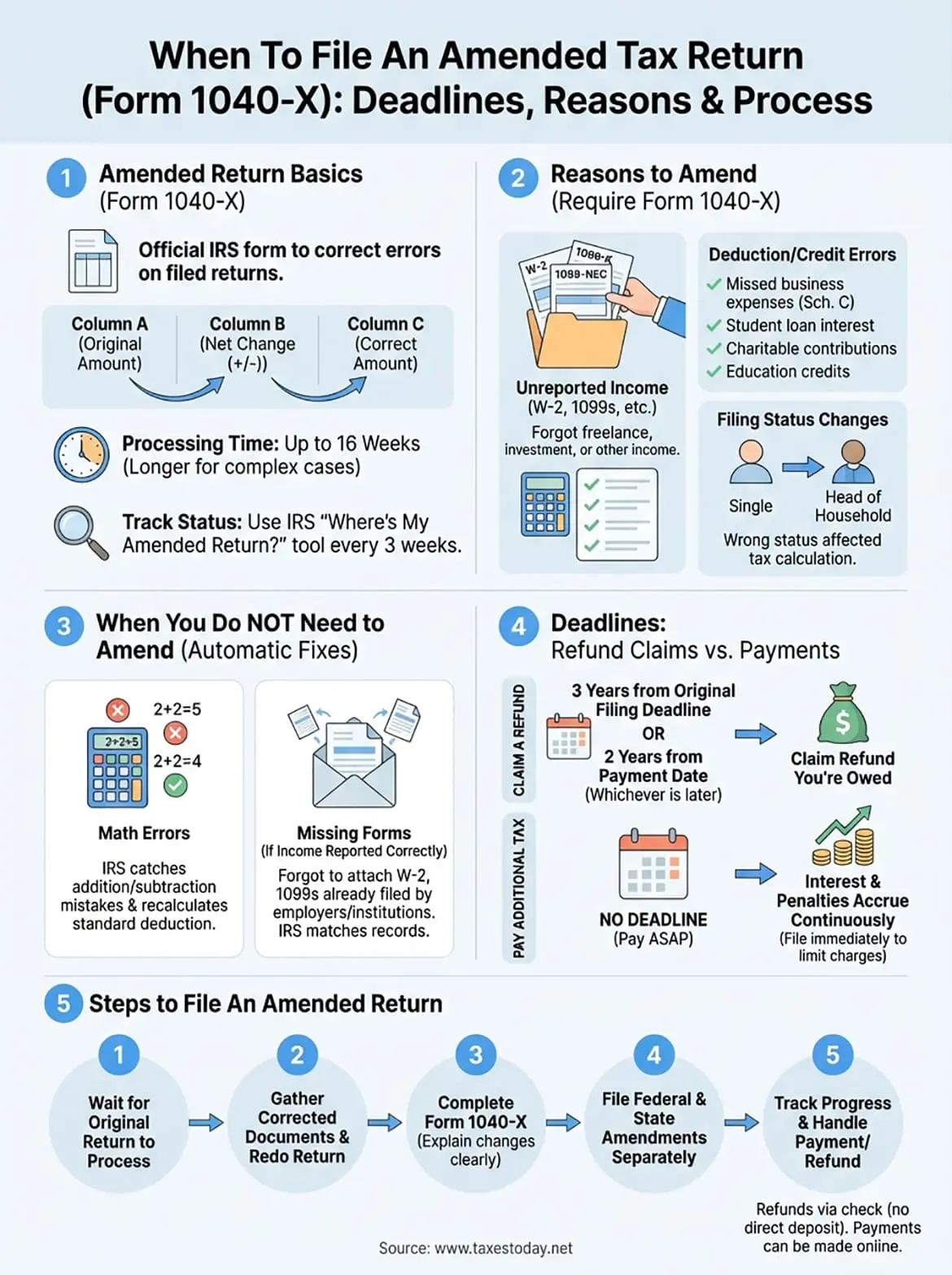
Wrap up and get help
You now understand when to file an amended tax return, the deadlines that apply, and the step-by-step process for submitting Form 1040-X. Most amendments arise from unreported income, missed deductions, or filing status errors, and you have three years from the original due date to claim a refund. The IRS takes up to 16 weeks to process your amendment, and you can track progress using their online tool while handling any payments or refunds that result.
Amended returns involve complex calculations and detailed explanations that leave little room for error. Professional tax preparers eliminate the guesswork and ensure your Form 1040-X contains accurate figures supported by proper documentation. If you're dealing with self-employment income, multiple tax years, or substantial changes to your original return, professional amended return preparation at TaxesToday gives you confidence that your correction will pass IRS review the first time. Our CTEC-certified tax preparers handle everything from gathering corrected forms to explaining your changes in language the IRS accepts.