


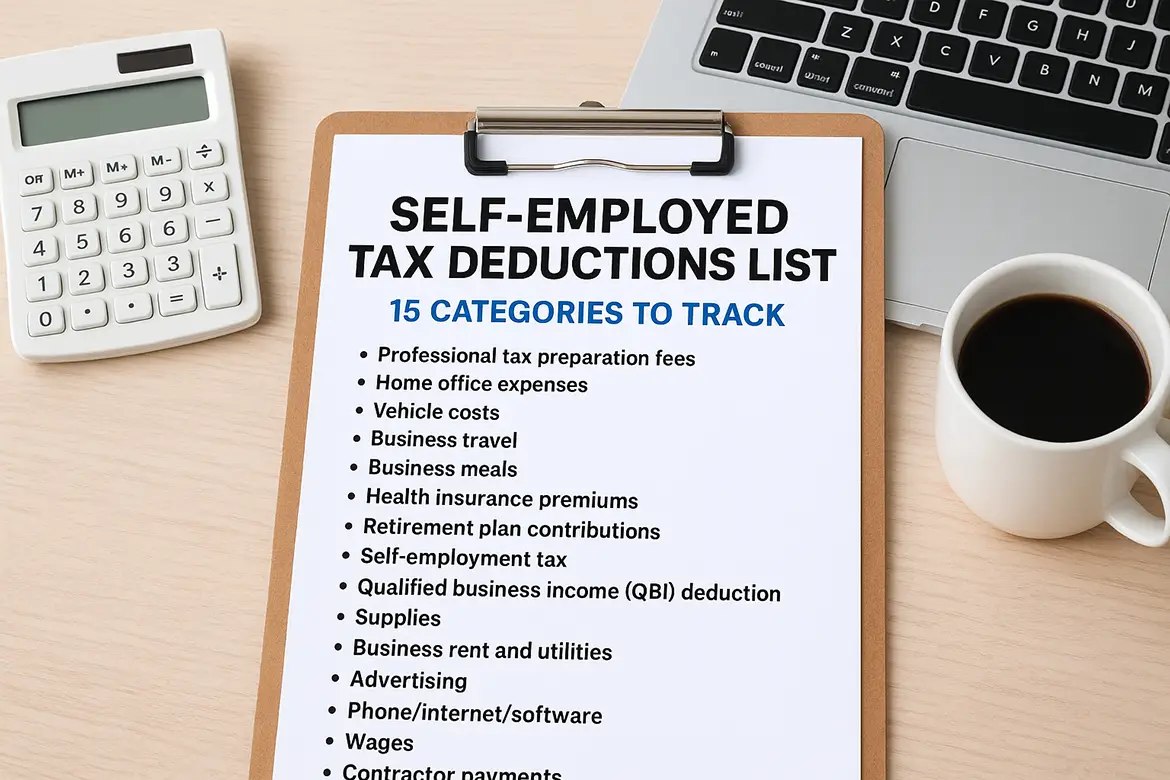
Self-Employed Tax Deductions List: 15 Categories to Track
You file your taxes as a self employed person and wonder if you captured every deduction you earned. That nagging feeling hits in April when you write a check to the IRS. Could you have written off more? The receipts pile up throughout the year and by December you have a shoebox full of paper with no clear system. You know expenses reduce your tax bill but which ones actually count? The IRS rules feel murky and tax forms look like they were designed to confuse people.
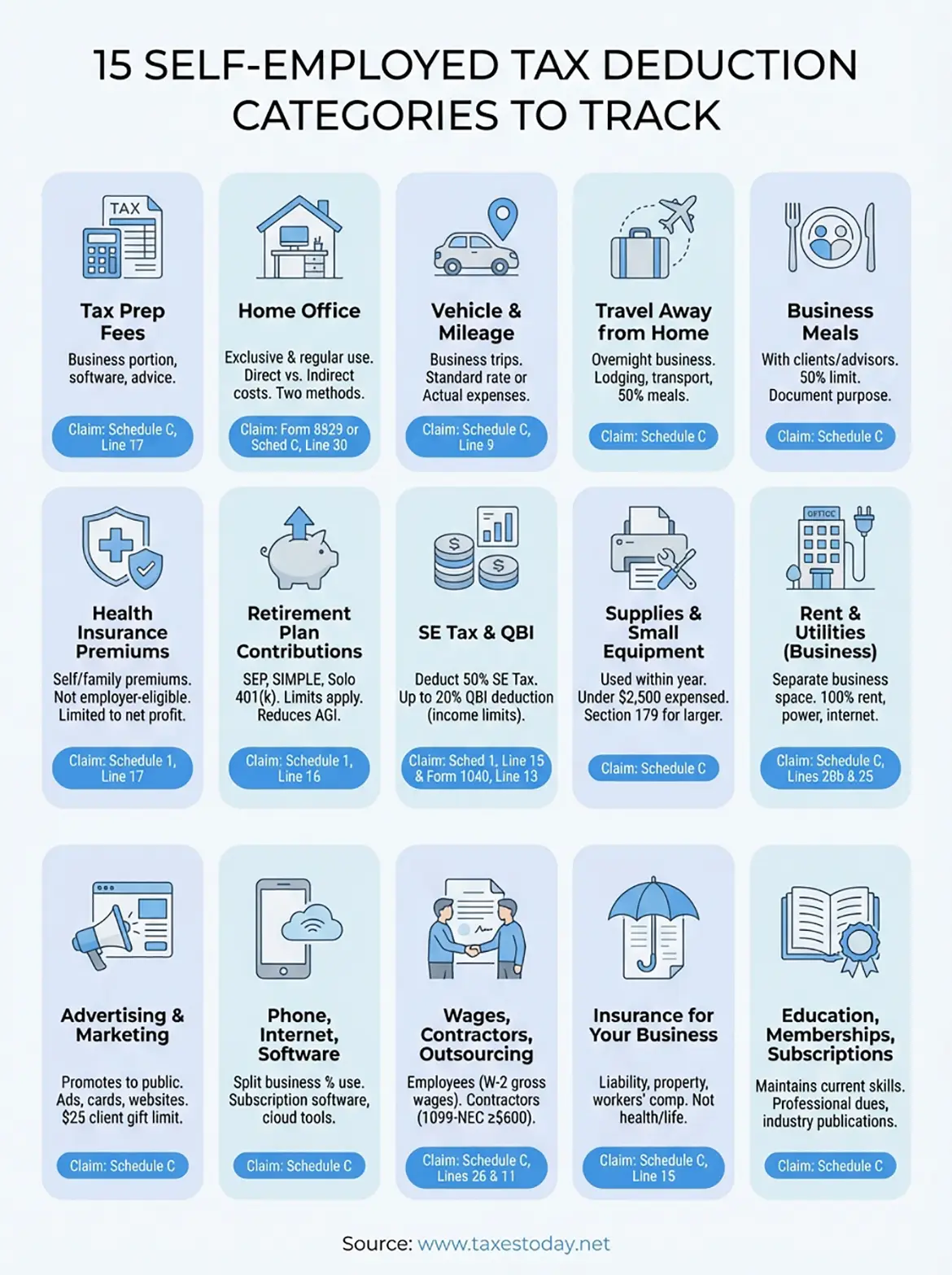
This guide walks through 15 major expense categories that self employed filers can deduct on their federal tax return. Each section explains what qualifies, how to calculate the deduction, where to claim it on your forms, and what records you need to keep. You will learn the difference between direct write offs and partial deductions. You will see which expenses trip up most filers and how to avoid common mistakes. Whether you drive for rideshare apps, consult from a home office, or run a small business with employees, these categories apply to your situation. Use this as your reference checklist when you track expenses throughout 2026 or prepare your 2025 return.
1. TaxesToday tax prep and advice fees
You pay for professional tax preparation every year and that expense belongs on your self-employed tax deductions list. The IRS allows you to deduct fees you pay to prepare the business portion of your return. This write-off covers payments to preparers, tax software subscriptions you use for your business, and advisory fees for questions about Schedule C or quarterly estimates. Most self-employed filers miss this deduction because they think of tax prep as a personal expense, but when you run a business, the portion tied to business income is fully deductible.
When tax prep fees are deductible
Tax preparation fees become deductible when they relate directly to your trade or business income. If you pay a preparer to complete Schedule C, that cost qualifies as a business expense. Software you purchase specifically to track business income and expenses also counts. Advisory calls or consultations about estimated tax payments, allowable write-offs, or entity structure fall under this category as well.
How TaxesToday fits into this category
TaxesToday charges a flat fee for self-employed tax preparation that starts at $99 and covers Schedule C filing, state returns, and ongoing support. You can deduct the entire fee because the service focuses exclusively on your business tax obligations. Virtual or in-person sessions that address quarterly payments, deduction strategies, or IRS notices all qualify for this write-off.
Where to claim this cost on your return
You report tax prep fees on Schedule C, line 17 under "Legal and professional services." This line captures costs for accountants, bookkeepers, and tax advisors. The deduction reduces your net profit before you calculate self-employment tax, which means you save on both income tax and the 15.3 percent self-employment levy.
Claiming tax prep fees on Schedule C lowers your adjusted gross income and cuts your self-employment tax bill at the same time.
What to track to maximize this deduction
Keep every invoice or receipt from your preparer, every confirmation email for software purchases, and notes from advisory calls. Record the date, amount, and purpose of each payment. If you use tax software for both personal and business filings, split the cost and deduct only the business portion on Schedule C.
2. Home office expenses
The home office deduction stands as one of the most valuable write-offs on any self-employed tax deductions list, yet many filers leave money on the table because they misunderstand the rules. You can deduct a portion of your rent or mortgage interest, utilities, insurance, and repairs when you use a defined space in your home exclusively and regularly for business. The IRS requires that your home office serve as your principal place of business or as a location where you meet clients in the normal course of your work. A corner of your bedroom where you answer emails does not qualify, but a spare room converted into an office does.
What qualifies as a home office
Your home office must meet two strict tests: regular use and exclusive use. Regular use means you conduct business in that space on an ongoing basis, not just once or twice per month. Exclusive use means the area serves only your business, not double duty as a guest room or family storage closet. You can claim a separate structure like a detached garage or studio if it qualifies under these same rules.
Direct versus indirect home office costs
Direct costs apply solely to your office space, such as painting the office or repairing a window in that room. You deduct 100 percent of direct costs because they benefit only the business area. Indirect costs cover your entire home, including mortgage interest, property taxes, utilities, and homeowners insurance. You deduct a percentage of indirect costs based on the square footage your office occupies relative to your total home size.
Methods to calculate the home office deduction
The IRS offers two calculation methods: simplified and regular. The simplified method multiplies your office square footage (up to 300 square feet) by five dollars per square foot, giving you a maximum deduction of $1,500. The regular method requires you to total all eligible expenses and multiply by your business-use percentage, which often yields a larger write-off for filers with high housing costs.
Choosing the regular method over the simplified option can increase your deduction by hundreds or thousands of dollars if you track every eligible expense.
How to report and document home office use
You report home office deductions on Form 8829 when you use the regular method or directly on Schedule C, line 30 for the simplified method. Keep floor plans, photos of your office, and receipts for all housing expenses. Measure your office and total home square footage, then save those calculations with your tax records to support your deduction if the IRS asks questions later.
3. Vehicle and mileage
Vehicle expenses rank high on every comprehensive self-employed tax deductions list because most business owners drive regularly for work. You can write off the cost of operating your car, truck, or van when you use it for business purposes, whether you drive to client sites, pick up supplies, or attend networking events. The IRS gives you two ways to calculate this deduction: the standard mileage rate or the actual expense method. Most self-employed filers choose the mileage rate because it simplifies recordkeeping, but actual expenses sometimes yield a larger write-off when your vehicle costs run high.
What driving counts as business mileage
Business mileage includes trips from your principal place of business to client locations, job sites, vendors, or temporary work locations. Driving from your home office to meet a client qualifies as deductible. Trips to the bank to deposit business checks, stops at the post office to mail products, and drives to continuing education seminars all count. Commuting from home to a permanent workplace outside your home does not qualify, even if you conduct business during the drive.
Standard mileage versus actual expense method
The standard mileage method multiplies your business miles by the IRS rate, which stands at 67 cents per mile for 2024 and 70 cents for 2025. You add parking fees and tolls on top of that amount. The actual expense method totals your gas, oil, insurance, repairs, lease payments, and depreciation, then multiplies that sum by the percentage of miles you drove for business versus personal use. You must choose one method in the first year you use a vehicle for business and stick with it for leased vehicles.

Tracking every business mile throughout the year protects your deduction and proves your claim if the IRS questions your mileage total.
How to track miles and vehicle costs
Record the date, starting odometer reading, ending odometer reading, and business purpose for every trip. Mobile apps automate this process by using GPS to log your routes. Paper logbooks work as well if you write entries consistently. Save receipts for gas, repairs, insurance premiums, and lease payments when you plan to use the actual expense method.
Where to claim vehicle expenses on your return
You report vehicle expenses on Schedule C, line 9 for car and truck costs. The form asks whether you used the standard mileage rate or actual expenses, and you must answer questions about vehicle purchase date and business use percentage in Part IV of Schedule C.
4. Travel away from home
Travel expenses appear frequently on a comprehensive self-employed tax deductions list because business owners often need to leave their tax home for work. Your tax home refers to the city or general area where you conduct business, not where you personally live. When you travel overnight or for multiple days outside that area for business purposes, you can deduct lodging, airfare, rental cars, taxis, and a portion of meals. The key requirement is that the trip must be ordinary and necessary for your trade, which means it fits your industry and helps you earn income.
When a trip qualifies as business travel
A trip qualifies as business travel when you leave your tax home overnight and the primary purpose of your trip relates to business. Attending a conference in your industry, meeting clients in another city, or visiting a vendor to inspect products all count as legitimate business travel. The IRS expects you to sleep away from home because day trips within your tax home fall under local transportation, not travel.
Deductible versus nondeductible travel costs
You can deduct airfare, train tickets, and baggage fees for business trips along with lodging, rental cars, taxis, and 50 percent of your meals. Parking fees and tolls count as well. You cannot deduct personal entertainment, sightseeing, or expenses for family members who tag along unless they work for your business and have a valid business reason to attend.
Rules for trips that mix business and personal time
The IRS looks at the primary purpose of your trip when you mix business and vacation. If you attend a three-day conference then stay two extra days to relax, you deduct travel costs to and from the destination plus expenses during the business days only. Personal days generate no deduction.
Documenting which days were business versus personal protects your deduction and prevents IRS adjustments later.
Recordkeeping for flights lodging and local transport
Save every receipt for flights, hotels, rental cars, and ground transportation. Note the business purpose, dates, and locations on each receipt. Keep a log of daily activities that shows meetings, site visits, or conference sessions you attended during the trip.
5. Business meals
Business meals appear on every self-employed tax deductions list because food costs add up quickly when you meet clients, attend networking events, or work through lunch while traveling. The IRS allows you to deduct a percentage of meals that have a clear business purpose and avoid lavish or extravagant spending. You must pay for the meal yourself, and either you or your employee must be present. The meal needs to happen during or immediately before or after a business discussion, whether you meet with a current client, prospective customer, or professional advisor.
Which meals qualify for a deduction
Meals qualify when you meet with clients, contractors, or advisors to discuss business matters, attend conferences or seminars where meals are provided, or travel overnight for work. Grabbing coffee with a potential client counts, as does taking a vendor to lunch to negotiate terms. Meals during business trips away from your tax home qualify even when you eat alone.
Current IRS percentage limits for meal deductions
The standard deduction limit sits at 50 percent of your meal costs for most business meals in 2025 and beyond. This percentage applies whether you buy a sandwich at a deli or pay for a client dinner at a restaurant. You calculate the deduction by multiplying your total eligible meal expenses by 0.50.
Tracking the business purpose and attendees for every meal protects your deduction and proves the expense was ordinary and necessary for your work.
How to document business purpose and attendees
Record the date, location, amount, and attendees for each meal on your receipt or in a digital log. Write notes about what business topics you discussed. Keep credit card statements and receipts that show the restaurant name and total cost.
Common meal deduction mistakes to avoid
Most filers forget to split personal and business meals when they eat out with family after a work meeting. Others claim 100 percent instead of 50 percent, which triggers IRS adjustments. Never deduct meals you eat alone at home or during your normal workday at your regular workplace.
6. Health insurance premiums
Health insurance premiums belong on every self-employed tax deductions list because they represent one of your largest annual expenses and the IRS allows you to write off the full cost of your premiums. This deduction differs from other business expenses because you claim it on your personal tax return as an adjustment to income, not on Schedule C. You can deduct premiums you paid for medical, dental, and qualified long-term care insurance that covers you, your spouse, your dependents, and children under age 27, even if they are not your dependents.
Who qualifies for the self employed health deduction
You qualify for this deduction when your business shows a net profit for the year and you are not eligible for coverage through an employer-sponsored health plan. The second requirement applies whether you work a part-time job that offers insurance or your spouse has access to employer coverage that could include you. Even if you choose not to enroll in your spouse's plan, the option to enroll disqualifies you from claiming this deduction.
Types of premiums you can deduct
You can deduct premiums for medical insurance, dental insurance, vision coverage, and qualified long-term care policies. Medicare premiums for Parts B, C, and D count as well once you reach age 65. Health savings account contributions do not fall under this deduction because they follow separate rules.
How to calculate the allowable deduction amount
Your deduction cannot exceed your net business profit for the year. If your business earns $20,000 in profit and you paid $25,000 in premiums, you can deduct only $20,000. You calculate net profit after subtracting all business expenses but before taking this health insurance deduction.
Claiming health insurance premiums as an adjustment to income lowers your adjusted gross income and reduces both your income tax and self-employment tax liability.
Where to claim this on your individual return
You report health insurance premiums on Schedule 1 of Form 1040, line 17, not on Schedule C. This placement makes the deduction available whether you itemize or take the standard deduction on your personal return.
7. Retirement plan contributions
Retirement plan contributions earn a spot on any comprehensive self-employed tax deductions list because they serve two purposes at once: building your nest egg and cutting your current tax bill. The IRS lets you deduct contributions you make to retirement plans designed for self-employed people, which reduces your adjusted gross income before you calculate income tax and self-employment tax. You claim this deduction on Schedule 1 of your Form 1040, not on Schedule C, which means the write-off applies whether you itemize or take the standard deduction on your personal return.
Retirement plan options for self employed people
Self-employed filers can choose from SEP IRAs, SIMPLE IRAs, solo 401(k) plans, and traditional or Roth IRAs. A SEP IRA allows contributions up to 25 percent of your net self-employment income or a higher percentage depending on how you calculate it. SIMPLE IRAs work well when you have employees because they require employer contributions but cap your personal deferral at lower levels. Solo 401(k) plans let you contribute as both employee and employer, which often results in the highest allowable deferral among all options.

Contribution limits and deadlines to know
Contribution limits change annually and depend on which plan you choose. For 2025, solo 401(k) plans allow up to $70,000 in total contributions if you are under age 50, while SEP IRAs let you contribute up to 25 percent of your net earnings from self-employment with the same dollar cap. You must make contributions by your tax return filing deadline, including extensions, which typically falls on April 15 or October 15 if you extend.
How these deductions reduce your taxable income
Retirement contributions lower your adjusted gross income directly, which means you save on income tax and self-employment tax simultaneously. Every dollar you contribute reduces your taxable income by that same dollar, making these deductions particularly valuable when your business earns strong profits.
Maximizing retirement contributions not only secures your financial future but also delivers immediate tax savings that reduce your liability across multiple tax categories.
Reporting contributions on your tax forms
You report retirement plan contributions on Schedule 1, line 16 for SEP, SIMPLE, and qualified plans. Solo 401(k) contributions require additional calculations that split employee deferrals from employer contributions, and you may need to file Form 5500-EZ if your plan assets exceed $250,000 at year end.
8. Self employment tax and QBI
Self-employment tax and the qualified business income deduction deserve prominent placement on your self-employed tax deductions list because they directly reduce your tax liability by thousands of dollars each year. The self-employment tax covers your Social Security and Medicare contributions at a combined rate of 15.3 percent, which hits harder than most business expenses. The qualified business income deduction, introduced in 2018, lets you write off up to 20 percent of your business profit before calculating income tax. Both deductions operate differently from standard business expenses because you claim them on your individual return rather than Schedule C.
How the self employment tax deduction works
You calculate self-employment tax on Schedule SE after determining your net business profit from Schedule C. The IRS lets you deduct 50 percent of the self-employment tax you paid, which mirrors the employer portion of Social Security and Medicare taxes that W-2 workers never see. This deduction appears on Schedule 1, line 15 of Form 1040 and reduces your adjusted gross income before you calculate federal income tax.
Basics of the qualified business income deduction
The qualified business income deduction allows you to write off up to 20 percent of your net business profit if you meet certain requirements. You calculate QBI after taking all business expenses but before applying this deduction. The write-off reduces your taxable income, not your business profit, which means it cuts your income tax without affecting self-employment tax calculations.
Income thresholds and limits to watch
QBI deduction rules tighten when your taxable income exceeds $191,950 for single filers or $383,900 for married couples filing jointly in 2025. Service-based businesses face additional restrictions above these thresholds, while product-based businesses may qualify for larger deductions. Phase-outs apply gradually as your income climbs.
The combination of the self-employment tax deduction and QBI deduction can save you thousands annually if you track both carefully and claim them on the correct forms.
Forms you use to claim these deductions
You report the self-employment tax deduction on Schedule 1, line 15 after completing Schedule SE. The QBI deduction appears directly on Form 1040, line 13 and requires Form 8995 or Form 8995-A depending on your income level and business structure.
9. Supplies and small equipment
Supplies and small equipment costs appear on every self-employed tax deductions list because these purchases keep your business running day to day. You can write off office supplies, raw materials, cleaning products, and tools you consume or use up within a year. The IRS separates supplies from larger equipment based on useful life and cost, which determines whether you deduct the full amount immediately or spread the write-off over several years through depreciation. Most self-employed filers benefit from expensing items as supplies whenever possible because that approach delivers an immediate tax benefit rather than forcing you to wait years to claim the full deduction.
Everyday supplies you can write off
You can deduct pens, paper, printer ink, cleaning supplies, packaging materials, postage, and small tools that wear out quickly. Professional supplies specific to your trade count as well, such as medical supplies for healthcare providers or art materials for designers. Items you use up within 12 months qualify as supplies, while purchases expected to last longer may need depreciation.
When to expense versus depreciate equipment
You expense supplies and equipment under $2,500 per item immediately on Schedule C. Items above that threshold typically require depreciation unless you apply Section 179 expensing. The cost limit applies to each individual item, not your total annual purchases.
Key rules for section 179 and bonus write offs
Section 179 lets you deduct up to $1,220,000 in equipment purchases for 2025 instead of depreciating them. Bonus depreciation allows 100 percent first-year write-offs for qualified property. Both rules help you claim larger deductions in the year you buy equipment.
Expensing equipment under Section 179 or bonus depreciation delivers immediate tax savings rather than spreading the deduction across multiple years.
How to organize receipts for this category
Save every receipt that shows date, vendor, amount, and item description. Group receipts by month and separate supplies from equipment purchases. Scan or photograph paper receipts to create digital backups that survive longer than thermal paper.
10. Rent and utilities for business
Rent and utilities expenses land on every self-employed tax deductions list because they represent fixed monthly costs that keep your business operating. You can deduct rent you pay for office space, warehouse storage, retail shops, or any other location used exclusively for business purposes. Utility bills for those spaces count as well, including electricity, gas, water, internet, and phone service. These deductions reduce your net business profit before you calculate income tax and self-employment tax, which makes them valuable write-offs when you maintain a separate business location outside your home.
Types of rent that are fully deductible
You can deduct 100 percent of rent payments for spaces used exclusively for business, such as a rented office, studio, warehouse, or retail storefront. Coworking space memberships qualify as deductible rent when you use them regularly for client meetings or daily work. Equipment rentals for copiers, printers, or specialized machinery count as well.
Utilities and services that count as business overhead
Utilities for your business location include electricity, natural gas, water, sewer, trash collection, and internet service. Phone lines dedicated to business calls qualify as deductible expenses. Security system monitoring fees and janitorial services for your business premises count as overhead costs you can write off.
How this interacts with the home office deduction
Rent and utilities for separate business locations do not overlap with home office deductions because the two categories cover different physical spaces. You claim rent for external offices as a full deduction on Schedule C while calculating home office expenses based on your residence square footage.
Keeping business locations separate from your home simplifies deduction calculations and eliminates percentage splits for shared spaces.
Where to list these expenses on Schedule C
You report rent on Schedule C, line 20b for business property rent or line 20a for vehicle, machinery, and equipment rentals. Utilities appear on line 25 under "Utilities" in Part II of Schedule C.
11. Advertising and marketing
Advertising and marketing expenses hold a valuable position on your self-employed tax deductions list because they help you attract customers and grow your business. The IRS allows you to deduct costs that promote your services or products to potential clients, whether you advertise online, in print, or through traditional media channels. These write-offs cover everything from business cards and website ads to billboards and social media campaigns, as long as the spending serves a clear business purpose and reaches your target audience.

What counts as advertising for tax purposes
Advertising for tax purposes includes any expense that promotes your business to the general public or targeted customer groups. Business cards, brochures, flyers, and promotional materials qualify as deductible costs. Website development focused on marketing, search engine ads, and social media campaigns count as well. Sponsorships of local events or community organizations that display your business name fall under this category.
Online and offline marketing costs you can deduct
You can deduct Google Ads, Facebook advertising, Instagram promotions, and other digital advertising platforms. Email marketing software, content creation costs, and graphic design fees for marketing materials qualify as deductible expenses. Traditional advertising like newspaper ads, radio spots, billboard rentals, and direct mail campaigns remain fully deductible as well.
Limits on gifts and promotional items
Business gifts to clients face a $25 per person per year limit for tax deductions. Promotional items you give broadly to the public, such as branded pens or calendars, avoid this limit as long as they cost $4 or less per item and display your business name permanently.
Staying under the $25 gift limit per client protects your deduction and prevents IRS adjustments that disallow excess amounts.
Tracking campaign and branding costs all year
Record the date, vendor, amount, and campaign purpose for every advertising expense. Save invoices from advertising platforms, receipts for printed materials, and contracts with media outlets. Group expenses by campaign or marketing channel to measure which efforts generate the best return on investment for your business.
12. Phone internet and software
Phone, internet, and software expenses appear on every self-employed tax deductions list because they represent essential tools that keep your business connected and productive. You can deduct monthly phone bills, internet service, and software subscriptions when you use them for business purposes, though the IRS requires you to split costs between business and personal use for most technology. Cloud storage, project management apps, accounting software, and other digital tools that help you run your business qualify as deductible expenses as long as you use them primarily for work rather than entertainment or personal tasks.
How to split personal and business use
You must calculate the percentage of time you use your phone or internet for business versus personal activities to determine your deductible amount. If you use your cellphone 60 percent for business calls and emails, you deduct 60 percent of your monthly bill. Internet service follows the same rule, requiring you to estimate how much bandwidth and time you spend on business tasks compared to streaming shows or browsing for personal reasons.
Deductible software and app subscriptions
Software subscriptions that run your business count as fully deductible expenses, including accounting platforms, customer relationship management tools, email marketing services, and invoicing systems. Design software, scheduling apps, and industry specific programs that help you deliver services or create products qualify as well.
Cloud tools and platforms that qualify as expenses
Cloud storage services like those offered by major technology companies become deductible when you store business files, client documents, or project assets on those platforms. Video conferencing subscriptions, file sharing platforms, and collaborative workspaces count as deductible tools when you use them to communicate with clients or manage your business operations.
Estimating business use percentages at the start of each year and reviewing them quarterly keeps your deductions accurate without requiring daily tracking.
Simple ways to document usage percentages
Track one typical week of phone and internet use to establish your baseline business percentage, then apply that ratio to your annual bills. Review call logs and browser history periodically to confirm your estimate remains accurate throughout the year.
13. Wages contractors and outsourcing
Wages, contractor payments, and outsourcing costs earn a spot on your self-employed tax deductions list because labor represents one of your largest business expenses when you grow beyond solo operations. You can deduct wages you pay to employees, including salaries, bonuses, commissions, and benefits, along with fees you pay to independent contractors who perform services for your business. The IRS lets you write off these costs as ordinary and necessary business expenses on Schedule C, line 26 for wages and line 11 for contract labor, which reduces your taxable profit before calculating income tax and self-employment tax.
Difference between employees and contractors
Employees work under your direct control and receive W-2 forms that report their wages, while contractors operate independently and receive 1099-NEC forms when you pay them $600 or more annually. You withhold payroll taxes from employee paychecks and match their Social Security and Medicare contributions, but contractors handle their own tax payments. The distinction matters because misclassifying workers triggers IRS penalties and back taxes that can cost thousands.
What you can deduct for payroll and labor costs
You deduct 100 percent of gross wages you pay to employees before withholding taxes, including regular pay, overtime, bonuses, and commissions. Employer payroll taxes you pay on employee wages count as separate deductions. Contractor payments become deductible when you pay them, whether you issue checks, bank transfers, or credit card payments for completed work.
Forms 1099 and W 2 you must issue
You must issue Form W-2 to every employee by January 31 following the tax year, regardless of how much you paid them. Form 1099-NEC goes to contractors who earned $600 or more from your business during the year, with the same January 31 deadline. Both forms require accurate reporting of total payments.
Filing 1099-NEC and W-2 forms on time protects your deductions and avoids late filing penalties that start at $60 per form.
How to track payments and meet IRS deadlines
Record every payment by date, payee name, amount, and purpose in your accounting system or spreadsheet. Collect Form W-9 from contractors before paying them to capture their tax identification numbers and business details. Set calendar reminders for January 15 to begin preparing forms and January 31 for filing deadlines.
14. Insurance for your business
Business insurance premiums secure a place on your self-employed tax deductions list because they protect your operations from financial loss and the IRS allows you to deduct most premiums as ordinary business expenses. You can write off liability coverage, professional malpractice insurance, property insurance for business assets, and workers compensation premiums when you hire employees. These deductions appear on Schedule C, line 15 and reduce your net business profit before you calculate income tax and self-employment tax, which makes insurance costs valuable write-offs that serve double duty by protecting your business while lowering your tax bill.
Types of business insurance that are deductible
You can deduct general liability insurance that covers accidents or injuries at your business location along with professional liability or malpractice coverage required in fields like healthcare, law, or accounting. Property insurance for equipment, inventory, or business buildings qualifies as deductible. Workers compensation premiums you pay to cover employees count as well, along with business interruption insurance and commercial auto coverage for vehicles used exclusively for work.

Insurance premiums that are not deductible
Life insurance premiums for yourself as the business owner cannot be deducted on Schedule C even when you purchase coverage to protect your business interests. Disability insurance that replaces your personal income during illness or injury fails to qualify as a business expense. Health insurance follows separate rules and belongs on Schedule 1 rather than your business return, as covered earlier in this guide.
How to allocate mixed personal and business coverage
Mixed-use insurance requires you to split premiums between personal and business portions based on usage percentages. Auto insurance for a vehicle you drive 70 percent for business and 30 percent personally allows you to deduct only the 70 percent business portion on Schedule C.
Calculating accurate business use percentages for mixed coverage protects your deductions and prevents IRS questions about personal expenses claimed as business costs.
Where to claim insurance costs on your return
You report business insurance premiums on Schedule C, line 15 under "Insurance (other than health)" in Part II of the form. This line captures all deductible coverage except health insurance, which appears separately on your personal return.
15. Education memberships subscriptions
Education, memberships, and subscriptions round out your self-employed tax deductions list because they help you maintain professional credentials and stay current in your field. You can deduct courses, training programs, professional dues, and industry publications when they maintain or improve skills required for your current business. The IRS draws a clear line between deductible education that enhances your existing expertise and non-deductible training that qualifies you for a new trade or career. Subscriptions to professional journals, industry databases, and specialized research tools count as deductible expenses when they directly support your business operations.
Courses and training that qualify as deductions
Courses that maintain or improve skills in your current line of work qualify as deductible education expenses. Continuing education credits required by your state licensing board, workshops that teach new software relevant to your trade, and seminars that update you on industry regulations all count. Online courses, webinars, and certification renewals fit this category when they relate to your existing business operations rather than preparing you for a different career.
Professional dues and memberships you can claim
Professional association memberships become deductible when they serve a clear business purpose such as networking opportunities, industry advocacy, or access to member resources. Chamber of commerce dues, trade organization fees, and professional licensing board memberships qualify as write-offs. You cannot deduct country club or social club memberships even when you discuss business at those venues.
Industry tools content and subscriptions that count
Industry publications, research databases, and specialized content platforms count as deductible subscriptions when you use them for business research or client work. Professional journals, trade magazines, and digital libraries that support your work qualify for this write-off.
Claiming only education expenses that improve your current business skills rather than training for a new career keeps your deductions aligned with IRS rules.
How to avoid claiming personal education expenses
Personal development courses unrelated to your business, hobby classes, and degree programs that prepare you for a new profession do not qualify as deductions. Education that meets minimum requirements to enter your field rather than maintain existing skills fails to meet IRS standards for deductible expenses.
Wrap up and next steps
You now have a complete self-employed tax deductions list covering 15 major expense categories that reduce your tax bill when you track them throughout the year. Each deduction follows specific IRS rules about what qualifies, how to calculate the write-off, and where to report it on your return. Consistent recordkeeping makes the difference between claiming every deduction you earned and leaving money on the table.
Start organizing your 2026 receipts today using these categories as your framework. Review your 2025 expenses to identify deductions you may have missed. Professional preparation helps you capture every write-off while avoiding costly mistakes that trigger audits. TaxesToday's affordable tax preparation services deliver accurate returns filed by licensed professionals who specialize in self-employed tax situations. Book your appointment now to maximize your deductions and minimize your tax liability.