


What Is Self-Employment Tax? 15.3% Rate & How to Calculate
Self-employment tax is the money you pay to cover Social Security and Medicare when you work for yourself. Unlike employees who split these costs with their employer, you handle both sides of the bill. The current rate is 15.3 percent of your net earnings. This tax applies once you make $400 or more from self-employment in a year. Whether you freelance, run a small business, or work as an independent contractor, you need to understand this obligation.
You'll learn exactly how to calculate what you owe, understand who needs to pay this tax, and discover what makes up that 15.3 percent rate. We'll walk you through the forms you need and when to file them. You'll see how self-employment tax works alongside your regular income tax. We'll also show you legal ways to reduce what you pay and help you spot common mistakes that cost people money. By the end, you'll know whether you should handle this yourself or get professional help.
Why self employment tax matters
Understanding what is self-employment tax affects every financial decision you make as a business owner. This tax funds your Social Security retirement benefits and Medicare coverage for the future. When you skip or miscalculate it, you face penalties from the IRS and lose credit toward your retirement. Many self-employed people discover this tax only when they file their first return, which creates a financial crisis they didn't plan for.
Your future benefits depend on it
Every dollar you pay in self-employment tax builds your Social Security credits and qualifies you for Medicare coverage when you turn 65. The IRS tracks these payments through your tax returns and reports them to the Social Security Administration. You need 40 credits (about 10 years of work) to qualify for retirement benefits. If you underreport your self-employment income or avoid filing, you reduce your future monthly Social Security checks. Medicare eligibility also requires a work history with proper tax payments.
The self-employment tax you pay today directly determines your retirement income tomorrow.
The financial impact hits harder than you expect
Self-employment tax adds 15.3 percent to your tax bill beyond regular income tax. A freelancer earning $50,000 in net profit pays roughly $7,065 in self-employment tax alone. This amount surprises people who transition from employee status, where employers covered half of these taxes invisibly. You need to set aside money throughout the year, not just at tax time. The quarterly estimated tax system requires you to pay in advance based on your projected annual income. Missing these deadlines triggers penalties and interest charges that compound your costs.
How to calculate self employment tax
You calculate self-employment tax by applying the 15.3 percent rate to your net earnings from self-employment. The IRS doesn't use your gross revenue but instead focuses on your profit after you subtract business expenses. This calculation happens on Schedule SE, which you attach to your Form 1040. The process involves a few specific steps that account for deductions and thresholds. You need accurate records of all income and expenses throughout the year to get this calculation right.
The basic formula you need
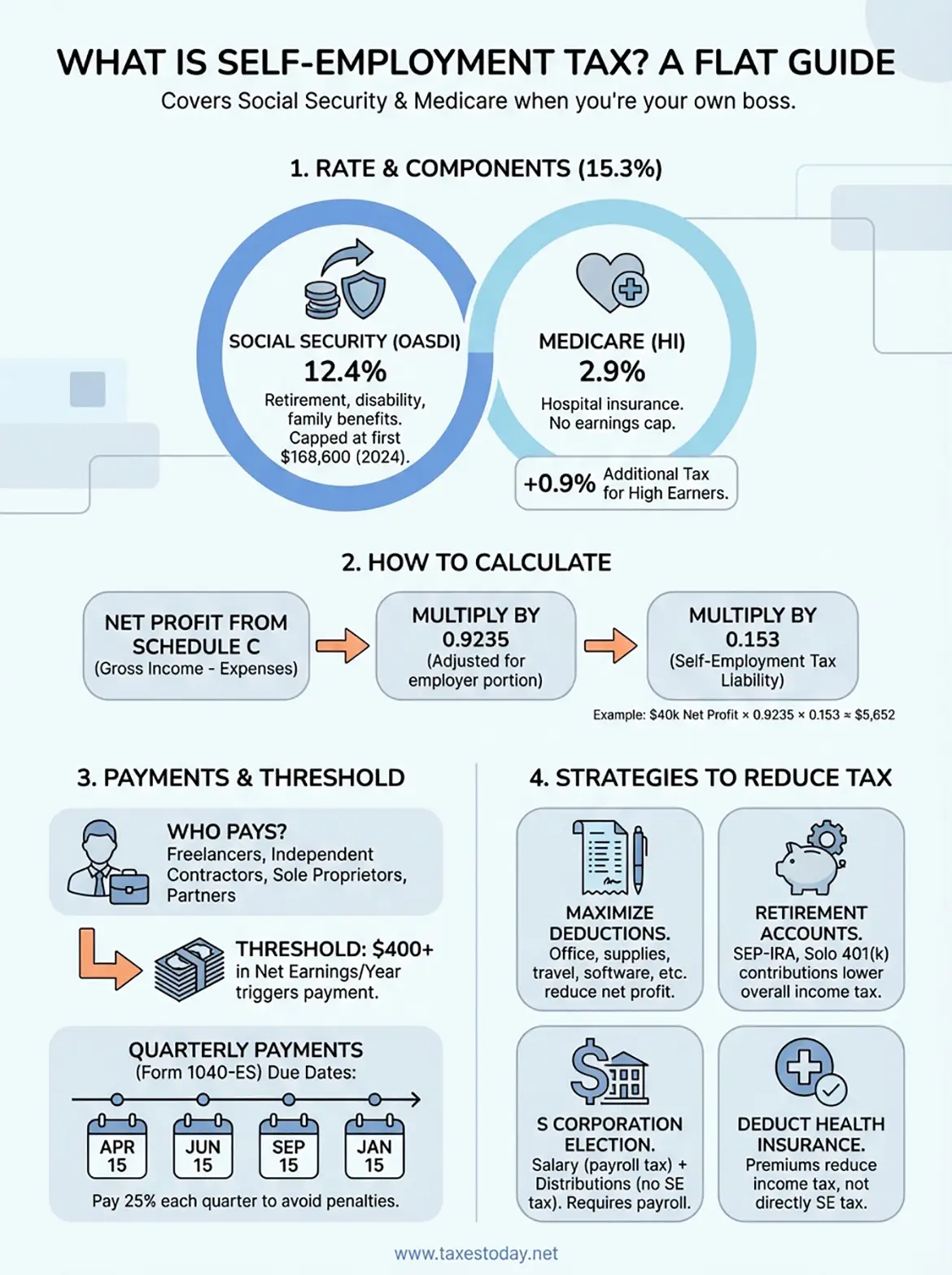
You start by determining your net profit from Schedule C, which shows your business income minus expenses. The IRS then multiplies this number by 92.35 percent to arrive at your net earnings subject to self-employment tax. This reduction accounts for the employer half of the tax that regular employees never see. You apply the 15.3 percent rate to this adjusted amount. The math looks like this: Net Profit × 0.9235 × 0.153 = Self-Employment Tax. A freelancer with $40,000 in net profit calculates $40,000 × 0.9235 = $36,940, then $36,940 × 0.153 = $5,652 in self-employment tax.
Step by step calculation walkthrough
Calculate your gross self-employment income first by adding all payments from clients, customers, or platforms. You track income from 1099-NEC forms, cash payments, and electronic transfers. Next, subtract your allowable business expenses like supplies, equipment, advertising, and vehicle costs to find your net profit. This number goes on Schedule C Line 31. Transfer that amount to Schedule SE Part II Line 2, where you multiply it by 0.9235. The resulting figure shows your earnings subject to self-employment tax. You then split this calculation between Social Security tax (12.4 percent on the first $168,600 for 2024) and Medicare tax (2.9 percent on all earnings). Add both amounts together to reach your total self-employment tax liability.
The 92.35 percent multiplier prevents you from paying tax on the employer portion that regular employees never face.
Important thresholds and limits
Social Security tax applies only to the first $168,600 of your net earnings for the 2024 tax year (rising to $176,100 for 2025). Earnings above this cap escape the 12.4 percent Social Security portion but still face the 2.9 percent Medicare tax. High earners pay an additional 0.9 percent Medicare tax on earnings exceeding $200,000 for single filers or $250,000 for married couples filing jointly. You calculate this extra amount on Form 8959 and add it to your regular self-employment tax. Multiple self-employment ventures combine their net profits for this calculation. You can't calculate each business separately and choose the most favorable treatment.
Quarterly payment considerations
You don't wait until April to pay what is self-employment tax. The IRS requires quarterly estimated payments using Form 1040-ES if you expect to owe $1,000 or more in total tax. You divide your expected annual self-employment tax by four and submit payments by April 15, June 15, September 15, and January 15. Each payment should cover both your self-employment tax and your income tax obligations. You base estimates on either your prior year's tax liability or your current year's projected income. Underpaying triggers penalties and interest charges that increase your total cost. Keep detailed records throughout the year to adjust your estimates if your income fluctuates significantly from your projections.
Who has to pay self employment tax
You pay self-employment tax when you operate a business as a sole proprietor, independent contractor, or member of a partnership. The IRS requires this payment when you earn $400 or more in net self-employment income during a tax year. This threshold applies regardless of your age, even if you already receive Social Security benefits. Understanding what is self-employment tax and whether you owe it depends on your business structure and how you receive income. You can't avoid this obligation by working part-time or having a full-time W-2 job on the side.
The $400 threshold that triggers payment
Your self-employment tax obligation begins when your net earnings reach $400 in a calendar year. This amount represents your profit after you subtract business expenses from your gross income. A freelance writer who earns $1,200 from clients but spends $850 on equipment and software has $350 in net earnings and owes no self-employment tax. However, if that same writer earns $1,500 with the same expenses, the $650 net profit triggers the requirement. You calculate this threshold separately from your W-2 wages if you hold both types of employment. The $400 minimum applies to your combined self-employment activities, not each business separately.

Even earning just $400 in self-employment profit creates a tax filing requirement you cannot ignore.
Business structures that require payment
Sole proprietors form the largest group of self-employment taxpayers because this structure requires no formal registration. You automatically become a sole proprietor when you offer services or sell products without creating a legal entity. Independent contractors who receive 1099-NEC forms fall into this category, including rideshare drivers, consultants, and gig workers. Single-member LLCs also pay self-employment tax because the IRS treats them as sole proprietorships by default for tax purposes. Partners in partnerships pay this tax on their share of partnership income, which they report on Schedule K-1. General partners face this tax on all partnership earnings, while limited partners typically pay it only on guaranteed payments for services.
Income types that count
All money you receive from business activities counts toward your self-employment income calculation. This includes payments reported on 1099-NEC forms from clients who paid you $600 or more during the year. Cash payments from customers also count, regardless of whether anyone issues a tax form. Digital payments through platforms like PayPal, Venmo, or payment processors add to your total when you use them for business transactions. Rental income from real estate generally escapes self-employment tax unless you provide substantial services to tenants. Director fees from corporate boards, notary fees, and income from professional practices all trigger self-employment tax obligations. You must track and report all these income sources accurately to calculate what you owe.
What the 15.3 percent rate includes
The 15.3 percent self-employment tax rate breaks down into two distinct programs that protect your financial security. You pay 12.4 percent toward Social Security (officially called OASDI for Old-Age, Survivors, and Disability Insurance) and 2.9 percent toward Medicare (Hospital Insurance). These percentages stay constant regardless of your income level, though the Social Security portion stops applying after you reach a specific earnings threshold. Understanding what is self-employment tax means recognizing that this rate doubles the contribution regular employees make because you cover both the employee and employer portions of these payroll taxes.
Social Security portion: 12.4 percent
Social Security tax takes the largest chunk of your self-employment tax payment at 12.4 percent of your net earnings. This tax applies only to the first $168,600 you earn for the 2024 tax year, increasing to $176,100 for the 2025 tax year. Once your net earnings exceed this wage base limit, you stop paying the Social Security portion on additional income. A consultant who earns $200,000 in net profit pays Social Security tax only on the first $176,100, saving $2,963.88 on the remaining $23,900. This cap doesn't apply if you have multiple self-employment ventures because the IRS combines all your earnings to determine whether you've reached the threshold.

The money you contribute to Social Security builds your earnings record with the Social Security Administration. Your future retirement benefits depend on your highest 35 years of earnings, so paying this tax now directly increases your monthly checks later. You also gain eligibility for disability benefits if you become unable to work before retirement age. Your family members may qualify for survivor benefits if you die, providing financial protection based on your contributions.
The Social Security portion of your self-employment tax creates your safety net for retirement, disability, and family protection.
Medicare portion: 2.9 percent
Medicare tax costs you 2.9 percent of all your net self-employment earnings with no upper limit. Unlike Social Security tax, you pay this percentage on every dollar you earn from your business activities. A freelancer making $300,000 pays Medicare tax on the entire amount, which equals $8,700 for this portion alone. This tax funds your hospital insurance coverage when you turn 65, regardless of how much you paid in total over your working years. You receive the same Medicare Part A benefits whether you contributed $10,000 or $100,000 during your career.
Additional Medicare tax for high earners
High-income self-employed individuals face an extra 0.9 percent Medicare tax on earnings above certain thresholds. You pay this additional tax once your combined wages and self-employment income exceeds $200,000 for single filers, $250,000 for married couples filing jointly, or $125,000 for married filing separately. A single freelancer earning $250,000 pays the standard 2.9 percent Medicare tax on all earnings plus 0.9 percent on the $50,000 above the threshold, adding $450 to their tax bill. This extra tax applies only to Medicare and doesn't affect your Social Security calculations. You report this amount on Form 8959 and include it with your annual return rather than in your quarterly estimates, though you can voluntarily include it to avoid underpayment penalties.
How self employment tax fits with income tax
You pay self-employment tax in addition to your regular federal income tax, not instead of it. Understanding what is self-employment tax means recognizing that these two obligations work together but calculate separately based on different rules. Your self-employment tax goes toward Social Security and Medicare, while your income tax funds general government operations. The IRS treats them as distinct line items on Form 1040, though you typically pay both through the same quarterly estimated payments. Your total tax bill combines both amounts, which surprises many new business owners who expect only one tax burden.
You pay both taxes separately
Self-employment tax calculates on 92.35 percent of your net earnings using the fixed 15.3 percent rate we covered earlier. Income tax, however, applies to your adjusted gross income after you claim deductions and uses progressive tax brackets that range from 10 percent to 37 percent depending on your total income. A freelancer with $60,000 in net profit pays self-employment tax of roughly $8,478 on $55,410 (the 92.35 percent portion). That same person then pays income tax on their full $60,000 minus the self-employment tax deduction and any other deductions they qualify for, such as the standard deduction or business expenses. The two calculations happen independently, though they both start with your business profit figure.
Your self-employment tax bill stays constant at 15.3 percent while your income tax rate changes based on your total earnings and filing status.
The deduction that reduces your income tax
You deduct 50 percent of your self-employment tax payment when calculating your income tax liability. This adjustment appears on Schedule 1 Line 15 of Form 1040 and reduces your adjusted gross income before you apply income tax rates. The deduction equals exactly half of your total self-employment tax, which represents the employer portion that W-2 employees never pay tax on. A consultant who owes $10,000 in self-employment tax claims a $5,000 deduction against their income tax. This reduction saves real money because it lowers the income subject to progressive tax brackets. Someone in the 24 percent bracket saves $1,200 in income tax through this deduction. You claim this benefit automatically when you file Schedule SE with your return.
Combined quarterly payments
Your quarterly estimated tax payments must cover both obligations together because the IRS doesn't accept separate payments for each tax type. You calculate your expected annual self-employment tax and income tax, add them together, then divide by four to determine each quarterly amount. Form 1040-ES provides worksheets that guide you through projecting both taxes simultaneously. Many self-employed people underpay because they forget to include self-employment tax when estimating only their income tax. You pay both taxes through the same voucher or electronic payment system using the quarterly due dates of April 15, June 15, September 15, and January 15.
Forms and deadlines for self employed filers
You file specific forms with the IRS to report and pay what is self-employment tax throughout the year. The main document you need is Schedule SE, which calculates your exact self-employment tax obligation based on your net earnings. You attach this schedule to your Form 1040 when you file your annual return. Beyond these core forms, you also use Form 1040-ES to make quarterly estimated payments during the year. Missing deadlines or filing incorrect forms triggers penalties that increase your total cost. The IRS expects accuracy and timeliness from self-employed taxpayers just as they do from traditional employers who withhold taxes from employee paychecks.
Schedule SE calculates what you owe
Schedule SE (Self-Employment Tax) serves as your calculation worksheet for determining your Social Security and Medicare tax liability. You complete Part I (the short method) if your net earnings from self-employment total less than $168,600, or Part II (the long method) if you earn more than this threshold. The form walks you through multiplying your net profit by 92.35 percent, then applying the 15.3 percent tax rate to that adjusted amount. You transfer the final number from Schedule SE Line 12 to your Form 1040 Schedule 2 Line 4. Most tax software completes this form automatically when you enter your Schedule C business income, but you should verify the calculations match your records.
Quarterly payment due dates you must meet
You pay your self-employment tax through quarterly estimated payments using Form 1040-ES on four specific dates each year. The deadlines fall on April 15, June 15, September 15, and January 15 of the following year. Each payment should cover one-quarter of your expected annual self-employment tax plus your income tax obligation. You calculate these amounts using the worksheet included with Form 1040-ES, which helps you project your year-end liability based on current earnings. Late or insufficient payments result in underpayment penalties that compound quarterly at the IRS interest rate.
The IRS penalizes you for missing quarterly deadlines even if you overpay when you file your annual return.
Payment methods include direct online transfers through IRS Direct Pay, the Electronic Federal Tax Payment System (EFTPS), or mailing physical checks with payment vouchers. You can adjust your estimates throughout the year if your income increases or decreases significantly from your projections. Many self-employed people pay more in earlier quarters to build a cushion against year-end surprises.
Annual filing requirements
Your Form 1040 with attached Schedule SE and Schedule C creates your complete self-employment tax filing package. You submit these documents by the standard tax deadline of April 15 following the tax year, or October 15 if you file an extension using Form 4868. The extension grants you extra time to file but doesn't delay your payment obligation. You must pay any estimated tax you owe by April 15 to avoid interest charges, then file the return later. State tax returns require separate forms and deadlines that vary by location, though most states follow the federal April 15 date for individual returns.
Strategies to reduce your self employment tax
You can legally lower what is self-employment tax through specific strategies that reduce your net earnings or shift how you structure your business. These methods require proper documentation and compliance with IRS rules, but they save you thousands of dollars annually. The key lies in maximizing deductions, using retirement accounts, and potentially changing your business entity. You should implement these strategies throughout the year rather than scrambling at tax time. Each approach carries different requirements and benefits depending on your income level and business type.

Maximize your business expense deductions
Every dollar you deduct from your gross income reduces your net profit by that amount, which directly lowers your self-employment tax bill. You should track and claim all legitimate business expenses including office supplies, software subscriptions, advertising costs, professional development, vehicle expenses, and equipment purchases. A freelancer who deducts $10,000 in business expenses saves roughly $1,530 in self-employment tax beyond the income tax savings. You must keep receipts, invoices, and documentation to support each deduction if the IRS audits your return. Common overlooked deductions include home office expenses (if you use a dedicated space exclusively for business), business-related travel, client meals (50 percent deductible), and professional licenses or memberships.
Set up a retirement account
Retirement contributions offer powerful tax advantages because you deduct them from your income tax while also reducing your adjusted gross income. You can open a SEP-IRA and contribute up to 25 percent of your net self-employment earnings (after subtracting half your self-employment tax), with a maximum of $69,000 for 2024. A Solo 401(k) lets you contribute as both employer and employee, potentially allowing you to save more at lower income levels. These contributions don't directly reduce your self-employment tax since that calculates before retirement deductions, but they significantly lower your income tax burden. You must set up these accounts by your tax filing deadline (including extensions) to claim contributions for that year.
Strategic retirement contributions reduce your overall tax burden while building your financial security for the future.
Consider an S corporation election
Filing Form 2553 to elect S corporation status changes how you pay yourself and can reduce your self-employment tax significantly. S corporations let you take a reasonable salary subject to payroll taxes, then distribute remaining profits as dividends that avoid self-employment tax. A consultant earning $120,000 might pay themselves a $60,000 salary (subject to payroll taxes) and take $60,000 as distributions, saving roughly $9,180 in self-employment tax annually. You must actually process payroll, file quarterly payroll tax returns, and justify your salary amount to the IRS. This strategy works best when your business profits exceed $60,000 to $80,000 because the administrative costs and complexity outweigh savings at lower income levels.
Deduct health insurance premiums
You deduct 100 percent of health insurance premiums you pay for yourself, your spouse, and your dependents as an adjustment to income on Form 1040 Schedule 1 Line 17. This deduction reduces your income tax liability but doesn't lower your self-employment tax since that calculates before this adjustment applies. You qualify for this deduction only if you aren't eligible for coverage through an employer plan (including your spouse's employer). Self-employed people paying $800 monthly for family health insurance save approximately $2,304 annually in income tax at the 24 percent bracket, though the deduction can't exceed your net self-employment income for the year.
Common self employment tax mistakes
Self-employed taxpayers make predictable errors that cost them money, trigger IRS penalties, or both. You can avoid these mistakes by understanding where others go wrong and taking preventive action throughout the year. Many of these errors stem from misunderstanding the rules or failing to keep proper records rather than intentional tax evasion. Learning what is self-employment tax includes recognizing these common pitfalls before they damage your finances. The IRS catches most mistakes through automated systems that match your reported income against information returns from clients and payment processors.
Forgetting to track all income sources
You must report all self-employment income regardless of whether you receive a 1099 form from the payer. Many freelancers forget to include cash payments, small gigs under $600, or income from platforms that don't issue tax forms. A graphic designer who receives $500 from three different clients owes tax on all $1,500 even though none of those clients sends a 1099-NEC. Payment apps like Venmo or PayPal for business transactions create a paper trail the IRS can audit. You need to maintain a spreadsheet or accounting system that captures every dollar you earn throughout the year. Missing income on your return triggers matching notices from the IRS that add penalties and interest to your original tax debt.
Not making quarterly estimated payments
Waiting until April to pay your entire tax bill results in underpayment penalties that compound quarterly. You face these penalties when you owe $1,000 or more and haven't paid at least 90 percent of the current year's tax or 100 percent of the prior year's tax through withholding or estimates. A consultant who earns $80,000 and ignores quarterly payments owes roughly $12,000 in self-employment tax plus penalties that can add several hundred dollars. You should calculate and submit payments by the quarterly deadlines rather than treating tax as an annual obligation. Setting aside 25 to 30 percent of each payment you receive prevents cash flow problems when estimates come due.
Quarterly payment deadlines exist to collect taxes throughout the year, not as suggestions you can ignore without consequences.
Mixing up gross income and net earnings
You calculate self-employment tax on your net profit after expenses, not your gross revenue. New business owners sometimes apply the 15.3 percent rate to their total income before deductions, creating an inflated tax estimate. Others forget the 92.35 percent multiplier that reduces the amount subject to tax. A writer who earns $50,000 but spends $15,000 on expenses calculates tax on $35,000 in net profit, not the full $50,000. You must track deductible business expenses carefully and subtract them before running your self-employment tax calculation. This mistake causes people to overpay significantly or underpay when they realize the error and overcorrect.
When to get professional tax help
You should hire a tax professional when your situation exceeds your knowledge or the cost of mistakes outweighs the service fee. Many self-employed people benefit from professional guidance during their first year of business when they lack experience with what is self-employment tax and quarterly payments. You also need help if you face an IRS audit, receive notices about underpayment penalties, or owe back taxes from previous years. Professionals save you money by finding deductions you miss and prevent costly errors that trigger penalties or interest charges.
Complex situations that require expertise
Your tax situation demands professional help when you operate multiple businesses, earn income across several states, or employ other people who require payroll tax management. Foreign income, cryptocurrency transactions, or substantial equipment purchases involve complicated rules that tax software can't navigate reliably. Partnerships and S corporations require specialized knowledge about profit distributions, reasonable compensation, and entity-level tax returns that most business owners don't understand fully. You should seek help before making major business structure changes rather than fixing problems afterward.
Professional tax guidance costs less than the penalties and missed deductions you face when handling complex situations alone.
Tax preparers, enrolled agents, and CPAs bring years of experience with IRS rules and can represent you if problems arise. You find qualified professionals through state CPA societies, the IRS enrolled agent directory, or referrals from other business owners in your industry.
Final thoughts
Understanding what is self-employment tax protects your financial future and keeps you compliant with IRS requirements. You now know the 15.3 percent rate covers your Social Security and Medicare obligations, and you understand how to calculate what you owe based on your net earnings. The strategies we covered help you reduce your tax burden legally while building your retirement security through proper planning.
You face quarterly payment deadlines, complex forms, and calculations that create real financial consequences when you make mistakes. Many self-employed people benefit from professional guidance that saves more money than the service costs. TaxesToday offers affordable tax preparation services that handle your self-employment tax calculations, maximize your deductions, and ensure you meet all deadlines without penalties. Our certified professionals bring expertise that protects your business and your financial peace of mind.