


IRS Fresh Start Program Guide: Eligibility and Options
Owing the IRS more than you can pay creates real stress. You worry about penalties piling up, collection notices arriving in the mail, and the threat of wage garnishments or bank levies. Many people assume they have no choice but to struggle under that debt for years.
The IRS Fresh Start Program offers legitimate ways to reduce or manage your tax debt. This federal initiative includes several relief options like payment plans, offers in compromise, and penalty reductions designed to help taxpayers who genuinely cannot pay what they owe. The program has been helping people since 2011, and it remains available in with clear eligibility requirements.
This guide walks you through everything you need to know about the Fresh Start Program. You will learn what the program actually is, how to check if you qualify, which relief option fits your situation, what forms and documents you need, and how to avoid common mistakes that could delay or derail your application. By the end, you will have a clear roadmap to potentially reduce your tax burden and get back on solid financial ground.
What is the IRS Fresh Start program
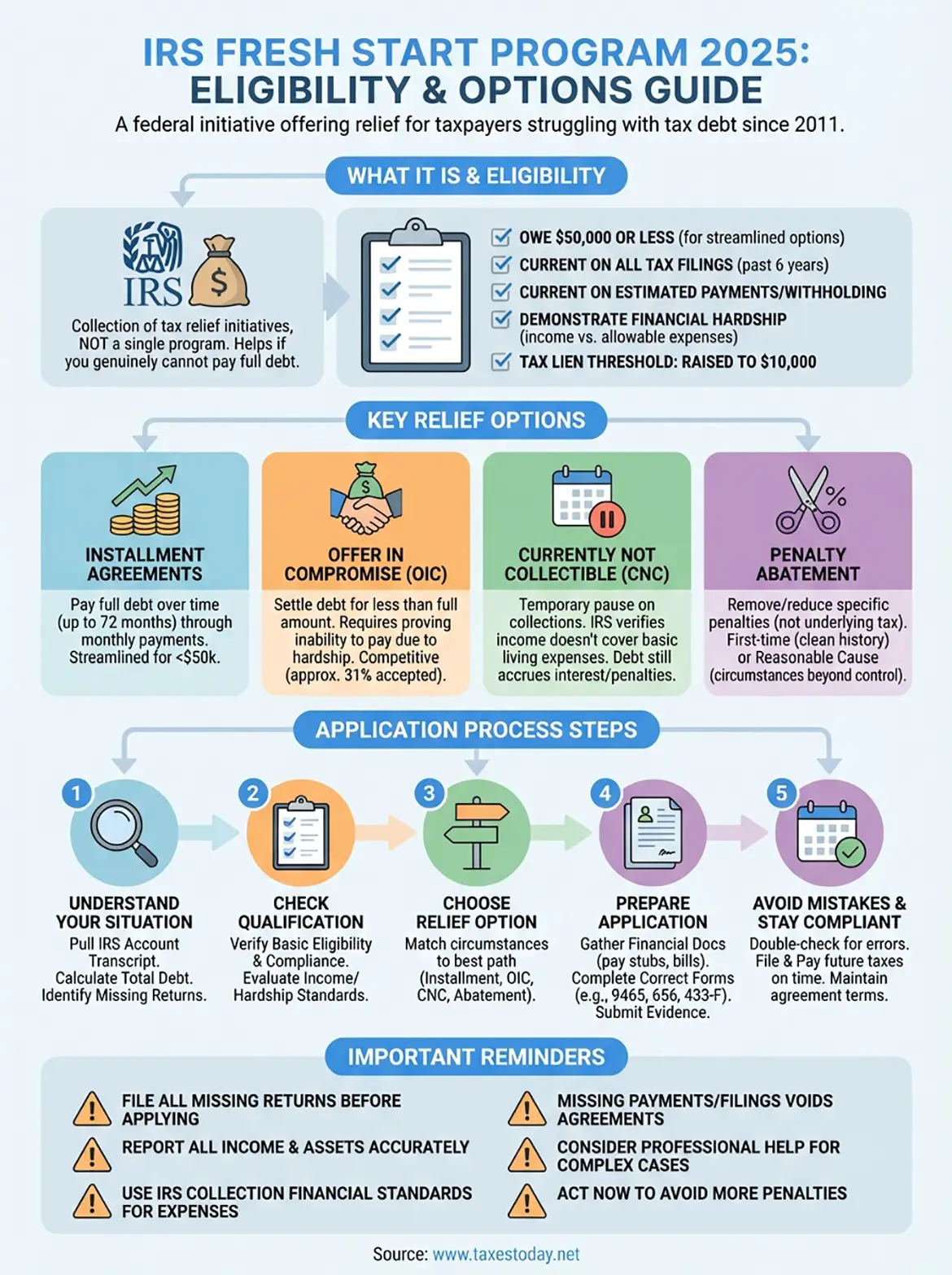
The IRS Fresh Start program is not a single program but rather a collection of tax relief initiatives that the Internal Revenue Service launched in 2011 and expanded in 2012. These policies help taxpayers who cannot afford to pay their full tax debt by offering several paths to reduce what you owe or create manageable payment arrangements. The program remains active and available in with consistent eligibility rules.
Key relief options available
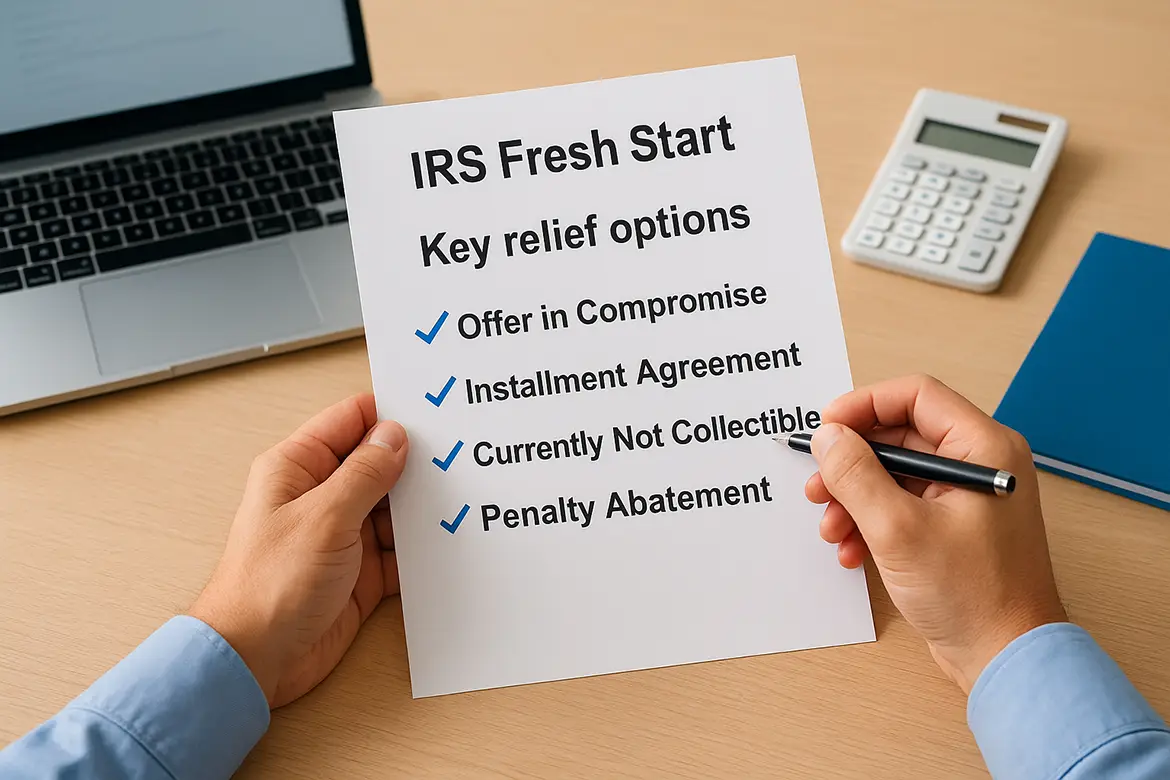
Fresh Start provides four main relief paths depending on your financial circumstances. You can request an Offer in Compromise to settle your debt for less than the full amount, set up an installment agreement to pay over time, apply for Currently Not Collectible status to pause collections temporarily, or seek penalty abatement to reduce or eliminate specific penalties. Each option has different qualification requirements and benefits.
The program also raised the threshold for when the IRS files a federal tax lien, increased it from $5,000 to $10,000 in total tax debt. This change helps more taxpayers avoid the credit damage and public record that comes with a lien. If the IRS already filed a lien against you, Fresh Start created a withdrawal process that can remove the public notice from your credit file once you meet certain payment conditions.
The IRS designed Fresh Start to make tax debt relief more accessible to taxpayers facing genuine financial hardship.
Understanding that the irs fresh start program is actually multiple options helps you approach your situation strategically. You need to evaluate which specific relief path matches your income, expenses, assets, and ability to pay. The next steps will show you exactly how to assess your situation and determine which option gives you the best chance of approval.
Step 1. Understand your tax situation
You cannot apply for the irs fresh start program without first knowing exactly what you owe and why. The IRS requires complete information about your tax debt before they will consider any relief option. You need to gather specific documents and calculate precise figures so you can determine which Fresh Start path matches your circumstances.
Pull your IRS account transcript
Your IRS account transcript shows every tax year you owe, the original amounts, penalties, interest, and any payments you have made. You can request this transcript online through the IRS website by creating an account, calling the IRS at 1-800-908-9946, or mailing Form 4506-T to request it by postal delivery. The transcript provides the official record of your tax debt that you will reference throughout your application process.
Order transcripts for every year you have unpaid taxes, not just recent years. Some taxpayers discover they owe for years they forgot about or assumed were resolved. Having complete records prevents surprises later when the IRS reviews your application.
Calculate your total tax debt
Add up the balance due from all tax years on your transcripts to determine your total debt. This number includes the original tax amount plus accumulated penalties and interest through the transcript date. You need this total to know which Fresh Start options you qualify for, since programs like streamlined installment agreements have specific debt thresholds.

Knowing your exact debt amount determines which relief programs you can access and helps you set realistic expectations for what the IRS might approve.
Write down the breakdown by year so you can see which years contribute most to your total. Some years might be close to the 10-year collection statute expiration, which affects your strategy. This detailed picture helps you or a tax professional evaluate whether negotiating an Offer in Compromise makes sense or if a payment plan works better for your situation.
Identify missing tax returns
Check your transcript for any years you did not file a tax return. The IRS will reject any Fresh Start application if you have unfiled returns, regardless of whether you qualify otherwise. You must file all missing returns before you can proceed with any relief request, even if filing them increases your total debt temporarily.
Step 2. Check if you qualify
The irs fresh start program sets specific financial and compliance requirements that determine whether you can access relief. These rules have remained consistent through , so you can evaluate your eligibility by comparing your situation against clear thresholds. Meeting these requirements does not guarantee approval, but failing to meet them will result in automatic rejection.
Basic eligibility requirements
You must owe $50,000 or less in combined tax debt (including penalties and interest) to qualify for streamlined installment agreements without providing detailed financial disclosure. Taxpayers who owe more than this amount can still access other Fresh Start options like Offer in Compromise or regular installment agreements, but you will need to submit comprehensive financial statements showing your income, expenses, assets, and ability to pay.
Your filing status must be current, meaning you filed all required tax returns for the past six years. The IRS will not process any Fresh Start application until you submit every missing return, even if those returns increase your total debt. If you are self-employed, you must have made all required estimated tax payments for the current year, and if you employ others, you need to be current on all payroll tax deposits.
Income and hardship standards
The IRS evaluates your monthly income against your allowable expenses using standardized amounts for housing, transportation, food, and other necessities. These standards vary by county and family size, and the IRS uses them to determine how much you can reasonably afford to pay each month. You can find these allowable expense amounts on the IRS website under Collection Financial Standards.
The IRS considers you eligible for relief when paying your tax debt in full would prevent you from meeting basic living expenses or create genuine economic hardship.
Demonstrating hardship requires specific documentation of your financial situation. You need recent pay stubs or proof of unemployment, bank statements from the past three months, bills showing monthly expenses, and statements listing all assets including retirement accounts and property. The IRS will compare your available income after expenses to your total debt to determine which relief option matches your circumstances.
Compliance requirements for approval
You must remain current on all tax obligations throughout the application process and after approval. This means filing returns on time each year and making required estimated payments if you are self-employed. Breaking these compliance rules during an installment agreement or after accepting an Offer in Compromise can void your relief and reinstate your full tax debt plus additional penalties.
Check that your current year withholding or estimates cover your expected tax liability. The IRS requires proof that you will not accumulate new debt while resolving old debt. Adjust your W-4 withholding or increase your quarterly estimated payments before applying so you can demonstrate ongoing compliance when the IRS reviews your application.
Step 3. Choose the right relief option
The irs fresh start program offers four distinct relief paths, and selecting the right one determines whether you successfully reduce your debt or waste months on an application that gets rejected. Each option serves different financial situations, debt amounts, and payment abilities. You need to match your circumstances to the relief path that fits your income, expenses, and total tax liability.
Installment agreements for manageable payments
Installment agreements let you pay your full tax debt over time through monthly payments instead of requiring a lump sum. This option works best when you can afford to pay your debt within 72 months (six years) but need the flexibility of spreading payments across multiple years. The IRS charges interest and some penalties during the repayment period, so you will ultimately pay more than the original debt.
Streamlined installment agreements require no financial disclosure if you owe $50,000 or less and agree to direct debit payments from your bank account. You simply propose a monthly payment amount that will pay off your balance within the allowed timeframe, and the IRS typically approves these requests quickly. Taxpayers who owe between $50,000 and $100,000 can access streamlined agreements by making a down payment to bring their balance below $50,000.
Regular installment agreements apply when you owe more than $50,000 or cannot meet streamlined requirements. These agreements require Form 433-F (Collection Information Statement) showing your complete financial situation including income, expenses, assets, and liabilities. The IRS uses this information to calculate your monthly payment based on what you can reasonably afford, which may result in a partial payment agreement that does not fully satisfy your debt before the collection statute expires.
Offer in Compromise to settle for less
An Offer in Compromise (OIC) allows you to settle your tax debt for less than the full amount when the IRS determines you cannot pay your liability through other means. This option provides the most substantial debt reduction but requires extensive documentation proving that paying the full amount would create genuine economic hardship or that the IRS made a mistake in calculating what you owe.

The IRS accepted approximately 31% of submitted Offers in Compromise in recent years, making this the most competitive Fresh Start option.
You must submit Form 656 (Offer in Compromise) along with a $205 application fee and an initial payment representing part of your offer amount. The IRS evaluates your reasonable collection potential by analyzing your income, expenses, asset equity, and future earning ability. They compare this potential to your offer amount and accept proposals when your offer equals or exceeds what they could reasonably collect before the statute expires.
Currently Not Collectible status for temporary relief
Currently Not Collectible (CNC) status stops IRS collection actions immediately without reducing your actual debt. The IRS grants this status when they verify that collecting from you would prevent you from meeting basic living expenses for necessities like rent, utilities, food, and medical care. Your debt continues accruing interest and penalties, but the IRS will not levy your wages or bank accounts while you maintain this status.
Request CNC status by calling the IRS number on your collection notice or submitting Form 433-F showing that your monthly expenses equal or exceed your income. The IRS reviews your status annually and may resume collections when your financial situation improves, so this option works best as temporary relief while you recover from unemployment, medical issues, or other short-term hardships.
Penalty abatement to reduce charges
Penalty abatement removes or reduces specific penalties added to your tax debt, though it does not affect the underlying tax amount or interest charges. First-time penalty abatement applies when you have a clean compliance history for the previous three years and meet current filing and payment requirements. This administrative relief removes failure-to-file, failure-to-pay, and failure-to-deposit penalties without requiring you to prove reasonable cause.
Reasonable cause penalty abatement requires you to demonstrate that circumstances beyond your control prevented you from meeting tax obligations. Submit Form 843 (Claim for Refund and Request for Abatement) with supporting documentation like medical records, death certificates, natural disaster declarations, or other evidence showing why you could not comply despite reasonable effort to meet your obligations.
Step 4. Prepare your application and forms
Submitting a complete and accurate application determines whether the IRS approves your irs fresh start program request or sends it back for corrections. Missing documents or incomplete forms create delays that can last months while interest continues accumulating on your debt. You need to gather specific financial records, complete the correct IRS forms for your chosen relief option, and compile supporting evidence that proves your eligibility.
Gather required financial documents
The IRS requires comprehensive proof of your current financial situation before they will consider any relief request. Collect your most recent pay stubs covering the last three months if you work as an employee, or profit and loss statements for the current year if you are self-employed. You need bank statements from all accounts (checking, savings, investment) showing the past three months of activity to verify your income and spending patterns.

Document all monthly expenses by gathering bills and receipts for rent or mortgage, utilities, insurance, car payments, medical costs, childcare, and other regular expenses. The IRS compares these actual expenses against their Collection Financial Standards to determine what you can reasonably afford to pay. Keep records of any extraordinary expenses like ongoing medical treatment or court-ordered obligations that exceed standard allowances.
Complete the correct IRS forms
Different Fresh Start options require different forms, and submitting the wrong paperwork will result in immediate rejection. Use Form 9465 (Installment Agreement Request) when requesting a payment plan, which you can complete and submit online through the IRS website for faster processing. Select the direct debit option on this form to qualify for streamlined agreements and reduced setup fees.
Submit Form 656 (Offer in Compromise) along with Form 433-A (individuals) or Form 433-B (businesses) when proposing to settle your debt for less than the full amount.
Request Currently Not Collectible status by submitting Form 433-F (Collection Information Statement) showing that your monthly income does not cover basic living expenses. For penalty abatement, file Form 843 (Claim for Refund and Request for Abatement) listing the specific penalties you want removed and the tax years affected. Download current versions of all forms directly from the IRS website to ensure you use the latest revision.
Submit supporting evidence
Attach documentation that proves every claim you make on your financial forms. Include copies of tax returns for all years involved in your debt, not just the returns you filed when applying. The IRS needs to see your complete filing history to verify compliance requirements.
Write a detailed letter explaining your financial hardship if you are requesting an Offer in Compromise or Currently Not Collectible status. Describe specific circumstances like job loss, medical emergencies, divorce, or business failure that created your inability to pay. Attach evidence such as termination letters, medical bills, divorce decrees, or bankruptcy records that verify your explanation.
Submit everything together in a complete package using certified mail with return receipt to prove the IRS received your application. Keep copies of every document you send, including the completed forms and all supporting evidence. The IRS will not return your original documents, so maintain a complete file for your records throughout the review process.
Step 5. Avoid mistakes and stay compliant
Small errors in your application can derail months of effort and trigger automatic rejections from the IRS. You need to double-check every form, number, and document before submitting your irs fresh start program request to avoid delays that let your debt grow while you wait. Common mistakes cost taxpayers thousands in additional penalties and interest while they resubmit corrected paperwork.
Don't miss these critical errors
Underreporting your income or assets creates immediate red flags that destroy your credibility with the IRS. They cross-reference your application against tax returns, bank records, and third-party income reports, so any discrepancy will surface during their review. Report every income source including cash payments, side jobs, rental income, and investment earnings even if you have not received tax forms for these amounts.
Claiming expenses that exceed IRS Collection Financial Standards without documentation will result in rejection. The IRS allows specific amounts for housing, transportation, food, and other necessities based on your location and family size. You can request higher allowances only when you provide proof through bills and receipts showing actual costs that exceed the standards due to medical conditions, court orders, or other verifiable circumstances.
Failing to file all required returns before applying guarantees rejection regardless of how strong your financial hardship case appears.
Check that you signed and dated every required form before mailing your application. Missing signatures represent the most common reason for returned applications, and this simple oversight adds months to your timeline. Use certified mail with return receipt requested so you can prove the IRS received your complete package.
Keep your agreement in good standing
File every tax return on time after the IRS approves your relief request. Missing even one filing deadline during an installment agreement or within five years of an accepted Offer in Compromise will void your agreement and reinstate your full original debt plus accumulated interest and penalties. Set calendar reminders for filing deadlines at least two weeks before they arrive.
Make all required payments by the due date specified in your agreement terms. Late payments trigger default notices and can terminate your entire arrangement. Set up automatic bank payments when possible to eliminate the risk of forgetting a due date or mailing a check that arrives late.
Next steps
You now have the complete roadmap to navigate the irs fresh start program, from checking your eligibility to submitting a complete application. Start by pulling your IRS account transcript to understand your exact debt situation, then evaluate which relief option matches your income and expenses. Most taxpayers benefit from professional guidance because tax professionals know how to present your financial information in the strongest possible light and can negotiate directly with the IRS on your behalf.
Review your current year withholding and estimated payments to ensure you will not accumulate new debt while resolving old balances. If your situation feels overwhelming or you want expert help maximizing your chances of approval, professional tax preparation services can handle the entire Fresh Start application process while you focus on getting your finances back on track. Take action now before penalties and interest increase your debt further.