


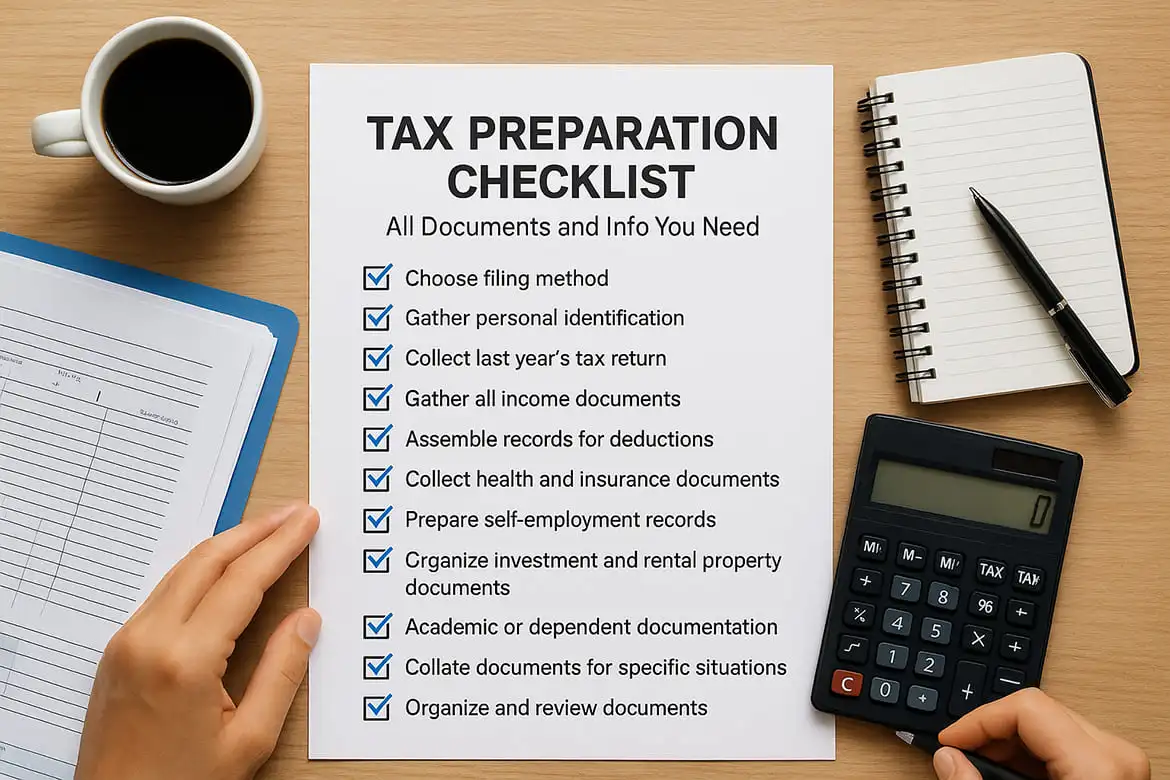
Tax Preparation Checklist: All Documents and Info You Need
Scrambling to find your W-2 forms in February or realizing you missed claiming a deduction after filing creates unnecessary stress and costs you money. Missing documents means delays in your refund, potential penalties for late filing, or leaving hundreds of dollars on the table. You need a tax preparation checklist that covers everything so you can gather your paperwork once and file with confidence.
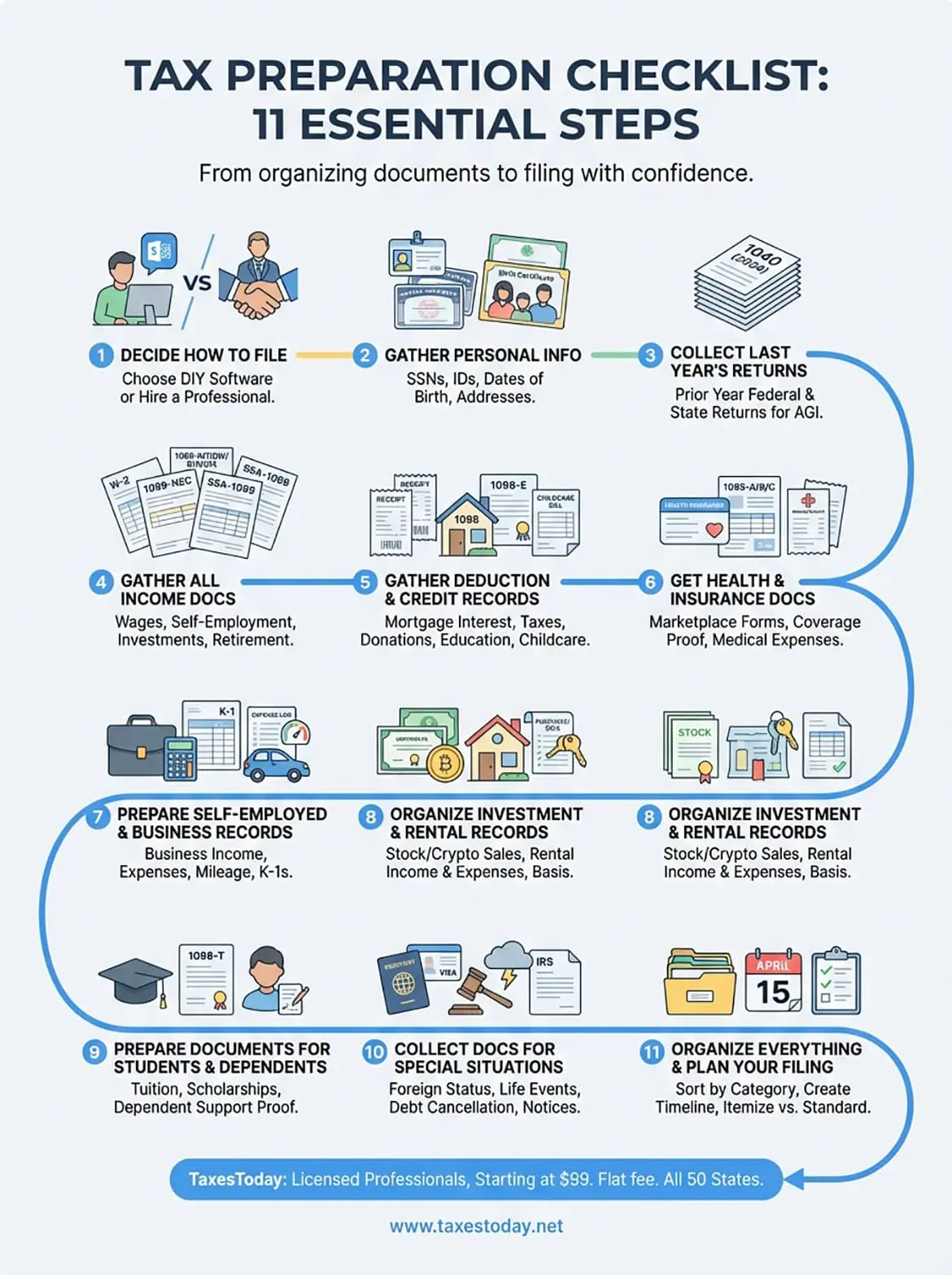
This guide walks you through 11 essential steps to organize every document and piece of information you need for your tax return. Whether you earn W-2 wages, run a side business, own rental property, or have kids in college, you'll find exactly what forms to collect and how to avoid common mistakes. By the end, you'll have a complete system for preparing your taxes that saves time and maximizes your refund.
1. Decide how you will file this year
Your first decision shapes your entire tax preparation checklist and determines which documents you'll need to prioritize. You must choose between DIY software, hiring a local tax professional, or using a virtual tax prep service before you start gathering paperwork. This decision affects your timeline, your costs, and how much help you'll get spotting deductions.
What this step covers
This step helps you evaluate your tax situation complexity and choose the filing method that saves you the most money and time. You need to consider whether you have simple W-2 income only or more complicated scenarios like self-employment income, rental properties, or investment sales. Your choice determines which documents require extra attention and whether you need professional review before submitting your return.
Documents and information to prepare
You don't need specific documents for this step, but you should write down your income sources and any major financial changes from last year. List whether you're employed, self-employed, own rental property, sold investments, or experienced life events like marriage or home purchases. This inventory of your tax situation guides you toward the right filing method and helps you avoid choosing software that can't handle your needs.
Pro tips and common mistakes
Many people underestimate their tax complexity and waste hours in DIY software before realizing they need professional help. Don't choose the cheapest option without considering whether you'll miss valuable deductions. Your filing method should match your confidence level with tax laws and the dollar value at stake in your return.
The wrong filing method costs you more than the price difference between options when you miss deductions or make errors that trigger IRS notices.
How TaxesToday can help you file
TaxesToday offers both virtual and in-person services with IRS-registered professionals who handle everything from simple W-2 returns to complex business filings. You get licensed tax preparers who review your documents, spot deductions you'd miss, and guarantee accuracy for a flat fee starting at $99. We serve clients across all 50 states and specialize in self-employment, small business, and non-resident tax situations.
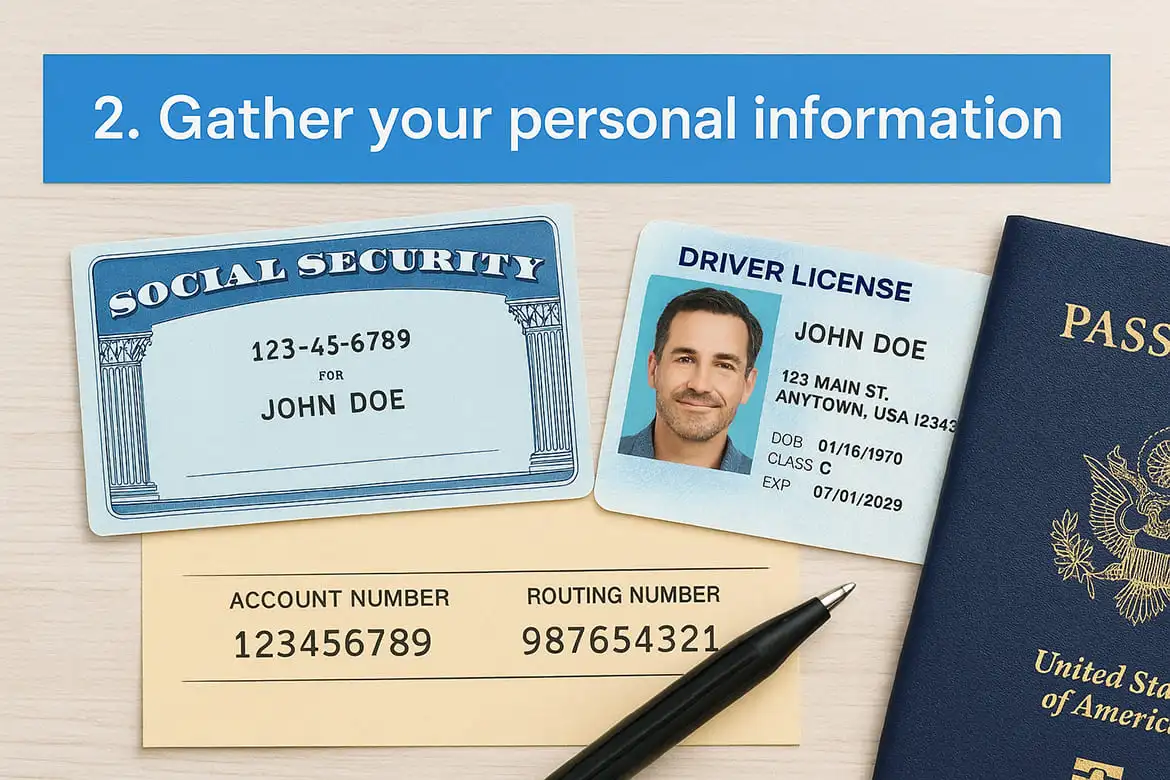
2. Gather your personal information
Your personal identification documents form the foundation of every tax return and you must have them ready before you start entering information into any system. The IRS uses this data to verify your identity and match your Social Security numbers with income reports from employers and financial institutions. Missing or incorrect personal information causes processing delays and can trigger verification letters that postpone your refund by weeks.
What this step covers
This step ensures you have the basic identification information for yourself, your spouse, and every dependent you plan to claim on your return. You need accurate Social Security numbers, birthdates, and current addresses because the IRS automatically rejects returns with mismatched or invalid data. This information appears on nearly every tax form you file and forms the header of your 1040.
Documents and information to prepare
Collect your Social Security card and your spouse's card if filing jointly, plus cards for all children and dependents you'll claim. You need a government-issued photo ID like your driver's license that shows your current address and legal name. Write down your bank account and routing numbers if you want direct deposit of your refund or plan to pay taxes electronically.
Pro tips and common mistakes
Taxpayers often type Social Security numbers incorrectly or use nicknames instead of legal names exactly as they appear on Social Security cards. Your tax preparation checklist should include verifying that names match Social Security records because even a missing middle initial causes rejections. Never rely on memory for nine-digit numbers because a single wrong digit delays your entire filing.
Transposed digits in Social Security numbers account for thousands of rejected tax returns every year that could have been avoided with a quick verification check.
3. Collect last year's tax returns
Your prior year tax return serves as a blueprint that speeds up your current filing and helps you catch carryover items you might otherwise miss. Tax preparers and software use your 2024 return to pre-fill personal information, verify income patterns, and identify deductions you claimed before. This document becomes essential if you need to reference past decisions about itemizing, business expenses, or capital loss carryovers.
What this step covers
This step ensures you locate your complete federal and state tax returns from the previous year along with any supporting schedules and worksheets. You need these documents to verify your Adjusted Gross Income (AGI) for e-filing identity verification and to track items that span multiple years. Your tax preparation checklist should include finding both the main return and attachments like Schedule C, Schedule E, or Form 8606.
Documents and information to prepare
Pull your complete Form 1040 and all attached schedules from your 2024 filing, plus your state return if you filed one. Locate any documentation showing estimated tax payments, prior year overpayments applied to 2025, or installment agreement details. Save digital copies if you filed electronically or organize paper copies in a folder you can reference throughout the preparation process.
Pro tips and common mistakes
People often locate only the first two pages of their return and miss critical schedules that contain carryover information for business losses or capital losses. Your 2024 return shows your filing status and dependent information that must stay consistent unless your situation changed.
Missing your prior year AGI during e-filing causes immediate rejection and forces you to paper file or wait for IRS assistance, delaying your refund by weeks.
4. Gather all income documents
Your income documents form the most critical category on your tax preparation checklist because the IRS receives copies of nearly every payment you earn throughout the year. You must collect every Form W-2, 1099, and income statement before you start your return because missing even a single document triggers IRS matching notices months after you file. This step requires patience because employers and financial institutions have until late January to send most forms, though some arrive as late as mid-March.
What this step covers
This step ensures you identify and collect every income form required to report your wages, investment earnings, self-employment payments, retirement distributions, and government benefits. You need to account for all taxable income sources because the IRS automatically flags returns that omit income reported by third parties. Your tax preparation checklist must include waiting for late forms if you had income from multiple sources or changed jobs during the year.
Wage and salary income forms
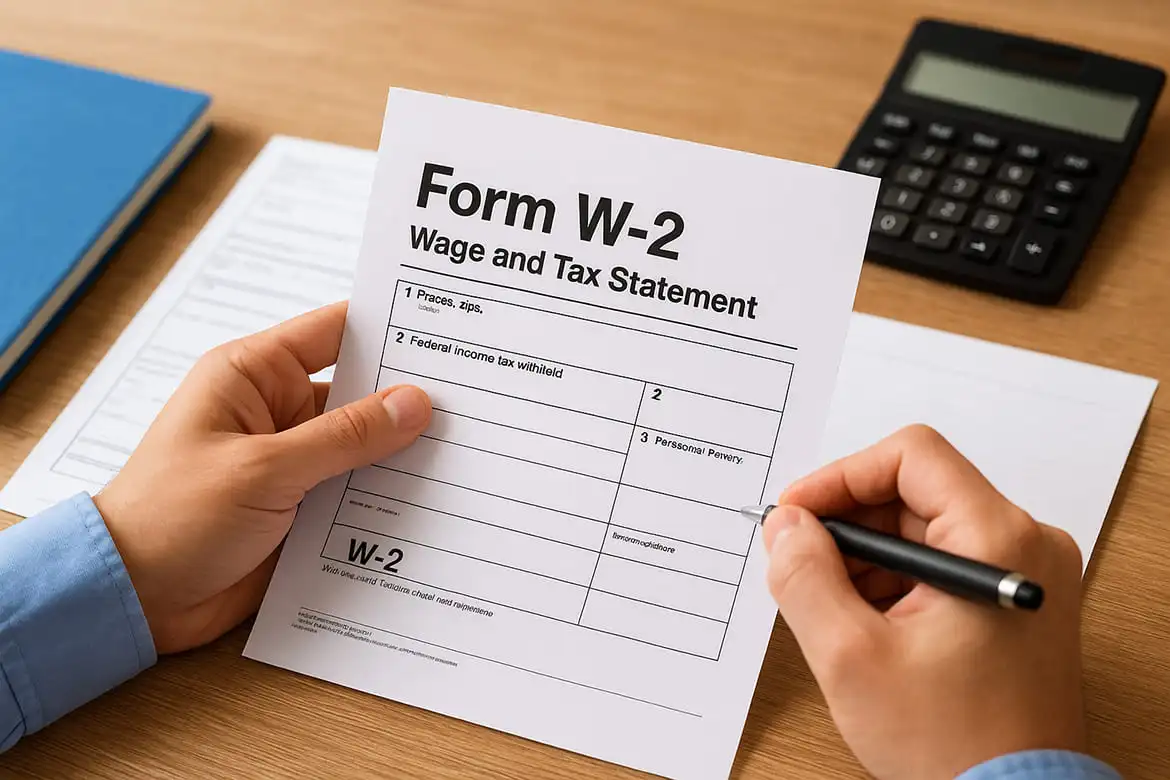
Collect every Form W-2 from each employer you worked for during 2025, even if you only worked there for a few weeks before quitting. Check that your W-2 shows correct Social Security wages in Box 1 and verify that federal and state withholding amounts match your final paystubs. You need separate W-2 forms for each job, and your employer must provide them by January 31, though you can access digital copies earlier through payroll systems.
Self employment and side gig income
Gather all Form 1099-NEC statements from clients who paid you $600 or more for services and any Form 1099-K from payment processors like PayPal or Venmo. Track income under $600 that won't generate forms because you still must report this self-employment income on Schedule C. Save records of all business income deposits in your bank account to verify totals if you didn't receive expected 1099 forms.
Investment, interest and dividend income
Collect Form 1099-INT for interest from bank accounts and Form 1099-DIV for dividends from stocks or mutual funds. You need Form 1099-B from brokerages showing stock sales and capital gains, plus any Form 1099-DA for cryptocurrency transactions. These forms arrive in February or early March, so your tax preparation checklist should note their later deadlines.
Retirement, Social Security and other income
Gather Form 1099-R for any distributions from retirement accounts, pensions, or annuities, plus Form SSA-1099 if you received Social Security benefits. Collect Form 1099-G for unemployment compensation or state tax refunds. Track any jury duty pay, gambling winnings, or other miscellaneous income that generates 1099-MISC forms.
Pro tips and common mistakes
Taxpayers often forget to wait for corrected 1099 forms that replace earlier versions with errors, causing them to file returns with wrong income amounts. Never estimate income or withholding amounts because exact figures matter when the IRS matches your return against third-party reports.
Filing before all your income documents arrive guarantees you'll need to file an amended return later, costing you time and potentially triggering an audit flag.
5. Gather deduction and credit records
Your deduction and credit documentation directly reduces your tax bill or increases your refund, making this category just as important as your income forms on your tax preparation checklist. You need receipts, statements, and proof of payments for expenses the IRS allows you to claim as itemized deductions or credits. This step requires organization because you must substantiate every dollar you claim if the IRS questions your return later.
What this step covers
This step ensures you collect documentation for major deductible expenses including mortgage interest, property taxes, charitable donations, education costs, and childcare payments. You need records that prove both the amount you paid and when you made those payments during 2025. Your preparation depends on whether you'll itemize deductions or take the standard deduction, though you should gather everything first before deciding which approach saves more money.
Home ownership and real estate documents
Collect your Form 1098 from your mortgage lender showing home mortgage interest and any points you paid on a new loan. You need records of property tax payments from your county assessor or mortgage escrow statements. Save documentation for any home improvements that increased your basis if you sold your house, and gather receipts for mortgage insurance premiums if you qualify to deduct them.
Education and student loan records
Gather Form 1098-E from your student loan servicer showing interest you paid on qualified education loans. Collect Form 1098-T from colleges showing tuition payments and scholarships received. You need receipts for qualified education expenses if you plan to claim the American Opportunity Credit or Lifetime Learning Credit.
Childcare and dependent care records
Track payments to daycare providers, after-school programs, or babysitters along with their tax identification numbers or Social Security numbers. You need the provider's name, address, and total amount paid to claim the Child and Dependent Care Credit. Keep records showing care was necessary so you and your spouse could work or look for work.
Charitable giving and donation records
Save receipts or acknowledgment letters for cash donations to qualified charities, especially gifts over $250 that require written confirmation. Document non-cash donations with lists of items given, their condition, and fair market values. You need appraisals for items worth more than $5,000 and Form 8283 for non-cash donations exceeding $500.
State and local tax and other deductible payments
Collect records of state and local income taxes paid through withholding or estimated payments, plus any property taxes on vehicles or boats. Track medical expenses exceeding 7.5% of your income if you plan to itemize. Save records for unreimbursed employee expenses, tax preparation fees from prior years, and safe deposit box fees though most of these no longer qualify as deductions.
Pro tips and common mistakes
Taxpayers often throw away donation receipts or fail to get written acknowledgment for large charitable gifts, losing valuable deductions they actually deserve. Never round deduction amounts or estimate totals because the IRS expects precise figures backed by contemporaneous records.
Missing documentation for just one large deduction can cost you hundreds in lost tax savings even when you legitimately paid the expense.
6. Get health and insurance documents
Your health insurance and medical documentation affects your tax return through premium tax credits, deductible medical expenses, and HSA contributions. You must prove you maintained minimum essential coverage throughout 2025 and document any marketplace subsidies you received. This category on your tax preparation checklist connects your healthcare spending to potential deductions and reconciles advance premium tax credits with your actual income.
What this step covers
This step ensures you collect all forms showing your health insurance coverage, premium payments, and medical expenses that exceeded insurance reimbursements. You need documentation for Health Savings Account contributions and distributions plus any long-term care insurance premiums you paid. These records determine whether you owe money back from marketplace subsidies or qualify for additional credits.
Health insurance forms and proof of coverage
Collect Form 1095-A if you purchased health insurance through a state or federal marketplace because you must file Form 8962 to reconcile premium tax credits. Gather Form 1095-B or 1095-C from your employer or insurance company as proof of coverage. You need records showing months of coverage gaps if you lacked insurance for part of the year.
Medical expense and HSA records
Track all unreimbursed medical expenses including doctor visits, prescriptions, dental work, and vision care if you plan to itemize deductions. Collect Form 5498-SA showing your HSA contributions and Form 1099-SA showing distributions. You need receipts proving HSA withdrawals paid for qualified medical expenses.
Long term care and disability records
Gather records of long-term care insurance premiums you paid for yourself or family members because these may qualify as medical expenses. Track any disability income you received and determine whether it's taxable based on who paid the premiums.
Pro tips and common mistakes
Taxpayers often discard medical receipts throughout the year and lose valuable deductions when their expenses exceed the 7.5% AGI threshold. Calculate your total unreimbursed costs before deciding to itemize because medical expenses often push people over the standard deduction.
Missing Form 1095-A prevents you from completing your tax return if you received marketplace subsidies, and the IRS will reject your e-filed return without it.
7. Prepare self employed and business records
Your self-employment and business documentation requires more detailed tracking than W-2 income because you must prove both your income and every expense you claim on Schedule C. You need organized records showing all business income you received regardless of whether clients issued 1099 forms, plus receipts or documentation for every deductible expense. This category on your tax preparation checklist determines your taxable profit and directly affects your self-employment tax liability.
What this step covers
This step ensures you collect all documentation proving your business income and expenses for sole proprietors, single-member LLCs, and independent contractors filing Schedule C. You need records for larger business entities like S-corps and partnerships that receive income on K-1 forms. Your preparation must include tracking systems for mileage, home office calculations, and depreciation of business assets.
Income records for contractors and freelancers
Gather all Form 1099-NEC statements from clients who paid you $600 or more, plus Form 1099-K from payment processors if your transactions exceeded reporting thresholds. Track every business deposit in your bank account to verify total income because you must report all earnings whether or not you received tax forms. Save invoices, payment receipts, and contracts showing dates and amounts clients paid you.
Expense and receipt tracking for Schedule C
Collect receipts for every deductible business expense including supplies, software subscriptions, advertising costs, contractor payments, and professional fees. You need documentation showing what you purchased, when you bought it, the business purpose, and the amount paid. Organize expenses by category matching Schedule C lines like office expenses, travel, and utilities.

Records for LLCs and S corps
Gather Schedule K-1 forms if you own partnership interests or S-corporation shares showing your portion of business income or losses. You need copies of corporate tax returns and documentation of any loans you made to your business. Track basis calculations if you took distributions from an S-corp during the year.
Mileage, home office and asset information
Maintain a mileage log showing business miles driven with dates, destinations, and purposes for each trip. Calculate your home office deduction using square footage measurements and total home expenses. Document any equipment or vehicle purchases over $2,500 that require depreciation schedules.
Pro tips and common mistakes
Business owners often mix personal and business expenses without clear documentation, losing legitimate deductions they can't prove. Track expenses throughout the year instead of reconstructing records in tax season because missing receipts cost you money.
Failing to substantiate business expenses with proper documentation gives the IRS grounds to disallow your entire Schedule C deduction during an audit.
8. Organize investment and rental records
Your investment and rental property documentation creates complexity on your tax preparation checklist because these transactions generate capital gains, passive income, and require detailed cost basis tracking. You must collect forms showing every stock sale, cryptocurrency transaction, and rental payment you received during 2025 because the IRS matches this information against your return. This category requires calculations that span multiple years when you track property depreciation or carry forward capital losses.
What this step covers
This step ensures you gather all documentation proving your investment sales, rental income, and partnership distributions that flow through to your personal return. You need records showing purchase prices and sale proceeds for stocks, crypto, and rental properties because accurate basis calculations determine your taxable gain or loss. Your documentation must support depreciation schedules for rental properties and verify income reported on K-1 forms from partnerships or S-corporations.
Brokerage and stock sale documents
Collect Form 1099-B from every brokerage showing stock sales, bond transactions, and mutual fund redemptions with proceeds and cost basis. You need purchase records for investments bought years ago if your broker doesn't track basis. Save documentation of any gifts or inheritances of securities because these require special basis rules.
Crypto and digital asset transaction records
Gather Form 1099-DA from cryptocurrency exchanges showing your digital asset sales and calculate gains on every trade or sale. Track your purchase price for each crypto transaction because exchanges often don't report basis. You need records showing wallet addresses and transaction dates for peer-to-peer transfers.
Rental property income and expense records
Collect rent payment records from tenants including security deposits received and returned. Document every deductible expense including mortgage interest, property taxes, insurance, repairs, and property management fees. You need depreciation schedules tracking basis and accumulated depreciation from prior years.
K 1s and other pass through income
Gather Schedule K-1 forms from partnerships, S-corporations, or trusts showing your share of income, deductions, and credits. Track your basis in each entity because distributions exceeding basis become taxable gains.
Pro tips and common mistakes
Investors often forget to adjust cost basis for stock splits or reinvested dividends, overpaying taxes on gains they didn't actually receive. Calculate wash sales carefully when you sell stocks at losses and repurchase similar securities within 30 days.
Missing cost basis documentation forces you to report zero basis on stock sales, turning legitimate small gains into massive taxable profits you never earned.
9. Prepare documents for students and dependents
Your dependent and student documentation unlocks valuable tax credits and deductions that reduce your tax bill by thousands of dollars. You must prove every dependent you claim meets IRS relationship, residency, age, and support tests because incorrect claims trigger audits and force you to repay credits. This section of your tax preparation checklist covers children, college students, and other dependents who affect your filing status and eligibility for credits.
What this step covers
This step ensures you collect all documentation proving your dependents qualify for tax benefits including the Child Tax Credit, education credits, and dependent care deductions. You need records showing relationships, Social Security numbers, and residency for each person you claim.
Records for claiming children and other dependents
Gather Social Security cards for each child or dependent along with birth certificates proving age and relationship. You need school or medical records showing they lived with you for more than half the year. Track support costs you paid including housing, food, and medical care to prove you provided over half their support.
Education forms for college and trade school
Collect Form 1098-T from colleges showing tuition payments and scholarships your student received. You need receipts for qualified education expenses including books and required supplies. Document whether your student qualifies as your dependent or files their own return.
Child support, custody and shared custody details
Keep your divorce decree or custody agreement showing which parent claims the child as a dependent. You need Form 8332 signed by the custodial parent if they're releasing the dependency exemption to you. Document child support payments received because these don't count as taxable income.
Pro tips and common mistakes
Parents often both claim the same child when they share custody without proper documentation, triggering IRS rejection of one return. Verify your student's income stays below $5,050 if you plan to claim them as a dependent.
Claiming a dependent without proper documentation guarantees IRS scrutiny and potential loss of thousands in tax credits you thought you qualified for.
10. Collect documents for special situations
Your tax preparation checklist must include documentation for unique circumstances that don't fit standard W-2 employee scenarios because these situations require special forms and additional proof. You need records for life-changing events, international tax status, debt forgiveness, and prior IRS interactions that affect your current return. This category catches items that people often forget until they're deep into their tax preparation and discover they need specific documentation.
What this step covers
This step ensures you identify and gather documentation for non-standard tax situations including foreign status, major life changes, financial hardships, and unresolved tax matters from prior years. You need forms proving your status and records showing dates when events occurred because timing determines which tax year covers these items.
Nonresident and foreign student information
Collect your visa documents (F-1, J-1, OPT, CPT) and Form I-20 or DS-2019 showing your US entry and exit dates. You need passport copies, Form 8843 for days of presence, and treaty position documentation if you claim tax treaty benefits under your country's agreement with the US.
Life events like marriage, divorce and moves
Gather your marriage certificate or divorce decree showing the date these events occurred because they change your filing status. You need records of address changes and moving expenses if you relocated for work.
Debt cancellation, foreclosure and disasters
Collect Form 1099-C for canceled debts and Form 1099-A for foreclosures or abandonments. You need FEMA assistance letters and property loss documentation if you experienced a federally declared disaster.
IRS and state letters and prior notices
Keep every IRS notice or letter you received during 2025 including CP2000 notices, audit correspondence, and payment plan agreements. You need prior year assessment notices showing balances owed or credits applied forward.
Back taxes, amendments and extension filings
Gather records supporting unfiled prior year returns or errors requiring amendments on Form 1040-X. You need copies of extension requests you filed on Form 4868 and documentation of estimated payments made throughout the year.
Pro tips and common mistakes
Taxpayers often ignore IRS notices until tax season and discover they can't file until resolving prior year issues.
Missing documentation for special situations prevents you from completing your return and forces delays while you scramble to obtain records from foreign universities or government agencies.
11. Organize everything and plan your filing
Your complete tax preparation checklist loses value if you can't find documents quickly or miss filing deadlines while searching through piles of paperwork. You need a system that organizes every form by category, tracks your progress, and helps you choose the best deductions before you start entering information. This final organization step prevents last-minute scrambling and ensures you file accurately by the April deadline.
What this step covers
This step ensures you create an organized filing system and develop a timeline that prevents rushed mistakes. You need to sort documents into categories matching the sections above, decide whether itemizing saves money, and determine if your situation requires professional help.
How to sort and store your documents
Sort all documents into labeled folders matching your income types, deductions, and credits using the categories from this guide. Keep digital copies by scanning paper forms and storing them in password-protected folders on your computer. Physical documents should go in a single filing location you'll access easily when preparing your return.

Create a timeline and filing checklist
Mark your calendar with the April 15 deadline and work backwards to set dates for gathering documents, reviewing your return, and submitting. Build a checklist tracking which forms you've received and which you're still waiting for based on the income sources you identified earlier.
Decide between standard and itemized deductions
Calculate your total itemized deductions from mortgage interest, property taxes, charitable donations, and medical expenses to compare against the 2025 standard deduction of $15,000 single or $30,000 married filing jointly. Choose itemizing only if your documented expenses exceed these thresholds by enough to justify the extra effort.
When to ask a tax pro for help
Schedule a professional consultation if you have self-employment income over $50,000, sold rental property, experienced foreign income, or face complex situations this tax preparation checklist can't fully address. Professionals spot deductions you'll miss and prevent costly errors worth far more than their fees.
Pro tips and common mistakes
Taxpayers often mix current year documents with prior years and waste hours sorting through irrelevant paperwork during preparation. Create separate folders for each tax year immediately when forms arrive.
Disorganized documents triple your preparation time and increase the likelihood you'll miss deductions or enter incorrect information on your return.
Final steps
You now have a complete tax preparation checklist covering every document and piece of information needed to file your 2025 return accurately. Working through these 11 steps before you start entering data prevents delays, maximizes your refund or minimizes your tax bill, and eliminates the stress of scrambling for missing forms at the last minute. Your organized approach protects you from IRS notices and ensures you claim every deduction and credit you deserve.
Filing becomes straightforward when you gather everything first, but complex situations involving self-employment income, rental properties, or international status still benefit from professional review. TaxesToday offers affordable tax preparation services starting at $99 with IRS-registered professionals who handle simple W-2 returns and complicated business filings across all 50 states. Get your taxes done right with our licensed tax preparers who guarantee accuracy and find deductions you'll miss filing on your own.