


How Long Do You Have to Amend a Tax Return? Federal Timeline
Found an error on your tax return after you already filed? You can fix it by filing an amended return using IRS Form 1040-X. But there's a catch: the IRS sets strict deadlines for when you can amend your return and still claim a refund. Miss that window and you forfeit any money the government owes you. The timeline depends on when you filed your original return and when you paid your taxes.
This guide breaks down the federal timeline for amending your tax return. You'll learn the three year and two year rules that determine your deadline, how to calculate your amendment window for any tax year, and what happens when special circumstances change the standard timeline. We'll also cover state deadlines, walk through real examples by tax year, and explain what to do if you discover an error after time is up.
Why the amendment deadline matters
The federal timeline for amending your tax return directly affects your wallet. Understanding how long do you have to amend a tax return determines whether you can claim money the IRS owes you or whether you'll pay unnecessary penalties and interest. The stakes are real: taxpayers who miss the deadline forfeit thousands of dollars in unclaimed refunds each year, and those who owe additional tax face mounting penalties the longer they wait.

You forfeit refund money after the deadline
The IRS keeps your money if you file an amended return too late. You permanently lose any additional refund you're entitled to once the three-year window closes. This applies to missed deductions, forgotten credits, or incorrectly reported income that worked in the government's favor. The money doesn't roll over to future years and you can't negotiate for it later.
Tax professionals see this scenario regularly: a client discovers $2,000 in overlooked deductions from three years ago, but the amendment deadline passed two months earlier. That money stays with the Treasury. Filing within the deadline is the only way to recover refunds from past mistakes.
Penalties and interest accumulate when you owe more
Discovering you owe additional tax creates the opposite urgency. The IRS charges interest and penalties from your original filing deadline, not from when you discover the error. Every month you delay filing an amended return adds to your total bill through compounding interest at the federal rate plus 3%.
Filing an amended return quickly when you owe additional tax minimizes the financial damage and demonstrates good faith compliance to the IRS.
The failure-to-pay penalty reaches 0.5% of unpaid taxes per month, capped at 25% of your total tax due. You control when this clock stops by filing Form 1040-X and paying what you owe. Waiting until the IRS discovers the error through an audit often results in additional accuracy-related penalties of 20% or more.
How to calculate your amendment window
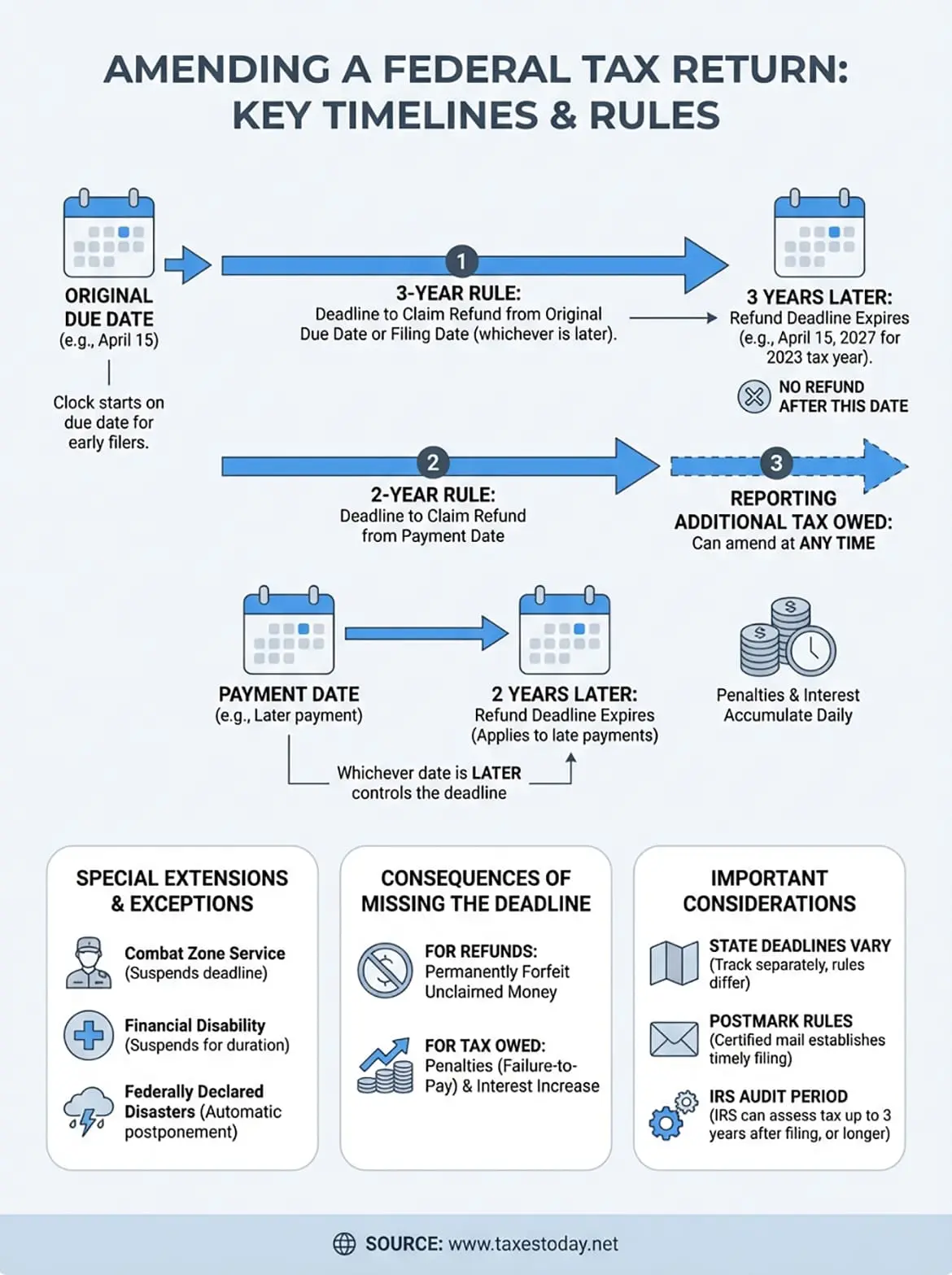
Calculating how long do you have to amend a tax return requires knowing three dates: when your return was due, when you actually filed it, and when you paid the tax. The IRS uses these dates to determine your deadline under two separate rules, and your actual deadline is whichever date falls later. Most taxpayers can file an amended return within three years from the original due date, but the calculation gets more complicated when you filed early, requested an extension, or paid estimated taxes throughout the year.
The three-year rule explained
You can file Form 1040-X within three years from the date you filed your original return. If you filed before the April deadline, the IRS counts from the actual filing date. If you filed on or after the deadline (including extensions), the clock starts on the deadline date itself, not when you actually submitted your return.

For example, you filed your 2022 tax return on March 15, 2023, weeks before the April 18 deadline. Your three-year window closes on April 18, 2026, not March 15, 2026. The IRS treats early filers as if they filed on the deadline for purposes of calculating the amendment period. This rule protects early filers from losing time on their amendment window.
The IRS automatically extends your amendment deadline to the tax return's due date if you filed early, giving you the full three-year period.
The two-year rule for late payments
Your amendment deadline extends to two years after you paid the tax if that date falls later than the three-year deadline. This rule applies when you paid estimated taxes, made payments with an extension request, or paid additional tax after filing your original return. You measure from whichever payment date gives you the longest window.
Consider this scenario: you filed your 2021 return on April 15, 2022, but didn't pay the full tax due until December 1, 2023. Your three-year deadline falls on April 15, 2025, but your two-year payment deadline extends to December 1, 2025. You have until the later date to file your amendment and claim any refund.
Determining which date controls your deadline
Start by identifying your original return's due date (typically April 15, or the next business day if that falls on a weekend or holiday). This date serves as your baseline for the three-year calculation, regardless of when you actually filed. Next, check if you filed before the deadline. If yes, your three-year period runs from the due date. If you filed late, it runs from your actual filing date.
Then review all tax payments you made for that year, including withholding from W-2s, estimated tax payments, and any amounts paid with your return or extension. The two-year rule measures from the last payment you made. Compare your three-year date against your two-year date. Whichever falls later becomes your amendment deadline. Most taxpayers find the three-year rule controls their deadline, but the two-year rule provides critical extra time when significant payments came after filing.
Federal statute of limitations for amended returns
The federal statute of limitations sets the legal boundaries for how long do you have to amend a tax return and claim a refund from the IRS. Congress established these rules under Internal Revenue Code Section 6511, which creates a strict framework that applies to every taxpayer. The law balances your right to correct mistakes against the government's need for finality in tax administration. Understanding these statutory deadlines protects you from losing money you're entitled to recover and helps you plan when dealing with past tax years.
The IRC Section 6511 framework
Internal Revenue Code Section 6511 establishes two separate limitation periods that run simultaneously, and your actual deadline depends on which period expires last. The first period gives you three years from the date you filed your original return to claim a refund. The second period gives you two years from the date you paid the tax to claim a refund. These periods don't reset or extend based on your actions after filing.
The three-year limitation measures from your filing date or the return's due date, whichever is later. If you filed on February 20th but the deadline was April 15th, the IRS uses April 15th as your filing date for statute purposes. This prevents early filers from losing amendment time. The two-year limitation measures from each tax payment you made, including withholding, estimated payments, and amounts paid with your return or extension.
Your refund claim is limited by which period you file under. If you file within three years, you can claim a refund of all tax paid within the three years plus any extension period before your original return was filed. If you file after three years but within two years of a payment, you can only recover the tax paid within the two years immediately before you file the claim. This distinction often determines whether amending a return makes financial sense.
The IRS must receive your Form 1040-X by the deadline date, not just postmark it, unless you use certified or registered mail, which establishes proof of timely filing.
How the IRS counts time
The IRS counts time periods in years, not days, and uses specific rules that differ from standard calendar calculations. A year for statute purposes means 365 days from the relevant date, adjusted for leap years. The deadline falls on the same calendar date three years (or two years) later, unless that date lands on a weekend or legal holiday. When the deadline falls on a Saturday, Sunday, or legal holiday, you get until the next business day to file your amended return.
Federal holidays extend your deadline nationwide, but state holidays don't affect federal tax deadlines unless the IRS office where you file is closed for that state holiday. For example, Patriots' Day in Massachusetts extends deadlines for taxpayers in that state because the IRS processing center is closed. The IRS publishes a list of recognized holidays each year that affect filing deadlines.
Postmark rules provide important protection when you mail your Form 1040-X near the deadline. The IRS treats returns sent by U.S. Postal Service certified or registered mail as filed on the postmark date, not when the IRS receives them. This gives you proof of timely filing even if delivery takes several days. Private delivery services like FedEx and UPS qualify under specific service levels designated by the IRS, but standard delivery doesn't count.
When the clock starts and stops
Your statute of limitations clock starts ticking on the date your original tax return was due, typically April 15th (or the next business day). If you requested an automatic six-month extension, the due date becomes October 15th, and your three-year period runs from that date. The IRS doesn't recognize late filing as changing when the statute begins for refund purposes. A return filed in July after a missed April deadline still measures the three-year period from April.
Tax payments trigger the two-year limitation period separately for each payment. Withholding from your W-2 counts as paid on your return's due date, regardless of when your employer actually withheld it throughout the year. Estimated tax payments count as paid on the dates you made them. Payments with your return or extension count as paid when the IRS receives them or on the postmark date if you used certified mail.
The statute stops running when the IRS receives your amended return or on the postmark date if properly mailed. Once the deadline passes, the statute is closed and you cannot claim any refund for that tax year. The IRS lacks authority to accept late claims or extend deadlines, even in cases of hardship or reasonable cause. Only specific statutory exceptions, such as financial disability or service in a combat zone, suspend the limitation period.
Deadlines for refunds versus tax owed
The IRS applies different consequences to the same deadline depending on whether you're claiming money back or reporting additional tax due. Understanding how long do you have to amend a tax return becomes critical because the statute of limitations for refunds acts as an absolute cutoff, while the deadline for reporting additional tax owed serves a different purpose. You face two distinct scenarios when you discover an error: one where time bars your claim forever, and another where time creates escalating penalties but doesn't prevent you from correcting the mistake.
When you're claiming a refund
You must file Form 1040-X within the three-year or two-year window to claim any refund from the IRS. The statute of limitations for refund claims functions as a hard deadline that eliminates your right to recover overpaid taxes once it expires. The IRS cannot legally issue a refund for claims filed after the limitation period closes, even if your return clearly shows you overpaid.
The refund deadline applies to all types of overpayments, including missed deductions, unclaimed credits, incorrectly calculated income, or excessive withholding. If you discover in January 2026 that you forgot to claim a $2,000 education credit on your 2021 return filed in April 2022, your deadline to amend and claim that refund falls on April 18, 2025. You missed the window and cannot recover that money through an amended return.
Filing your refund claim even one day late means you forfeit your money permanently, with no exceptions for reasonable cause or hardship.
Your refund amount also depends on which limitation period you file under. Claims filed within three years allow you to recover all tax paid within three years before filing, plus any extension period. Claims filed after three years but within two years of a payment only recover taxes paid within the two years immediately before filing. This limitation reduces the refund available on late amendments.
When you owe additional tax
You can file an amended return to report additional tax owed at any time, with no statute of limitations preventing you from correcting the error. The IRS accepts Form 1040-X reporting additional tax liability years after the original deadline passed, though filing late increases your total bill through penalties and interest. The failure-to-pay penalty accrues at 0.5% per month, capped at 25% of unpaid taxes, and interest compounds daily at the federal short-term rate plus 3%.
Filing quickly when you discover you owe more demonstrates voluntary compliance and good faith to the IRS, which can reduce or eliminate certain penalties. You avoid the substantial understatement penalty of 20% by filing before the IRS discovers the error through an audit or matching program. The accuracy-related penalty doesn't apply when you voluntarily correct mistakes, making prompt amendment financially beneficial even though no deadline forces you to act.
Special rules that extend or change deadlines
Certain circumstances suspend or extend the normal statute of limitations for filing amended returns. Congress created exceptions to the standard three-year and two-year rules that give qualifying taxpayers additional time beyond the deadlines that apply to most filers. These special provisions address situations where taxpayers face extraordinary challenges that prevent timely filing, such as military service in combat zones, diagnosed financial disabilities, or presidentially declared disasters. You might qualify for months or even years of additional time to file Form 1040-X and claim your refund, but you must meet specific criteria defined in the Internal Revenue Code and Treasury regulations.

Combat zone service and military extensions
Military service in designated combat zones automatically suspends your deadline for the entire period you serve in the zone plus 180 days after you leave. The IRS stops the statute of limitations clock on the date you enter the combat zone and restarts it 180 days after you depart. This suspension applies to all IRS deadlines, including the window for filing amended returns. You gain additional time beyond what the standard three-year rule provides, measured by how long you served in qualifying locations.
Service members deployed to combat zones in 2023 who return in 2026 receive automatic extensions for amending their 2022 returns. Your three-year deadline from April 2025 suspends during your entire deployment and doesn't resume until 180 days after you return home. Hospitalization for combat injuries extends your deadline further by adding the hospitalization period to the 180-day window. You don't need to request this extension or file special forms; the IRS applies it automatically when you file your amended return and document your service dates.
Financial disability provisions
The IRS cannot enforce any statute of limitations against you while you suffer from a medically determinable physical or mental impairment that prevents you from managing your financial affairs. Financial disability suspends all deadlines, including the amendment period, until your disability ends or someone receives authority to act on your behalf. The impairment must be severe enough that you cannot handle your tax matters, and a physician must certify your condition.
You prove financial disability by submitting a signed statement from a qualified physician that describes your impairment and confirms you cannot manage financial affairs. The suspension continues for the entire period of disability, with no maximum duration. Courts have granted this relief to taxpayers with Alzheimer's disease, severe mental illness, and debilitating injuries. Your deadline resumes one year after the disability ends or when a legal guardian or power of attorney takes control of your finances.
The financial disability exception provides the only way to extend amendment deadlines after they've already passed, but requires clear medical documentation of your inability to manage taxes.
Federally declared disaster relief
Presidential disaster declarations trigger automatic deadline extensions for affected taxpayers in designated areas. The IRS postpones all filing and payment deadlines, typically for six months or longer, when disasters like hurricanes, wildfires, or floods strike. These extensions apply to the amendment window for past returns, giving you additional time beyond the standard limitation period. You qualify if your primary residence or business location falls within the federally declared disaster area on the declaration date.
Disaster relief extends how long do you have to amend a tax return by postponing your deadline to a future date specified in IRS announcements. The extension applies automatically; you don't file forms or request relief. The IRS identifies affected taxpayers by address and applies the extension to all open deadlines, including amendment periods that would otherwise expire during the postponement window.
State deadlines to amend a tax return
State tax agencies set their own deadlines for amended returns that often differ from the federal three-year rule. Each state follows its own statute of limitations, and some states tie their deadlines to federal rules while others create completely independent timelines. You must track both federal and state deadlines separately because amending your federal return doesn't automatically extend your state deadline. Most states allow two to four years to file amended returns, but the calculation methods and specific dates vary significantly across jurisdictions.
Common state timeline patterns
Many states align their amendment deadlines with the federal statute of limitations, giving you three years from your original filing date or the return's due date to file an amended state return. California, New York, Texas, and Pennsylvania follow this federal framework, making it easier to track both deadlines simultaneously. These states measure the three-year period using the same rules the IRS applies, counting from April 15th or your actual filing date if you filed late.
Other states create shorter windows that close before the federal deadline expires. Illinois limits amendments to three years from the original due date or three years from when you filed, whichever is later, but adds a one-year deadline from when you paid the tax. Michigan gives you four years from the original due date to claim refunds, providing more time than federal law. Georgia uses a three-year period but measures from the due date of the return, not from when you actually filed, potentially reducing your window if you filed early.
States with unique requirements
Several states impose special conditions beyond simple time limits that affect when and how you can amend returns. Colorado requires you to file an amended state return within 30 days after the IRS makes changes to your federal return, regardless of the standard three-year period. This short window catches many taxpayers off guard who assume they have the full federal timeline to address state implications.
States can audit your return and assess additional tax for longer periods than you have to claim refunds, creating an asymmetry that favors the tax agency over taxpayers.
Massachusetts gives you three years to amend but calculates the deadline differently for different types of amendments. You get three years from when you filed your original return or one year from when you made your final payment, similar to federal rules. Wisconsin extends the period to four years from the unextended due date for most taxpayers but applies different rules if you filed a federal extension.
Finding your state's specific deadline
You locate your state's amendment deadline by checking your state tax agency's website or publication for amended return instructions. Every state publishes guidance that explains the statute of limitations for refund claims, typically in the instructions for their version of Form 1040-X. State-specific rules determine how long do you have to amend a tax return at the state level, and these instructions identify which date controls your deadline.
Contact your state's taxpayer assistance line if the published deadline information remains unclear. Tax agencies provide direct guidance on calculating your specific amendment window based on when you filed and paid your state taxes. Professional tax preparers familiar with your state's rules can also calculate your deadline and ensure you don't miss opportunities to recover state refunds.
Timeline examples by tax year
Calculating how long do you have to amend a tax return becomes clearer when you see real examples using actual tax years and filing dates. These scenarios demonstrate how the three-year and two-year rules work in practice, showing you exactly when your amendment deadline falls for returns filed in different circumstances. Each example reflects the rules that apply whether you filed early, requested an extension, or made payments after filing your return.
Example: 2023 tax return filed in 2024
You filed your 2023 federal tax return on March 10, 2024, three weeks before the April 15, 2024 deadline. Your employer withheld all your taxes throughout 2023, and you didn't make any additional payments when you filed. Your amendment deadline falls on April 15, 2027, exactly three years from the original due date, not from your March filing date.

The IRS treats your early filing as if you filed on the deadline, protecting your full three-year window. You can file Form 1040-X any time before April 15, 2027 to claim a refund. The two-year rule doesn't extend your deadline in this case because the IRS considers your withholding paid on April 15, 2024, making your two-year deadline April 15, 2026, which falls earlier than the three-year date.
Example: 2022 tax return with extension
You requested an automatic extension for your 2022 tax return and filed on October 10, 2023, before your extended deadline of October 16, 2023. You paid $3,000 with your extension request on April 18, 2023, and another $1,500 when you filed in October. Your three-year deadline is October 16, 2026, measured from the extended due date, not the original April deadline.
However, your two-year payment deadline extends to October 10, 2025 for the $1,500 payment you made when filing. You have until October 16, 2026 to amend your return under the three-year rule, which controls your deadline because it falls later. Extensions push both your filing deadline and your three-year amendment window forward by six months.
Extensions give you more time to file your original return and automatically extend your three-year amendment window to match the extended due date.
Example: 2021 tax return with late payment
You filed your 2021 tax return on April 15, 2022, but couldn't pay the full $4,000 tax due. You made monthly payments throughout 2022 and 2023, with your final payment of $800 on March 1, 2024. Your three-year deadline is April 18, 2024 (April 15 falls on Saturday), but your two-year payment deadline extends to March 1, 2026.
You have until March 1, 2026 to amend your 2021 return because the two-year rule gives you the later deadline. Any refund you claim on an amendment filed after April 18, 2024 but before March 1, 2026 is limited to taxes paid within the two years before you file the claim. This means you can only recover the payments you made during that two-year lookback period, not the full amount you paid over the entire year.
If you discover an error after time is up
Discovering a tax error years later creates different outcomes depending on whether the mistake favors you or the IRS. The statute of limitations eliminates your right to claim refunds once the three-year or two-year window closes, but you can still report additional tax owed at any time. Understanding how long do you have to amend a tax return matters most before the deadline passes, because afterward your options narrow significantly and the financial consequences become permanent.
Your options when the refund deadline passes
You permanently forfeit any refund you're entitled to when you discover an error after the deadline expires. The IRS lacks legal authority to issue refunds for claims filed after the limitation period closes, even when your return clearly shows you overpaid taxes. A missed $2,000 deduction discovered four years later cannot be recovered through an amended return.
You can still file Form 1040-X to correct errors that increase your tax liability, regardless of how much time has passed. The IRS accepts late amendments reporting additional income or disallowed deductions because you're paying money owed, not claiming refunds. Filing voluntarily helps you avoid worse penalties if the IRS discovers the error through other means.
Missing the deadline to amend costs you money permanently when you're owed a refund, but you can always correct mistakes that increase what you owe.
What the IRS can still do
The IRS operates under separate audit statutes that extend far beyond your deadline to amend. The agency can assess additional tax within three years from when you filed your return, and this period extends to six years if you substantially understated income by 25% or more. Fraud allegations remove all time limits, allowing the IRS to audit and assess taxes decades after you filed.
Your expired amendment deadline doesn't protect you from IRS audits or assessments. The government retains full authority to examine your return and bill you for errors even after you lose the right to claim refunds for the same tax year.
When to get professional tax help
Complex tax situations demand professional expertise to navigate amendment deadlines correctly and maximize your refund potential. Tax professionals understand how statutory exceptions interact with standard limitation periods and can identify opportunities you might miss when calculating deadlines on your own. You benefit from their experience with IRS procedures, especially when dealing with multiple tax years or coordination between federal and state amendments.
Complex amendment scenarios
Hiring a tax professional makes sense when you need to amend multiple years simultaneously, discovered errors involving business income or self-employment, or face complicated situations like carryback claims or net operating losses. Professional preparers calculate exactly how long do you have to amend a tax return for each year while ensuring you claim all available deductions and credits. They handle the paperwork correctly and can represent you if the IRS questions your amended return.
Tax professionals prevent you from missing deadlines or losing money by applying specialized knowledge of limitation periods and refund calculation rules.
Avoiding costly timing mistakes
Professional help protects you from expensive errors that occur when you misunderstand which deadline controls your amendment window. Tax preparers verify whether the three-year or two-year rule applies to your situation, confirm your state's separate requirements, and identify any special extensions you qualify for based on military service or disasters. You avoid forfeiting refunds by getting your amendment filed before the statute expires, and professionals minimize penalties when you owe additional tax by filing promptly with proper documentation.
Final thoughts
Understanding how long do you have to amend a tax return protects your money and keeps you compliant with IRS rules. The three-year and two-year deadlines determine whether you can claim refunds, while additional tax owed can be reported anytime without forfeiting your right to correct mistakes. Missing the refund deadline costs you money permanently, making it critical to track your filing dates and payment dates carefully for every tax year.
Calculate your amendment window as soon as you discover an error. Check whether special extensions apply to your situation and verify your state's separate deadline if you need to amend state returns. Professional tax preparation services help you file amended returns correctly and on time, ensuring you recover every dollar you're entitled to before the statute of limitations expires.