


15 Reasons to Amend a Tax Return (and When Not to Amend)
You filed your tax return weeks ago. Now you just found a W-2 you forgot to include, or realized you missed claiming your student loan interest deduction. Your stomach drops. Do you need to file an amended return? Will the IRS penalize you? What happens if you do nothing?
This article breaks down 15 specific reasons to file Form 1040X, the amended tax return form. You'll learn which mistakes require immediate action, which ones the IRS will fix automatically, and which situations can actually make things worse if you amend. We cover everything from missing income and incorrect filing status to self employment errors and forgotten tax credits. You'll also discover when expert help makes the biggest difference, especially for complex situations involving business income, rental properties, or residency status. By the end, you'll know exactly whether your situation calls for an amendment and what steps to take next.
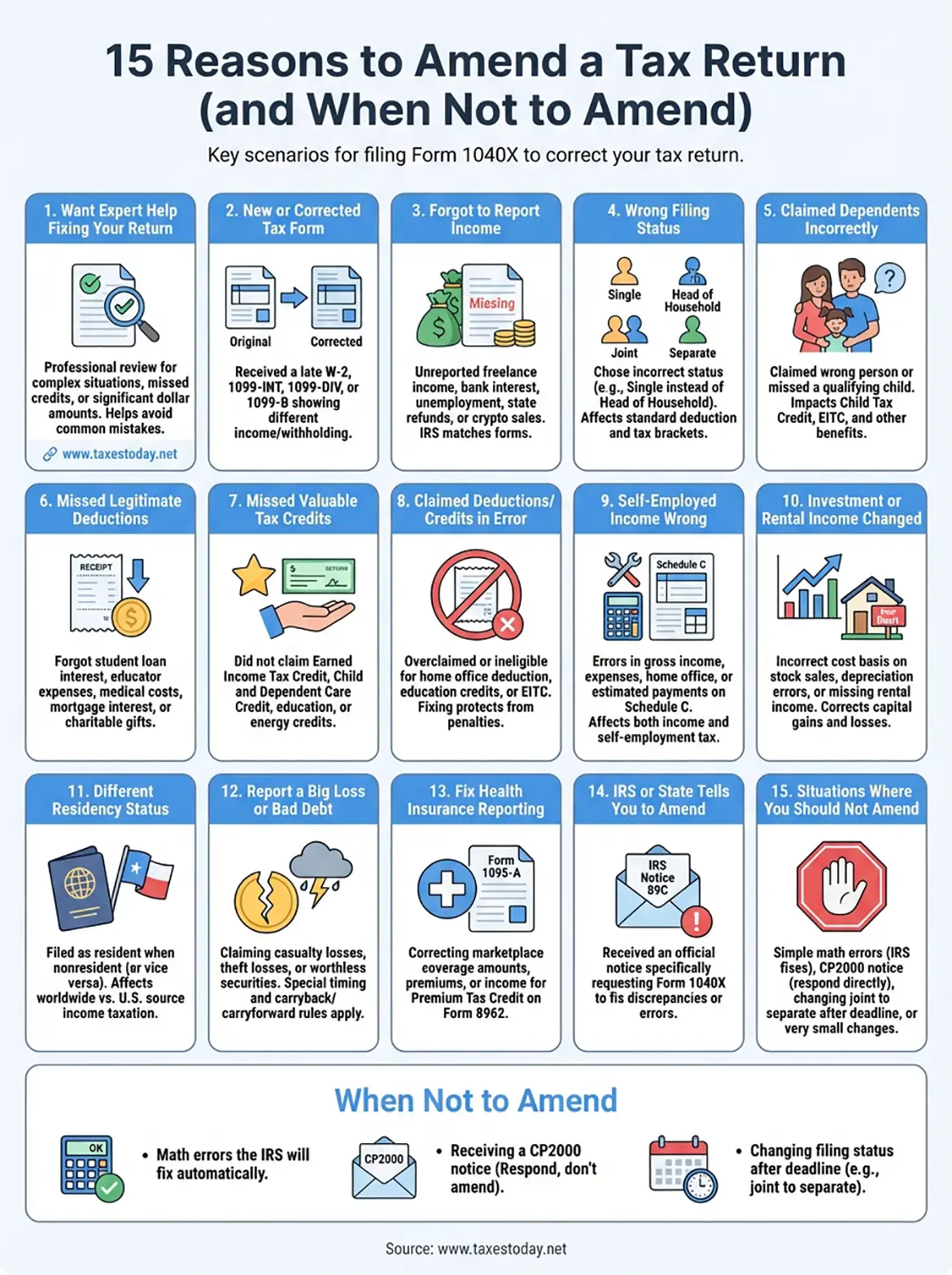
1. You want expert help fixing your return
You spotted an error on your filed return, but you're not sure if fixing it yourself makes sense. Professional tax preparers bring experience that helps you avoid common mistakes and identify additional corrections you might have missed. A qualified preparer reviews your entire return, not just the obvious error, and often finds missed deductions or credits that increase your refund beyond what you expected.
When a pro should review your tax return
Complex situations call for professional review before you file Form 1040X. Self employment income, rental property transactions, foreign income reporting, and business losses require specialized knowledge to amend correctly. Your amended return carries the same audit risk as an original filing, so accuracy matters just as much the second time around.
Getting expert help becomes especially valuable when your amendment involves multiple tax forms or significant dollar amounts.
Key deadlines for filing Form 1040X
You typically have three years from your original filing date to amend and claim a refund. If you filed early, the three year clock starts on the tax deadline (usually April 15), not your actual filing date. Extensions and special circumstances can shift these deadlines, so verifying your specific deadline protects your refund opportunity.
How a preparer approaches an amended return
Professional preparers start by reviewing both your original return and supporting documents. They identify all errors, not just the one you noticed, and calculate whether amending improves your outcome. Many reasons to amend a tax return become clear only after a complete review, including missed credits or incorrect calculations you never suspected.
How TaxesToday supports amended tax returns
Our team handles federal and state amendments for returns we prepared and for returns filed elsewhere. Licensed preparers review your situation, prepare Form 1040X, and ensure all supporting schedules are correct. You get clear explanations of every change and what to expect from the IRS processing timeline.
2. You got a new or corrected tax form
Receiving a corrected tax document after you file your return ranks among the most common reasons to amend a tax return. Form 1099 corrections arrive frequently, especially from brokerages and financial institutions that discover reporting errors. Your original return now shows different numbers than what the IRS received from your payer, creating a mismatch that can trigger correspondence or delay your refund.
Common late or corrected tax forms
Form 1099-INT and 1099-DIV corrections happen when banks or investment firms adjust interest or dividend amounts. Form 1099-B revisions occur when cost basis information changes or sale dates get corrected. You might also receive late W-2 forms from employers you forgot about or Schedule K-1 documents from partnerships that file extensions. Each corrected form shows a different dollar amount or tax withholding than your filed return.
Why new forms often require an amendment
New or corrected forms change your reported income totals and potentially your tax withholding credits. The IRS matches information returns against your filed numbers, so discrepancies create processing issues. Even small differences can result in notices or adjustments to your refund or balance due.
Corrected forms with higher income or lower withholding almost always require you to file Form 1040X.
Steps to take before you amend for new forms
Compare the new form amounts carefully against what you originally reported. Calculate whether the correction actually changes your tax liability or refund. Gather all corrected documents together before preparing your amendment, since multiple corrections often arrive around the same time.
3. You forgot to report some of your income
Unreported income creates one of the strongest reasons to amend a tax return because the IRS already knows about it. Financial institutions and employers send copies of every Form W-2, 1099-NEC, 1099-MISC, and other income documents directly to the IRS. When your reported income doesn't match their records, the IRS notices immediately and sends you a CP2000 notice proposing changes to your return.
Income types filers often forget to report
Freelance or gig income on Forms 1099-NEC and 1099-MISC tops the list of forgotten income sources. You might also miss bank interest under $10 (banks aren't required to send you a 1099-INT for small amounts, but they still report it), unemployment compensation, state tax refunds that became taxable, or cryptocurrency sales and staking rewards. Side jobs paid through payment apps like Venmo or PayPal generate income you must report even without a 1099-K.
Consequences of unreported income
The IRS assesses additional tax, interest, and penalties on unreported income. Accuracy penalties can reach 20% of the tax you underpaid if the IRS determines you were negligent. Filing Form 1040X before the IRS catches the error shows good faith and typically eliminates or reduces penalties.
Amending proactively to report missing income almost always results in better outcomes than waiting for an IRS notice.
How to judge if the missing income is significant
Any unreported Form 1099 or W-2 warrants an amendment regardless of amount. Even $50 in unreported income can trigger IRS correspondence. Calculate whether the missing income actually increases your tax liability before deciding to amend.
4. You used the wrong filing status
Your filing status determines your standard deduction amount and which tax brackets apply to your income. Choosing the wrong status can cost you thousands of dollars in unnecessary taxes or trigger IRS scrutiny when your status doesn't match your actual situation. Filing status errors rank among the most financially significant reasons to amend a tax return because they affect every calculation on your return.
Typical filing status errors
Single filers sometimes qualify for Head of Household but miss the lower tax rates and higher standard deduction. Married couples occasionally file as Married Filing Separately when Married Filing Jointly would save them money. Some taxpayers continue filing as Single after getting married or file jointly after a divorce finalized before year end. You might also qualify for Qualifying Surviving Spouse status for two years after your spouse dies but file as Single instead.
Tax impact of changing your filing status
Head of Household status delivers a $10,000 higher standard deduction compared to Single filing and places you in lower tax brackets at each income level. Married Filing Jointly typically provides better tax outcomes than Married Filing Separately, especially when claiming education credits or the Earned Income Tax Credit. Correcting your filing status can shift your entire tax calculation and result in substantial refunds.
Changing from Single to Head of Household or from Married Filing Separately to Jointly often creates the largest refund increases on amended returns.
Rules on when you can and cannot change status
You can amend to change your filing status within three years of your original filing deadline. However, married couples face a deadline restriction when switching from separate to joint returns. You typically cannot change from joint to separate after the filing deadline passes. Your filing status must match your actual circumstances on December 31 of the tax year.
5. You claimed dependents incorrectly
Dependent claiming errors create serious tax problems because multiple credits and deductions tie directly to the dependents you list on your return. Adding a dependent you don't qualify to claim or forgetting to claim an eligible dependent both represent strong reasons to amend a tax return. The IRS receives Social Security numbers for every dependent claimed across all returns and flags duplicates or ineligible claims automatically.

Common dependent eligibility mistakes
Parents alternating years often claim children in the wrong year according to their divorce decree. You might claim a child over 19 who no longer qualifies because they weren't a full-time student or didn't meet the age requirements. Divorced parents sometimes both claim the same child, creating duplicate dependent claims the IRS catches immediately. Adult children supporting elderly parents occasionally fail to claim them as dependents when income and support tests are met.
How dependent errors affect credits and filing
Each dependent you claim incorrectly or miss claiming changes your Child Tax Credit, Earned Income Tax Credit, dependent care credits, and your overall filing status eligibility. Head of Household status requires a qualifying dependent, so dependent errors can invalidate your entire filing status choice. The cumulative impact often reaches thousands of dollars in tax differences.
Dependent mistakes typically create the largest dollar adjustments on amended returns because they affect multiple tax calculations simultaneously.
Correcting dependents on an amended return
Form 1040X requires you to explain every dependent addition or removal in the explanation section. Attach supporting documentation like birth certificates, school records, or residency proof when adding previously unclaimed dependents. Calculate all affected credits and deductions before submitting your amendment to ensure accuracy across your entire return.
6. You missed deductions you can legally take
Discovering missed deductions after filing represents one of the most rewarding reasons to amend a tax return because you can claim money you already earned the right to receive. Overlooked deductions happen to careful filers who simply don't know which expenses qualify or who forget to gather receipts before their filing deadline. You might have paid deductible expenses throughout the year but never connected them to potential tax savings.
Frequently missed above the line deductions
Student loan interest up to $2,500 qualifies as an above the line deduction that many borrowers forget to claim. You can deduct educator expenses up to $300 if you're a teacher who bought classroom supplies. Health Savings Account contributions made outside your paycheck, self employment tax (half of what you paid), and IRA contributions often get missed when you rush through filing. Moving expenses for active duty military members and alimony payments under pre-2019 divorce agreements also reduce your income before calculating your adjusted gross income.
Above the line deductions reduce your taxable income regardless of whether you itemize, making them especially valuable to claim.
Itemized deductions people often overlook
Medical expenses exceeding 7.5% of your income qualify for deduction when you itemize. Mortgage interest on second homes, property taxes up to the annual limit, and charitable contributions including mileage and out-of-pocket costs represent frequently forgotten itemized deductions. You might have paid tax preparation fees or investment advisory fees that no longer qualify but could have been deducted in earlier years you're amending.
How to document new deductions before you amend
Gather bank statements, credit card records, and receipts showing you actually paid the expenses you plan to deduct. Calculate whether your new deductions will push your itemized total above the standard deduction if you originally claimed the standard amount. Verify that each expense meets IRS requirements before including it on Form 1040X.
7. You missed out on valuable tax credits
Tax credits reduce your tax bill dollar-for-dollar, making missed credits some of the most expensive reasons to amend a tax return. Unlike deductions that only lower your taxable income, credits directly cut what you owe or increase your refund. You might qualify for thousands of dollars in credits you never claimed simply because you didn't realize they existed or thought your income disqualified you.
Credits that are most often missed
The Earned Income Tax Credit delivers substantial refunds to working families but requires manual claiming even when you qualify. Child and Dependent Care Credit covers up to 35% of care expenses you paid to work or look for work. You might have missed the Saver's Credit for retirement contributions, American Opportunity Credit or Lifetime Learning Credit for education expenses, or Premium Tax Credit adjustments for health insurance purchased through the marketplace. Energy efficiency credits for home improvements and the Adoption Credit also get overlooked frequently.
Why credits are strong reasons to amend
Credits create larger refund increases than deductions because they reduce your tax directly rather than just lowering taxable income. A $2,000 Child Tax Credit saves you $2,000 in taxes, while a $2,000 deduction only saves you the tax rate on that amount. Missing refundable credits like the Earned Income Tax Credit means you left money on the table that the IRS will actually pay you even if you owed no tax.
Claiming missed credits on an amended return often generates refunds exceeding $1,000 per credit, making them worth the effort to file Form 1040X.
Deadlines for claiming or adjusting credits
You have three years from your original filing deadline to amend and claim missed credits. Credits claimed on your original return but calculated wrong can also be corrected within this window. File your amended return before the deadline expires or you permanently lose the credit and any refund it would have generated.
8. You claimed deductions or credits in error
Overclaiming deductions or credits creates serious problems when the IRS reviews your return. You might have claimed the Home Office Deduction without meeting the exclusive use test, doubled up on education credits between yourself and a parent who also claimed you, or taken the Earned Income Tax Credit when your investment income exceeded the limit. Fixing these mistakes voluntarily protects you from larger penalties and interest charges that accumulate when the IRS discovers the errors first.
Signs you claimed deductions or credits wrongly
Review your return when you discover that documentation doesn't support a deduction you claimed or when you realize you didn't meet all eligibility requirements for a credit. You might have claimed mortgage interest on a property you don't actually own, taken the First-Time Homebuyer Credit when you owned property in the previous three years, or deducted charitable contributions without proper receipts. Software errors sometimes apply credits you don't qualify for, especially when you answer screening questions incorrectly.
Why fixing overclaimed tax breaks protects you
The IRS charges accuracy-related penalties up to 20% of the tax you underpaid when you claim deductions or credits you don't qualify for. Voluntary amendments demonstrate good faith and often result in penalty relief or complete waiver. Interest continues accumulating on unpaid tax from your original filing date, so amending quickly reduces your total cost.
Correcting overclaimed deductions before the IRS contacts you typically eliminates penalties entirely and shows you made an honest mistake.
Strategies to reduce penalties when you amend
File Form 1040X immediately after discovering your error rather than waiting. Include a detailed explanation in Part III describing what happened and why you're correcting the mistake. Pay any additional tax owed with your amendment to stop interest from accruing and strengthen your case for penalty relief.
9. Your self employed income was reported wrong
Self employment income mistakes create some of the most complicated reasons to amend a tax return because errors cascade through multiple forms and calculations. Schedule C reporting errors affect your income, your self employment tax, and your eligibility for various credits. You might have reported gross income when you should have reported net income, miscalculated business expenses, or forgotten to include all 1099-NEC income from clients.
Self employed income areas prone to mistakes
Business expense categories get mixed up frequently, with personal expenses accidentally deducted or legitimate business costs left off your Schedule C entirely. You might have calculated home office deductions incorrectly, claimed vehicle expenses using the wrong method, or missed depreciation on business equipment. Inventory calculations for product-based businesses often contain errors that throw off your entire profit calculation. Missing or incorrect quarterly estimated tax payments also need correction when they affect your penalty calculations.

How wrong business numbers affect your taxes
Schedule C mistakes change your adjusted gross income, which affects almost every other calculation on your return. Higher reported business income increases your self employment tax by roughly 15% of the additional profit. Lower income might disqualify you from credits like the Earned Income Tax Credit that phase out at certain thresholds.
Self employment income errors typically create larger amendment complexity because they affect both income tax and self employment tax calculations simultaneously.
Amending Schedule C and self employment tax
Form 1040X requires a corrected Schedule C showing all changes to business income and expenses. Recalculate your Schedule SE for self employment tax based on the new profit amount. Attach detailed explanations of what changed and why, especially for large expense corrections that might raise IRS questions.
10. Your investment or rental income changed
Investment and rental property transactions involve complex reporting rules that frequently lead to errors on your original return. Cost basis mistakes on stock sales, incorrect depreciation calculations for rental properties, and partnership distribution errors create substantial tax differences. These situations represent common reasons to amend a tax return because even small reporting mistakes can shift your tax liability by thousands of dollars when multiple transactions compound the error.
Investment income issues that trigger amendments
Brokerage statements showing different capital gains than what you reported require immediate correction. You might have received a corrected Form 1099-B with adjusted cost basis, forgotten to report mutual fund dividends, or miscalculated wash sale adjustments on similar securities sold at a loss. Cryptocurrency transactions often get reported incorrectly when you miss taxable events like trading one coin for another or receiving staking rewards as income.
Rental income and expense corrections
Rental property income calculations go wrong when you deduct ineligible personal expenses or fail to claim legitimate costs like repairs, insurance, and property management fees. Depreciation errors happen frequently, especially when you use the wrong recovery period or forget to depreciate improvements separately from the building. Missing rental income from partial-year rentals or vacation property use also triggers amendment needs.
Investment and rental income corrections typically involve multiple supporting schedules, making professional review valuable for ensuring all related forms reflect your changes accurately.
Handling capital loss rules on an amendment
Capital loss deductions face a $3,000 annual limit against ordinary income, with excess losses carrying forward to future years. Correcting investment income on your amendment requires you to recalculate loss carryforwards and adjust future year returns if you already filed them. Track these adjustments carefully to maintain accurate records for upcoming tax years.
11. You qualify for a different residency status
Residency status determines which income you must report and what tax rates apply to your earnings. Filing as a resident when you should have filed as a nonresident creates significant tax differences because residents pay tax on worldwide income while nonresident aliens only pay tax on U.S. source income. These residency classification errors represent critical reasons to amend a tax return because they affect your entire tax calculation from the ground up.
Filing as resident when you were nonresident
You might have filed Form 1040 as a resident when you should have filed Form 1040-NR as a nonresident alien. This happens when you don't meet the substantial presence test but mistakenly report all income as if you were a U.S. resident. Foreign nationals working temporarily in the U.S. sometimes file the wrong form, paying tax on worldwide income they shouldn't have reported at all.
Dual status and foreign student tax errors
Foreign students on F-1 or J-1 visas often file incorrectly during their first five years in the U.S. when they qualify as nonresident aliens. You might have claimed the standard deduction available only to residents or failed to file Form 8843 documenting your days in the country. Dual status taxpayers who changed residency mid-year need special handling that regular tax software doesn't accommodate correctly.
Residency status mistakes typically require complete return reconstruction because the applicable tax forms and calculations differ entirely between residents and nonresidents.
Why residency problems call for expert guidance
Residency tax law involves complex treaty provisions and immigration status rules that require specialized knowledge. Professional preparers experienced with international tax situations identify which tax treaty benefits you qualify for and ensure your amended return uses the correct forms and calculations for your actual status.
12. You need to report a big loss or bad debt
Significant financial losses and uncollectible debts create valuable tax deductions you can claim by amending your return. Casualty losses from disasters, theft losses, and bad debts from money you loaned that became worthless all reduce your taxable income when properly documented. These situations represent important reasons to amend a tax return because the deductions can offset income from the loss year or even generate refunds from previous years through carryback provisions.
Examples of deductible losses and bad debts
Federally declared disaster losses qualify for deduction when your property damage exceeds insurance reimbursements. You can claim business bad debts when customers or clients fail to pay amounts you already reported as income. Nonbusiness bad debts from personal loans to friends or family members qualify as short-term capital losses when they become completely worthless. Theft losses and Ponzi scheme losses also generate deductions, though recent tax law changes limit some casualty and theft loss claims to federally declared disaster areas.
Special timing rules for worthless securities
Stock and bond investments that become completely worthless create capital losses you report in the year they become worthless, not when you discover the loss. You must file an amendment if you learn your securities became worthless in a prior year you already filed. The IRS allows a seven-year lookback period for worthless securities instead of the normal three-year amendment deadline, giving you extra time to claim these losses.
Worthless security losses require careful documentation showing the exact year the investment became completely worthless with no recovery potential.
Using carrybacks and carryforwards correctly
Net operating losses from business activities can carry back to previous years or forward to future years under specific IRS rules. Loss carrybacks generate immediate refunds from earlier profitable years, while carryforwards reduce future tax bills. Calculate whether carrying your loss backward or forward produces better tax savings before deciding which years to amend.
13. You need to fix health insurance reporting
Health insurance reporting errors create confusion because multiple forms track your coverage, premium payments, and subsidies. Form 1095-A from the Health Insurance Marketplace shows what subsidies you received, while Form 8962 calculates what you actually qualified for based on your final income. Mismatches between advanced premium tax credits you received and what you earned create reasons to amend a tax return that can shift your refund or balance due significantly.

Marketplace health coverage reporting mistakes
You might have reported the wrong policy amounts from Form 1095-A or entered premium figures incorrectly on Form 8962. Some filers forget to include marketplace coverage entirely when they switch jobs mid-year and qualify for subsidies only part of the year. Income estimation errors that differ from your actual annual income also require correction when they change your subsidy eligibility.
Fixing premium tax credit and subsidy errors
Correcting Form 8962 calculations requires you to recalculate your household income percentage and compare it against the federal poverty line for your family size. You might owe money back if you received more advance premium tax credits than you qualified for, or you could claim additional credits if your income came in lower than expected. Attach a corrected Form 8962 to your Form 1040X showing the proper credit calculation.
Premium tax credit corrections often result in substantial balance due amounts when your final income exceeded your original estimate by enough to reduce your subsidy eligibility.
When the IRS will adjust health items for you
The IRS automatically corrects some Form 1095-A transcription errors when the numbers you reported don't match what the marketplace submitted. You typically don't need to amend for small calculation mistakes on Form 8962 that the IRS catches during processing.
14. The IRS or state tells you to amend
Receiving an official notice instructing you to file an amended return represents one of the clearest reasons to amend a tax return because the tax authority identified specific problems requiring correction. IRS Letter 89C and similar notices directly request that you file Form 1040X to fix account discrepancies or reporting errors. State tax departments send comparable notices when your state return needs correction. These notices differ from standard adjustment letters because they specifically ask you to submit an amended return rather than simply accepting proposed changes.
Types of IRS and state notices about your return
IRS Letter 545 arrives when you accidentally filed multiple returns for the same tax year and need to clarify which one you want processed. State notices about estimated tax payment mismatches or missing schedules often request amendments to complete your filing. You might receive Form 8962 notices requiring health insurance reconciliation corrections or letters about missing dependent information that affects your credits.
When to amend versus only respond to a notice
Some notices ask you to provide additional documentation without filing Form 1040X. CP2000 notices propose changes but don't require amendments because you can accept or dispute the adjustment through correspondence. File an amendment only when the notice specifically requests Form 1040X or when you disagree with proposed changes and want to submit corrected figures with supporting documentation.
Notices explicitly requesting an amended return give you a specific deadline that you must meet to avoid additional penalties.
Coordinating your federal and state amendments
Changes to your federal return often require corresponding state amendments because most states calculate tax based on your federal adjusted gross income. File your federal Form 1040X first, then prepare state amendments using the corrected federal figures. Some states automatically adjust returns when the IRS changes your federal return, while others require you to file separate state amendment forms within specific timeframes.
15. Situations where you should not amend
Not every tax mistake requires filing Form 1040X. Understanding when not to amend saves you time and prevents unnecessary complications with the IRS. Some errors get corrected automatically during processing, while other situations can actually make your tax situation worse if you file an amendment. Knowing these exceptions helps you avoid the reasons to amend a tax return that don't actually require action.
Math errors the IRS will fix automatically
The IRS recalculates every return during processing and corrects simple arithmetic mistakes without requiring an amendment from you. Addition errors, subtraction mistakes, and incorrect tax calculations from the tax tables all get fixed automatically. You receive a notice explaining the correction and any resulting change to your refund or balance due. Filing an amendment for math errors duplicates work the IRS already handled and can delay your refund processing.
Why a CP2000 notice is not a cue to amend
Receiving a CP2000 notice means the IRS found income discrepancies but doesn't require you to file Form 1040X. You respond directly to the notice by either agreeing with the proposed changes or providing supporting documentation to dispute them. Filing an amendment after getting a CP2000 creates confusion because you'll have both an amendment and an active notice in the system simultaneously.
Responding to IRS notices through their requested process instead of filing an amendment prevents processing delays and keeps your account clear of duplicate submissions.
Other situations where amending can backfire
You can't amend to change joint returns to separate returns after the filing deadline passes. Amending solely to change your withholding or estimated tax payments doesn't work because these amounts were set when you actually paid them. Small corrections under $10 typically cost more in time and effort than the refund increase they generate.
Next steps
You now understand the most common reasons to amend a tax return and which situations don't require Form 1040X. Review your filed return carefully to determine if any of these 15 scenarios apply to your situation. Calculate whether the correction actually changes your tax liability before investing time in an amendment.
Complex amendments involving business income, rental properties, or multiple tax forms benefit from professional review. Simple corrections like adding a forgotten W-2 or claiming a missed deduction you might handle yourself if you feel confident with tax forms.
Track your amendment deadline carefully since you typically have three years from your original filing date to claim refunds. Missing this deadline means you permanently lose any refund the correction would generate. Need expert help preparing your Form 1040X? TaxesToday offers professional amended return preparation with licensed preparers who review your entire situation and ensure accuracy across all affected forms and schedules.
Planning ahead prevents next year's refund stress and confusion. If you want to avoid delays or maximize your tax return, work with experienced professionals who understand IRS processing timelines and current requirements. Professional tax preparation services help you file accurately the first time, claim all eligible deductions and credits, and reduce the risk of reviews that slow down your refund. Getting expert help now means faster refunds and fewer complications when next tax season arrives.