


How to Amend a Tax Return: Complete Guide to Form 1040-X
You filed your tax return and moved on with your life. Then you spotted an error. Maybe you forgot to claim a deduction, left off income from a side job, or realized your filing status was wrong. That sinking feeling hits when you know something needs fixing but you're not sure how to amend a tax return properly.
The good news is that fixing a filed return is straightforward. You'll use Form 1040-X to correct your original submission. The IRS expects mistakes and built this process to handle them. You can claim refunds you missed, correct income errors, or update your filing status without facing penalties if you act within the allowed timeframe.
This guide walks you through each step of amending your federal tax return. You'll learn when amendments are necessary, what documents you need, how to fill out the three-column format on Form 1040-X, and where to submit your paperwork. We'll also cover critical deadlines for claiming refunds and how to track your amendment after you file.
When to file an amended tax return
Not every mistake on your tax return requires an amendment. The IRS automatically corrects basic math errors and missing forms in many cases. You'll receive a notice if they adjust your return for these simple issues. Understanding when you actually need Form 1040-X saves you time and prevents unnecessary paperwork.
Situations that require Form 1040-X
You must file an amended return when you need to change your filing status, claim additional dependents, or correct income amounts that the IRS won't catch automatically. These substantive changes require your action because they affect your tax liability in ways the IRS cannot verify without documentation from you.

Your filing status impacts your tax rates and available credits. If you originally filed as single but should have filed as head of household, you need to amend. Changing from married filing separately to married filing jointly also requires Form 1040-X. These status corrections often result in significant refunds because they unlock better tax brackets and higher standard deductions.
Income corrections trigger the need for amendments when you receive corrected W-2 forms or discover unreported income. You might get a revised 1099 form months after filing that shows different interest, dividend, or freelance income. Similarly, if you forgot to report income from a side business or rental property, you must amend to report that income accurately.
The three-year window for claiming refunds through amendments starts from your original filing deadline, not when you actually filed.
Deduction and credit errors require amendments when they change your tax liability or refund amount. You might discover you qualified for the Earned Income Tax Credit but didn't claim it. Perhaps you forgot to deduct student loan interest, mortgage interest, or business expenses. Medical expenses, charitable contributions, and education credits also fall into this category. Each of these corrections can increase your refund or reduce what you owe.
When you don't need to amend
The IRS automatically fixes mathematical errors without requiring any action from you. If you added numbers incorrectly on your original return, their systems catch these mistakes during processing. You'll receive a notice explaining the correction and any adjustment to your refund or balance due. This applies to simple addition, subtraction, and calculation errors on standard forms.
Missing forms that the IRS receives from third parties don't always need amendments. When you forget to attach a W-2 or 1099 form but the information matches what your employer or payer reported, the IRS processes your return normally. They have copies of these forms in their system and can verify your reported amounts. You only need to amend if the income amounts you reported differ from what appears on these forms.
Several situations that feel like errors actually don't require amendments. Updating your direct deposit information after filing gets handled by calling the IRS, not through Form 1040-X. Similarly, fixing your mailing address happens through Form 8822 instead of an amendment. If you're waiting for your refund and want to check its status, you use the IRS "Where's My Refund" tool rather than filing paperwork.
Math errors on estimated tax payments or small discrepancies in credits usually get resolved automatically. The IRS compares your return against their records and makes minor adjustments without notification in many cases. You'll see these corrections reflected in your final refund amount or balance due. Only when these changes significantly affect your tax outcome should you consider amending.
Critical deadlines for claiming a refund
Time limits control when you can claim a refund through an amended return. Missing these deadlines means forfeiting money the IRS owes you. The rules vary based on when you filed your original return and specific circumstances that might extend your window. Understanding these timeframes helps you act quickly when you discover errors that would increase your refund amount.
The three-year rule for refund claims
You have three years from the original filing deadline to claim a refund through an amendment. For most taxpayers, this means three years from April 15th of the year after your tax year. If you filed your 2023 return in February 2024, your deadline to amend for a refund runs until April 15, 2027. This timeline applies regardless of when you actually submitted your original return.
Returns filed before the deadline use the April 15th date as their starting point. Early filers who submitted in January still have until three years from April 15th to amend. Late filers follow a different rule: you get three years from the date you actually filed your return. Filing on October 15th after an extension gives you three years from that October date, not from the original April deadline.
The IRS cannot issue refunds for amendments filed after the three-year window closes, even if you're entitled to the money.
Exceptions that extend your filing window
Some situations give you more time to claim refunds. Financial disability extends your deadline if you cannot manage your financial affairs due to a physical or mental impairment. The IRS requires medical documentation proving your condition prevented you from filing during the standard three-year period. This exception applies from the time your disability began until one year after it ends.
Military service in a combat zone or contingency operation extends your deadline by the number of days you served plus 180 days. If you served six months in a combat zone, you get that six-month period plus an additional 180 days added to your three-year window. Spouses serving in support roles in these areas receive the same extensions.
Special deadlines for specific situations
Bad debt deductions and worthless securities follow a seven-year rule instead of three years. You can amend to claim losses from loans that became worthless or stocks that lost all value within seven years from the original filing deadline. This extended window recognizes that discovering these losses often takes longer than identifying typical tax errors.
Foreign tax credits carry a ten-year window for amendments. When you learn how to amend a tax return for claiming or adjusting foreign taxes paid, you have ten years from the original deadline to file Form 1040-X. This extended period accommodates the complexity of international tax situations where documentation and final assessments arrive years after filing.
Net operating losses require amendments within specific carryback periods. Business losses that you carry back to previous years must be claimed within three years of the due date for the year the loss occurred. The carryback generates a refund from the earlier year, but you must act within the standard three-year timeframe to claim it.
Step 1. Gather original and new documents
The first step in learning how to amend a tax return requires assembling two sets of paperwork: your original return and the corrected documentation that shows what needs to change. You cannot complete Form 1040-X without both versions because the form requires you to show the original figures, the correct figures, and the difference between them. This three-column comparison format makes collecting everything upfront critical to avoiding mistakes.
Your original tax return and supporting documents
You need a complete copy of your originally filed Form 1040 with all schedules and forms you attached. This includes Schedule 1 for additional income, Schedule A for itemized deductions, Schedule C for business income, or any other schedules you submitted. Pull your personal copy from your files or download it from your tax software if you used one. The IRS also lets you request a transcript of your return through their website or by calling 800-908-9946.
Locate all the supporting documents you used to prepare your original return. These include W-2 forms from employers, 1099 forms showing interest, dividends, or freelance income, mortgage interest statements (1098), and receipts for deductions you claimed. Having these originals helps you compare them against new information and explain what changed in your amendment.
New or corrected documentation
Gather every piece of corrected or newly discovered paperwork that triggered your need to amend. This might be a revised W-2 from an employer who made an error, a 1099 form that arrived late, or receipts for deductions you forgot to claim. If you're claiming a dependent you missed, collect their Social Security number, birth certificate, and any documentation proving they lived with you and you provided their support.
Organizing your documents by category (income, deductions, credits) before starting Form 1040-X speeds up the completion process significantly.
Business owners amending for unreported income or missed expenses need their profit and loss statements, bank statements showing business transactions, and receipts for deductible expenses. Self-employed individuals correcting Schedule C should have mileage logs, home office measurements, and equipment purchase records ready. Missing documentation weakens your amendment and can trigger IRS questions during processing.
Required IRS forms
Download the current year's version of Form 1040-X from IRS.gov, even if you're amending a return from several years ago. The IRS updates this form regularly and requires you to use the most recent version regardless of which tax year you're correcting. You'll also need a blank copy of the original Form 1040 for the year you're amending to reference line numbers correctly.
Collect any new schedules or forms your amendment requires. Adding itemized deductions means you need Schedule A. Claiming education credits requires Form 8863. Business expense corrections need Schedule C. Download these forms in the versions that match your original tax year, not the current year, since tax forms change annually.
Step 2. Complete the three columns on Form 1040-X
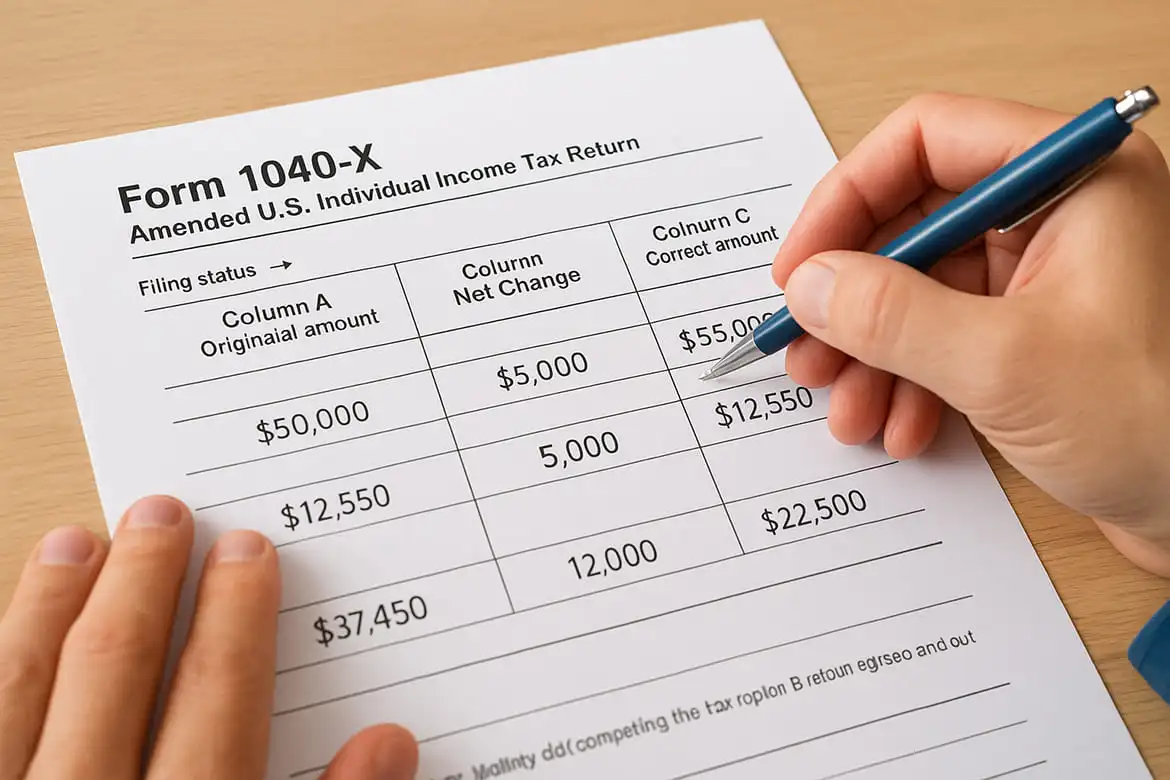
Form 1040-X uses a three-column format that shows your original figures, the changes you're making, and the corrected amounts. This layout helps the IRS process your amendment quickly by displaying exactly what changed and why. You fill out one line at a time across all three columns before moving to the next line. The form references line numbers from your original Form 1040, so keep your original return nearby as you work through each section.
Column A: Original amount or as previously adjusted
You enter the amounts from your original return in Column A. These numbers come directly from the Form 1040 you already filed. If you amended this return before, you use the figures from your most recent amendment instead of the original filing. Look at line 1 on Form 1040-X, which asks for your adjusted gross income. You find that number on line 11 of your original Form 1040 and transfer it to Column A.
Check your original tax return for each line item that Form 1040-X requests. Common entries include your total income, deductions, taxable income, total tax, payments, and refund or amount owed. You must transcribe these numbers exactly as they appeared on your filed return. Incorrect entries in Column A create processing delays because the IRS cannot verify what you're changing.
Column B: Net change
Column B shows the dollar difference between your original amount and your corrected amount. You calculate this by subtracting Column A from Column C. If your corrected amount is larger, you enter a positive number. When your corrected amount is smaller, you show a negative number in parentheses. Many taxpayers complete Column C first, then return to calculate Column B once they know both figures.
The IRS processes your amendment faster when you accurately calculate Column B instead of leaving it blank for them to compute.
Column C: Correct amount
You enter the accurate figures that should have appeared on your original return in Column C. These numbers come from your corrected documentation: revised W-2 forms, additional 1099s, missed deduction receipts, or new information about credits. When learning how to amend a tax return, this column represents what you're asking the IRS to accept as correct.
Here's how the three columns work together for a sample line:
| Column A (Original) | Column B (Net Change) | Column C (Correct) |
|---|---|---|
| $50,000 | $5,000 | $55,000 |
| $12,550 | $0 | $12,550 |
| $37,450 | $5,000 | $42,450 |
Calculate your tax liability on the corrected amount using the tax tables for your filing year. Complete every line that applies to your situation, leaving blank only those lines where nothing changed and you had no original entry. Your final entries in Part I determine whether you receive an additional refund or owe more tax.
Step 3. Write the explanation in Part III
Part III of Form 1040-X requires you to explain why you're amending your return in plain language. This explanation box sits at the bottom of page 2 and gives you space to describe the errors you discovered and the corrections you made. The IRS uses this section to understand your amendment quickly without reviewing every line of your return. A clear, specific explanation speeds up processing and reduces the chance of follow-up questions from the IRS.
What to include in your explanation
Your explanation should state exactly what changed and why. You describe the specific items you're correcting, such as "forgot to claim mortgage interest deduction" or "received corrected W-2 from employer showing additional income." Avoid vague statements like "made a mistake" or "found an error." The IRS needs concrete details about which forms, schedules, or line items you modified.
Include the dollar amounts that changed when they're significant. Writing "claiming additional $8,000 in business expenses from Schedule C" gives the IRS immediate context. Reference specific form numbers and schedules in your explanation, such as "correcting Schedule A to include $3,500 in charitable contributions" or "updating Form 8863 to claim American Opportunity Credit."
A detailed explanation in Part III prevents the IRS from requesting additional documentation and speeds your amendment through processing by an average of 4-6 weeks.
Sample explanation templates
Here are concrete examples you can adapt for common amendment situations:
For unreported income: "Received corrected Form 1099-MISC from ABC Company dated January 15, 2026, showing additional freelance income of $4,200. Original 1099 reported $8,000; corrected form shows $12,200. Updated Schedule C accordingly."
For missed deductions: "Failed to claim student loan interest deduction of $2,100 on original return. Received Form 1098-E from loan servicer showing qualifying interest paid. Adding deduction on line 20 of Schedule 1."
For filing status correction: "Originally filed as Single but qualify as Head of Household. Daughter resided with me for entire year and I provided over half her support. Attaching documentation of her residency."
For dependent claims: "Omitted dependent son (SSN: XXX-XX-XXXX) from original return. He lived with me full year, is under 17, and I provided all support. Claiming Child Tax Credit of $2,000."
Keep it brief and factual
Limit your explanation to essential facts without unnecessary details. You don't need to explain how you discovered the error or apologize for the mistake. When learning how to amend a tax return, focus on what changed and provide supporting documentation. The IRS cares about the correction itself, not the story behind it. Write in complete sentences using professional language, and keep your total explanation under 150 words when possible.
Step 4. Submit your amended return
You have two options for submitting Form 1040-X: mail it to the IRS or file electronically for recent tax years. The submission method you choose affects processing time and your ability to track the amendment. Most taxpayers still mail paper forms because electronic filing for amendments only became available in 2020 and has limited software support. Understanding where and how to submit your completed form ensures the IRS receives and processes your amendment correctly.
Mailing your paper Form 1040-X
You must mail your Form 1040-X to a specific IRS address based on your state and whether you're including a payment. The IRS maintains different processing centers for different regions, and sending your form to the wrong address delays processing by several weeks. You find the correct mailing address in the instructions for Form 1040-X, which list addresses by state and payment status.
Attach all supporting documentation that explains your changes to the back of Form 1040-X. This includes corrected W-2 forms, additional 1099s, receipts for deductions you're now claiming, or any schedules you didn't file originally. Staple these documents in the upper left corner and write your Social Security number on each page in case they separate during processing.
Make a complete copy of everything you're mailing before you send it. Keep this copy with your tax records for at least three years in case the IRS has questions or your amendment gets lost in processing. Use certified mail with return receipt if you're close to the three-year deadline for claiming a refund. This gives you proof of when the IRS received your amendment.
Mailing your amendment with tracking provides delivery confirmation and protects you if the IRS claims they never received your paperwork.
Electronic filing options
You can file Form 1040-X electronically if you're amending tax returns from 2019 or later and use compatible tax software. TurboTax, H&R Block, and TaxAct all support electronic amendments for these years. The IRS does not accept electronic amendments for tax years before 2019, regardless of which software you use. You must mail those amendments on paper.

Electronic filing gives you instant confirmation that the IRS received your amendment and lets you track its status online through the "Where's My Amended Return" tool. This method eliminates the risk of lost mail and typically processes faster than paper submissions. Your tax software guides you through importing your original return data and uploading supporting documents digitally.
Including payment if you owe
You pay any additional tax you owe separately from submitting Form 1040-X. The IRS accepts payments through their Direct Pay system at irs.gov, by credit card through approved processors, or by check made payable to "United States Treasury." Write your Social Security number, tax year, and "Form 1040-X" on your check memo line to help the IRS apply your payment correctly.
Submit your payment as soon as you know you owe more tax, even before you finish preparing Form 1040-X. This stops interest charges from accumulating while you complete the form. When learning how to amend a tax return, remember that payment and submission are separate actions. You can pay immediately and mail your explanation later without penalty.
Tracking your amendment status
The IRS provides a tracking tool that shows the progress of your amended return from the day they receive it through final processing. You can check this status starting about three weeks after you submit Form 1040-X electronically or four weeks after they receive your mailed amendment. The system updates weekly, typically on Saturdays, so checking more frequently than once per week won't show new information.
Using the Where's My Amended Return tool
You access the IRS tracking tool at irs.gov by searching for "Where's My Amended Return" or going directly to the amended return status page. The tool requires three pieces of information from your amended return: your Social Security number, date of birth, and zip code. You enter these details and the system displays the current status of up to three amended returns you filed within the past three years.
The tool shows three distinct status stages as your amendment moves through processing:
- Received means the IRS logged your amendment into their system. This status appears 3-4 weeks after mailing or immediately after electronic filing.
- Adjusted indicates the IRS processed your changes and either approved or modified your requested corrections. You'll see your new refund amount or balance due.
- Completed confirms the IRS finished processing and issued your refund or sent you a notice about changes they made.
Each status includes a progress bar and estimated completion date when available. You can view detailed information about what the IRS changed, why they adjusted certain items differently than you requested, and when they mailed any correspondence.
The IRS cannot provide status updates over the phone until 12 weeks have passed for electronically filed amendments or 16 weeks for mailed forms.
Understanding processing timeframes
Electronically filed amendments take 8 to 12 weeks to process under normal circumstances. Paper amendments require 12 to 16 weeks because the IRS must manually enter your information into their system before processing begins. These timeframes represent average cases without complications. Complex amendments involving business income, multiple schedules, or requests for large refunds often take longer.
Several factors extend processing time beyond these averages. The IRS processes amendments in the order they receive them, so filing during peak tax season (January through April) adds weeks to your wait. Incomplete forms, missing documentation, or errors in your calculations trigger manual review that delays processing by an additional 4 to 8 weeks. When learning how to amend a tax return, submitting accurate, complete paperwork the first time prevents these delays.
Contact the IRS directly if your amendment shows "Received" status for longer than 16 weeks or if the tool displays an error message. Call 866-464-2050 and have your Form 1040-X, original return, and all supporting documents ready when you speak with a representative. They can research your amendment and identify any processing holds that don't appear in the online system.
Updating your state tax return
Your federal amendment often requires a corresponding state tax return amendment. Most states base their tax calculations on your federal adjusted gross income, so changes to your federal return automatically affect your state taxes. You cannot skip the state amendment just because you filed Form 1040-X with the IRS. Each state processes amendments independently and requires separate forms and submission procedures.

When state amendments are required
You must file a state amendment whenever your federal changes affect income, deductions, or credits that your state taxes. States that use your federal adjusted gross income as a starting point require amendments for any correction that changes that number. This includes unreported income, filing status corrections, dependent claims, and most deduction adjustments. Your state tax liability changes when these federal corrections flow through to your state calculation.
Some federal changes don't trigger state amendments. States that don't tax certain income types (like Social Security benefits or municipal bond interest) won't require amendments when you correct those items on your federal return. Similarly, federal credits that your state doesn't recognize won't affect your state filing. You review your state's tax forms and instructions to determine which federal changes impact your state return.
Filing your state amendment within 90 days of your federal amendment prevents most states from charging interest on additional tax owed.
Filing state Form 1040-X equivalents
Each state uses different forms for amendments. California requires Form 540-X, New York uses Form IT-201-X, and Texas has no state income tax requiring no amendment. You find your state's specific amendment form on your state tax agency's website. Most states don't accept federal Form 1040-X as a substitute for their own amendment forms.
State amendment forms follow a similar structure to the federal version. You enter original amounts, show the changes, and calculate corrected figures. Many states require you to attach a copy of your federal Form 1040-X with your state amendment to verify the federal changes. Some states ask for additional documentation that wasn't required for your federal filing.
Timing and coordination
File your state amendment after the IRS accepts your federal amendment or simultaneously with your federal submission. Waiting for federal approval isn't required, but it reduces the chance of your state rejecting changes that the IRS later denies. When learning how to amend a tax return at both levels, coordinating your submissions prevents processing complications.
Processing times for state amendments vary widely. Some states complete amendments in 4 to 6 weeks, while others take up to 16 weeks. California and New York typically process faster than smaller states with limited resources. You track your state amendment through your state tax agency's online portal or by calling their taxpayer service line. States without online tracking require phone inquiries after reasonable processing time passes.
Payment procedures differ from federal rules. Many states require you to submit payment with your amendment rather than paying separately. You include a check with your state Form 1040-X equivalent or pay through your state's online payment system before mailing the form. State interest rates on unpaid balances often exceed federal rates, making prompt payment more critical.
Final thoughts on tax amendments
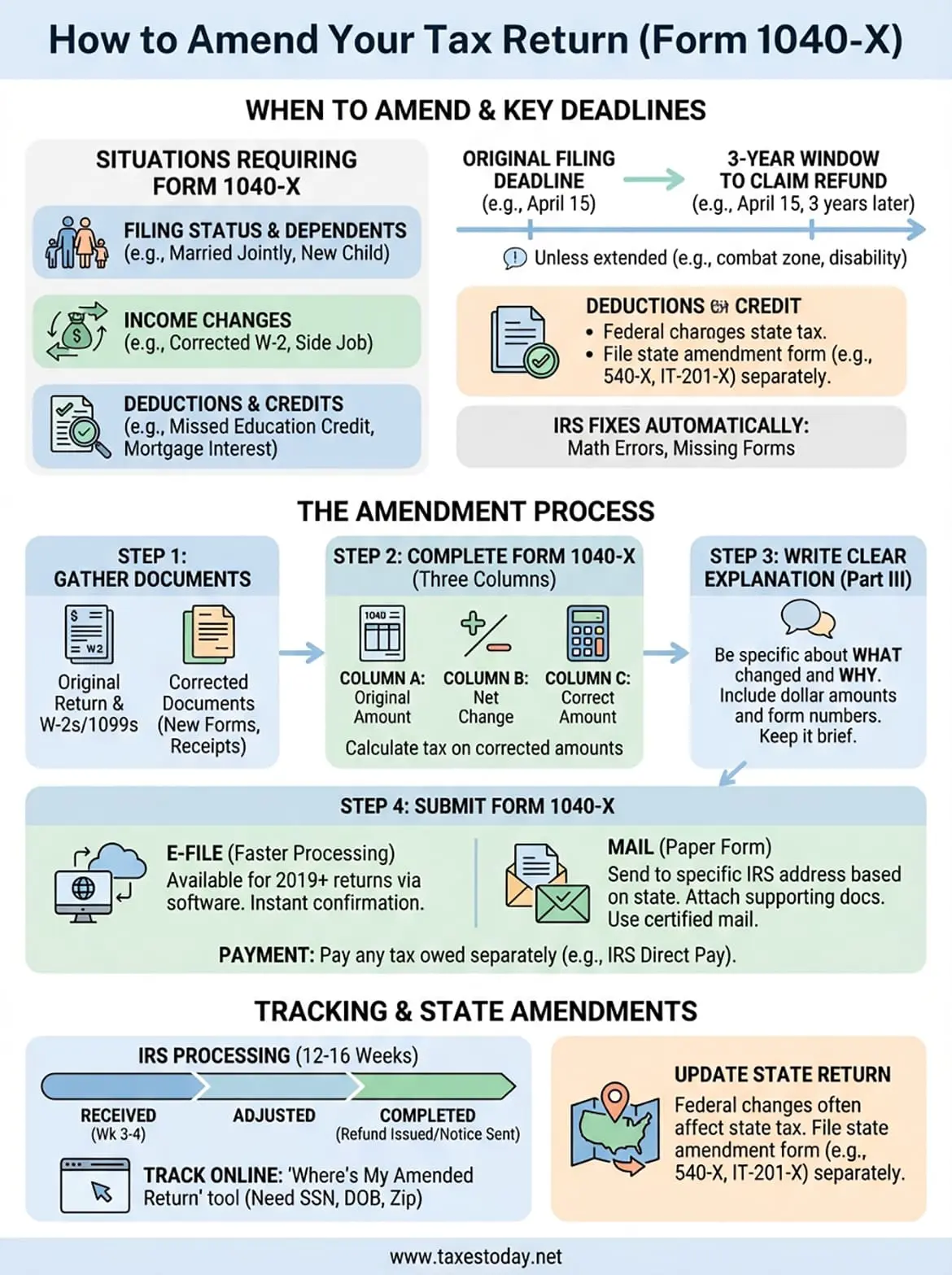
Learning how to amend a tax return protects your financial interests when errors slip through on your original filing. You have clear deadlines to meet, specific forms to complete, and straightforward steps to follow. The three-year window for claiming refunds gives you reasonable time to discover mistakes, but waiting risks losing money you rightfully earned back.
Processing takes 12 to 16 weeks for most amendments, so file as soon as you identify errors that affect your tax liability or refund amount. Your state likely requires a separate amendment that coordinates with your federal changes. Track your amendment status regularly through the IRS online tool to catch any processing issues early.
Professional help eliminates the stress of navigating Form 1040-X and prevents costly mistakes on complex returns. Affordable tax preparation services guide you through amendments, handle both federal and state filings, and ensure you claim every refund you deserve before deadlines expire.