



What Is an Amended Tax Return? Reasons, Deadlines & Steps
You filed your tax return, hit submit, and then it hits you, you forgot to report freelance income, missed a deduction, or entered the wrong filing status. That sinking feeling is more common than you think, and fortunately, the IRS has a solution. Understanding what is an amended tax return can save you from penalties, help you claim a larger refund, or simply correct honest mistakes before they become bigger problems.
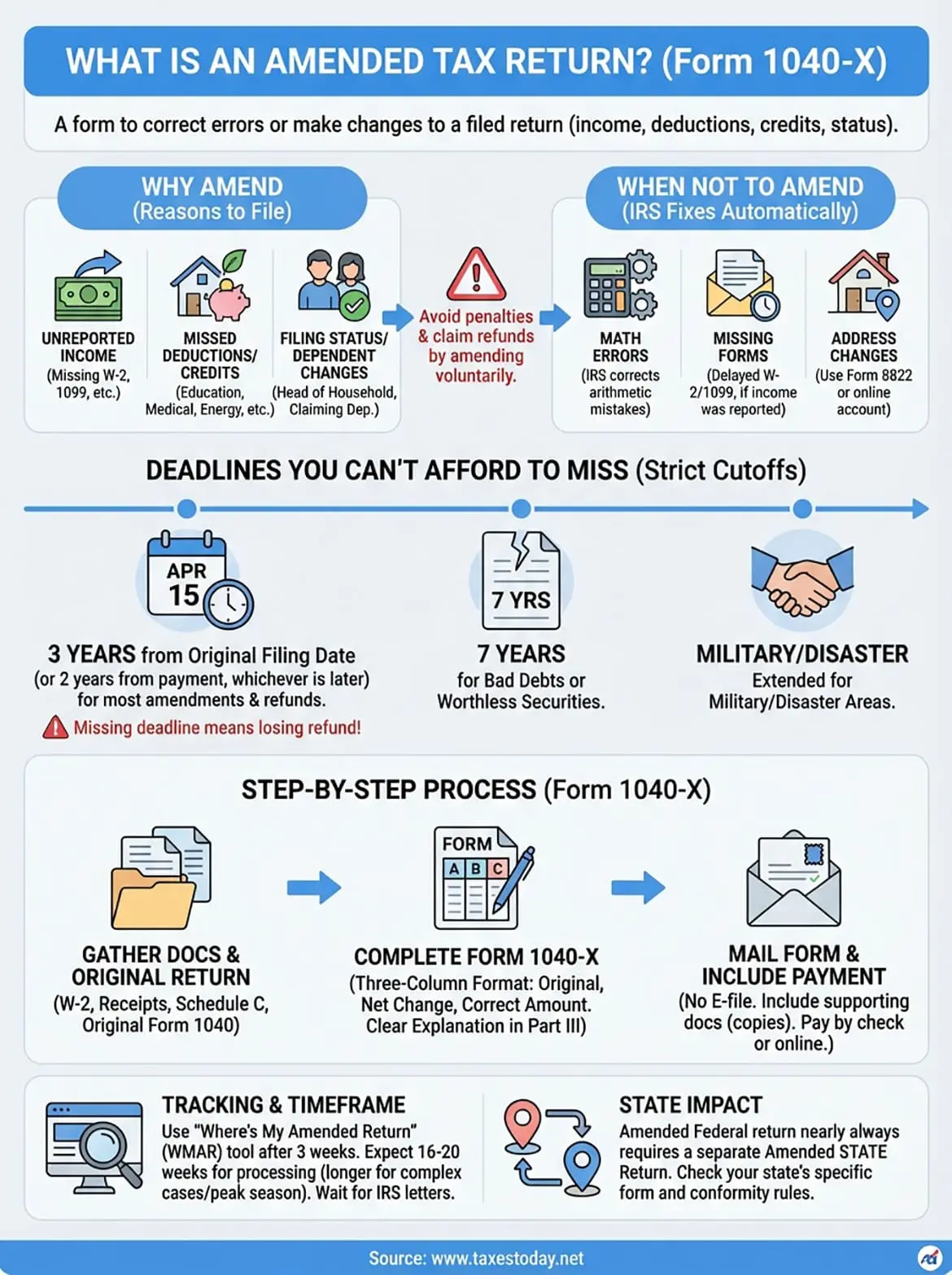
An amended tax return is a form you file to correct errors or make changes to a tax return you've already submitted. Whether you underreported income, overlooked a tax credit, or need to update your filing status, the IRS allows you to set the record straight using Form 1040-X.
At TaxesToday, we've helped countless clients navigate the amended return process, from identifying what needs correction to filing accurately and tracking refund status. In this guide, you'll learn exactly when you need to amend, the deadlines you can't afford to miss, the step-by-step process, and how to monitor your amended return with the IRS. Let's get your tax situation back on track.
Why amended returns matter
Filing an amended return isn't just about fixing paperwork. You're protecting yourself from potential IRS audits, avoiding costly penalties, and sometimes putting hundreds or thousands of dollars back in your pocket. The IRS processes millions of tax returns each year, and mistakes happen more often than you'd expect. Some errors trigger automatic reviews, while others sit unnoticed until the IRS catches them during an audit. When you understand what is an amended tax return and why it matters, you gain control over your tax situation instead of waiting for the IRS to find problems first.

The difference between proactively filing an amended return and ignoring an error can be significant. If you owe additional tax and the IRS discovers it first, you'll face interest charges and penalties that grow over time. However, when you voluntarily amend your return, you demonstrate good faith, which can reduce or eliminate certain penalties. You also get ahead of any compliance issues that might affect future returns or financial decisions, like applying for a mortgage or business loan.
Protecting yourself from IRS penalties
Underpaid taxes don't disappear. The IRS has three years from your filing date to audit your return, and in cases of substantial underreporting (more than 25% of your income), that window extends to six years. When the IRS identifies errors that result in additional tax owed, they assess a failure-to-pay penalty of 0.5% per month on the unpaid amount, plus interest that compounds daily. These costs add up quickly.
Filing an amended return before the IRS contacts you shows you're correcting an honest mistake rather than attempting to evade taxes. This distinction matters. Accuracy-related penalties typically run 20% of the underpayment, but the IRS often waives these when you file Form 1040-X voluntarily. You pay the tax you owe plus interest from the original due date, but you avoid the steeper penalty charges that come with IRS-initiated corrections.
When you amend proactively, you maintain control of the correction process and avoid the stress of responding to IRS notices under pressure.
Claiming money you left on the table
Not all amendments result in owing more tax. Many taxpayers discover they qualified for deductions or credits they didn't claim on their original return. Maybe you forgot about eligible education expenses, overlooked energy-efficient home improvements, or didn't realize a medical expense crossed the deductibility threshold. Each of these represents real money the government owes you.
The IRS won't automatically give you a larger refund just because you qualified for it. You need to actively claim what you're entitled to by filing an amended return. We've seen clients recover anywhere from a few hundred dollars to several thousand, depending on the credits or deductions they initially missed. That money belongs to you, but only if you take action within the statute of limitations.
Correcting errors before they compound
Tax mistakes rarely stay isolated. An error on your federal return often carries over to your state return, creating two problems instead of one. If you incorrectly reported your income, that figure likely appeared on multiple forms and schedules throughout your return. Amending allows you to fix the root issue and ensure all connected forms reflect accurate information.
Consider what happens when you don't amend. Future tax years might build on incorrect information from previous returns. You might make financial decisions based on an inaccurate picture of your tax situation. Lenders and financial institutions sometimes request past tax returns, and discrepancies between what you filed and what you actually earned can raise red flags. Cleaning up your tax record now prevents these complications from affecting your financial future.
Beyond the immediate correction, amended returns create a clean audit trail. If the IRS ever questions your taxes from a particular year, having documentation that shows you identified and corrected errors yourself demonstrates diligence. This record can be invaluable if you face scrutiny on other tax matters. You show a pattern of compliance and attention to accuracy that works in your favor.
When you should file an amended return
You need to file an amended return whenever you discover errors that change your tax liability or affect the amount you owe or the refund you receive. The IRS expects accurate reporting, and when you identify mistakes after filing, Form 1040-X becomes your tool for correction. Knowing exactly which situations require an amendment helps you act quickly and avoid potential problems down the road.

Income reporting errors
Unreported income represents one of the most common reasons taxpayers file amended returns. You might have received a 1099 form after filing, discovered freelance income you forgot to include, or realized you entered W-2 information incorrectly. Every dollar of taxable income needs to appear on your return, and when it doesn't, you must amend.
Cryptocurrency transactions, side gig earnings, investment income, and rental property profits all qualify as taxable income that triggers the need for an amendment if omitted. The IRS receives copies of most 1099 forms, and their systems automatically flag discrepancies between what you reported and what your employers or clients submitted. You want to correct these issues before the IRS sends you a notice.
Filing an amended return for unreported income demonstrates your commitment to accurate reporting and can help you avoid penalties that come with IRS-initiated corrections.
Missed deductions and tax credits
You discover after filing that you qualified for deductions or credits you didn't claim. This happens frequently with education expenses, charitable donations, medical costs, business expenses for self-employed individuals, and energy-efficient home improvement credits. Each of these can significantly reduce your tax bill or increase your refund, making an amendment worthwhile.
Professional tax preparers often identify these opportunities when reviewing previously filed returns. Maybe you didn't realize your total medical expenses exceeded the adjusted gross income threshold, or you overlooked eligible retirement contributions. What is an amended tax return if not a second chance to claim every benefit you legally earned? These corrections typically result in the IRS owing you money rather than the other way around.
Filing status and dependent changes
Your filing status directly affects your tax rates, standard deduction, and credit eligibility. If you filed as single but should have filed as head of household, or you incorrectly claimed married filing separately instead of jointly, you need to amend. The tax differences between these statuses can amount to thousands of dollars.
Dependent claiming issues also require amendments. You might have forgotten to claim an eligible child or relative, claimed someone you weren't entitled to claim, or discovered that another taxpayer incorrectly claimed your dependent. Custody situations, support tests, and residency requirements all factor into dependent eligibility. Getting these details right ensures you receive the correct tax benefits and avoid IRS disputes over dependent claims that affect multiple returns.
When you do not need to amend
Understanding what is an amended tax return includes knowing when you don't need one. The IRS automatically corrects certain errors, saving you time and paperwork. You might panic when you spot a mistake, but many situations don't require Form 1040-X. Learning which errors the IRS handles internally helps you avoid unnecessary work and lets you focus on corrections that actually matter.
Math errors the IRS fixes automatically
The IRS computers catch and correct mathematical mistakes without requiring an amended return from you. If you added your income incorrectly, calculated your tax from the wrong column, or made arithmetic errors on any line, the IRS fixes these during processing. Their systems recalculate everything automatically.
You'll receive a notice explaining the correction and any resulting change to your refund or tax owed. This process happens routinely with millions of returns each year. Simple addition, subtraction, multiplication, and division errors all fall into this category. You don't need to do anything unless you disagree with the IRS correction, in which case you can respond to their notice with supporting documentation.
Missing or incorrect forms from employers
Waiting on a delayed W-2 or 1099 form doesn't require an amended return if you reported your income accurately based on your pay stubs or records. When you file your original return with the correct income amounts, you've fulfilled your reporting obligation. The IRS receives copies of these forms directly from employers and payers, so they can verify your reported amounts match the documentation on file.
Similarly, if a form arrives after you filed showing slightly different amounts than you reported, and the difference is minimal, the IRS typically adjusts your return during processing. You'll receive correspondence showing the adjustment. However, if the difference is substantial or represents entirely unreported income, you need to file Form 1040-X to correct the record.
The IRS processing systems handle routine corrections automatically, so you don't need to amend for every minor discrepancy you discover after filing.
Changes that don't affect tax liability
Updating your address or bank account information doesn't require an amended return. You can change your address directly with the IRS using Form 8822, or by updating it through your online IRS account. Bank account changes for direct deposit can't be made after the IRS processes your return, but this doesn't warrant an amendment.
Correcting spelling errors in names, fixing transposed numbers in your Social Security number (if the IRS processed your return without issue), or updating contact information all fall outside the scope of Form 1040-X. These administrative details don't change your tax calculation or payment. The IRS cares about accurate tax liability calculations, refund amounts, and income reporting. Everything else represents administrative data that you can update through simpler methods or that doesn't require correction at all unless it prevents the IRS from processing your return properly.
Deadlines to file and claim a refund
You face specific deadlines when filing an amended return, and missing these cutoff dates can cost you money or prevent you from claiming a refund you're entitled to. The IRS sets different timeframes depending on whether you owe additional tax or expect a refund. Understanding what is an amended tax return also means knowing exactly when you can file it and when your window closes permanently.

The three-year window for most amendments
You have three years from the original filing deadline (typically April 15) to file Form 1040-X for most corrections. If you filed your 2022 tax return by the April 15, 2023 deadline, you can amend it until April 15, 2026. This three-year period applies whether you're correcting errors that result in owing more tax or claiming additional deductions.
The IRS also provides an alternative calculation: you can file within two years from the date you paid the tax, whichever gives you more time. This matters if you filed an extension, paid estimated taxes throughout the year, or made payments after the original deadline. You use whichever date gives you the longer filing window. For most taxpayers, the three-year rule from the filing deadline provides more time.
Track your original filing date carefully, because the IRS strictly enforces these deadlines and won't process amended returns that arrive even one day late.
Claiming refunds has stricter deadlines
When you're amending to claim a refund you didn't originally receive, the deadline becomes critical. You must file Form 1040-X within three years of filing your original return or two years of paying the tax, whichever is later. Missing this deadline means the IRS keeps your money permanently, regardless of how much you're entitled to receive.
Taxpayers who filed early face a specific rule. If you submitted your return before the April 15 deadline, the IRS treats April 15 as your filing date for calculating the three-year window. This gives early filers the same amount of time as everyone else to discover and claim missed deductions or credits. You don't lose time by filing ahead of the deadline.
Special situations that extend your deadline
Certain circumstances give you additional time beyond the standard three-year window. If you're in a federally declared disaster area, you typically receive extra months to file your amended return. The IRS also extends deadlines for military personnel serving in combat zones and those who are incapacitated.
Amended returns related to bad debts or worthless securities follow a seven-year rule instead of three years. If you need to claim a loss from a business debt that became uncollectible or stock that became worthless, you have seven years from the original return's due date to file Form 1040-X. These specialized situations require documentation proving when the debt or security became worthless, so you'll need to gather supporting evidence along with your amended return.
How to file Form 1040-X step by step
Filing Form 1040-X requires attention to detail and specific documentation. You need to walk through a structured process that ensures the IRS can understand exactly what you're changing and why. Understanding what is an amended tax return means knowing not just when to file one, but how to complete it correctly the first time. Most rejections happen because taxpayers skip crucial steps or provide incomplete information. Following this systematic approach saves you from delays and additional paperwork.

Get your original return and gather documents
You start by locating your original tax return and all supporting documents you filed. This includes W-2s, 1099s, receipts for deductions, and any schedules you attached. You'll need these to complete the three-column format on Form 1040-X, which requires you to show original amounts, changes, and correct amounts side by side.
Next, gather documentation for the changes you're making. If you're adding unreported income, collect the 1099 or W-2 you missed. When claiming additional deductions, organize receipts, bank statements, or other proof of expenses. The IRS may request this documentation, so having everything ready before you start filling out the form streamlines the process and ensures accuracy.
Complete the three-column format
Form 1040-X uses a unique layout with three columns labeled A, B, and C. Column A shows amounts from your original return. Column B displays the net change (increase or decrease). Column C presents the correct amounts after adjustments. You fill in these columns for key lines like income, deductions, taxable income, and tax liability.
Pay special attention to Part III of the form, where you explain each change you're making. The IRS requires clear explanations written in plain language. You describe what you're correcting, why you're correcting it, and reference any additional forms or schedules you're attaching. This section often determines how quickly the IRS processes your amendment.
Clear, specific explanations in Part III help IRS agents process your amended return faster and reduce the chance of follow-up questions or delays.
Choose your filing method
You must mail Form 1040-X to the IRS because electronic filing isn't available for amended returns in most situations. The IRS processes these manually, which explains the longer wait times compared to original returns. Check the form's instructions for the correct mailing address based on your state and whether you're enclosing a payment.
Include all supporting documentation with your mailed return. You attach copies, not originals, of W-2s, 1099s, receipts, and any additional schedules. If your amendment results in owing additional tax, you can pay online through IRS Direct Pay or include a check with your mailed form. Write your Social Security number, tax year, and "Form 1040-X" on your check to ensure proper processing.
What to include and how to explain changes
You need to provide specific documentation and clear written explanations that show the IRS exactly what you're correcting and why. The quality of your explanation often determines how smoothly your amendment processes and whether the IRS accepts your changes without requesting additional information. Knowing what is an amended tax return means understanding that the IRS reviews these manually, so every detail you provide helps the agent assigned to your case make faster decisions.
Required documentation and supporting forms
You must attach copies of all new or corrected forms that support your amendment. If you're adding unreported income from a 1099 form that arrived late, include a copy of that 1099. When claiming additional business expenses, attach Schedule C or Schedule F showing the corrected amounts. Any new or revised schedules become part of your amended return package.
Include receipts, statements, or other proof for deductions or credits you're claiming. Medical expense amendments require documentation showing the costs you paid. Charitable contribution corrections need acknowledgment letters from the organizations. The IRS doesn't always request this upfront, but attaching it with your initial filing speeds up processing and demonstrates you have legitimate support for your changes. Keep originals for your records and send copies only.
Providing complete documentation with your initial Form 1040-X filing reduces the chance of IRS follow-up requests and helps your amendment process faster.
Writing clear explanations in Part III
Part III of Form 1040-X requires you to explain in detail what you're changing and why the change is necessary. You write this in plain language, not tax code references or technical jargon. The IRS agent reading your explanation needs to understand your situation quickly, so you state facts directly and reference specific line numbers from your original return.
Start each explanation with the specific item you're correcting, such as "unreported 1099-MISC income" or "missed education credit." Follow with a brief reason: "received 1099 after filing" or "discovered eligibility after filing." Then state the impact: "increases income by $5,000" or "adds $2,000 education credit." This format gives the IRS agent everything they need in a logical, scannable format that matches the three-column layout on the front of the form.
Common explanation examples
When adding unreported income, you write something direct like: "Adding $3,200 from 1099-NEC (copy attached) received from ABC Company after original filing. Increases total income on Line 1." You reference the specific form and line numbers affected, making it easy for the IRS to verify your math and locate the change on your return.
For missed deductions, your explanation might read: "Claiming $8,500 in qualified medical expenses (receipts attached) that exceeded AGI threshold. Reduces taxable income on Schedule A, Line 4." You clearly identify what you're claiming and where it appears on the supporting schedules. Corrections to filing status require more context: "Changing from Single to Head of Household. Qualifying dependent (son, lived with me full year) was incorrectly omitted. Updated Form 1040, Line 19, and claiming correct standard deduction."
How long it takes and how to track it
The IRS takes significantly longer to process amended returns compared to original filings. You should expect 16 to 20 weeks from the date the IRS receives your Form 1040-X until they finish processing it. This extended timeline exists because amended returns require manual review by IRS agents rather than automatic computer processing. Understanding what is an amended tax return includes accepting that patience becomes part of the process, but you don't have to wait blindly.
Processing timeframes you can expect
Your amended return moves through several stages during those 16 to 20 weeks. The IRS first confirms they received your Form 1040-X, which typically takes three weeks after mailing. They then assign your amendment to an agent who reviews your explanations, verifies your documentation, and recalculates your tax liability. This review stage consumes most of the processing time.
Certain factors extend processing beyond the standard timeframe. If you owe additional tax and didn't include payment, the IRS processes your amendment but adds interest until you pay the balance. Returns requiring additional documentation or those filed during peak tax season (January through April) often take longer. Complex amendments involving multiple schedules or business returns can push processing closer to 24 weeks or more.
The IRS handles amended returns in the order they receive them, so filing earlier in the year typically results in faster processing than amendments submitted during busy periods.
Using Where's My Amended Return tool
You track your amendment through the IRS's Where's My Amended Return (WMAR) online tool. You can access this system three weeks after mailing your Form 1040-X. The tool requires your Social Security number, date of birth, and ZIP code to pull up your amendment status. You'll see one of three stages: received, adjusted, or completed.
The received status means the IRS logged your Form 1040-X into their system but hasn't started reviewing it. Adjusted indicates they've processed your amendment and made changes to your account. Completed shows they finished all processing, issued any refund due, or sent you a bill for additional tax owed. You can check WMAR as often as you want, though updates typically occur weekly rather than daily.
What to do while you wait
You continue with normal tax activities while your amendment processes. File your next year's return on time using the correct information from your amended return, not the original incorrect filing. If your amendment affects estimated tax payments, adjust those calculations immediately rather than waiting for the IRS to finish processing.
Respond promptly to any IRS correspondence about your amendment. They might request additional documentation or clarification about changes you made. These letters typically give you 30 days to respond, and quick replies help keep your amendment moving through the system. Missing these deadlines can result in the IRS rejecting your amendment or adjusting it differently than you intended. Keep copies of everything you send to the IRS and use certified mail for important responses to create a paper trail showing when you replied.
How amended federal returns affect state taxes
Your federal amended return almost always impacts your state tax return because most states base their tax calculations on your federal adjusted gross income or taxable income. When you change your federal return, those numbers ripple through to your state calculations. Understanding what is an amended tax return means recognizing that fixing one return often requires fixing two or more returns depending on which states you filed in during the tax year in question.
State conformity with federal changes
Most states automatically receive information when you file an amended federal return, but they don't automatically adjust your state return. You need to file a state amended return separately using your state's specific form and procedures. States fall into different conformity categories: some use federal adjusted gross income as their starting point, others reference federal taxable income, and a few calculate everything independently from scratch.
States with high conformity to federal tax law make the amendment process more straightforward because changes to your federal income directly affect your state tax liability. California, for example, uses federal adjusted gross income but makes its own adjustments, so you need to evaluate whether your federal changes require corresponding state corrections. States like Texas, Florida, and Nevada don't have state income tax, so your federal amendment doesn't create additional state filing requirements if you lived there during the tax year you're correcting.
When your federal amendment changes your income or deductions, you typically must file a state amended return even if your state tax liability stays the same.
When you need to amend your state return
You must file a state amended return whenever your federal changes affect your state taxable income. Adding unreported income, claiming additional deductions, or correcting your filing status on your federal return all trigger the need for state amendments. The impact might increase or decrease your state tax liability, but you need to report the changes regardless of the direction.
Certain federal changes don't require state amendments. If you corrected items that only exist on federal returns, like certain credits that your state doesn't recognize, you might not need to amend your state filing. Review your state's tax instructions or contact their revenue department to confirm whether your specific federal corrections require a corresponding state amendment. Each state maintains its own rules about which federal changes trigger state amendment requirements.
Filing state amendments and tracking status
You file state amended returns using your state's specific amendment form, which varies by state. Some states require you to wait until the IRS finishes processing your federal amendment before submitting your state correction, while others let you file both simultaneously. Check your state's revenue department website for their amendment form, instructions, and any unique timing requirements they enforce.
State processing times differ significantly from federal timelines. Some states process amendments within eight to twelve weeks, while others take longer. You track your state amendment through your state's online system or by calling their taxpayer service line directly. Keep copies of both your federal and state amendments together because you might need to reference them if either tax authority requests additional documentation or explanation about the changes you made.
Wrap up and take the next step
You now understand what is an amended tax return, when you need to file one, and how to complete Form 1040-X correctly. The process requires attention to detail, proper documentation, and clear explanations, but you don't have to navigate it alone. Missing deadlines or submitting incomplete amendments can delay your refund or leave errors uncorrected on your permanent tax record.
Professional guidance makes the difference between a smooth amendment and months of frustration with the IRS. At TaxesToday, our licensed and certified tax professionals handle amended returns for individuals, families, and small businesses across all 50 states. We review your original return, identify what needs correction, prepare accurate Form 1040-X filings, and communicate with the IRS on your behalf. Get expert help with your amended tax return and ensure your correction gets processed right the first time. Your peace of mind is worth more than the stress of doing it alone.