



14 1099 Contractor Deductions To Lower Your Tax Bill In 2026
If you earned income on a 1099 this year, the IRS expects you to pay both income tax and self-employment tax, a combined rate that can take a serious bite out of your earnings. The good news? 1099 contractor deductions exist specifically to offset that burden. Every legitimate business expense you claim directly reduces your taxable income, which means a smaller tax bill or a bigger refund.
The problem is that most independent contractors either don't know which expenses qualify or are too cautious to claim them. That hesitation costs real money. According to the IRS, self-employed taxpayers leave billions in unclaimed deductions on the table each year. Whether you drive for deliveries, run a consulting practice, or freelance from your home office, there are write-offs you're likely missing, and some of them are surprisingly generous.
At TaxesToday, we prepare taxes for freelancers, independent contractors, and small business owners every day. Our CTEC-certified and IRS-registered tax preparers have 15+ years of experience identifying deductions that clients frequently overlook. We built this guide based on what we actually see during tax season, not generic advice pulled from a textbook. Below, you'll find 14 deductions available to 1099 contractors for the 2025 tax year (filed in 2026), with clear explanations of what qualifies, what doesn't, and how to document everything properly.
1. Tax prep and bookkeeping fees
The money you pay to get your taxes prepared and your books organized is itself a deductible business expense. This is one of the most overlooked 1099 contractor deductions available, and it covers more ground than most people realize. If you paid someone to prepare your return or manage your financial records this year, you can write off that cost directly against your self-employment income.
What expenses qualify
This deduction covers fees you pay directly related to managing your business finances and tax obligations. Tax preparation fees for the portion of your return that covers your self-employment income, such as the cost of preparing Schedule C, qualify in full. Bookkeeping software subscriptions, monthly fees paid to an accountant or bookkeeper, and fees for payroll processing tools you use in your business also count.
The deduction does not cover the personal portions of your return, such as entering W-2 income or claiming personal credits. Only the business-related share of the total fee is deductible, so if your preparer charges one flat rate, you need to allocate it.
Key rules to follow
The expense must be ordinary and necessary for your business, which is the IRS standard for most self-employed deductions. Tax prep and bookkeeping fees meet that standard without debate. You also need to pay the expense in the same tax year you claim it, so a December invoice paid in January belongs in the following year's return, not the current one.
If a single fee covers both personal and business tax work, you must allocate the cost and deduct only the business share.
Records you should keep
Good documentation protects you if the IRS questions your return. Save every invoice, receipt, and bank statement that shows what you paid and to whom. For software subscriptions, keep the billing confirmation that shows the product name, amount, and payment date.
Your records should also clearly tie each expense to your business. A quick handwritten note on a receipt, such as "annual accounting software for freelance consulting practice," takes seconds to add and provides solid support during any audit.
Where to claim it on your tax return
You report this deduction on Schedule C. Tax preparation fees typically go on Line 17 (legal and professional services), while bookkeeping software usually fits on Line 18 (office expense). Because your net profit on Schedule C flows directly to Form 1040, every dollar you deduct here also reduces your self-employment tax base, giving you a double benefit.
2. Self-employment tax deduction
When you work as a 1099 contractor, you pay both the employee and employer portions of Social Security and Medicare taxes. That combined rate is 15.3% on your net self-employment income. The IRS gives you a partial offset: you can deduct half of that amount directly from your gross income, reducing your taxable income without needing to itemize anything.
What the deduction covers
This deduction equals exactly 50% of your total self-employment tax for the year. It doesn't reduce the SE tax you owe, but it lowers the income on which your federal income tax is calculated. Here's what that looks like in practice:
- $4,000 in SE tax owed means a $2,000 deduction off your gross income
- $10,000 in SE tax owed means a $5,000 deduction off your gross income
Who qualifies and when it applies
Any self-employed individual who files Schedule SE qualifies automatically. That includes freelancers, independent contractors, sole proprietors, and single-member LLC owners reporting income on Schedule C. You qualify as soon as your net self-employment earnings exceed $400 for the year.
This is one of the few 1099 contractor deductions the IRS essentially calculates for you, since the deductible amount flows directly from your completed Schedule SE.
How to estimate it during the year
Use IRS Form 1040-ES when projecting your quarterly estimated payments. Factor in your expected SE tax deduction to avoid overpaying. A quick estimate: multiply your projected net profit by roughly 7.65% to get the approximate deductible amount.
Where to claim it on your tax return
You claim this deduction on Schedule 1 (Form 1040), Line 15. It reduces your adjusted gross income before your standard or itemized deductions apply.
3. Qualified business income deduction
The qualified business income (QBI) deduction lets eligible self-employed individuals deduct up to 20% of their net business income from their taxable income. For most 1099 contractors with straightforward freelance or service income, this deduction applies automatically and can reduce your tax bill significantly without requiring extra documentation.
What counts as qualified business income
Qualified business income is the net profit you earn from your self-employment activity after subtracting business expenses. If you run a sole proprietorship, single-member LLC, or S-Corp and report that income on Schedule C or Schedule K-1, you likely qualify. The deduction generally covers income from most trades and businesses, with some important exceptions around high-income earners in certain professions.
Common limits that reduce the deduction
Your taxable income determines how much of this deduction you actually receive. For 2025, the phase-out starts at $197,300 for single filers and $394,600 for married filing jointly. Above those thresholds, the rules become more complex, especially if you work in a specified service trade such as consulting, law, or financial services.
If your income falls below the phase-out range, you can take the full 20% deduction without any additional calculations.
How to avoid common QBI mistakes
One of the most frequent errors in this category is failing to reduce your QBI by self-employed health insurance premiums and retirement contributions, which are required adjustments before calculating the 20%. Running these numbers out of order inflates the deduction and can trigger IRS scrutiny.
Where to claim it on your tax return
You claim the QBI deduction on Form 8995 (or Form 8995-A for higher-income filers), and the result carries to Schedule 1 (Form 1040), Line 13. Unlike most 1099 contractor deductions, this one does not reduce your self-employment tax base, only your federal income tax.
4. Self-employed health insurance premiums
Health insurance is expensive, and as a 1099 contractor, you pay for it entirely on your own. The IRS allows you to deduct 100% of the premiums you pay for yourself and your family, making this one of the most valuable 1099 contractor deductions available to independent workers. Unlike most business deductions, this one directly reduces your adjusted gross income, not just your self-employment income.
What premiums you can deduct
You can deduct premiums for medical, dental, and vision insurance that you pay out of pocket. Long-term care insurance premiums also qualify, though the deductible amount is capped based on your age. The policy can cover you, your spouse, your dependents, and any child under age 27, even if your child does not qualify as a dependent on your return.
Eligibility rules that trip people up
You cannot take this deduction if you were eligible to enroll in a subsidized health plan through your spouse's employer during any month of the year. Eligibility is what disqualifies you, not whether you actually enrolled. If your spouse's employer offers coverage and you opted out, you lose the deduction for those months.
Run this calculation month by month if your eligibility changed during the year, since partial-year deductions are allowed.
How to handle spouses, dependents, and Medicare
If you are 65 or older and enrolled in Medicare, your Medicare Part B, Part C, and Part D premiums all qualify. You can also include premiums paid on behalf of a spouse who works in your business, even if they are formally employed by you.
Where to claim it on your tax return
You claim this deduction on Schedule 1 (Form 1040), Line 17. The deduction reduces your adjusted gross income and also lowers your qualified business income calculation for the QBI deduction, so the order in which you complete these sections matters.
5. Retirement plan contributions
Contributing to a retirement account does two things at once: it builds your financial future and reduces your taxable income today. As a 1099 contractor, you have access to retirement plans specifically designed for self-employed individuals, and the contribution limits are far more generous than what W-2 employees typically get through a workplace plan.
Plans that work well for 1099 income
Three plans stand out for independent contractors. A SEP-IRA (Simplified Employee Pension) allows contributions up to 25% of your net self-employment income, with a 2025 cap of $70,000. A Solo 401(k) lets you contribute as both the employee and employer, which pushes your potential contribution even higher. A SIMPLE IRA is less common for solo contractors but still available if you have no employees.
A Solo 401(k) often produces the largest deduction for 1099 contractors with moderate net income because of the dual contribution structure.
How contribution limits usually work
Your allowable contribution is based on your net self-employment income after deducting half of your SE tax and any other above-the-line adjustments. For a SEP-IRA, the IRS limits your contribution to roughly 20% of your net profit once those adjustments are factored in, not the full 25% many people expect.
How to time contributions for a bigger benefit
Unlike most deductions, SEP-IRA contributions can be made up until the tax filing deadline, including extensions. That means you can calculate your exact profit, open an account if needed, and still capture a significant deduction after December 31.
Where to claim it on your tax return
You report self-employed retirement contributions on Schedule 1 (Form 1040), Line 16. The deduction lowers your adjusted gross income and also reduces your QBI calculation.
6. Home office deduction
If you use part of your home exclusively for your business, you can deduct a portion of your housing costs against your self-employment income. This is one of the most commonly misunderstood 1099 contractor deductions, mainly because people assume it triggers audits. Used correctly, with solid documentation, the home office deduction is completely legitimate and worth claiming every year.
What counts as a qualifying home office
Your workspace must meet two IRS requirements: regular and exclusive use for business, and it must be your principal place of business. A dedicated desk in a shared bedroom does not qualify. A separate room you use only for client work, project delivery, or administrative tasks does qualify, even if you occasionally step into that room for personal reasons, as long as its primary function is business.
Choose between the simplified and actual method
The simplified method lets you deduct $5 per square foot of your office space, up to 300 square feet, for a maximum deduction of $1,500. The actual expense method calculates your deduction by applying the business-use percentage of your home to real costs like rent, utilities, and insurance.

The actual method almost always produces a larger deduction for contractors who pay significant rent or carry a mortgage.
Expenses you can include and exclude
Under the actual method, deductible costs include rent, mortgage interest, utilities, and homeowners or renters insurance. You cannot deduct landscaping, lawn care, or any cost tied exclusively to personal areas of the home.
Where to claim it on your tax return
You calculate the home office deduction on IRS Form 8829 and carry the result to Schedule C, Line 30.
7. Vehicle mileage and car expenses
If you drive for client meetings, supply runs, job sites, or any other business purpose, those miles reduce your taxable income. Vehicle costs rank among the most commonly claimed 1099 contractor deductions, and the IRS gives you two distinct methods to calculate them.
Pick standard mileage or actual expenses
You must choose one method and apply it consistently. The standard mileage rate for 2025 is 70 cents per mile, which you multiply by total business miles driven. The actual expense method adds up real costs including gas, insurance, registration, maintenance, and depreciation, then applies the business-use percentage of your vehicle to that total.

If you use your car heavily for business, the actual method often produces a larger deduction, but it requires significantly more detailed records throughout the year.
What you can add on top of mileage
Even when you use the standard mileage rate, parking fees and tolls paid during business trips remain fully deductible on top of your mileage calculation. You cannot add gas, insurance, or repair costs on top of the standard rate, but business-related parking costs are fair game regardless of which method you choose.
How to keep a mileage log that holds up
The IRS requires contemporaneous records, meaning you log each trip at or near the time it occurs. Your log should capture the date, destination, business purpose, and total miles for every trip. A simple spreadsheet or notes app works fine as long as you update it consistently rather than reconstructing the whole year from memory in April.
Where to claim it on your tax return
You report vehicle expenses on Schedule C, Part IV for mileage details, and carry the deductible amount to Line 9 of Schedule C.
8. Travel away from home for work
When a client project or job site requires you to travel overnight, the IRS allows you to deduct qualifying travel costs against your self-employment income. These expenses go well beyond airfare, and knowing exactly what counts is one of the more valuable 1099 contractor deductions you can claim if you work outside your local area regularly.
Travel costs you can deduct
Deductible travel expenses include flights, train tickets, rental cars, and bus fare for reaching your destination. Once you arrive, you can also deduct the following:

- Hotel and lodging for each business night
- Taxi, rideshare, and public transit at your destination
- Baggage fees tied to the trip
What counts as a business trip
A trip qualifies when its primary purpose is business and it takes you away from your tax home overnight. Your tax home is generally the city or area where you conduct the majority of your work, which is not always where you live.
If the main reason for the trip is business and you tack on a personal day, you can still deduct the full cost of your transportation to and from the destination.
How to split business and personal days
When a trip mixes business and personal time, you deduct only the expenses tied directly to business days. Hotels, meals, and transit on personal days do not qualify. Track each day separately and note what business activity you conducted on every day you plan to deduct.
Where to claim it on your tax return
You report travel expenses on Schedule C, Line 24a. Keep receipts and a brief written record of the business purpose for every trip you deduct.
9. Business meals
Meals with clients, prospects, or business partners can qualify as legitimate business expenses when they meet specific IRS criteria. Among all the 1099 contractor deductions available, meals are the most frequently claimed incorrectly, which makes understanding the rules here especially important.
When meals qualify as a deduction
A meal qualifies when it has a clear business purpose and you discuss actual business during or directly around it. The meal must not be lavish or extravagant relative to the context, and you or an employee must be present. Meals you eat alone while working, such as lunch at your desk, generally do not qualify under current IRS rules, even if you are working through the meal.
How the percentage limit usually works
The IRS caps the deduction at 50% of the qualifying meal cost, including tax and tip. So if you spend $80 on a client lunch, your deduction is $40. This limit applies to most business meals, and there are very few exceptions that allow a full 100% deduction.
Employee meals provided for the convenience of the employer can sometimes qualify at 100%, but that rule rarely applies to solo 1099 contractors without staff.
What to write down for each meal
Document each meal with the date, location, total amount paid, and the names of everyone present. Also write a brief note about what business topic you discussed. A quick line in your notes app or on the back of the receipt is sufficient, as long as you record it at the time.
Where to claim it on your tax return
You report business meals on Schedule C, Line 24b. Keep all receipts and your written notes organized by date so you can reconstruct the business purpose quickly if the IRS asks.
10. Phone, internet, and home connectivity
Phone and internet costs are real business expenses for most 1099 contractors, but the IRS requires you to separate personal use from business use before you claim them. These are among the most underreported 1099 contractor deductions simply because people assume the split is too complicated to bother calculating.
Expenses you can deduct
You can deduct the business-use portion of your monthly phone bill and home internet service. If you pay for a dedicated business line or a separate hotspot plan used exclusively for work, the full cost of that line qualifies without any proration required.
How to calculate your business-use percentage
Start by estimating the percentage of time you use each service for business versus personal purposes. If you use your phone 60% for business, you deduct 60% of your monthly bill. Most contractors who work from home full time can reasonably support a 50% to 80% business-use percentage, depending on their actual work habits and schedule.
Document how you arrived at your percentage so you can explain the calculation clearly if the IRS asks.
How to document mixed personal and business use
Keep monthly billing statements for your phone and internet provider for the full year. Write a brief note explaining your business-use estimate and how you determined it. Reviewing your call logs or usage history once to support that percentage is a practical approach that holds up well during an audit.
Where to claim it on your tax return
You report these phone and internet costs on Schedule C, Line 25 under utilities. Keep your annual billing records and written usage estimate together in the same folder so they are easy to locate if questions arise.
11. Supplies, materials, and shipping
Office supplies, raw materials, and packaging costs are everyday business expenses that add up fast over a full year. These 1099 contractor deductions are straightforward to claim, but a few rules determine how and where you report them.
Common write-offs in this category
Supplies you use to run your business qualify for a full deduction in the year you buy them. Common examples include printer paper, pens, notebooks, tape, labels, and cleaning products for your workspace. If your work involves physical goods, raw materials you consume during production also count here, along with shipping costs you pay to send finished work or products to clients.
When supplies become inventory or cost of goods sold
Not every material purchase belongs on Line 22 of Schedule C. If you purchase goods specifically to resell them, or buy raw materials that go into products you sell, those costs belong in the cost of goods sold section of Schedule C (Part III) rather than the supplies line. The distinction matters because the IRS treats inventory differently from consumable supplies, and mixing them up can create calculation errors.
If you are unsure whether a material purchase is a supply or inventory, ask yourself whether you use it up in your work or sell it as part of a finished product.
Receipt rules and best practices
Keep every receipt for supply purchases, whether you buy in-store or online. For online orders, save the order confirmation and the bank or credit card statement that shows the charge. Write a short note on each receipt identifying the business use if it is not already obvious.
Where to claim it on your tax return
You report qualifying supplies on Schedule C, Line 22. Shipping costs you pay on behalf of your business operations also go on Line 22 unless they relate to inventory, in which case they flow through Part III of Schedule C instead.
12. Computers, equipment, and depreciation
When you buy a laptop, camera, or specialized tool for your business, the IRS lets you recover that cost against your income. These purchases represent some of the most impactful 1099 contractor deductions available, but the tax rules around larger items work differently than ordinary supplies, so understanding the mechanics before you file is worth your time.
What counts as equipment versus supplies
Equipment refers to items with a useful life beyond one year, such as computers, monitors, printers, cameras, and specialized tools. Supplies, by contrast, are consumable items you use up within the tax year. That distinction determines which line of Schedule C you use and whether depreciation rules apply to your purchase.
Depreciation, bonus depreciation, and Section 179 basics
The IRS normally requires you to spread the cost of equipment across its useful life through depreciation. However, two accelerated options let you deduct a much larger portion upfront. Section 179 allows you to deduct the full cost of qualifying equipment in the year you place it in service, up to the annual limit, currently $1,220,000 for 2025. Bonus depreciation lets you deduct a percentage of the remaining cost beyond Section 179.

Section 179 cannot exceed your net business income for the year, so if your profit is low, bonus depreciation may produce a better result.
How to avoid red flags with big equipment write-offs
Document when you placed each item in service and confirm it was used more than 50% for business before claiming accelerated deductions. Mixed-use assets, like a personal laptop you also use for work, require you to prorate the deduction based on your actual business-use percentage.
Where to claim it on your tax return
You report equipment deductions on Form 4562, which feeds into Schedule C, Line 13. Keep your purchase receipts and a written record of business-use percentage for every asset you claim.
13. Advertising, marketing, and website costs
Most contractors spend real money to attract clients, and those costs are fully deductible. Advertising and marketing expenses are among the clearest 1099 contractor deductions the IRS allows, covering everything from online ads to your professional website.
What marketing expenses qualify
You can deduct the cost of any advertising directly tied to promoting your business. That includes paid social media ads, search engine advertising, business cards, flyers, branded merchandise you hand out to potential clients, and website design fees. Hosting fees, domain registration, and website maintenance costs also qualify in full as long as the site serves a business purpose.
If you run a website that mixes personal content with business promotion, deduct only the portion that relates to your business activity.
What to watch for with gifts and promotional items
The IRS caps the deduction for business gifts at $25 per recipient per year, regardless of what you actually spend. Branded items you hand out broadly, such as pens or notepads with your logo, may qualify as advertising rather than gifts depending on their cost and distribution method. Items worth $4 or less with your business name permanently printed on them are generally treated as advertising, not gifts.
How to document results-driven ad spend
Keep receipts and screenshots of every ad campaign, including the platform, the amount spent, and the business purpose. For ongoing subscriptions like website hosting, save your monthly billing statements for the full year.
Where to claim it on your tax return
You report these costs on Schedule C, Line 8 under advertising.
14. Business insurance premiums
Protecting your business costs money, and that money comes right back to you at tax time. Premiums you pay for business-related insurance policies are fully deductible as ordinary business expenses, making this one of the more straightforward 1099 contractor deductions you can claim.
Policies that often qualify
Several common policy types qualify for this deduction. General liability insurance that protects your business against third-party claims is deductible in full. Errors and omissions insurance, also called professional liability insurance, qualifies as well and is especially relevant if you provide advice, designs, or professional services to clients. Commercial property insurance covering equipment or tools you use exclusively for business also counts.
If you carry a policy that covers both personal and business property, deduct only the portion tied to your business assets.
What does not qualify as a business insurance deduction
Not every premium you pay belongs on Schedule C. Life insurance premiums are not deductible as a business expense, even if you name your business as the beneficiary. Health insurance is handled separately through the self-employed health insurance deduction covered earlier in this guide, so do not double-count those premiums here.
How to document coverage and payments
Keep your annual policy declarations page for every qualifying policy, along with payment receipts or bank statements showing each premium you paid during the year. Note the business purpose the policy serves so the connection to your work is clear in your records.
Where to claim it on your tax return
You report business insurance premiums on Schedule C, Line 15. Keep your policy documents and payment records organized together for easy reference during filing.
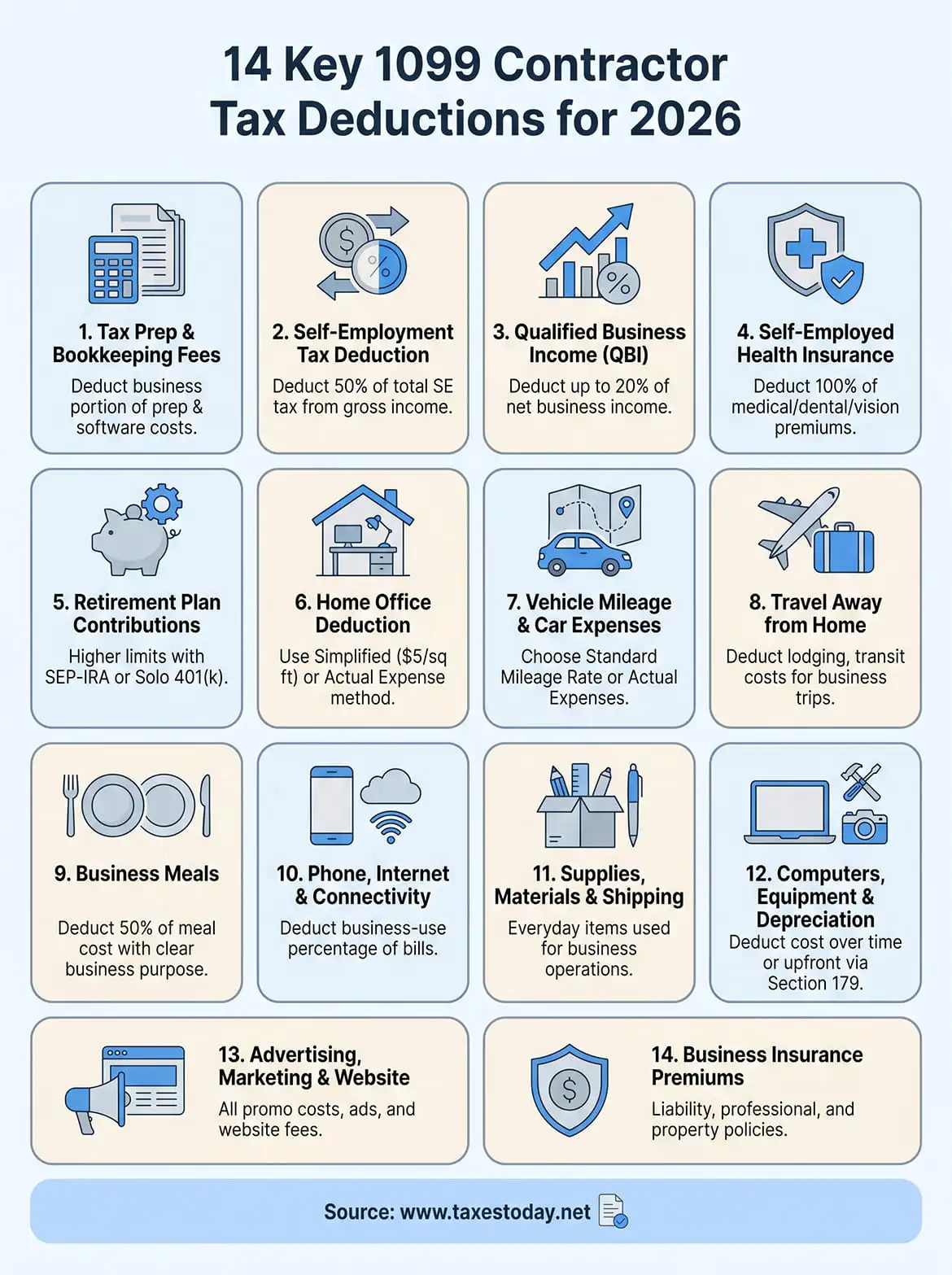
Next steps
You now have a complete picture of the 14 most valuable 1099 contractor deductions available for the 2025 tax year. The next move is straightforward: start organizing your records now so nothing falls through the cracks when you file. Pull your receipts, review your bank statements, and note any expenses you may have missed earlier in the year. Even partial-year documentation is better than none.
Claiming these deductions correctly requires more than knowing they exist. The rules around eligibility, allocation, and proper documentation vary enough that a single mistake can cost you the deduction or invite IRS scrutiny. If your tax situation involves significant self-employment income, multiple deduction categories, or anything unfamiliar, working with a professional is the smarter call.
Our CTEC-certified and IRS-registered preparers are ready to handle your return accurately and find every deduction you qualify for. File your 1099 taxes with a professional today and stop leaving money on the table.