


What Are Estimated Tax Payments? Who Pays, When, How Much
If you earn income that doesn't have taxes automatically withheld, think freelance work, rental properties, or investment gains, the IRS expects you to pay as you go. That's where estimated tax payments come in. These quarterly payments help you avoid a hefty tax bill (and potential penalties) when you file your return.
Missing these payments or calculating them incorrectly can cost you hundreds or even thousands of dollars in IRS penalties. Yet many self-employed individuals and small business owners don't fully understand how the system works until it's too late.
At TaxesToday, we help freelancers, independent contractors, and small business owners across California and nationwide stay ahead of their tax obligations. Our licensed and certified tax professionals have spent over 15 years guiding clients through estimated tax requirements, ensuring accurate calculations and on-time filings.
This guide breaks down everything you need to know: who must make estimated tax payments, how to calculate the correct amounts, the quarterly deadlines you can't afford to miss, and strategies to avoid underpayment penalties. Whether you're new to self-employment or simply want a clearer understanding of your obligations, you'll walk away with the knowledge to handle estimated taxes confidently.
Why estimated tax payments matter
The US tax system operates on a pay-as-you-go principle, which means the IRS expects to collect taxes throughout the year rather than in one lump sum. When you work for an employer, withholding handles this automatically. Your paychecks already have federal income tax, Social Security, and Medicare deducted. But when you're self-employed or earn income without withholding, you become responsible for paying these taxes directly through quarterly estimated payments.
Understanding what are estimated tax payments becomes crucial because the IRS doesn't wait until April to collect. They want their share as you earn income, just like traditional employees pay with each paycheck. This system keeps government funding steady and prevents taxpayers from facing impossible tax bills they can't afford when filing season arrives.
The pay-as-you-go principle protects you from year-end shock
You might wonder why the IRS doesn't simply let everyone pay once a year. The answer lies in both government funding needs and taxpayer protection. Without quarterly payments, you could easily owe $15,000, $30,000, or more when you file your return. Many people struggle to save that amount, especially when they haven't set aside money throughout the year.
Making regular estimated tax payments forces you to account for taxes as you earn. This approach mirrors how traditional employment works and helps you avoid the financial stress of scrambling to pay a massive tax bill. You spread your tax obligation across four manageable payments instead of facing one overwhelming amount.
Regular quarterly payments prevent the shock of owing thousands in taxes you didn't budget for during the year.
Avoiding costly IRS penalties
The IRS charges underpayment penalties when you don't pay enough tax throughout the year. These penalties can add up quickly, typically calculating interest on the amount you should have paid from the date each quarterly payment was due. You'll face these penalties even if you're due a refund when you file, as long as you didn't pay enough during the year.
Penalties range from 3% to 8% annually depending on IRS interest rates, which change quarterly. On a $10,000 underpayment, you could owe several hundred dollars in penalties alone. That's money leaving your pocket for no reason other than missing or underpaying your quarterly obligations.
Cash flow management advantages
Beyond avoiding penalties, estimated tax payments help you manage your business finances more effectively. When you set aside money quarterly for taxes, you gain a clearer picture of your actual available funds. You're less likely to overspend thinking you have more money than you actually do after tax obligations.
This quarterly discipline also simplifies year-end tax filing. You've already paid most or all of what you owe, so filing becomes a matter of reconciling rather than panicking about payment. Many self-employed individuals find this approach reduces stress and allows them to focus on growing their business instead of worrying about an approaching tax deadline.
Building a sustainable business practice
Regular estimated payments establish healthy financial habits that benefit your business long-term. You learn to separate personal spending from business revenue, account for taxes in your pricing, and maintain proper cash reserves. These skills become increasingly valuable as your income grows.
Your business gains stability when tax payments become routine rather than crisis events. You can plan expenses, invest in growth, and make confident financial decisions knowing your tax obligations are under control. This foundation supports sustainable business operations and reduces the risk of tax-related financial emergencies that derail otherwise successful ventures.
Who has to make estimated tax payments
You need to make estimated tax payments if you expect to owe $1,000 or more when you file your tax return. The IRS uses this threshold because smaller amounts don't justify the administrative burden of quarterly payments. Most people who fall into this category earn income without withholding, meaning no employer automatically takes taxes from their paychecks.

Understanding what are estimated tax payments helps you determine whether this requirement applies to your situation. The general rule states you must pay if your withholding and credits will be less than 90% of your current year's tax or 100% of the prior year's tax (whichever is smaller). This calculation protects you from penalties even if your income fluctuates significantly year to year.
Self-employed and freelance workers
If you work for yourself, you almost certainly need to make estimated payments. Freelancers, independent contractors, consultants, and gig economy workers typically receive their full payment without any tax withholding. Your clients issue 1099 forms instead of W-2s, which means you're responsible for both income tax and self-employment tax covering Social Security and Medicare.
Your self-employment tax alone equals 15.3% of your net earnings, and that's before calculating income tax based on your bracket. This combination often pushes your total tax obligation well above the $1,000 threshold, making quarterly payments necessary.
Self-employed individuals pay double the Social Security and Medicare taxes because they cover both the employee and employer portions.
Business owners with various structures
You need to make estimated payments when you operate as a sole proprietor, partner in a partnership, or S corporation shareholder receiving distributions. Even single-member LLC owners typically fall into this category since the IRS treats them as sole proprietors for tax purposes. Your business structure determines how income flows to you, but the requirement for estimated payments remains consistent across these entities.
Corporations that owe $500 or more in tax must make estimated payments using different rules and forms than individuals. However, if you own a corporation and take salary, your withholding from that salary may reduce or eliminate your personal estimated payment requirement.
People with investment and passive income
You're required to make estimated payments when you earn substantial income from investments, rental properties, royalties, or other passive sources. This includes capital gains from selling stocks or real estate, dividend income exceeding withholding amounts, and rental income after expenses. Your investment broker may not withhold taxes, or the withholding rate might fall short of what you actually owe.
Retirees receiving large IRA distributions or pension payments without adequate withholding also need to make estimated payments. You can either increase withholding from these sources or make quarterly payments separately.
What income is subject to estimated taxes
You need to make estimated tax payments on any income that doesn't have taxes withheld or has insufficient withholding. The IRS requires payment on all taxable income, whether it comes from working, investing, or passive sources. Understanding what are estimated tax payments includes knowing which income types trigger this obligation, as different sources carry different tax implications and rates.
The key factor determining whether you owe estimated taxes isn't the income type itself but rather whether you've paid enough tax throughout the year through withholding or previous estimated payments. You'll owe on the combined total of all taxable income sources, not just individual streams.
Self-employment and business income
Your freelance earnings, consulting fees, and independent contractor payments all require estimated tax payments. This includes income reported on Form 1099-NEC, 1099-K for payment platforms, or any business income you earn without an employer withholding taxes. When clients pay you directly for services, that full amount becomes subject to both income tax and self-employment tax.
Business profits from your sole proprietorship, partnership, or S corporation also fall into this category. You calculate these profits on Schedule C or through your business tax return, and the net income flows to your personal return. Even if you leave money in your business account, the IRS taxes you on the profit you earned.
Investment and capital gains income
You owe estimated taxes on profits from selling stocks, bonds, mutual funds, or cryptocurrency. These capital gains trigger tax liability whether you hold investments for short or long terms, though the rates differ. Short-term gains (assets held less than one year) face ordinary income tax rates, while long-term gains receive preferential lower rates.
Dividend income and interest earnings also require estimated payments when they exceed withholding amounts. Your brokerage might not withhold taxes, or the standard withholding rate might fall short of your actual tax bracket. This applies to both qualified and non-qualified dividends, with each type taxed differently.
Investment income often surprises taxpayers who forget that realized gains trigger immediate tax obligations regardless of whether they reinvest the proceeds.
Rental property and other passive income
Income from rental properties, after deducting eligible expenses, counts toward your estimated tax requirement. You report this on Schedule E, and the net rental income adds to your adjusted gross income. Property depreciation can reduce your taxable rental income, but you still owe on any remaining profit.
Royalties, prize winnings, gambling gains, and jury duty pay all trigger estimated tax obligations as well. These miscellaneous income sources may not seem substantial individually, but they add up and contribute to your total tax liability. The IRS expects payment on all taxable income, regardless of how infrequently you receive it or how unconventional the source might be.
When estimated tax payments are due
The IRS divides the tax year into four payment periods, and you must submit your estimated tax payment by the deadline for each period. These quarters don't align with standard calendar quarters, which catches many taxpayers off guard. Understanding what are estimated tax payments includes knowing these specific deadlines, as missing even one payment triggers penalties regardless of whether you eventually pay your full tax liability.
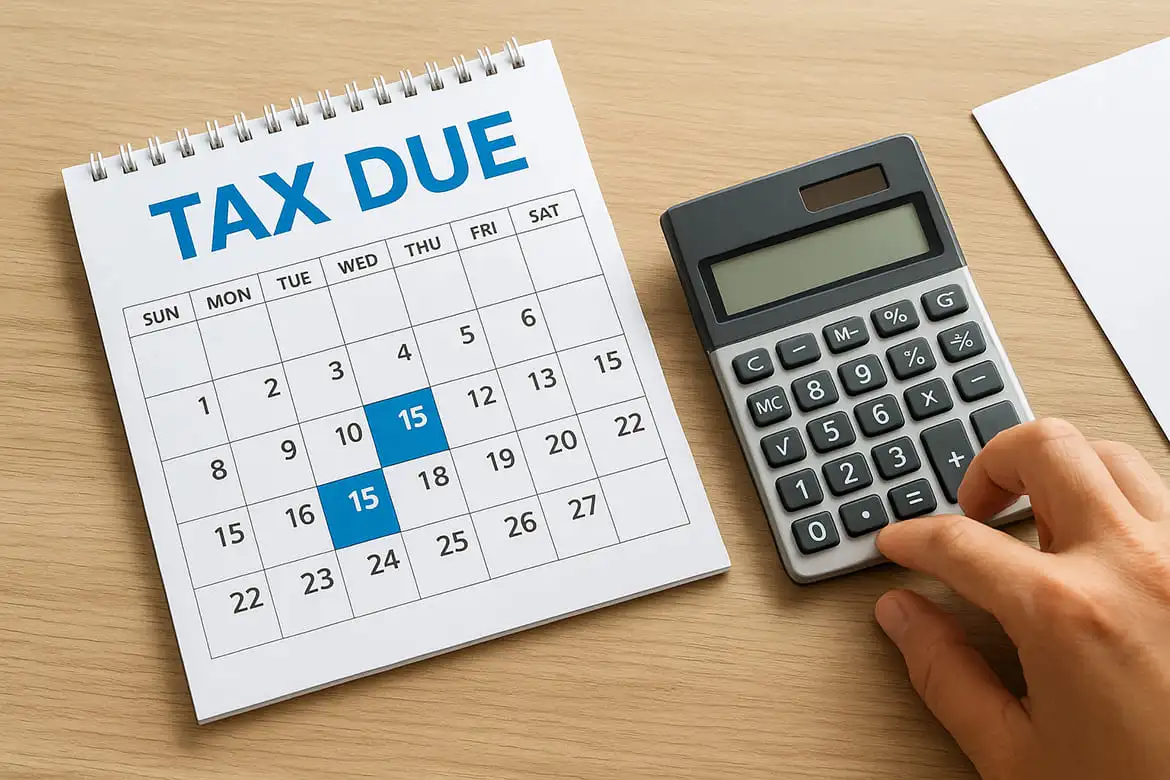
You make payments based on income received during each period, though the IRS allows you to pay the full year's estimated amount in the first quarter if you prefer. Most people spread payments across all four quarters to maintain better cash flow and account for income fluctuations throughout the year.
The four quarterly payment deadlines
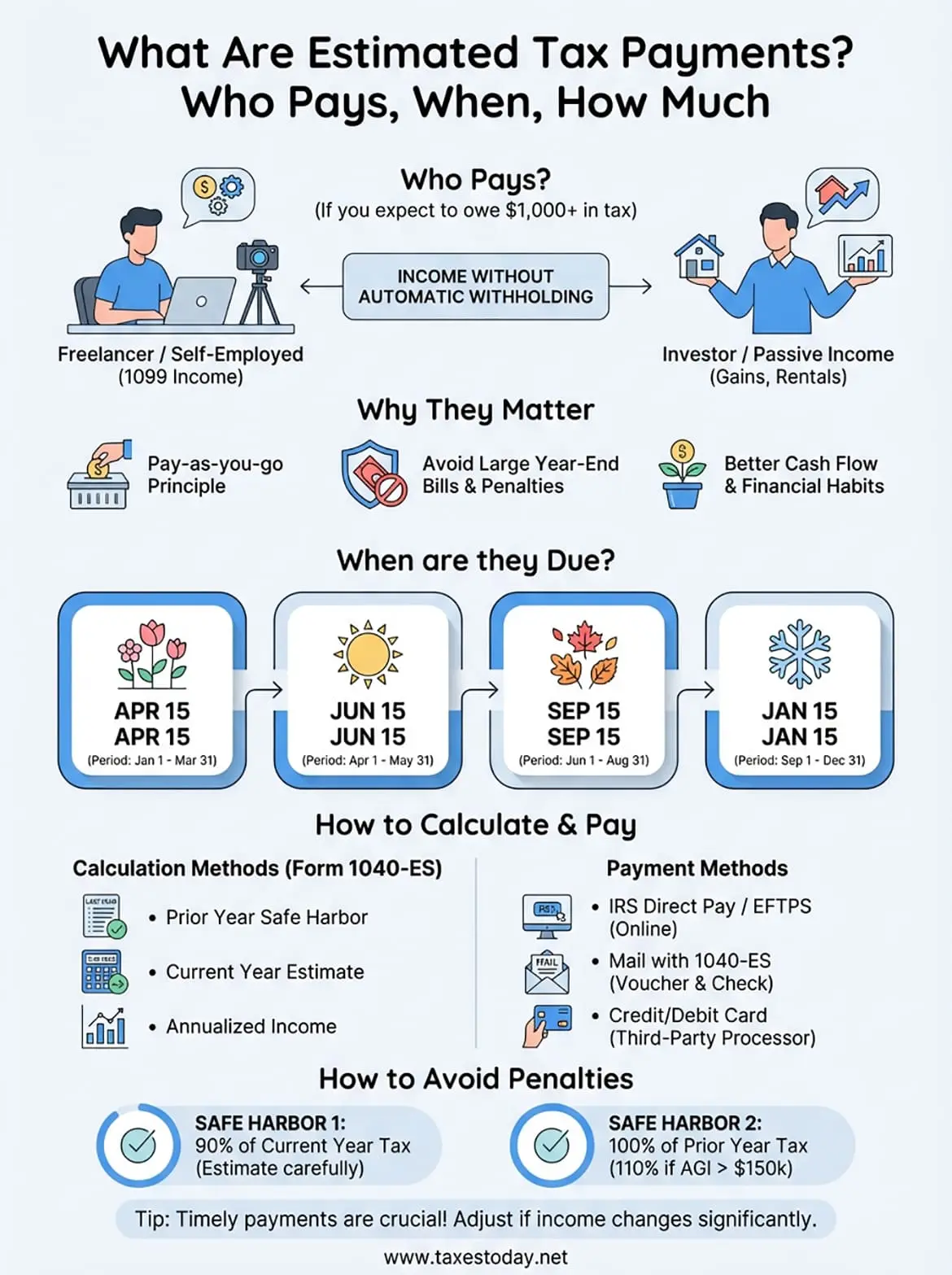
Your first payment covers income from January 1 through March 31 and is due on April 15. This deadline coincides with the tax filing deadline for the previous year, so you're often juggling both obligations simultaneously. The second payment covers April 1 through May 31 and is due June 15, giving you only two months of income to account for instead of three.
Payment three addresses income from June 1 through August 31 and is due September 15. Your final payment covers September 1 through December 31 but isn't due until January 15 of the following year. This four-month period before the final deadline gives you time to assess your full year earnings and make final adjustments.
Missing a quarterly deadline means you owe penalties from that due date forward, even if you file your annual return early and pay everything you owe.
When deadlines fall on weekends or holidays
The IRS automatically extends your deadline to the next business day when a payment date falls on a weekend or federal holiday. You don't need to request this extension or file any special forms. For example, if April 15 falls on a Saturday, your payment becomes due the following Monday unless that Monday is a holiday.
State holidays can affect deadlines in specific states, so California residents might have different effective deadlines than taxpayers in other states. Washington D.C. holidays also impact federal deadlines nationwide, as the IRS headquarters location determines federal business days. You should verify each year's specific dates since they shift annually based on the calendar.
How to estimate how much to pay each quarter
Calculating your quarterly payments requires estimating your total tax liability for the year and dividing that amount into four payments. You need to account for income tax, self-employment tax, and any other taxes you expect to owe. Understanding what are estimated tax payments means knowing you can use different methods to arrive at your quarterly amount, and choosing the right approach depends on whether your income stays consistent or fluctuates throughout the year.
The IRS provides Form 1040-ES with worksheets that walk you through the calculation process. You'll estimate your adjusted gross income, taxable income, taxes, deductions, and credits to arrive at your total estimated tax for the year. Most taxpayers then divide this amount by four to determine each quarterly payment, though you can adjust individual quarters if your income varies significantly.
The safe harbor method using prior year tax
You can base your estimated payments on your previous year's total tax liability without worrying about underpayment penalties. This method works by paying 100% of what you owed last year (or 110% if your adjusted gross income exceeded $150,000). You divide this prior year amount by four and make equal quarterly payments.
This approach provides certainty and simplicity since you already know the exact number from your filed return. You won't face penalties even if your income increases substantially, though you'll owe the difference when you file. Many taxpayers prefer this method when they expect similar or higher earnings compared to the previous year.
Using your prior year's tax as a baseline protects you from penalties regardless of how much your current year income grows.
Projecting current year income and deductions
You calculate your estimated payments based on what you expect to earn and owe this year rather than relying on historical data. This method requires projecting your business income, investment gains, deductions, and credits for the full year ahead. You then calculate the tax on this projected income and divide by four.
Your calculation needs to include both income tax and self-employment tax if applicable. Self-employment tax adds 15.3% on net earnings up to the Social Security wage base, then 2.9% on amounts above that threshold. You can deduct half of your self-employment tax when calculating income tax, which reduces your overall liability.
Adjusting payments for irregular income
You can use the annualized income installment method when your earnings vary significantly by quarter. This approach lets you pay based on actual income received during each period rather than spreading an annual estimate evenly. You'll need to complete IRS Form 2210 Schedule AI when you file your return to show you calculated payments correctly for each period.
This method prevents overpaying early in the year when you earn less and helps maintain better cash flow for seasonal businesses or those with concentrated income periods.
How to pay estimated taxes to the IRS
You have multiple payment methods available when submitting your quarterly estimated taxes, and the IRS makes the process straightforward once you understand what are estimated tax payments and how the payment system works. Choosing the right payment method depends on your comfort with technology, how quickly you need confirmation, and whether you prefer keeping paper records. Each method posts to your account within days, though electronic options provide faster confirmation and better tracking.
The IRS encourages electronic payments because they reduce processing time and minimize errors. You'll receive immediate confirmation with electronic methods, giving you proof of payment if any questions arise later. Paper checks still work but take longer to process and carry a small risk of getting lost in mail.
IRS Direct Pay and electronic options
Your fastest and easiest option is IRS Direct Pay through the IRS website, which transfers money directly from your checking or savings account at no cost. You create a payment by entering your Social Security number, tax year, and payment amount, then authorize the transfer. The system generates a confirmation number immediately, and you can schedule payments up to 365 days in advance.
Electronic Federal Tax Payment System (EFTPS) offers another free electronic option that requires advance enrollment. You receive login credentials after registering, and you can schedule payments, view payment history, and manage your account online. EFTPS appeals to taxpayers who make regular payments and want centralized tracking of all federal tax payments.
Electronic payment methods provide instant confirmation and eliminate the risk of mail delays or lost checks.
Paying by mail with Form 1040-ES
You can mail a check or money order with Form 1040-ES payment voucher to the address listed in the form instructions. Write your Social Security number, tax year, and "Form 1040-ES" on your check to ensure proper crediting. Mail payments at least one week before the deadline to account for processing time, as the IRS considers your payment timely based on the postmark date.
Each 1040-ES booklet includes four payment vouchers for the year's quarters. You tear off the appropriate voucher, complete the identifying information, and include your payment. Keep copies of everything you mail for your records.
Credit and debit card payments through approved processors
The IRS accepts credit and debit card payments through approved third-party processors, though these services charge convenience fees typically ranging from 1.85% to 1.99% of your payment amount. You access these processors through links on the IRS website, and they handle the transaction while remitting payment to the IRS on your behalf.
Card payments make sense when you want to earn rewards points or need extra time to cover your tax obligation, but the fees often outweigh any benefits unless your rewards rate exceeds the processing charge.
How to avoid underpayment penalties
You can completely avoid underpayment penalties by understanding what are estimated tax payments and meeting specific IRS safe harbor thresholds. The IRS won't charge penalties if you pay enough tax throughout the year, either through withholding, estimated payments, or a combination of both. You need to focus on meeting one of several protective thresholds rather than worrying about paying your exact tax liability down to the dollar.
The penalty system exists to encourage timely payment, but the IRS provides clear guidelines that protect you when you make a good faith effort to pay the correct amount. Your goal should be meeting at least one safe harbor rule each year to eliminate penalty risk entirely.
Meet the safe harbor thresholds
You avoid penalties automatically by paying 100% of your prior year's total tax through withholding and estimated payments (110% if your adjusted gross income exceeded $150,000). This safe harbor method gives you certainty because you already know the exact amount from your filed return. You won't face penalties even if your income doubles, though you'll owe the additional tax when you file.
Your other safe harbor option requires paying at least 90% of your current year's tax by the deadline. This threshold recognizes that estimating future income involves uncertainty and gives you a 10% cushion for miscalculations. The IRS calculates whether you met this threshold after you file your return, comparing what you paid during the year against your actual tax liability.
Meeting either safe harbor threshold eliminates underpayment penalties regardless of how much your income increased during the year.
Adjust payments when circumstances change
You should recalculate your estimated payments whenever you experience significant income changes during the year. Major contract wins, unexpected investment gains, or business growth all increase your tax obligation and require higher quarterly payments. Waiting until year end to address these changes means you've already missed earlier payment deadlines and will likely owe penalties on the underpaid quarters.
The annualized income installment method lets you pay based on actual quarterly income rather than spreading an annual estimate evenly. This approach works particularly well for seasonal businesses or income that concentrates in specific months. You complete IRS Form 2210 Schedule AI when filing to demonstrate you calculated each quarter's payment correctly based on income received during that period.
Make timely payments throughout the year
You protect yourself from penalties by submitting all four quarterly payments by their respective deadlines. Missing even one payment triggers penalties from that due date forward, calculated on the amount you should have paid. The IRS charges interest on underpayments, which compounds over time and can add hundreds of dollars to your tax bill on significant underpayment amounts.
What to do if you miss a payment or income changes
Missing a quarterly deadline or experiencing significant income changes doesn't mean you've lost control of your tax situation. You can still take corrective action to minimize penalties and get back on track with your obligations. Understanding what are estimated tax payments includes knowing how to respond when circumstances shift unexpectedly, whether through oversight, cash flow problems, or substantial changes in your earnings throughout the year.
The IRS provides flexibility for taxpayers who make good faith efforts to catch up or adjust their payment amounts based on new information. Acting quickly reduces the penalty interest that accumulates on underpaid amounts and helps you avoid a larger tax bill when you file your return.
Making catch-up payments for missed deadlines
You should submit your missed payment as soon as you realize the oversight, even if the deadline has passed. The penalty clock started running on the original due date, but making the payment now stops additional interest from accumulating on that quarter's underpayment. Your late payment won't eliminate the penalty for that period, but it prevents the situation from getting worse with each passing day.
Calculate the penalty using IRS Form 2210 when you file your annual return, or let the IRS calculate it for you and send a bill. Most taxpayers choose to let the IRS handle the calculation since the worksheet involves complex interest rate factors that change quarterly. The penalty typically amounts to a few percentage points annually on the underpaid amount, calculated from the missed due date.
Submitting a late payment immediately stops penalty interest from continuing to grow on that quarter's underpayment amount.
Adjusting future payments when income increases
Your increased income requires higher estimated payments for remaining quarters to avoid additional underpayment penalties. Recalculate your annual tax liability using your new income projection, determine how much you've already paid, and divide the remaining obligation across your future quarterly payments. This adjustment helps you meet the 90% safe harbor threshold by year end.
You can make larger payments than initially planned for upcoming quarters without penalty. The IRS accepts any amount you choose to pay, and overpaying through estimated payments simply results in a larger refund or smaller balance due when you file.
Reducing payments when income drops
Income decreases allow you to lower your remaining quarterly payments since your total tax liability will be less than originally projected. Recalculate your expected annual tax based on current earnings trends and adjust your future payments accordingly. You won't receive refunds on previous quarters where you overpaid, but that excess carries forward and applies to your final tax bill.
Document your income changes and payment adjustments carefully in case the IRS questions your calculations later. Keeping records of when and why you adjusted payments demonstrates you made reasonable estimates based on available information at each payment deadline.
Estimated tax payments for California and other states
Understanding what are estimated tax payments extends beyond your federal obligation, as most states with income taxes require their own separate estimated payments. California and other states calculate these payments independently from your federal estimates, and you must track and submit them according to each state's specific rules and deadlines. Your state estimated tax payments follow similar principles to federal payments but use different forms, rates, and sometimes different due dates.
California's estimated tax requirements
California requires estimated tax payments when you expect to owe $500 or more after subtracting withholding and credits from your total state tax liability. You calculate these payments using Form 540-ES, which follows a worksheet similar to the federal 1040-ES but applies California's progressive tax rates ranging from 1% to 13.3%. Your safe harbor threshold mirrors the federal system, requiring you to pay either 90% of your current year's California tax or 100% of your prior year's tax (110% if your adjusted gross income exceeded $150,000 or $75,000 for married filing separately).
California uses the same quarterly due dates as the IRS (April 15, June 15, September 15, and January 15), which simplifies planning when you owe both federal and state estimated taxes. You can pay online through the California Franchise Tax Board's Web Pay system, by mail with payment vouchers from Form 540-ES, or through their phone payment service. Electronic payments provide immediate confirmation and reduce processing time compared to mailed checks.
California's estimated tax rates reach up to 13.3%, making state payments a substantial obligation for high-income earners alongside federal taxes.
State-specific deadlines and variations
Different states handle estimated tax payments with varying rules that affect your payment schedule and calculation methods. New York requires quarterly payments but uses slightly different safe harbor percentages for high-income taxpayers, while states like Texas, Florida, and Washington have no state income tax and therefore no estimated payment requirement. You need to research your specific state's rules if you earn income in multiple states or move during the tax year.
Some states tie their estimated payment requirements to federal adjusted gross income, while others calculate based on state-specific taxable income definitions. States also differ in how they treat deductions, credits, and business expenses, which means your state estimated payment amount won't simply equal a percentage of your federal payment. You must calculate each obligation separately to avoid underpayment penalties at both levels.
Next steps
You now understand what are estimated tax payments, who must make them, and how to calculate and submit your quarterly obligations without triggering penalties. Your next action depends on where you stand with your current tax year. If you haven't made any payments yet, calculate your obligation immediately and submit what you owe to minimize penalty interest. If you've been making payments but aren't confident in your calculations, review your numbers now before the next deadline approaches.
Many self-employed individuals and small business owners find that professional guidance saves them money and stress when handling estimated taxes. Our team at TaxesToday has helped thousands of clients across California and nationwide navigate quarterly payments, maximize deductions, and avoid costly IRS penalties. We handle the calculations so you can focus on running your business. Get professional tax preparation help starting at $99 and eliminate the guesswork from your estimated tax obligations.