


California FTB Estimated Tax Payments: Dates, Web Pay, Forms
If you earn income that doesn't have taxes withheld, whether from freelance work, rental properties, or business profits, California expects you to pay as you go. That means making California FTB estimated tax payments throughout the year, not just settling up in April. Miss a deadline or underpay, and you could face penalties that add up fast.
The good news? Once you understand the payment schedule, forms, and online options, staying compliant becomes straightforward. You'll need to know the quarterly due dates, how to calculate what you owe, and the easiest ways to submit payments, whether through Web Pay or Form 540-ES.
At TaxesToday, we help California freelancers, small business owners, and self-employed individuals navigate estimated taxes every day. This guide walks you through everything you need to file correctly and avoid costly mistakes, from calculating your quarterly amounts to setting up payments through the FTB's online system.
What California FTB estimated payments cover
California FTB estimated tax payments apply to income that doesn't have withholding deducted throughout the year. When you receive a W-2 paycheck, your employer withholds taxes automatically. But when you earn money from self-employment, rental properties, investment gains, or business income, you need to calculate and submit payments yourself. The state requires these quarterly installments to mirror the withholding system employees use, keeping tax revenue flowing throughout the year instead of all at once.
Income types that require estimated payments
You must make estimated payments if you receive 1099-NEC income from clients, operate as an independent contractor, or run a sole proprietorship filing Schedule C. Rental income from California properties triggers the requirement, even if you live elsewhere. Capital gains from stock sales, dividend payments, and interest income beyond what's withheld also count. Business owners with S-corporation or partnership distributions that lack sufficient withholding fall into this category. The Franchise Tax Board doesn't distinguish between full-time business operations and side income; both require estimated payments when withholding doesn't cover your liability.
Tax components included in your quarterly installments
Each estimated payment covers both your regular income tax and any alternative minimum tax (AMT) you expect to owe. The payments also include California's mental health services tax if your income exceeds $1 million. You calculate these amounts based on your projected annual income, applying California's progressive tax brackets to determine what you'll owe. Unlike federal estimated taxes, California doesn't require you to include self-employment tax in these payments because the state doesn't impose its own version of Social Security or Medicare taxes.
California estimated payments address state income tax only, which means you'll handle federal quarterly payments separately through the IRS.
Your payment calculation should account for any credits you plan to claim, such as the dependent exemption credit or the renters' credit. Subtract these from your projected tax liability before dividing into quarterly amounts. Withholding from other income sources also reduces what you need to pay through estimates. If you have a part-time W-2 job alongside your freelance work, factor in those withheld amounts when determining your quarterly obligations.
State versus federal estimated tax obligations
California FTB estimated tax payments function independently from federal estimated taxes. You file separate forms, follow different payment schedules, and submit payments to different agencies. The federal system uses Form 1040-ES and routes payments to the IRS, while California uses Form 540-ES and directs payments to the Franchise Tax Board. Your California tax rate differs from your federal rate because each system applies its own brackets and rules.
Many taxpayers confuse the two systems or assume one payment covers both. You need to calculate and submit payments to each agency separately based on their individual requirements. California's top marginal rate reaches 13.3% for high earners, while federal rates top out at 37%, creating different payment amounts even when your income stays constant. The FTB doesn't coordinate with the IRS on estimated payments, so missing one doesn't automatically trigger issues with the other, though both agencies will assess penalties independently if you underpay.
Step 1. Check if you must pay quarterly
You need to determine whether California law requires you to make estimated tax payments before you calculate amounts or set up a schedule. The Franchise Tax Board bases this requirement on how much tax you expect to owe and how much withholding you'll have by the end of the year. Most self-employed individuals and business owners must pay quarterly, but specific thresholds and exceptions can eliminate this obligation.
The basic threshold test
California requires estimated payments when you expect to owe $500 or more in tax after subtracting your withholding and credits. Calculate your projected annual California tax liability using your expected income and deductions. Subtract any tax you expect your employer to withhold from W-2 wages. Subtract any credits you plan to claim. If the remaining balance reaches $500 or more, you must make california ftb estimated tax payments.
Part-year residents and nonresidents use the same $500 threshold, but they calculate it based only on California-source income. You might earn $100,000 total but only $30,000 from California sources, which changes your calculation entirely. The FTB doesn't prorate the threshold based on how many months you lived in California.
Situations that exempt you from quarterly payments
You skip estimated payments if your total tax liability stays under $500 after accounting for withholding and credits. Retirees with pension withholding often fall below this threshold. California also waives the requirement if you had no tax liability in the prior year, you were a California resident for the full 12 months, and your prior year covered a full 12-month period.
If you had zero tax liability last year and remained a resident all year, you don't need to make estimated payments this year, regardless of your expected income.
Increase your W-2 withholding instead of making quarterly payments if you prefer one consolidated approach. You can submit a new Form DE-4 to your employer requesting additional withholding from each paycheck. This method satisfies your payment obligation without tracking quarterly deadlines, though it requires enough W-2 income to withhold from.
Quick exemption checklist
Check these conditions to verify whether you must pay:
- Expected tax after withholding and credits exceeds $500
- Prior year had tax liability (or you weren't a full-year resident)
- Current year withholding won't cover at least 90% of your liability
- You don't qualify for any special exemptions (farmers, fishermen)
If all four apply, you need to make quarterly payments.
Step 2. Find your required annual payment
You need to calculate your total annual payment requirement before dividing it into quarterly installments. The FTB offers two safe harbor methods that protect you from penalties: paying 90% of your current year's tax or paying 100% of your prior year's tax. Both methods work, but choosing the right one depends on whether your income is increasing, decreasing, or staying relatively flat.
Calculate using prior year's tax method
Take your total tax liability from line 61 of your 2025 Form 540 and use that exact amount as your required payment for 2026. This method works best when your income is growing because it locks in last year's lower tax amount. You won't face penalties even if your actual 2026 tax ends up much higher, as long as you pay at least 100% of what you owed in 2025.
High-income earners ($150,000 or more for single filers, $75,000 for married filing separately) must pay 110% of their prior year's tax instead of 100%. The FTB bases this threshold on your adjusted gross income from the previous year. If you earned $160,000 in 2025 and owed $8,000 in state tax, your required 2026 payment would be $8,800 ($8,000 × 110%).
Using the prior year method eliminates calculation guesswork because you're working with a known number from your filed return.
Calculate using current year's projected income
Estimate your total 2026 California income from all sources, including self-employment, rentals, investments, and W-2 wages. Subtract your standard or itemized deductions. Apply California's tax brackets to determine your projected tax liability. Multiply that liability by 90% to find your required annual payment. This approach saves money when your income is dropping compared to last year.
Suppose you project $85,000 in taxable income for 2026. After applying deductions and California's tax brackets, your estimated liability comes to $5,200. Your required california ftb estimated tax payments for the year would be $4,680 ($5,200 × 90%).
Choose the safe harbor that works best
Compare both calculations and select the lower amount to minimize your quarterly payments while staying compliant. If your prior year tax was $6,000 but your projected current year payment is $4,680, you can safely pay the smaller amount. You'll settle any difference when you file your annual return. Track your actual income monthly to verify your projection stays accurate, adjusting future quarters if your earnings shift significantly.
Step 3. Use the right dates and installment split
California divides your required annual payment into four quarterly installments, each with a specific due date and percentage. You cannot simply divide your total by four because the FTB assigns different payment weights to each quarter. Missing a deadline or using the wrong percentage triggers penalties, even if your total annual payment ends up correct.
California's quarterly payment dates
Your first quarterly payment comes due on April 15, 2026, covering the period from January 1 through March 31. The second payment follows on June 16, 2026 (since June 15 falls on a Sunday), covering April 1 through May 31. Your third installment comes due September 15, 2026, addressing June 1 through August 31. The final payment arrives January 15, 2027, covering September 1 through December 31 of the prior year.
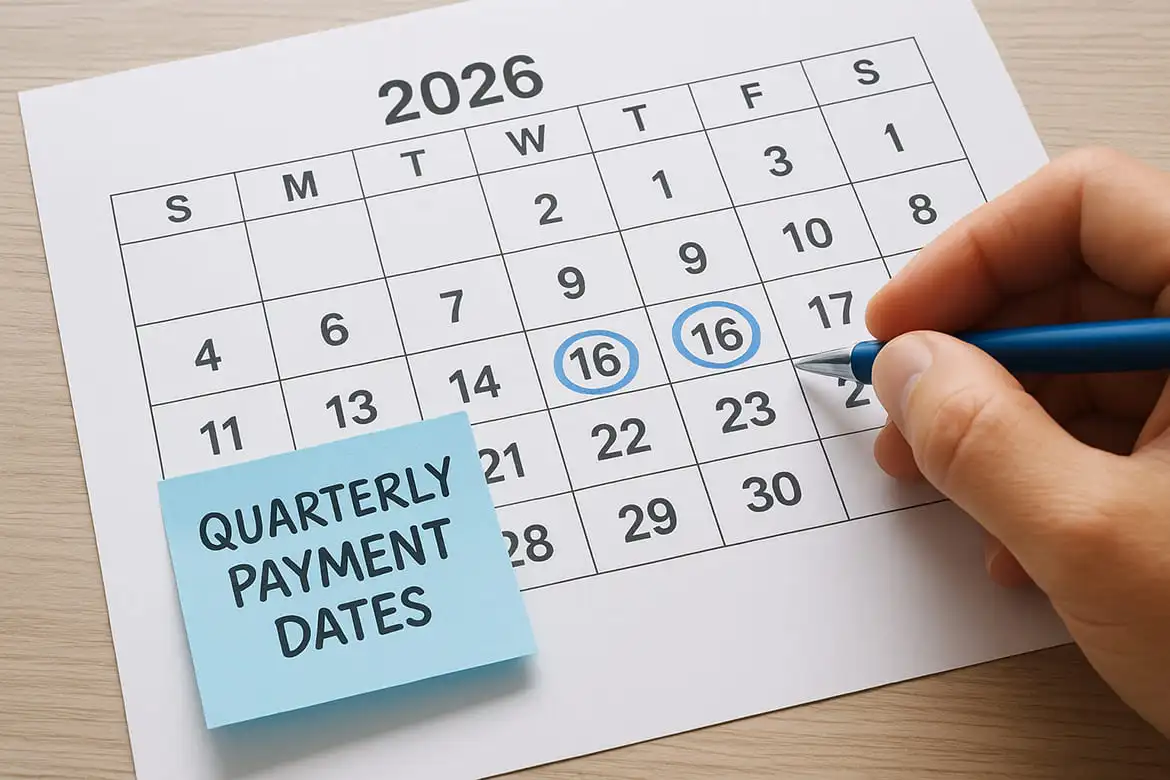
Weekend and holiday rules push deadlines to the next business day when a due date falls on Saturday, Sunday, or a legal holiday. The FTB considers the payment timely if you submit it by midnight Pacific Time on the adjusted deadline. You can make payments earlier than the deadline without any issue, though paying late triggers immediate penalty calculations.
Payment deadlines apply to when the FTB receives your payment, not when you initiate it, so allow processing time for checks and electronic transfers.
Required percentage for each installment
California requires 30% of your total annual payment for the first quarter due in April. The second quarter requires another 40% of your annual amount due in June. Your third installment drops to zero percent because California waives the September payment if you file your annual return and pay any remaining balance by January 31. The fourth quarter requires the final 30% of your total due in January.
If you calculated a $12,000 required annual payment, your installments would break down as follows:
| Due Date | Period Covered | Percentage | Payment Amount |
|---|---|---|---|
| April 15, 2026 | Jan 1 - Mar 31 | 30% | $3,600 |
| June 16, 2026 | Apr 1 - May 31 | 40% | $4,800 |
| September 15, 2026 | Jun 1 - Aug 31 | 0%* | $0 |
| January 15, 2027 | Sep 1 - Dec 31 | 30% | $3,600 |
*Waived if you file and pay by January 31, 2027
Track these california ftb estimated tax payments separately from your federal obligations because the IRS uses equal 25% quarterly installments instead of California's weighted approach.
Step 4. Pay and schedule payments with FTB Web Pay
The Franchise Tax Board's online payment system gives you the fastest and most reliable method to submit your quarterly installments. You can make one-time payments or set up automatic recurring payments that eliminate deadline stress. Web Pay processes your payment immediately and sends you a confirmation, removing any uncertainty about whether your submission arrived on time.
Web Pay lets you schedule payments up to a year in advance, ensuring you never miss a deadline even during busy periods.
Create your MyFTB account
You need a MyFTB account before you can access Web Pay for california ftb estimated tax payments. Visit ftb.ca.gov and click "Login" in the top right corner, then select "Register for MyFTB." The system asks for your Social Security number, date of birth, California driver's license or ID number, and your filing status. After you verify your identity, create a username and password. The entire setup takes less than five minutes, and you can start making payments immediately after registration.
Submit a one-time payment
Log into your MyFTB account and select "Make a Payment" from the main menu. Choose "Estimated Tax" as your payment type and enter the tax year you're paying for. Input your payment amount based on the quarterly installment you calculated earlier. Select your payment date, which can be today or any future date up to 365 days ahead. Enter your bank account and routing numbers for electronic withdrawal. Review all details before clicking submit, because you cannot cancel electronic payments once processed.
The FTB accepts payments from checking accounts, savings accounts, and money market accounts. Credit card and debit card payments are not available for estimated taxes through Web Pay.
Set up recurring quarterly payments
Click "Manage Payments" after logging into MyFTB, then select "Set Up Recurring Payments." Enter your total annual estimated tax amount, and the system automatically calculates each quarterly installment using California's 30%-40%-0%-30% split. Choose your payment start date and confirm your bank account details. The system schedules all four payments at once, withdrawing the correct amount on each deadline. You receive email confirmations before each withdrawal, and you can modify or cancel future payments anytime through your account dashboard.

Step 5. Fix missed payments and avoid penalties
Missing a quarterly deadline doesn't exempt you from your tax obligation, and the FTB calculates penalties from the original due date until you pay. You need to submit your late payment immediately and understand how penalties compound, because waiting only increases what you owe. The Franchise Tax Board charges both underpayment penalties and interest on missed california ftb estimated tax payments, and these amounts accrue daily until you settle your balance.
Calculate your penalty amount
The FTB assesses a penalty based on the interest rate in effect during the period you missed, which changes quarterly. Your penalty equals your unpaid amount multiplied by the applicable interest rate, calculated from the due date through your actual payment date. For example, if you owed $1,500 on June 16, 2026, but didn't pay until September 15, 2026, you'd owe the $1,500 plus penalty interest for those three months.
You can estimate your penalty using the FTB's penalty calculator on their website, though the system calculates your exact amount automatically when you file your annual return. Each missed payment compounds separately, so missing multiple quarters creates multiple penalty calculations that add up quickly.
Submit your late payment through Web Pay
Log into your MyFTB account and select "Make a Payment" just like a regular estimated payment. Choose the tax year and enter the original installment amount you should have paid. The system accepts late payments without requiring special forms or explanations. You'll receive confirmation immediately, and the FTB applies your payment to reduce future penalty calculations.
Paying late is always better than not paying at all, because penalties and interest continue accumulating until you submit the full amount.
Request penalty relief for reasonable cause
File Form FTB 2916 to request penalty abatement if you missed a payment due to circumstances beyond your control. The FTB considers serious illness, natural disasters, death in the family, or incorrect written advice from tax professionals as reasonable cause. Attach documentation supporting your claim, such as medical records or disaster declarations. Submit the form after you file your annual return and receive your penalty assessment. The FTB reviews each request individually, and approval eliminates or reduces your penalty while interest charges remain.

Your next move
You now have the complete framework for handling california ftb estimated tax payments correctly. Calculate your required annual amount using either the prior year or current year method, whichever gives you the lower safe harbor. Schedule your quarterly payments through FTB Web Pay to avoid missing deadlines and triggering penalties that compound daily. Set up recurring payments if you want to eliminate the manual tracking entirely and guarantee on-time submissions.
Track your actual income monthly and adjust your remaining quarterly payments if your earnings shift significantly from your original projection. File Form 540-ES if you prefer mailing paper vouchers instead of using the online system, though electronic payments process faster and provide instant confirmation. Keep confirmation records for every payment you submit, whether electronic or by check, because the FTB uses these as proof if questions arise later.
If calculating estimates feels overwhelming or you're unsure about deductions that could lower your quarterly amounts, professional tax preparation services can handle the entire process for you. We calculate your requirements, set up your payment schedule, and ensure you claim every deduction you're entitled to without risking compliance issues.