


Estimated State Tax Payments California: Dates & How To Pay
If you're self-employed, a freelancer, or earn income that doesn't have taxes withheld, California expects you to pay as you go. That means making estimated state tax payments California requires throughout the year, not just settling up in April. Miss a deadline or underpay, and the Franchise Tax Board (FTB) will tack on penalties and interest that eat into your hard-earned money.
The good news? Once you understand the rules, staying compliant is straightforward. You'll need to know whether you meet the $500 threshold that triggers the requirement, when each quarterly payment is due, and exactly how to submit your payments to the FTB. This guide covers all of it, calculation methods, 2026 payment deadlines, and step-by-step instructions for paying online.
At TaxesToday, we help California freelancers, independent contractors, and small business owners navigate these requirements every day. Whether you need help calculating your estimated taxes or want a professional to handle the entire process, our CTEC-certified tax preparers have you covered. Let's break down everything you need to know about making your California estimated tax payments on time and accurately.
Who needs to make CA estimated tax payments
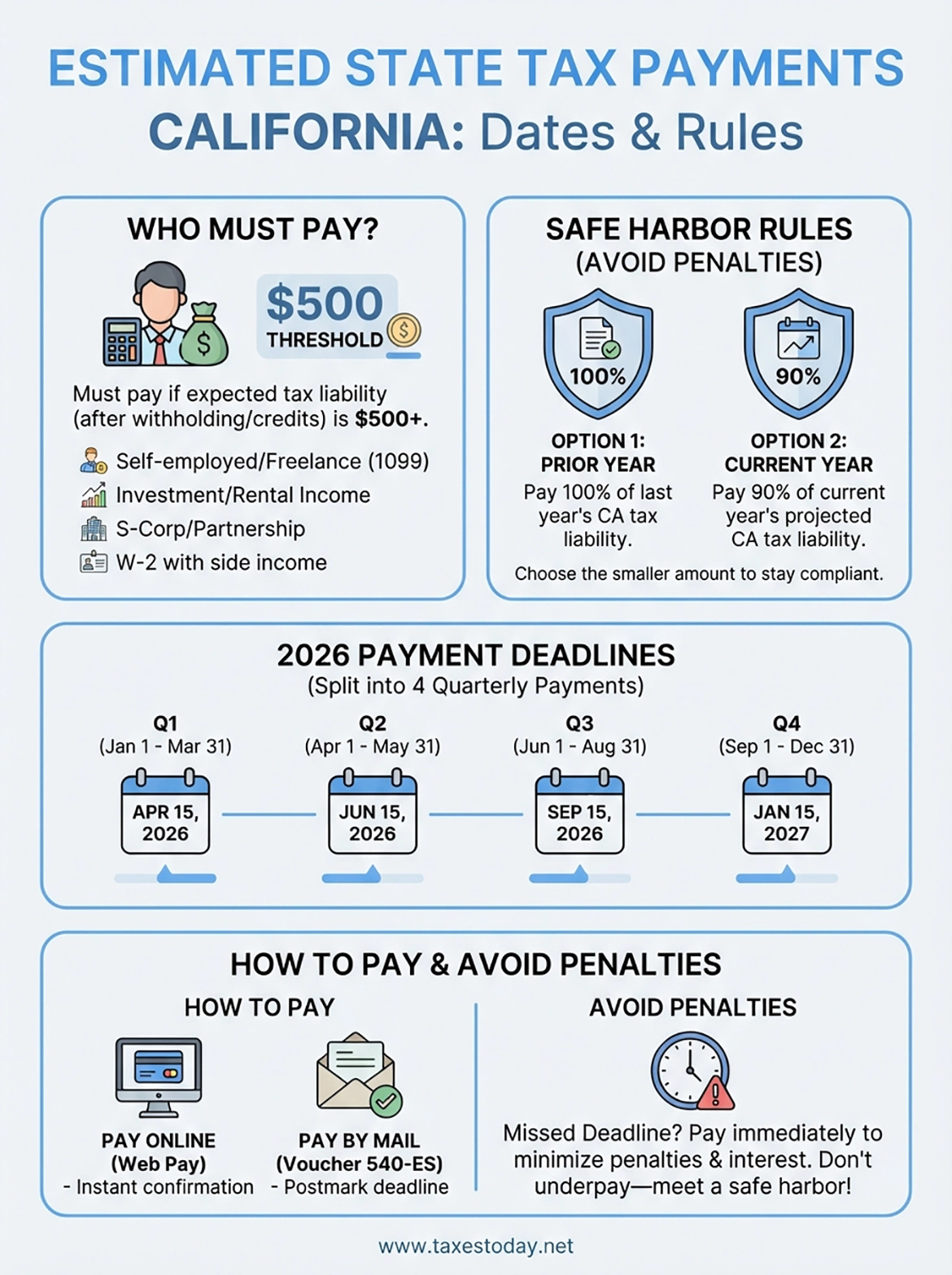
You must make estimated state tax payments California requires if you expect to owe at least $500 in state income tax after subtracting withholding and credits. This rule applies whether you're a freelancer, independent contractor, small business owner, or even a W-2 employee with substantial side income. The California Franchise Tax Board doesn't wait until April to collect, they want quarterly installments throughout the year when your income isn't subject to regular withholding.
The $500 minimum threshold explained
California uses a straightforward calculation to determine if you owe estimated payments. Take your expected total state tax liability for the year, subtract any withholding from W-2 jobs or other sources, and subtract any refundable tax credits you qualify for. If the result is $500 or more, you're on the hook for quarterly payments. For example, if you calculate your 2026 California tax will be $3,200 and you had $2,500 withheld from a part-time W-2 job, you owe $700, which exceeds the threshold.
The $500 rule protects taxpayers with minimal additional income from unnecessary paperwork. Someone earning $8,000 from freelance work alongside their regular job might only owe $300 in additional state tax, which falls below the threshold and eliminates the quarterly payment requirement.
If your total California tax liability minus withholding and credits equals $500 or more, you must make quarterly estimated payments.
Types of income that trigger estimated payments
Self-employment income is the most common reason for estimated payments. If you're a freelancer, independent contractor, gig worker, or sole proprietor, you receive 1099-NEC or 1099-K forms with no taxes withheld. Your clients pay you the full amount, leaving you responsible for both federal and state taxes through quarterly payments.
Investment income also triggers the requirement. Capital gains from selling stocks, rental property income, substantial dividend payments, and interest income all come without withholding. Even if you have a W-2 job with proper withholding, these additional income sources push you over the $500 threshold quickly.
Business owners with S-corporation or partnership income face this requirement regularly. These pass-through entities don't withhold California taxes on your K-1 distributions, so you handle the tax obligation through estimated payments. The same applies to landlords with rental properties, retirees taking large IRA distributions without withholding, and anyone with substantial income from sources beyond traditional employment.
Special situations and exceptions
You can skip estimated payments even if you owe more than $500 by using voluntary withholding. Some taxpayers increase their W-2 withholding at their day job to cover self-employment income, avoiding the quarterly payment system entirely. You can also request withholding from pension distributions, unemployment benefits, or Social Security payments to satisfy your obligation.
First-year California residents might owe estimated payments depending on when they moved to the state. If you relocated mid-year, calculate your California tax based only on income earned while living in the state. New residents often discover they owe estimated payments for the portion of the year they lived in California, particularly if they arrived with existing self-employment or investment income.
Part-year residents who move out of California during the year follow similar rules. Calculate your obligation based on income earned while you were a California resident, and make estimated payments if you meet the $500 threshold for that period.
Step 1. Estimate your California tax for the year
Your first task is calculating how much California income tax you'll owe for 2026. This involves projecting your total income, subtracting deductions, and applying California's tax rates to determine your liability. The more accurate your estimate, the less likely you'll face penalties or a large tax bill in April. Start by gathering your financial records from the current year, including income statements, business receipts, and previous tax returns.
Calculate your expected taxable income
Begin with your gross income from all sources. Add up projected earnings from self-employment, freelance work, rental properties, investment gains, and any W-2 wages. For example, if you expect $60,000 in freelance income, $15,000 from rental properties, and $8,000 in capital gains, your gross income totals $83,000. Don't forget irregular income sources like royalties, alimony, or side gigs.
Subtract your California standard deduction or itemized deductions to reach your taxable income. For 2026, the California standard deduction is $5,363 for single filers and $10,726 for married couples filing jointly. Using the example above, a single filer with $83,000 in gross income would subtract $5,363, resulting in $77,637 in taxable income.
Accurate income projection requires reviewing your current year-to-date earnings and adjusting for expected changes in the remaining months.
Apply California tax rates to your income
California uses progressive tax brackets that range from 1% to 13.3% depending on your income level. Your taxable income gets split across multiple brackets, with each portion taxed at its corresponding rate. For a single filer with $77,637 in taxable income, the calculation works like this:
- First $10,412: taxed at 1% = $104.12
- Next $14,268 ($10,413 to $24,684): taxed at 2% = $285.36
- Next $14,267 ($24,685 to $38,959): taxed at 4% = $570.68
- Next $15,969 ($38,960 to $54,081): taxed at 6% = $958.14
- Remaining $23,556 ($54,082 to $77,637): taxed at 8% = $1,884.48
Total California tax liability: $3,802.78 for the year. This represents your baseline before considering withholding, credits, or the $500 threshold for estimated state tax payments california requires. If you have W-2 withholding or tax credits, subtract those amounts to determine what you'll pay quarterly.
Step 2. Use safe harbor rules to avoid penalties
California offers two safe harbor methods that protect you from underpayment penalties even if you ultimately owe more tax than you paid quarterly. These rules give you a predictable target to hit throughout the year, removing the guesswork from estimated state tax payments california requires. The FTB won't charge penalties as long as you meet either safe harbor threshold, regardless of how much you actually owe when you file your return in April.
The 100% of prior year tax method
You can avoid penalties by paying 100% of your previous year's California tax liability through estimated payments and withholding. Look at your 2025 California tax return to find your total tax liability (the number on Form 540, line 63). If that amount was $4,200, you need to pay at least $4,200 in 2026 through quarterly estimated payments, W-2 withholding, or a combination of both.
This method works best when your income stays relatively stable or decreases from the previous year. For example, if you earned $85,000 in 2025 and expect similar or lower income in 2026, using last year's tax liability provides a clear target. Even if your 2026 income jumps to $95,000 and you owe $5,100 in taxes, you won't face penalties because you met the prior year safe harbor requirement.
Meeting 100% of your prior year's California tax liability protects you from underpayment penalties, even if your current year income increases significantly.
The 90% of current year tax method
Your second option is paying at least 90% of your actual 2026 California tax liability through estimated payments and withholding. Calculate your expected 2026 tax using the method in Step 1, then multiply by 0.90. If you project owing $5,200 in California taxes for 2026, you must pay at least $4,680 ($5,200 x 0.90) to avoid penalties.
This approach makes sense when your income drops substantially from the previous year. Suppose you earned $95,000 in 2025 with a $5,800 tax liability, but expect only $60,000 in 2026 with projected taxes of $3,400. Using the 90% method requires paying just $3,060 ($3,400 x 0.90) instead of $5,800, freeing up cash flow during a lean year.
Choosing the right safe harbor strategy
Compare both methods each year to determine which requires lower quarterly payments. Calculate 100% of your 2025 tax liability and 90% of your projected 2026 tax, then use whichever number is smaller. You're not locked into one method, you can switch strategies annually based on your income fluctuations and financial situation.
Step 3. Follow California due dates and payment splits
California divides your annual tax obligation into four quarterly payments throughout the year. These deadlines don't align with traditional calendar quarters, and missing even one payment triggers penalties and interest from the FTB. You must pay each installment by the deadline, regardless of whether you've calculated your exact liability yet. The dates remain consistent year after year, making it easier to build them into your financial planning routine.
California's 2026 estimated payment deadlines
Your estimated state tax payments california requires must reach the FTB by four specific dates in 2026. Each payment covers income earned during a particular period, though the periods aren't equal in length. Mark these dates on your calendar and set reminders at least one week in advance to avoid missing deadlines.

| Payment Period | Income Period Covered | Due Date |
|---|---|---|
| 1st Quarter | January 1 - March 31 | April 15, 2026 |
| 2nd Quarter | April 1 - May 31 | June 15, 2026 |
| 3rd Quarter | June 1 - August 31 | September 15, 2026 |
| 4th Quarter | September 1 - December 31 | January 15, 2027 |
The second quarter only covers two months instead of three, while the fourth quarter deadline falls in January of the following year. These irregularities catch many taxpayers off guard, particularly the June 15 deadline that arrives just two months after the April payment.
California's quarterly payment schedule differs from federal deadlines for the second quarter, so don't assume you can pay both on the same date.
How to split your annual tax into quarterly payments
Divide your total estimated California tax liability by four to calculate each quarterly payment amount. If you determined in Step 1 that you'll owe $4,800 in California taxes for 2026, each quarterly payment equals $1,200 ($4,800 ÷ 4). Send $1,200 to the FTB by each of the four deadlines listed above.
You can adjust your payment amounts if your income fluctuates throughout the year. California allows you to pay more in quarters when you earn more and less when income drops, as long as you meet one of the safe harbor thresholds by year-end. This flexibility helps freelancers and seasonal business owners match payments to their actual cash flow.
Step 4. Pay the California FTB online or by mail
The California Franchise Tax Board gives you two straightforward options for submitting your quarterly estimated payments. You can pay electronically through their Web Pay system or mail a check with the appropriate payment voucher. Electronic payment offers instant confirmation and eliminates the risk of lost mail, but paper checks work fine if you prefer traditional methods. Choose whichever approach fits your financial workflow, just make sure your payment reaches the FTB by the deadline to avoid penalties.
Pay online through Web Pay for instant confirmation
The FTB's Web Pay portal lets you submit estimated state tax payments california requires directly from your bank account without creating an account or logging in. Navigate to the FTB website and select "Web Pay for Individuals" from the payments section. Choose "Estimated Tax Payment" as your payment type, enter your Social Security number, and specify the tax year and quarter you're paying for.

You'll enter your bank routing number and account number to authorize an electronic funds transfer from your checking or savings account. The system processes your payment immediately and provides a confirmation number you should save for your records. Web Pay accepts payments 24 hours a day, seven days a week, though you must initiate the transaction by 11:59 PM Pacific Time on the due date to meet the deadline.
Electronic payments through Web Pay post immediately to your FTB account and provide instant confirmation, eliminating uncertainty about whether your payment arrived on time.
Mail your payment with voucher 540-ES
Download and print Form 540-ES from the FTB website if you prefer mailing a check. This form includes four payment vouchers, one for each quarter. Fill out the voucher corresponding to the payment period, including your Social Security number, name, address, and payment amount. Write your SSN and "2026 Form 540-ES" on your check or money order.
Mail your payment to: Franchise Tax Board, PO Box 942867, Sacramento, CA 94267-0008. The FTB considers your payment on time if the postmark date falls on or before the quarterly deadline. Use certified mail with tracking if you want proof of delivery, particularly for large payments or if you're cutting it close to the deadline.
Step 5. Fix missed payments and avoid common mistakes
Missing a quarterly deadline doesn't mean you're stuck with penalties forever. You can minimize the damage by acting quickly and understanding how the FTB calculates underpayment interest. The longer you wait, the more penalties accumulate, so your best move is submitting the missed payment immediately after you realize the error. California charges both penalty fees and interest on late payments, but you can reduce the total amount by catching up as soon as possible.
What to do when you miss a quarterly deadline
Submit your late payment through Web Pay immediately, even if the deadline has passed by days or weeks. The FTB applies penalties and interest from the original due date, so each day you delay adds to your bill. For example, if you missed the June 15 deadline and realize it on July 10, submit that quarter's payment right away to stop additional penalties from accruing.
Calculate your penalty using the FTB's underpayment rate, which the state sets annually based on the federal short-term rate plus 3%. As of 2026, the rate stands at 8% annually, prorated daily for the period your payment was late. A $1,200 payment that's 30 days late incurs roughly $7.89 in interest ($1,200 x 0.08 ÷ 365 x 30).
Submit missed estimated state tax payments california requires immediately to minimize penalty charges, then adjust your remaining quarterly payments to stay on track for the year.
Continue making your remaining quarterly payments on schedule. If you missed your June payment and it's now July, you still need to submit your September 15 payment on time. Don't let one missed deadline derail your entire year of payments.
Common mistakes that trigger penalties
Underpaying each quarter ranks as the most frequent error. You must meet one of the safe harbor thresholds (100% of prior year tax or 90% of current year tax) to avoid penalties. Paying $900 per quarter when you owe $1,200 leaves you short and triggers underpayment penalties, even if you file on time in April.
Taxpayers frequently confuse California's June 15 deadline with the federal June 15 date or assume it's June 30. Mark California's specific dates on your calendar separately from federal deadlines to avoid this mistake. Another common error involves forgetting to adjust payments when income increases mid-year. Recalculate your quarterly amounts if you land a major project or client to ensure you're paying enough to meet safe harbor requirements.
Keep your payments on track
Managing estimated state tax payments california requires throughout the year gets easier once you establish a routine. Set calendar reminders two weeks before each quarterly deadline (April 15, June 15, September 15, and January 15) to review your income and calculate your payment. Save confirmation numbers from Web Pay or copies of your mailed vouchers in a dedicated tax folder. Track your payments in a spreadsheet or accounting software to monitor whether you're meeting your safe harbor target.
Professional help eliminates costly mistakes and missed deadlines. At TaxesToday, our CTEC-certified tax preparers calculate your estimated payments, track deadlines, and ensure you meet California's safe harbor requirements. We serve self-employed individuals, freelancers, and small business owners across California with affordable tax preparation services starting at $99. Contact us to schedule your tax preparation and simplify your quarterly payment process.