


What Is A Tax Extension? How It Works, IRS Forms, Deadlines
Tax Day is approaching, but your documents aren't ready, or life simply got in the way. If you're wondering what is a tax extension, you're not alone. Millions of taxpayers request extra time each year, and understanding how this option works can save you from unnecessary stress and IRS penalties. A tax extension gives you six additional months to submit your return, pushing your deadline from April to October.
Here's what catches many people off guard: an extension to file is not an extension to pay. Any taxes you owe are still due by the original April deadline, and missing that can trigger interest and late-payment fees. Knowing the difference between these two concepts is essential before you file for extra time.
In this guide, we'll break down exactly how tax extensions work, which IRS forms you need (including Form 4868), and how to avoid common mistakes. At TaxesToday, we help clients across California and nationwide file extensions correctly and stay compliant, so you can take the time you need without the worry.
Why a tax extension matters
You might think requesting a tax extension signals trouble or raises red flags with the IRS, but that's not how it works. Filing for extra time is a legitimate tool that millions of taxpayers use every year, and it carries no negative consequences when done correctly. The IRS doesn't flag your return or scrutinize it more closely simply because you needed additional months to prepare. What matters most is that you file your extension before the April deadline and pay any estimated taxes you owe.
Understanding what is a tax extension and why it matters can protect you from financial penalties and give you the breathing room to file an accurate return. Many situations justify requesting extra time, from missing forms to complex financial changes, and the IRS built this option into the system for exactly these reasons.
Protection from failure-to-file penalties
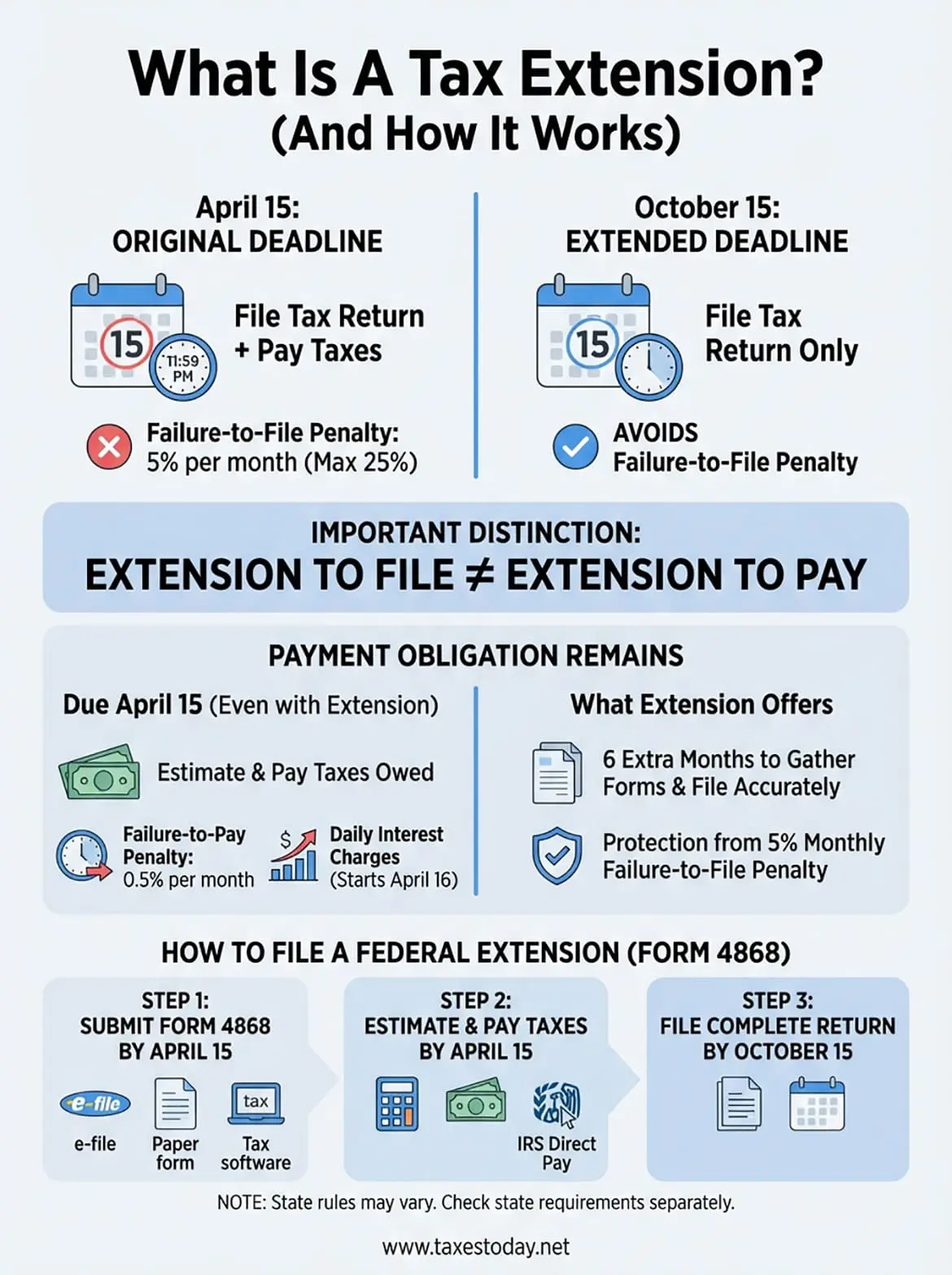
The failure-to-file penalty costs you 5% of your unpaid taxes for each month your return is late, up to a maximum of 25%. This penalty starts accruing immediately after the April deadline passes if you haven't submitted your return or filed an extension. By contrast, the failure-to-pay penalty is only 0.5% per month, making late filing ten times more expensive than late payment.
Filing an extension eliminates the failure-to-file penalty entirely, even if you can't pay your full tax bill by April. Your extension gives you until October to submit your return without facing that steep 5% monthly charge. You'll still owe interest and the smaller failure-to-pay penalty on any unpaid balance, but you avoid the much larger hit that comes from not filing at all.
Filing your extension before the April deadline protects you from the most expensive IRS penalty, even if you can't pay your taxes in full.
Time to gather accurate documentation
Tax preparation requires dozens of forms, and they don't all arrive at the same time. Your W-2s and 1099s typically come in January, but K-1s from partnerships or S-corporations often don't arrive until March or even early April. If you have investments, rental properties, or business income, waiting for these late-arriving documents is common and completely valid.
Rushing to file without complete information leads to errors, which then require you to file an amended return using Form 1040-X. Amendments take the IRS months to process, and they can delay your refund or create complications if you made mathematical mistakes. An extension gives you time to verify every number, double-check your calculations, and ensure all documentation is present before you submit.
Avoiding rushed mistakes that trigger audits
Filing under pressure increases your chance of making errors that catch IRS attention. You might miss important deductions, claim credits you don't qualify for, or enter income amounts that don't match what employers and financial institutions reported. These mismatches trigger automated IRS systems that flag your return for review or audit.
Taking extra time to prepare your taxes carefully reduces these risks significantly. You can review your return multiple times, cross-reference all forms against your personal records, and catch discrepancies before the IRS does. Professional tax preparers also have more availability later in the year, giving you better access to expert help when you extend your deadline.
Your financial situation matters more than your filing speed. Extensions exist to help you submit an accurate, complete return rather than a hasty one that creates problems later. The six additional months you gain can make the difference between a smooth filing experience and months of correspondence with the IRS trying to fix preventable mistakes.
What a tax extension does and does not do
Confusion about what is a tax extension often stems from the misleading name itself. The extension applies only to your filing deadline, not your payment deadline. This distinction trips up countless taxpayers who assume that extra time to file means extra time to pay. The IRS separates these two obligations completely, and understanding this difference prevents costly mistakes that can drain your bank account through penalties and interest charges.
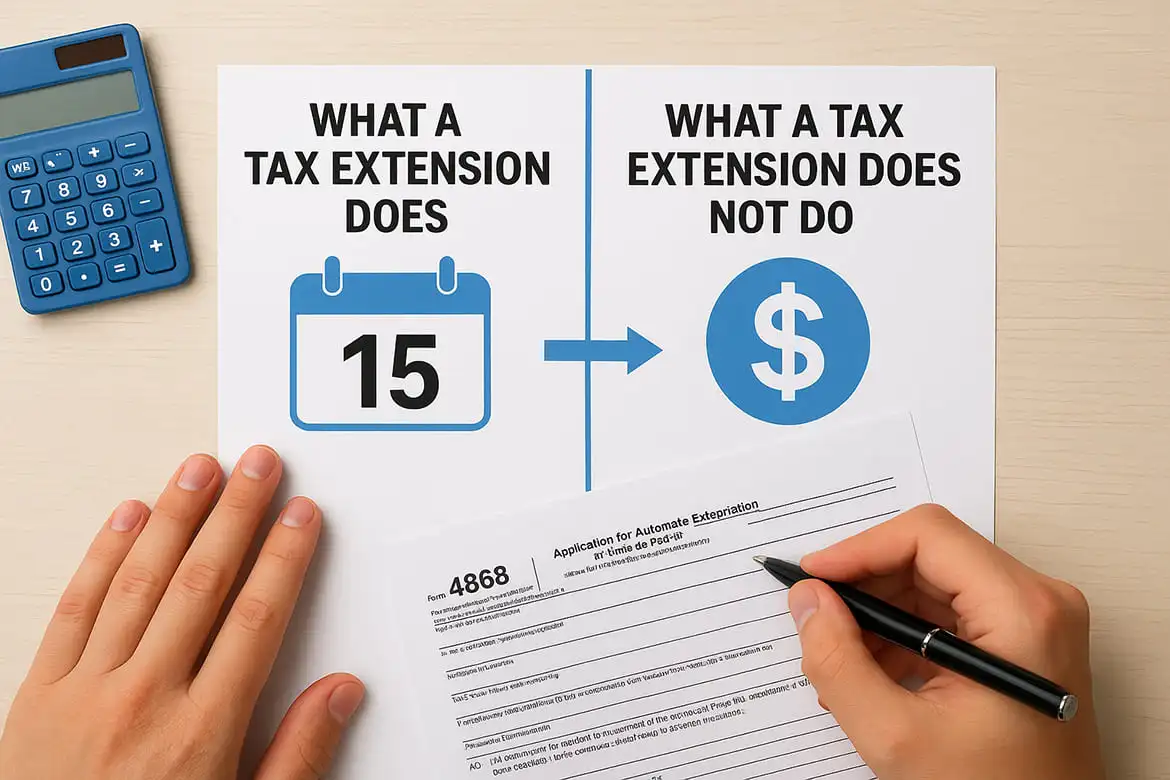
What an extension gives you
Filing Form 4868 moves your tax return deadline from April 15 to October 15, giving you six additional months to prepare and submit your paperwork. This extra time lets you gather missing documents, work with a tax preparer when they're less busy, or handle complex situations like overseas income or business losses without rushing. Your extension applies to both your federal return and any required schedules, including Schedule C for self-employment income or Schedule D for capital gains.
The extension also eliminates your failure-to-file penalty as long as you submit Form 4868 before the April deadline. This penalty costs 5% of your unpaid taxes per month, making it the most expensive IRS penalty you can face. By filing your extension on time, you protect yourself from this charge even if you end up owing thousands in taxes and can't pay immediately.
An extension gives you more time to file your return accurately, but your tax payment is still due by the original April deadline.
What an extension does not cover
Your tax payment deadline stays fixed at April 15 regardless of your extension. If you owe taxes and don't pay by this date, the IRS charges you 0.5% of your unpaid balance each month plus daily compound interest on the full amount. These charges start accumulating the day after the April deadline passes, and they continue growing until you pay your balance in full.
Extensions also don't protect you from accuracy-related penalties if the IRS finds substantial errors on your return. Filing in October instead of April won't shield you from penalties for negligence, substantial understatement of income, or claiming credits you don't qualify for. The extension simply gives you more time to prepare your return correctly, but it doesn't excuse mistakes or reduce the consequences of filing inaccurate information.
Payment plan requests require separate action from your extension filing. You need to contact the IRS directly or submit Form 9465 to set up an installment agreement for taxes you can't pay by April. The extension and payment plan are two distinct processes, and filing one doesn't automatically trigger or approve the other.
Federal deadlines and extension dates for 2026
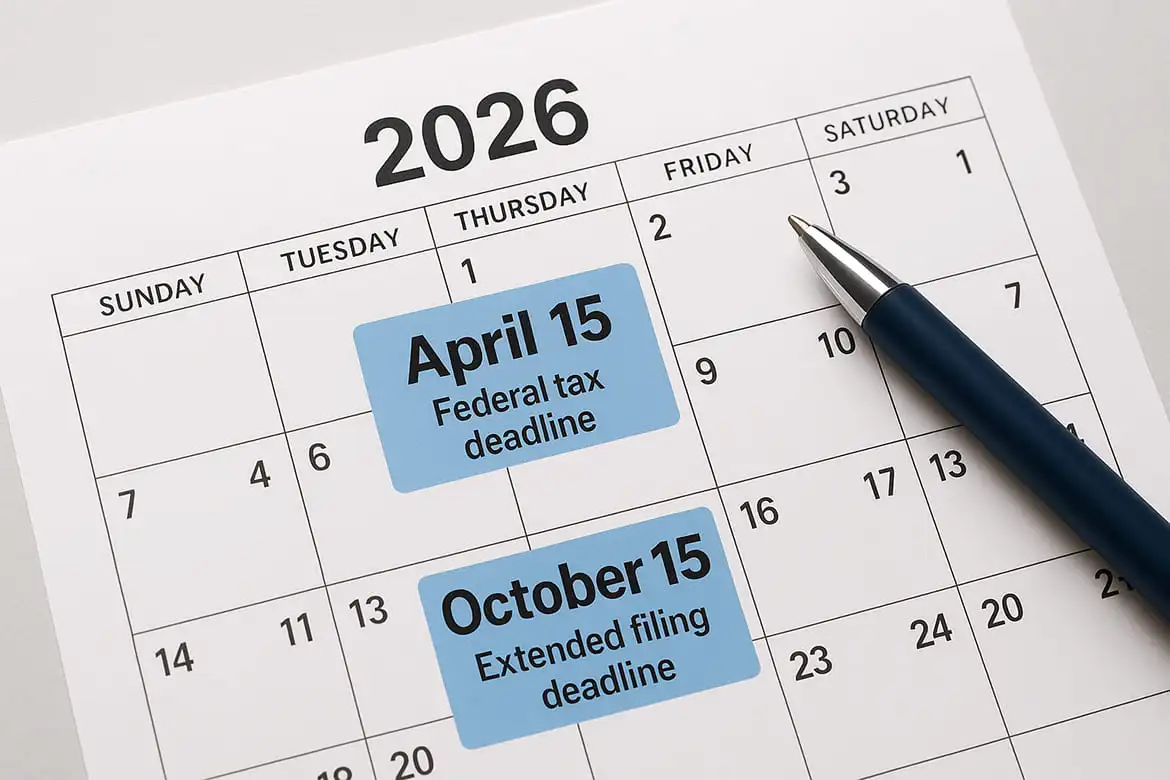
Your tax calendar for 2026 follows the standard IRS schedule, with specific dates you need to mark immediately. The April 15, 2026 deadline applies to both filing your return and paying any taxes you owe, while the extension pushes your filing deadline to October 15, 2026. These dates stay fixed unless April 15 falls on a weekend or federal holiday, which doesn't happen in 2026. Understanding what is a tax extension means knowing exactly when each deadline hits and what you must complete by each date.
Your standard filing deadline
April 15, 2026 is the date your tax return and full payment are due if you file without requesting an extension. This deadline applies to your 2025 tax year (January 1 through December 31, 2025), and you must postmark or electronically submit your return by 11:59 PM in your time zone on that date. The IRS counts electronic submissions based on the timestamp their system receives, not when you clicked submit, so don't wait until the last minute.
You face immediate penalties starting April 16, 2026 if you miss this deadline without filing an extension. The failure-to-file penalty begins accruing at 5% per month, while the failure-to-pay penalty charges 0.5% monthly on your unpaid balance. Both penalties continue accumulating until you file your return or reach the maximum penalty caps.
Your extended filing deadline
Filing Form 4868 by April 15, 2026 automatically moves your filing deadline to October 15, 2026. This six-month extension gives you until that date to submit your complete tax return without facing failure-to-file penalties. You don't need IRS approval after submitting your extension request, and the extension applies automatically once you file the form correctly.
Filing your extension by April 15, 2026 gives you until October 15, 2026 to submit your return, but your payment deadline stays at April 15.
October 15 represents your absolute final deadline for filing your 2025 tax return. The IRS grants no further extensions beyond this date except in specific disaster situations. If you miss the October deadline, you immediately face the full failure-to-file penalty backdated to April 16, and the IRS may file a substitute return on your behalf using incomplete information.
Special circumstances affecting your dates
Taxpayers living or serving outside the United States automatically receive a two-month extension to June 15, 2026 without filing Form 4868. This extra time applies if you live abroad or serve in the military overseas on the April deadline. You can still request the standard six-month extension on top of this automatic extension, giving you until December 15, 2026 to file.
Federal disaster declarations change deadlines for affected taxpayers in designated areas. The IRS typically grants automatic extensions lasting several months for anyone living in a federally declared disaster zone, and these extensions apply to both filing and payment deadlines without requiring you to submit any forms.
How to file a federal tax extension
Filing your federal tax extension takes minutes once you know which method works best for your situation. The IRS offers three simple ways to submit Form 4868, and all three automatically grant you the full six-month extension. You don't wait for approval or receive a confirmation letter because the extension applies immediately when you file correctly. Understanding what is a tax extension includes knowing how to actually request one, and the process requires far less effort than most taxpayers expect.

You need to complete your extension request before 11:59 PM on April 15, 2026 in your time zone. Missing this deadline by even one minute means you lose the protection from failure-to-file penalties, and the IRS offers no grace period. Choosing the right filing method depends on whether you plan to make a payment with your extension and how quickly you want confirmation that your request went through.
Three methods to submit Form 4868
Your first option is electronic filing through IRS Free File, which gives you instant confirmation and costs nothing. The IRS partners with tax software companies to offer free extension filing for all taxpayers regardless of income. You log into the Free File portal, enter your basic information, and receive immediate verification that your extension is complete.
Your second option involves filing through tax software like TurboTax or H&R Block if you already use these programs for your tax preparation. Most tax software includes extension filing as a built-in feature, and the program automatically generates and submits Form 4868 for you. This method works well when you want to make a payment simultaneously because the software calculates your estimated tax and processes your payment in one transaction.
Your third option is mailing a paper Form 4868 to the IRS processing center for your state. You download the form from IRS.gov, fill it out by hand or on your computer, and send it to the address listed in the form instructions. Paper filing takes longer and provides no instant confirmation, but it works when you don't have internet access or prefer traditional mail. You must postmark your envelope by April 15 for your extension to count as timely.
Electronic filing gives you instant confirmation that your extension request succeeded, while paper filing requires you to trust the mail system and IRS processing times.
What information you need ready
You need your Social Security number (or ITIN), your spouse's number if you file jointly, and your current address. The form also asks for your estimated total tax liability for the year and any payments you already made through withholding or estimated tax payments. You calculate these numbers using your income information from the year, even if you don't have all your final tax documents yet.
Your extension request requires your reasonable estimate of what you'll owe when you file your complete return. The IRS doesn't penalize you for getting this estimate wrong as long as you made a genuine effort to calculate it accurately. Most taxpayers look at their prior year's tax return and adjust for any major income changes to arrive at a solid estimate.
How to estimate and pay what you owe by April
Understanding what is a tax extension means recognizing that you must still pay your estimated taxes by April 15 even when you file Form 4868. The IRS expects you to calculate what you owe based on your income and deductions, then submit payment by the original deadline to avoid interest charges and penalties. Your extension gives you extra time to prepare your return paperwork, but it doesn't postpone your financial obligation to settle your tax bill.
Most taxpayers struggle with this calculation because they don't have all their documents finalized by April. You don't need perfect accuracy, but you must make a reasonable good-faith estimate using the information available. The IRS understands estimates involve some guesswork, and they won't penalize you for honest calculation errors as long as you pay at least 90% of your actual tax liability by the deadline.
Calculate your estimated tax liability
You start by adding up all your income from every source for the tax year, including wages, self-employment earnings, investment income, rental property profits, and retirement distributions. Look at your last pay stub to see year-to-date withholding, check your 1099 forms for contractor payments, and review any other documentation showing money you received. This gives you your gross income starting point.
Next, you subtract your standard deduction or itemized deductions to arrive at your taxable income. The standard deduction for 2025 is $14,600 for single filers and $29,200 for married couples filing jointly. You then apply the tax rates to this amount, subtract any credits you qualify for, and compare the result to what you already paid through withholding or estimated payments. The difference is what you owe by April 15.
Your payment obligation doesn't disappear just because you filed an extension, and waiting until October to pay creates expensive interest charges on your unpaid balance.
Choose your payment method
The IRS accepts payments through IRS Direct Pay, which pulls money directly from your checking or savings account at no cost. You visit the IRS website, enter your bank information, specify that you're making an extension payment, and receive immediate confirmation. This method processes within minutes and gives you a confirmation number you should save.
Credit and debit card payments work through third-party processors that charge convenience fees ranging from 1.85% to 1.99% of your payment amount. You can also mail a check with Form 4868, though this leaves no instant confirmation trail and risks getting lost in the mail system.
Track your payment confirmation
Save every confirmation number, receipt, and bank statement showing your April payment. The IRS processes millions of transactions during tax season, and occasionally payments get misapplied or lost in their system. Your documentation proves you paid on time if the IRS later claims they never received your money.
Understand penalties and interest when you extend
Filing an extension protects you from the failure-to-file penalty, but it does nothing to stop the failure-to-pay penalty or interest charges if you owe taxes. Many taxpayers assume that requesting extra time shields them from all financial consequences, but the IRS continues charging you for unpaid balances starting April 16. Understanding what is a tax extension means knowing exactly how much these charges cost and how they accumulate over the six months until you file your return.
Your total cost depends on how much you owe and how long you wait to pay it. The IRS applies both a monthly penalty and daily compound interest to your unpaid balance, and these charges add up faster than most people expect. Waiting until October to pay your tax bill can increase your total obligation by several hundred dollars or more depending on your balance.
Failure-to-pay penalty calculation
The IRS charges 0.5% of your unpaid tax balance each month you remain behind on payment. This penalty starts on April 16 and continues until you pay in full or reach the maximum penalty cap of 25% of your original tax debt. If you owe $5,000 and wait until October to pay, you face six months of penalties totaling $150 (0.5% × $5,000 × 6 months).
Partial payments reduce your penalty because the IRS calculates the charge based on your remaining unpaid balance each month. Paying $2,500 in April cuts your monthly penalty in half for the remaining months. The penalty continues accumulating on whatever amount you still owe, making early partial payments valuable even when you can't pay everything at once.
Interest charges on unpaid balances
Interest accrues daily on your total unpaid balance at the federal short-term rate plus 3%, which the IRS adjusts quarterly. As of January 2026, the rate sits at 8% annually, translating to roughly $1.10 per day on a $5,000 balance. Unlike the penalty, interest compounds, meaning you pay interest on your growing interest balance as time passes.
Interest charges continue building every single day until you pay your balance in full, and the IRS offers no way to reduce or waive these charges.
Combined penalty and interest costs
Your total cost combines both the monthly penalty and daily interest, creating a compounding effect that grows your debt steadily. On a $5,000 tax bill left unpaid from April to October, you face approximately $150 in failure-to-pay penalties plus $240 in interest charges, adding $390 to your original debt. Larger balances see proportionally bigger increases, with a $20,000 debt adding roughly $1,560 in combined charges over the same six-month period.
Payment plans don't stop these charges either. The IRS continues adding penalty and interest even after you set up an installment agreement, though they may reduce your failure-to-pay penalty rate to 0.25% per month once your payment plan is active.
Know who gets extra time automatically
Certain taxpayers receive automatic filing extensions without submitting Form 4868, and these extensions often provide more time than the standard six-month period. The IRS recognizes that specific circumstances make meeting the April deadline impossible or unreasonable, so they built automatic extensions into the tax code for qualified individuals. You still need to understand your obligations and deadlines even when you qualify for automatic extra time, because these extensions work differently than requesting a standard extension.
U.S. citizens and residents living abroad
You automatically receive two extra months to file and pay your taxes if you live and work outside the United States on the April 15 deadline. This automatic extension moves your deadline to June 15, 2026 for both filing your return and paying any taxes owed. Unlike the standard extension, this extra time applies to your payment obligation as well, meaning you avoid failure-to-pay penalties and interest charges until mid-June.
Your automatic extension requires you to attach a statement to your tax return explaining why you qualified for the extra time. You must demonstrate that your tax home (main place of business) was located outside the U.S. and Puerto Rico, and that you were physically present abroad on the April deadline. This extension applies whether you work for a foreign employer, run your own business overseas, or simply live abroad without working.
Living abroad on Tax Day automatically gives you until June 15 to file and pay without requesting an extension, but you can still file Form 4868 for even more time until October 15.
You can stack a standard six-month extension on top of your automatic two-month extension by filing Form 4868 before June 15. This combination pushes your filing deadline all the way to December 15, 2026, giving you ten total months instead of six. Your payment deadline stays at June 15 regardless of any additional extension you file.
Military personnel in combat zones
Service members deployed to combat zones or qualified hazardous duty areas receive automatic extensions that last the entire length of their deployment plus 180 days after they leave the combat zone. This extension applies to filing your return, paying your taxes, and taking most other tax-related actions. The deadline suspension starts the day you enter the combat zone and continues until six months after you depart.
Your extension covers both active duty military and support personnel serving in these designated areas. The IRS publishes a list of qualifying combat zones, which includes areas like Afghanistan, Jordan, Kosovo, and other locations where U.S. forces face hostile action. You don't file any forms to claim this extension because your military service records automatically document your eligibility.
Disaster victims in federally declared areas
Federal disaster declarations trigger automatic extensions for anyone living or working in the affected area, and these extensions typically last several months beyond the standard April deadline. The IRS announces the specific deadline extensions for each disaster through their website and news releases. You don't request these extensions because they apply automatically based on your address in IRS records.
Handle state tax extensions the right way
Understanding what is a tax extension becomes more complicated when you add state taxes to the equation because each state follows different rules for extensions. Your federal Form 4868 doesn't automatically extend your state filing deadline in most cases, and assuming it does can leave you facing state penalties and interest charges. You need to check your specific state's requirements separately from your federal extension, and in many cases you'll need to file a completely separate state extension form to protect yourself from state-level penalties.

States fall into three categories when handling extensions: those that automatically honor your federal extension, those requiring their own extension forms, and states with no income tax at all. Knowing which category your state belongs to determines whether you need to take additional action beyond filing Form 4868 with the IRS.
States that follow the federal extension automatically
Roughly 30 states automatically grant you an extension when you file federal Form 4868, meaning you don't submit any additional paperwork to your state tax agency. These states include California, New York, Texas (no income tax), Florida (no income tax), Illinois, Pennsylvania, Ohio, Georgia, North Carolina, and Michigan among others. Your federal extension filing satisfies both your federal and state extension requirements simultaneously.
You still need to verify your state's specific policy because some states in this category require you to make an estimated state tax payment by the April deadline even though they honor your federal extension. California, for example, accepts your federal extension automatically but expects you to pay any estimated state taxes you owe by April 15 to avoid penalty and interest charges.
States requiring separate extension forms
About 10 states require you to file a separate state extension form regardless of your federal extension status. These states include Delaware, Louisiana, New Hampshire, North Dakota, Oklahoma, Oregon, Rhode Island, South Carolina, Virginia, and West Virginia. You must submit the state-specific extension form by your state's deadline, which usually matches the federal April 15 date but not always.
Filing your federal extension doesn't automatically protect you from state penalties, and missing your state extension deadline can cost you hundreds in unnecessary charges.
Payment obligations for state taxes
Your state tax payment deadline typically stays at April 15 regardless of any extension you file, mirroring the federal payment rule. States charge their own penalty and interest rates on unpaid balances, and these rates often differ significantly from federal rates. Some states impose higher penalties than the IRS, while others charge less.
Calculate your estimated state tax liability separately from your federal taxes because deductions and credits differ between state and federal returns. You pay your state taxes directly to your state revenue department using their designated payment methods, which might include online portals, mailed checks, or credit card processors different from those the IRS uses.
What to do after you file an extension
Filing your extension marks the beginning of your extended tax preparation period, not the end of your responsibilities. You have six months until October 15 to complete your return, but this time passes quickly if you don't stay organized. Many taxpayers file their extension and then ignore their taxes until September, creating the same last-minute rush they tried to avoid in April. Understanding what is a tax extension includes knowing how to use those extra months productively while protecting yourself from mistakes that can cost you money.
Your actions between April and October determine whether your extension helps or hurts your financial situation. You need to keep specific documents safe, continue gathering tax information as it arrives, and monitor any payments or IRS correspondence related to your account. Taking these steps prevents confusion when you finally sit down to prepare your return and ensures you don't miss important deadlines or requirements.
Keep your extension confirmation safe
You must save your Form 4868 confirmation number and any related receipts in a secure location where you can find them months later. This confirmation proves you filed your extension on time if the IRS later claims they have no record of it. Print a copy of your confirmation email if you filed electronically, or keep a photocopy of your mailed form with the certified mail receipt if you filed by mail.
Store this documentation with your 2025 tax records in a dedicated folder or digital file. You'll need to reference your extension when you file your actual return because some tax software asks whether you filed an extension and what date you submitted it. Having this information readily available speeds up your October filing process and prevents errors on your return.
Your extension confirmation is your proof that you requested extra time legitimately, and losing it can create headaches if the IRS questions your filing timeline.
Continue organizing your tax documents
Keep collecting all tax-related documents as they arrive between April and October. W-2s and 1099s typically arrive by early February, but amended forms, K-1s from partnerships, and year-end investment statements can show up throughout the spring and summer. Create a system where you immediately file each document in your tax folder rather than letting them pile up on your desk or in your email inbox.
Review each document when it arrives to check for accuracy and completeness. Look for your name, Social Security number, and income amounts to ensure they match your records. Catching errors early gives you time to request corrections from the issuer before October rather than discovering problems during your final tax preparation rush.
Monitor your payment status and balance
Log into your IRS online account periodically to verify that your April payment posted correctly and check your current balance. The IRS updates these accounts regularly, showing any payments you made, penalties or interest that accrued, and estimated payments credited to your account. This monitoring helps you catch processing errors while you still have time to fix them.
Calculate whether you need to make additional estimated tax payments during the extension period. If you're self-employed or have significant income not subject to withholding, you might owe quarterly estimated payments in June and September. Missing these payments creates additional penalties that your extension doesn't protect you from.
Next steps
You now understand what is a tax extension really means and how to use it correctly. The six-month extension gives you breathing room to file accurately, but remember your payment deadline stays at April 15 regardless. File Form 4868 before the deadline, estimate and pay what you owe, and keep your confirmation documentation safe throughout the extension period.
Your extension protects you from failure-to-file penalties while giving you time to gather complete documentation and avoid costly mistakes. Track your state requirements separately, monitor any payments you make, and stay organized between April and October so you don't create another last-minute scramble when your extended deadline arrives.
Need help filing your extension or preparing your return? TaxesToday helps California residents and clients nationwide file extensions correctly and maximize deductions on their returns. Our licensed tax preparers handle everything from simple W-2 returns to complex self-employment and business taxes, ensuring you stay compliant and avoid unnecessary penalties.