



16 Deductible Expenses for LLC Owners (2026 Checklist)
Every dollar you spend running your LLC either works for you at tax time, or it doesn't. The difference usually comes down to whether you know which deductible expenses for LLC owners actually qualify as write-offs. Miss one, and you're handing money to the IRS that you didn't owe. Claim one incorrectly, and you're inviting an audit. Either way, the stakes are real, and they add up fast.
The IRS allows LLC owners to deduct ordinary and necessary business expenses from their taxable income. That sounds simple enough, but the details matter. Some deductions are straightforward, office rent, business insurance, software subscriptions. Others, like the home office deduction or vehicle expenses, come with specific rules and limitations that trip up even experienced business owners. Knowing what qualifies (and what doesn't) is the difference between a solid return and a costly mistake. At TaxesToday, our CTEC-certified preparers work with LLC owners across California and nationwide, and we see these errors every filing season.
Below, you'll find 16 tax-deductible expenses that LLC owners should review before filing their 2026 returns. Each one includes what the IRS expects, how to claim it correctly, and practical notes based on real filing scenarios. Whether you're a single-member LLC filing a Schedule C or an S-Corp election filer, this checklist will help you capture every deduction you're entitled to, without crossing any lines.
1. Tax preparation and accounting fees
Paying someone to handle your taxes is itself a deductible expense. Tax preparation and accounting fees are among the most commonly overlooked deductible expenses for LLC owners, even though they directly reduce your taxable income dollar for dollar. If you paid a tax professional, bookkeeper, or accountant to manage your business finances in 2025, that cost almost certainly belongs on your return.
What qualifies as a deduction
The IRS allows LLCs to deduct fees paid for tax preparation and accounting services that are directly tied to your business. This includes what you pay a CPA or enrolled agent to prepare your Schedule C or business return, fees for bookkeeping support, payroll service charges, and accounting consultations related to your business operations. Fees paid strictly for personal tax preparation on the same return do not qualify and need to be separated before you claim anything.
Personal tax preparation costs are no longer deductible for individuals under the 2017 Tax Cuts and Jobs Act, but business-related fees remain fully deductible.
How to calculate the deduction
Your deduction equals the total amount you paid for qualifying business tax and accounting services during the tax year. If your accountant prepares both your personal and business returns under a single invoice, ask for an itemized breakdown so you can deduct only the business portion accurately. There is no dollar cap on this deduction, so the full qualifying amount reduces your net profit directly.
What you need to document
Keep every invoice and payment receipt from your tax preparer, accountant, or bookkeeper. Each record should clearly show the service provider's name, the service date, the amount paid, and a description of the work performed. Bank or credit card statements help confirm payments but are not sufficient on their own if the IRS requests supporting details.
Your documentation should include:
- Invoices from your CPA, enrolled agent, or tax preparer
- Receipts or bank statements confirming payment
- Engagement letters or service agreements that describe the scope of work
Common mistakes to avoid
The most frequent error is deducting the full invoice amount when it includes both personal and business tax preparation. Only the business portion qualifies, so if your preparer does not break it out automatically, ask them to. A second mistake is forgetting mid-year fees for bookkeeping or payroll services and only thinking about the year-end tax bill. Track every accounting-related payment throughout the year so nothing gets missed when you file.
2. Startup and LLC formation costs
Starting an LLC comes with real upfront costs, and many of them qualify as deductible expenses for LLC owners. The IRS gives you a specific window to recover these costs, but the rules limit how much you can deduct in year one, so understanding the mechanics before you file is worth your time.

What qualifies as a deduction
The IRS allows you to deduct startup costs and organizational costs under IRC Sections 195 and 248. Startup costs include market research, pre-opening advertising, and fees paid to advisors during your planning phase. Organizational costs cover state filing fees, attorney fees to draft your operating agreement, and other expenses directly tied to forming the LLC itself.
The IRS treats startup costs and organizational costs as two separate categories, and each carries its own $5,000 first-year deduction limit.
How to calculate the deduction
You can deduct up to $5,000 in startup costs and up to $5,000 in organizational costs in your first active year of business, as long as each category totals less than $50,000. Any amount over that threshold must be amortized over 180 months, starting from the month your business opened.
What you need to document
Keep records that show when each expense occurred and how it connects directly to forming or launching your LLC. This includes attorney invoices, state filing confirmations, receipts for market research, and any consultant agreements signed before you opened for business.
Common mistakes to avoid
A frequent error is deducting formation costs in the wrong tax year. These expenses must be claimed starting in the year your business becomes active, not the year you paid them if the business had not yet opened. Missing that distinction can trigger corrections or penalties.
3. Rent and lease payments
If your LLC rents office space, a retail location, a warehouse, or any other facility used for business, those payments count as deductible expenses for LLC owners. Rent is one of the cleaner deductions available, but it still requires proper documentation and a clear business purpose to hold up if the IRS asks questions.
What qualifies as a deduction
You can deduct rent or lease payments for any property your LLC uses exclusively for business. This includes commercial office space, retail storefronts, storage units, and equipment leases. If you sublet space or rent a facility only part-time for business use, only the business-use portion qualifies.
You cannot deduct rent you pay on property that you own, even partially. The IRS requires an arm's-length rental arrangement for the deduction to apply.
How to calculate the deduction
Your deduction equals the total rent paid during the tax year for qualifying business property. If you lease equipment like copiers or company vehicles, those payments are included in the same category. For mixed-use properties where only part of the space serves your business, calculate the percentage of business use based on square footage and apply that percentage to total rent paid.
What you need to document
Keep every signed lease agreement and all monthly payment records. Bank statements or canceled checks showing each payment work well as backup. Your records should clearly tie each payment to a specific business address or piece of equipment.
Common mistakes to avoid
One common error is deducting a full lease payment when the property serves both personal and business purposes without calculating the proper split. Another is missing equipment lease payments entirely because they don't look like traditional rent. Both are deductible when used for your business.
4. Home office deduction
The home office deduction ranks among the most valuable deductible expenses for LLC owners who work from home, but it also triggers more IRS scrutiny than most write-offs. The IRS sets a clear bar for who qualifies, and meeting it means following the rules precisely.

What qualifies as a deduction
Your home office qualifies only if you use a specific area of your home regularly and exclusively for business. That means a dedicated room or clearly defined workspace, not a kitchen table you also use for meals. The space must be your principal place of business or where you meet clients regularly.
The "exclusive use" rule is strict. A room with a guest bed, even if you work there daily, does not qualify.
How to calculate the deduction
The IRS offers two methods. The simplified method gives you $5 per square foot of your home office, up to 300 square feet, capping the deduction at $1,500. The regular method requires you to calculate the percentage of your home used for business and apply that percentage to actual home expenses like mortgage interest, rent, utilities, and insurance.
What you need to document
Keep a floor plan or measurements showing your office dimensions alongside your home's total square footage. If you use the regular method, save all home expense receipts for the year, including:
- Mortgage interest or rent statements
- Utility bills
- Homeowner's or renter's insurance invoices
Common mistakes to avoid
The biggest mistake is claiming a shared space. If the room serves any personal purpose, the deduction fails. Many LLC owners also skip this deduction entirely out of fear of an audit, leaving real money on the table.
5. Utilities, internet, and phone
Utility costs are legitimate deductible expenses for LLC owners, but how much you can deduct depends on whether you operate from a dedicated business location or work from home. Getting the numbers right requires a clear separation between personal and business use.
What qualifies as a deduction
Electricity, gas, water, internet, and phone service all qualify when they support your business operations. If your LLC rents a commercial space, 100% of the utilities tied to that property are deductible. For home-based businesses, only the business-use portion of each utility qualifies.
A dedicated business phone line is fully deductible, but a personal cell phone used partly for work requires you to calculate and deduct only the business-use percentage.
How to calculate the deduction
For a commercial location, your deduction equals the full amount paid for each utility during the tax year. For a home office, apply the same business-use percentage you calculated for your home office deduction to each utility bill. If your home office represents 15% of your home's square footage, you can deduct 15% of your electricity, gas, and internet costs.
What you need to document
Save every monthly utility bill and payment confirmation for the year. For phone and internet plans with mixed use, keep records that show how you arrived at your business-use percentage. Your documentation should include:
- Monthly utility statements with amounts and service dates
- Internet and phone bills showing total charges
- Notes or logs supporting any business-use percentage calculations
Common mistakes to avoid
The most common error is deducting 100% of a home internet or phone bill without calculating the business portion. Another is forgetting to include internet costs at all, particularly for businesses that operate primarily online.
6. Software and online services
Software subscriptions are among the most overlooked deductible expenses for LLC owners, especially as more business tools move to monthly billing. If you pay for tools that help you run, manage, or grow your business, those costs belong on your return.
What qualifies as a deduction
The IRS allows you to deduct subscription fees and one-time purchases for software used in your business operations. This includes accounting software, project management tools, cloud storage, e-commerce platforms, video conferencing services, and design tools. If a subscription serves both personal and business purposes, only the business-use portion qualifies.
If you use a single subscription for both personal and business tasks, track your usage and calculate a reasonable business percentage before claiming the deduction.
How to calculate the deduction
Your deduction equals the total amount paid during the tax year for qualifying software and online services. Annual and monthly subscription charges both count. For mixed-use tools, apply your estimated business-use percentage to the total cost to arrive at the deductible amount.
What you need to document
Save every billing confirmation or invoice from your software providers, along with bank or credit card statements showing each payment. Your records should include:
- Service name and provider
- Billing date and amount
- Description of how the tool supports your business
Common mistakes to avoid
A frequent error is forgetting annual subscriptions renewed automatically at year-end, which can slip through if you're not reviewing bank statements carefully. Another is deducting personal streaming or entertainment services that have no clear business purpose, which won't hold up under review.
7. Advertising and marketing
Money you spend promoting your LLC is fully deductible, and it covers more than most owners realize. Advertising and marketing costs rank among the most accessible deductible expenses for LLC owners because the IRS applies a broad definition, and nearly every dollar you spend building visibility for your business qualifies.
What qualifies as a deduction
The IRS allows you to deduct any ordinary and necessary cost you incur to promote your business, attract customers, or build your brand. This includes paid digital ads on social platforms and search engines, website design and hosting fees, logo creation, print materials like flyers and business cards, email marketing platforms, and sponsored content. Promotional giveaways with your business name on them also qualify as long as the primary purpose is advertising.
Sponsoring a local event to get your business name in front of potential customers is deductible, but a personal donation to the same event is not.
How to calculate the deduction
Your deduction equals the total amount paid for qualifying advertising and marketing activities during the tax year. There is no cap on this deduction, so every dollar spent on legitimate business promotion reduces your net profit directly.
What you need to document
Save every invoice, receipt, and billing confirmation from agencies, designers, ad platforms, and print vendors. Your records should include the vendor name, payment date, amount, and a brief note on the purpose of each expense.
Common mistakes to avoid
One common error is mixing personal branding costs with business advertising and claiming the full amount. Another is overlooking annual retainer fees paid to marketing agencies, which are fully deductible but easy to miss if you only review monthly expenses.
8. Office supplies and shipping
Day-to-day operational costs like paper, pens, printer ink, and postage add up quickly over the course of a year, and they all count as deductible expenses for LLC owners. These are some of the easiest write-offs to qualify for, but they also tend to get lost in the noise of daily spending if you're not tracking them consistently.
What qualifies as a deduction
The IRS allows you to deduct any office supplies purchased and used during the tax year for business purposes. This includes paper, folders, toner cartridges, envelopes, staplers, and packing materials. Shipping and postage costs for sending business-related packages, invoices, or products to customers also qualify in full. If you buy supplies that get used across both personal and business contexts, only the business-use portion qualifies.
Supplies you purchase at year-end but don't use until the following year should generally be deducted in the year they are actually used, not the year of purchase.
How to calculate the deduction
Your deduction equals the total amount paid for qualifying supplies and shipping during the tax year. There is no cap on this deduction, so every receipt you save from an office supply store or shipping carrier applies directly against your net profit.
What you need to document
Keep every receipt and order confirmation from office supply stores, shipping carriers, and online retailers. Records should show the purchase date, vendor name, items bought, and total amount paid.
Common mistakes to avoid
One common error is skipping small purchases under a few dollars, assuming they don't matter. Collectively, they do. Another mistake is claiming personal supplies you also use at home without separating out the business portion first.
9. Equipment and furniture purchases
Physical items your LLC uses to operate, from laptops and printers to desks and shelving, count as deductible expenses for LLC owners. The IRS allows you to recover these costs, but the method you use to deduct them depends on the item's cost, its useful life, and which tax election you choose when you file.
What qualifies as a deduction
Any equipment or furniture purchased for business use qualifies, including computers, monitors, printers, cameras, office chairs, desks, and industry-specific machinery. The item must be used primarily for your business. If you use a piece of equipment for both personal and business tasks, only the business-use percentage of the cost qualifies.
A computer used 80% for business and 20% for personal browsing allows you to deduct 80% of the purchase price.
How to calculate the deduction
You have two main options. You can deduct the full purchase price in the year you buy the item using Section 179 or bonus depreciation (covered in the next section), or you can spread the cost over the item's useful life through standard depreciation. For most LLC owners, expensing the full amount in year one makes more sense from a cash flow standpoint.
What you need to document
Keep every purchase receipt and invoice showing the item name, purchase date, vendor, and amount paid. For higher-value equipment, also note the business purpose and usage percentage in your records.
- Receipts or order confirmations from vendors
- Serial numbers or asset tags for major equipment
- Notes on business purpose and usage split for mixed-use items
Common mistakes to avoid
One common error is deducting personal furniture used in a home but not actually in your dedicated office space. Another is failing to track mixed-use equipment accurately, which can lead to overclaiming and problems if the IRS asks for backup.
10. Depreciation, Section 179, and bonus depreciation
When your LLC buys long-term assets, the IRS generally expects you to recover those costs over time rather than all at once. But two tax provisions let you accelerate that recovery significantly, making depreciation one of the most powerful deductible expenses for LLC owners to understand before filing.

What qualifies as a deduction
Business assets with a useful life of more than one year qualify for depreciation, Section 179, or bonus depreciation. This includes computers, machinery, vehicles used for business, office furniture, and certain software. The asset must be placed in service during the tax year you claim the deduction.
For 2025 tax returns, bonus depreciation sits at 40%, down from the 60% rate that applied in 2024, so timing your purchases matters.
How to calculate the deduction
Section 179 lets you deduct the full cost of qualifying assets in the year of purchase, up to $1,160,000 for tax year 2025, with phase-outs beginning at $2,890,000 in total purchases. Bonus depreciation applies a flat percentage to any remaining cost after Section 179. Standard MACRS depreciation then spreads whatever is left over the asset's recovery period, which varies by asset class.
What you need to document
Save every purchase receipt and invoice for each asset you depreciate, along with the date it was placed in service. Your records should include:
- Asset description and cost
- Date purchased and placed in service
- Business-use percentage for any mixed-use items
Common mistakes to avoid
A frequent error is claiming Section 179 on assets used primarily for personal purposes. Another is forgetting that Section 179 cannot create a net loss, so if your deduction exceeds your business income, the excess carries forward to the next year.
11. Vehicle expenses and mileage
Vehicle costs are legitimate deductible expenses for LLC owners when the vehicle is used for business purposes, but the IRS draws a clear line between business driving and personal driving. Only miles or costs tied directly to your business activity count.

What qualifies as a deduction
Driving to meet clients, visit job sites, pick up supplies, or travel between business locations all qualifies. Commuting from your home to a regular office does not, regardless of how far you drive. If you use the same vehicle for personal and business purposes, only the business portion of your expenses is deductible.
Using your vehicle exclusively for business allows you to deduct 100% of qualifying costs, but that arrangement is rare for single-member LLCs.
How to calculate the deduction
The IRS gives you two methods. The standard mileage rate for 2025 is 70 cents per mile, which you multiply by your total business miles. The actual expense method lets you deduct the business-use percentage of real costs like gas, insurance, repairs, and depreciation. You can only choose one method per vehicle, and switching methods in later years has restrictions.
What you need to document
A mileage log is your most important record here. Each entry should include the date, destination, business purpose, and miles driven. Your supporting records should include:
- Mileage log with date, destination, and purpose for each trip
- Receipts for gas, repairs, and insurance if using the actual expense method
- Total odometer readings at the start and end of the year
Common mistakes to avoid
The most common error is claiming commuting miles as business miles, which the IRS specifically disallows. Another frequent problem is keeping no mileage log at all and trying to reconstruct records at tax time, which rarely holds up under scrutiny.
12. Business travel and meals
Business travel and meals represent a significant category of deductible expenses for LLC owners, but the IRS sets strict limits on what qualifies and how much you can deduct. Understanding those limits before you book your next trip or client lunch can save you real money and keep your return clean.
What qualifies as a deduction
Travel costs for business purposes are fully deductible when the primary purpose of the trip is work-related. This includes airfare, hotels, rental cars, and ground transportation to and from business destinations. Meals with clients, partners, or employees qualify when they have a clear business purpose, but the IRS caps the deduction at 50% of the total cost.
Meals during solo business travel are also 50% deductible, but you must document the business purpose of the trip itself to support the claim.
How to calculate the deduction
Your travel deduction equals the full amount paid for qualifying transportation and lodging. For meals, multiply your total qualifying meal costs by 50% to arrive at your deductible amount. Keep personal expenses completely separate from business costs on any trip where both occur.
What you need to document
Save every receipt, itinerary, and booking confirmation for travel expenses. For meals, record the names of everyone present, the business topic discussed, and the total amount paid. Your records should include:
- Airfare and hotel receipts with dates and locations
- Meal receipts noting attendees and business purpose
- Rental car agreements and ground transportation records
Common mistakes to avoid
A common error is deducting meals without documenting the business purpose, which the IRS specifically requires. Another mistake is claiming travel costs for a primarily personal trip even if some business activity took place during it, because the IRS looks at the primary purpose of the trip when evaluating the deduction.
13. Payroll, benefits, and contractor payments
If your LLC pays employees or hires contractors, those costs are among the most valuable deductible expenses for LLC owners. Every dollar you pay in wages, benefits, or contractor fees reduces your taxable income directly, as long as the work performed connects to your business and the amounts you pay are reasonable and documented.
What qualifies as a deduction
You can deduct wages and salaries paid to W-2 employees, employer-side payroll taxes, health insurance premiums you contribute for employees, retirement plan contributions, and payments to independent contractors. Owner compensation in a single-member LLC does not qualify because draws are not treated as wages under the tax code. If your LLC has elected S-Corp status, reasonable W-2 salary you pay yourself does qualify.
Payments to contractors over $600 in a calendar year require you to file a Form 1099-NEC, and missing that filing can put your deduction at risk.
How to calculate the deduction
Your deduction equals the total gross wages, benefits contributions, and contractor payments made during the tax year. Include employer-paid payroll taxes like Social Security and Medicare in your total, since those are a separate deductible cost on top of the wages themselves.
What you need to document
Keep payroll records, pay stubs, and tax deposit confirmations for all employees. For contractors, save every invoice and proof of payment alongside any signed 1099-NEC filings you submitted.
Common mistakes to avoid
A frequent error is missing contractor invoices paid through apps like Venmo or Zelle, which still require documentation. Another is failing to separate owner draws from employee wages when calculating the deduction.
14. Insurance premiums
Insurance is a real cost of running a business, and most premiums your LLC pays qualify as deductible expenses for LLC owners. The IRS treats business insurance as an ordinary and necessary expense, which means if you carry coverage to protect your operations, your assets, or your employees, you can generally write it off in full.
What qualifies as a deduction
The IRS allows you to deduct premiums paid for insurance policies that protect your business. Qualifying policies include general liability insurance, professional liability and errors and omissions coverage, commercial property insurance, business interruption insurance, workers' compensation, and cyber liability coverage. If you are self-employed and pay for your own health insurance, that premium is deductible separately as a self-employed health insurance deduction, not as a business expense on Schedule C.
Health insurance premiums you pay for your employees are fully deductible as a business expense and can also support additional payroll-related deductions.
How to calculate the deduction
Your deduction equals the total premiums paid during the tax year for qualifying business insurance policies. If you pay a policy annually and it covers a period that extends into the next tax year, you generally deduct only the portion that applies to the current year.
What you need to document
Keep every insurance invoice, policy declaration page, and payment confirmation on file. Your records should show the policy type, coverage period, premium amount, and payment date.
Common mistakes to avoid
A common error is deducting personal life insurance premiums as a business expense, which the IRS does not allow. Another mistake is overlooking mid-year policy changes that affect how much of a premium actually applies to your current tax year.
15. Licenses, permits, and professional dues
Licenses, permits, and professional memberships are routine costs of staying in business, and the IRS treats them as fully deductible expenses for LLC owners. If your business is required to hold a license to operate, or if you pay annual dues to a professional association relevant to your work, those payments reduce your taxable income directly.
What qualifies as a deduction
You can deduct state and local business licenses, operating permits, regulatory fees required in your industry, and annual dues paid to professional organizations or trade associations. This includes contractor licenses, health department permits, real estate licenses, and memberships in industry groups directly tied to your business activity. Personal club memberships or dues paid to organizations with a primarily social purpose do not qualify.
Dues paid to a chamber of commerce or a professional association tied to your trade are deductible, but country club memberships are specifically excluded by the IRS even if you occasionally conduct business there.
How to calculate the deduction
Your deduction equals the total amount paid for qualifying licenses, permits, and professional dues during the tax year. These are typically fixed annual fees with no usage calculation required, which makes them straightforward to claim in full.
What you need to document
Keep every invoice, payment confirmation, and renewal notice for each license, permit, or membership. Your records should show the issuing organization, the coverage period, and the amount paid.
Common mistakes to avoid
A common error is overlooking annual membership renewals that auto-bill at year-end and get buried in December bank statements. Another is claiming dues for professional organizations unrelated to your business, which do not meet the ordinary and necessary standard.
16. Bank fees, payment processing, and interest
Financial transaction costs are easy to overlook because they show up as small deductions in your account statement rather than as standalone invoices. But bank fees, payment processing charges, and business loan interest are fully qualifying deductible expenses for LLC owners, and they add up to a real number by year-end.
What qualifies as a deduction
The IRS allows you to deduct fees charged by your business bank account, credit card processing fees, merchant service charges, wire transfer fees, and interest paid on business loans or lines of credit. If you use a platform like Stripe or Square to collect payments, those transaction fees are fully deductible. Personal bank account fees or interest on personal loans do not qualify, even if you occasionally use that account for business purchases.
Keep your business and personal bank accounts completely separate. Mixing funds makes it nearly impossible to accurately claim these deductions without raising flags.
How to calculate the deduction
Your deduction equals the total fees and interest paid during the tax year for qualifying business financial accounts and loans. Pull your annual statements and add up every line item that represents a bank charge, processing fee, or interest payment tied to your business.
What you need to document
Save your monthly and annual bank statements along with payment processor reports showing transaction fees. For business loans, keep your loan agreement and amortization schedule to confirm how much of each payment went toward interest versus principal.
Common mistakes to avoid
A common error is claiming interest on a loan used for personal purposes simply because the funds passed through a business account. Only interest on debt used directly for business operations qualifies.
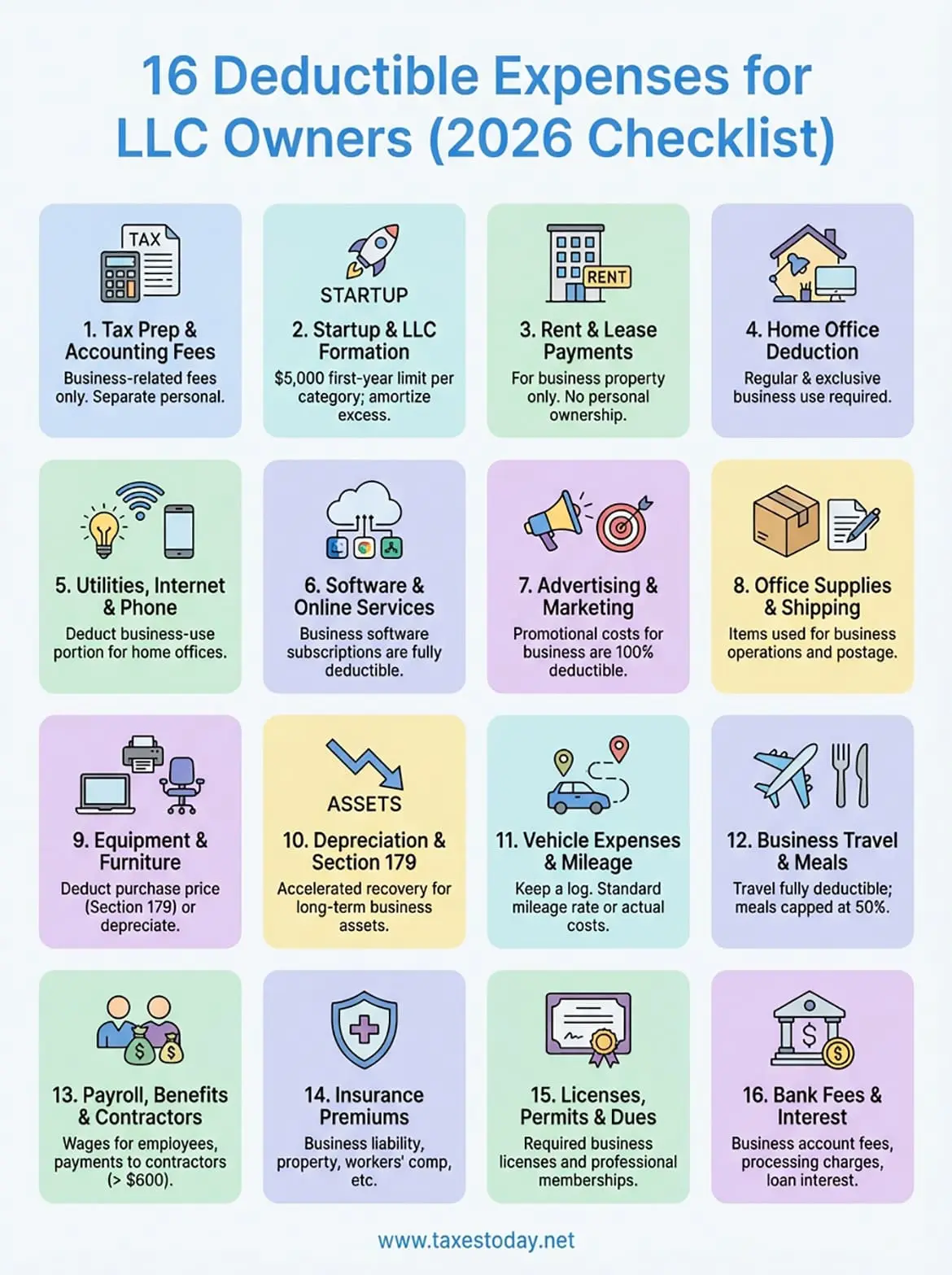
Next steps for your LLC tax checklist
You now have a complete picture of the deductible expenses for LLC owners that matter most when you file. Going through each category once a year is not enough. Consistent recordkeeping throughout the year is what separates a clean return from a stressful scramble in April. Start by opening a dedicated folder, digital or physical, for receipts, invoices, and bank statements. Separate business accounts from personal ones if you have not already.
Claiming every deduction you qualify for requires more than a checklist. It requires knowing how the rules apply to your specific situation, your business structure, your home office setup, your vehicle use, and your mix of income sources. A qualified tax professional can review your records, catch deductions you missed, and make sure nothing you claim creates problems down the road. If you want accurate, affordable help with your LLC return, work with a CTEC-certified tax preparer who handles exactly these situations every filing season.