


Best Tax Experts Near Me: How To Find The Right CPA Or EA
Searching for the best tax experts near me brings up dozens of results, CPAs, enrolled agents, tax preparers, franchise offices, and solo practitioners all competing for your attention. The real challenge isn't finding options. It's knowing which one actually fits your situation, whether you're filing a straightforward W-2 return, managing 1099 income, or running a small business.
Hiring the wrong tax professional can mean missed deductions, costly errors, or simply overpaying for services you don't need. On the other hand, the right expert saves you money, keeps you compliant with the IRS, and takes the stress out of tax season entirely. The difference between the two often comes down to asking the right questions before you commit.
At TaxesToday, we've spent over 15 years preparing taxes for individuals, freelancers, and small business owners, so we know exactly what separates a great tax professional from an average one. In this guide, we'll walk you through how to evaluate credentials, compare pricing, and spot red flags so you can confidently choose a tax expert who's worth your time and money. We'll also cover the key differences between CPAs and enrolled agents to help you decide which type of professional makes the most sense for your filing needs.
What a tax expert is and who you need
The phrase "tax expert" covers a wide range of professionals, and not all of them hold the same credentials or offer the same services. Before you start comparing anyone on a list of the best tax experts near me, you need to understand what each title actually means. Hiring a tax preparer when you need IRS representation, or paying CPA rates for a straightforward W-2 return, both cost you more than they should.
CPAs, enrolled agents, and tax preparers: what they can do for you
A Certified Public Accountant (CPA) is licensed by a state board and must pass a rigorous four-part exam. CPAs can handle everything from tax preparation to full financial audits, and they have unlimited representation rights before the IRS. That makes them a strong fit for complex business taxes, corporate returns, and situations where a financial audit could be on the table.

An Enrolled Agent (EA) holds a federal license issued directly by the IRS and specializes exclusively in tax matters, giving them the same unlimited IRS representation rights as a CPA but with a sharper focus on tax law specifically.
Tax preparers and CTEC-certified preparers (required by law in California) are qualified to prepare and file returns accurately but typically carry more limited IRS representation rights than a CPA or EA. For most individuals and freelancers with straightforward filing needs, a licensed preparer with solid experience gets the job done at a lower cost than hiring a CPA.
| Professional Type | IRS Representation | Best For |
|---|---|---|
| CPA | Unlimited | Business, audits, complex returns |
| Enrolled Agent (EA) | Unlimited | Tax-focused issues, back taxes, IRS notices |
| CTEC / Licensed Preparer | Limited | Individuals, W-2, 1099 filers |
Matching the right expert to your tax situation
Your filing situation should drive your decision more than any credential title does. If you earn W-2 income only with no major life changes, a qualified licensed preparer handles your return accurately and affordably. If you're a freelancer with 1099 income, run a single-member LLC, or claim home office deductions, you benefit from someone who knows Schedule C and self-employment tax inside and out.
Small business owners filing as an S-Corp or managing payroll taxes need either a CPA or an EA with confirmed business tax experience. The same applies if you've received an IRS notice, need to file back taxes, or plan to amend a prior-year return. These situations require a professional who can speak directly to the IRS on your behalf without restrictions.
Picking the right type of expert from the start protects you from both overpaying for credentials you don't actually need and ending up with insufficient help once things get complicated with the IRS.
Step 1. Build a short list near you
Start with a broad search before you narrow anything down. When you type best tax experts near me into Google, you get a map pack showing local professionals with ratings and reviews. That's a useful starting point, but don't stop there. You want at least three to five candidates on your list before you start comparing credentials, pricing, or experience in any serious way.
Where to find qualified professionals
The IRS maintains two free, official directories worth checking before you look anywhere else. The IRS Tax Pro Directory lets you search by zip code and filter by credential type, including CPAs, enrolled agents, and Annual Filing Season Program participants. These listings only include professionals with active federal credentials, which cuts out a significant layer of guesswork from the start. California filers should also confirm that any preparer holds a valid CTEC registration, which is required by state law for paid preparers who aren't already licensed as a CPA or EA.
Beyond the IRS directory, check Google Maps reviews and ask people in your network. A referral from someone with a similar tax situation to yours, whether that's self-employment income, rental properties, or a small business, carries more weight than a generic five-star rating from an unrelated filer.
What to capture for each candidate
Once you have your names, record the same details for each professional so you can compare them side by side. Use this simple template:
| Detail | Notes |
|---|---|
| Name and firm | |
| Credential type (CPA, EA, CTEC) | |
| Specialization (individual, self-employed, business) | |
| Location or virtual option available | |
| Google rating and review count | |
| Response time to first contact |
A professional who takes more than two business days to return your first inquiry will likely be difficult to reach once tax season peaks.
Filling out this table before you make any calls keeps your evaluation organized and objective, so you compare actual details rather than vague impressions.
Step 2. Verify credentials and IRS rights
Once you have your short list, verification is the step most people skip, and it's the one that matters most. Anyone can print a business card with "tax expert" on it. What you need to confirm is whether that person holds an active credential and whether they have the legal right to represent you in front of the IRS if something goes wrong after you file.
Check the official IRS and state databases
The IRS provides a free public tool called the IRS Tax Pro Directory where you can search any preparer by name and confirm their credential status and Preparer Tax Identification Number (PTIN). Every paid tax preparer is legally required to hold an active PTIN, so the absence of one is an immediate disqualifier. For enrolled agents specifically, you can verify active status directly through the IRS EA database.
If a preparer cannot provide their PTIN when you ask, stop the conversation and move to the next name on your list.
California filers have one extra step. The California Tax Education Council (CTEC) maintains a public register of all state-registered tax preparers. Any paid preparer in California who is not a licensed CPA or EA must hold a valid CTEC registration. Checking this takes under two minutes and confirms that your preparer has met the state's continuing education and bonding requirements.
Know what credentials actually authorize
Not every tax professional carries the same IRS representation rights, and this distinction becomes important if you're searching for the best tax experts near me to handle more than a basic filing. Use this checklist before you move forward with anyone on your list:
- Active PTIN: Required for all paid preparers
- CPA or EA license: Grants unlimited IRS representation
- CTEC registration (California): Required for non-CPA, non-EA preparers in the state
- No disciplinary history: Search the IRS Return Preparer Office for any sanctions
Confirming these four points takes less than ten minutes per candidate and gives you a factual basis for narrowing your list further.
Step 3. Interview and compare pricing
Once you've verified credentials, a short conversation tells you more than any online review will. Most reputable professionals offer a free initial consultation, and you should take advantage of it. This call is your chance to assess whether the person actually understands your tax situation or is just trying to close a deal quickly.
Questions to ask before you commit
Your goal in this conversation is to confirm relevant experience and communication style. A preparer who has never handled Schedule C income shouldn't be your first choice if you're self-employed, no matter how many five-star reviews they've collected from W-2 filers searching for the best tax experts near me.
Ask every candidate these questions before you agree to anything:
- What experience do you have with tax situations like mine (self-employed, LLC, non-resident, etc.)?
- Who will actually prepare my return, you or a staff member?
- How do you communicate during the process, email, phone, or a client portal?
- What documents do you need from me upfront?
- How do you handle it if the IRS contacts me after filing?
The answer to that last question separates professionals with real representation rights from those who will hand you off the moment things get complicated.
How to compare pricing without surprises
Pricing in this industry varies widely, and vague quotes lead to billing surprises you don't want after the work is done. Ask each candidate to give you a written fee estimate based on your specific filing needs before you commit. A flat fee is usually preferable to hourly billing for a standard return because you know exactly what you're paying going in.

Use this comparison template to evaluate your top candidates side by side:
| Candidate | Fee Structure | Estimated Cost | Includes State Return | Includes IRS Representation |
|---|---|---|---|---|
| Candidate 1 | ||||
| Candidate 2 | ||||
| Candidate 3 |
Never choose a preparer who charges a percentage of your refund as their fee. The IRS flags this as a red flag practice, and it creates a direct conflict between their incentives and your accurate filing.
Step 4. Hire with confidence and get organized
Once you've chosen your professional, the work isn't over yet. How you start the engagement sets the tone for the entire filing process, and a few straightforward steps upfront protect you from confusion, delays, and miscommunication before your return is even started.
Confirm the agreement in writing
Before you hand over any documents, get the key terms of your arrangement confirmed in writing. A reputable professional will provide an engagement letter or service agreement that outlines the scope of work, the fee, the expected timeline, and what happens if the IRS contacts you after filing. If someone resists putting any of this in writing, treat that as a warning sign and return to your list of candidates.
A written agreement isn't just about protection. It also tells you whether the professional operates a structured, organized practice or a loose one.
Your written agreement should confirm at minimum:
- Full fee amount and what it covers (federal, state, amendments)
- Who prepares the return and who signs it
- Estimated completion date or filing timeline
- Process for handling IRS inquiries or notices post-filing
Get your documents ready before the first meeting
After you sign, your job is to make the intake process as smooth as possible. Arriving organized saves time on both sides and reduces the risk of a preparer missing something because you forgot to provide it. Even the best tax experts near me can only work with the information you give them.
Use this document checklist to get ready before your first session:
| Document Type | Examples |
|---|---|
| Income records | W-2s, 1099-NEC, 1099-K, 1099-INT |
| Business expenses | Receipts, mileage log, home office measurements |
| Deductions | Mortgage interest, charitable donations, student loan interest |
| Prior-year return | Last year's federal and state filed return |
| ID and SSN | Social Security cards, ITIN letters |
Bringing complete, organized records to your first meeting lets your preparer focus on finding deductions rather than chasing missing paperwork.
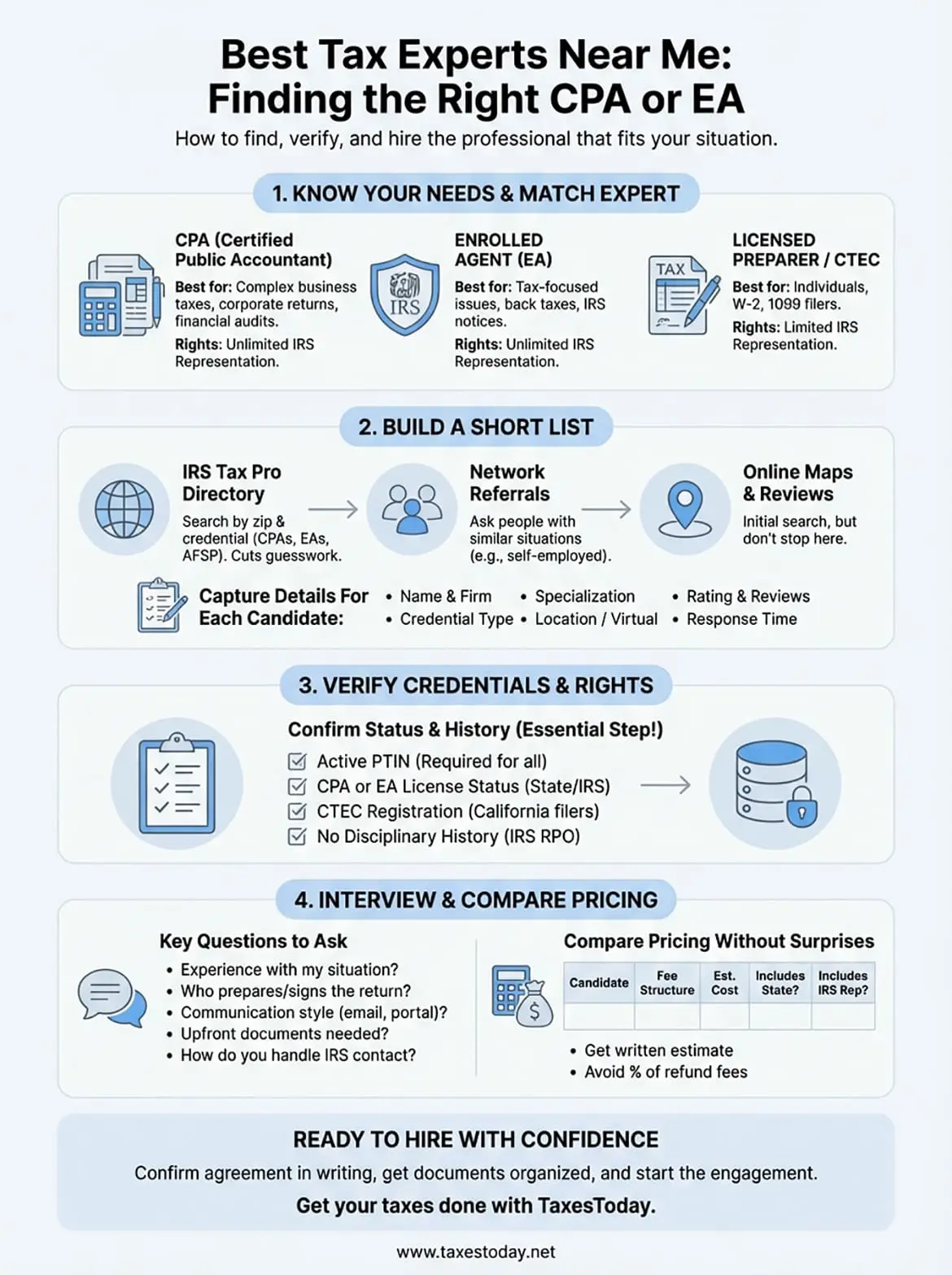
A simple way to move forward
Finding the best tax experts near me doesn't require hours of research if you follow a clear process. You now know the difference between a CPA, an enrolled agent, and a licensed preparer, and you know exactly how to match that credential to your filing situation. You've also got a step-by-step method for building a short list, verifying credentials, interviewing candidates, and arriving organized on day one.
Most people stall because they try to evaluate everything at once instead of taking it one step at a time. Start with your short list today, run the credential checks this week, and book one consultation before tax season peaks. That's the entire process.
If you want to skip the search entirely and work with a CTEC-certified, IRS-registered team that handles everything from W-2 returns to self-employment and small business filing, get your taxes done with TaxesToday and be done with it.