


IRS Schedule C Form: Who Files It and How It Works
If you earned money as a freelancer, independent contractor, or sole proprietor, the IRS Schedule C form is likely part of your tax filing requirements. This form is how you report your business income and expenses to the IRS, and it directly affects how much self-employment tax you owe.
Schedule C can feel intimidating at first glance. Between calculating gross receipts, categorizing deductible expenses, and determining your net profit or loss, there's a lot to get right. Filing it incorrectly could mean paying more than you owe or triggering an IRS notice down the road. The good news? Once you understand how the form works, the process becomes far more manageable.
This guide covers everything you need to know: who must file Schedule C, how to complete each section, which expenses you can deduct, and where to find the official form and instructions. At TaxesToday, our CTEC-certified tax preparers have helped thousands of self-employed individuals and small business owners file accurate Schedule C returns, maximizing deductions while staying fully compliant. Whether you're filing on your own or considering professional help, this article will give you the clarity you need to handle your business taxes with confidence.
Why Schedule C matters for your tax return
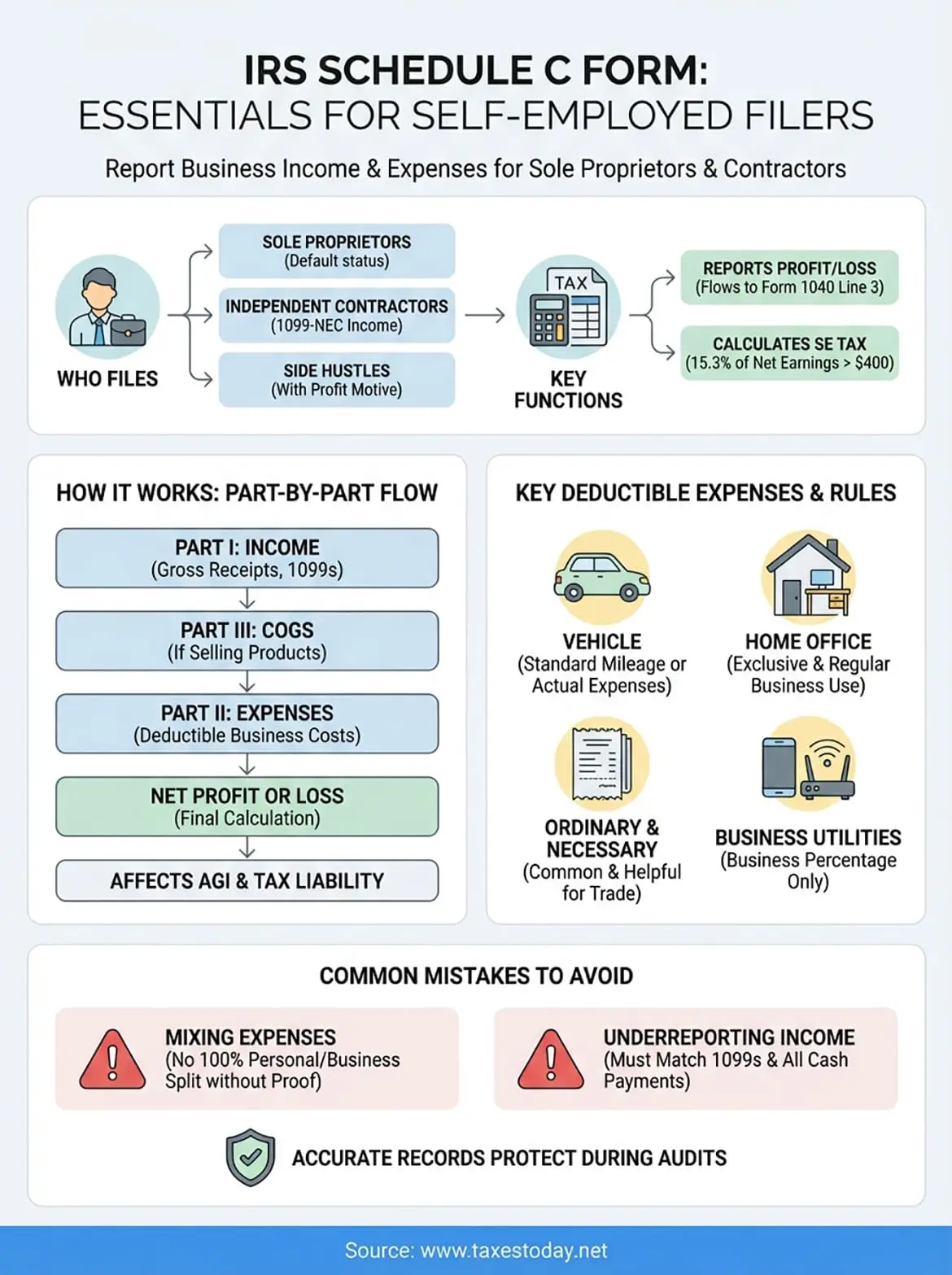
Schedule C serves as the official record of your business activity for the IRS. When you file Form 1040, Schedule C attaches to it and becomes part of your complete tax picture. The net profit or loss you calculate on Schedule C flows directly to line 3 of your Form 1040, where it combines with your other income sources to determine your total taxable income. This means every number you enter on Schedule C has a direct impact on how much tax you ultimately pay or what refund you receive.

Beyond the immediate tax calculation, Schedule C establishes your business legitimacy in the eyes of the IRS. Filing this form signals that you're operating as a self-employed individual or sole proprietor, which opens the door to deductions and credits that W-2 employees cannot claim. Your Schedule C also creates a documented history of your business income, which you may need when applying for loans, mortgages, or other financial products. Lenders typically require two years of Schedule C filings to verify your income if you're self-employed.
How Schedule C affects your taxable income
The profit or loss you report on Schedule C directly changes your adjusted gross income (AGI), which is the foundation for nearly every tax calculation that follows. A higher net profit increases your AGI, which can reduce your eligibility for certain tax credits and deductions that phase out at higher income levels. Conversely, a business loss on Schedule C can lower your overall taxable income, potentially qualifying you for credits you wouldn't otherwise receive or reducing the taxes owed on other income sources.
Your Schedule C results also determine whether you qualify for the Qualified Business Income (QBI) deduction, which allows eligible self-employed individuals to deduct up to 20% of their qualified business income. This deduction can significantly reduce your tax liability, but it's only available if you report positive business income on Schedule C. Understanding how your business expenses affect your bottom line helps you make strategic decisions about timing expenses and maximizing deductions.
"The net profit or loss from Schedule C flows directly to your Form 1040 and affects your adjusted gross income, which impacts nearly every other tax calculation."
The connection to self-employment tax
Filing the irs schedule c form triggers an additional tax obligation that many new business owners overlook: self-employment tax. When you work as an employee, your employer pays half of your Social Security and Medicare taxes. As a self-employed individual, you're responsible for both halves, which totals 15.3% of your net business income. This tax applies to any net profit you show on Schedule C, and you calculate it using Schedule SE, which attaches to your tax return along with Schedule C.
Self-employment tax kicks in when your net earnings exceed $400, which is a much lower threshold than most people expect. Even if your standard deduction eliminates all income tax liability, you still owe self-employment tax on your business profit. This catches many first-time filers by surprise, especially freelancers who earned modest amounts throughout the year. Planning for this tax obligation is critical to avoid penalties and interest charges for underpayment.
The IRS requires you to make quarterly estimated tax payments if you expect to owe $1,000 or more in taxes, including self-employment tax. Your Schedule C projections help you calculate these payments accurately. Missing these deadlines or underpaying can result in penalties, even if you file your annual return on time and pay the full balance due.
Who needs to file IRS Schedule C
You need to file the irs schedule c form if you operated a business as a sole proprietor or earned income as an independent contractor during the tax year. The IRS considers you self-employed if you provided services, sold products, or engaged in any business activity with the intent to make a profit. This requirement applies whether you ran your business full-time, part-time, or as a side venture alongside W-2 employment.

Sole proprietors and single-member LLCs
If you own and operate a business without forming a partnership or corporation, you're a sole proprietor by default. This applies even if you never registered a business name or obtained special licenses. The moment you started offering services or selling products with the expectation of earning money, you became a sole proprietor. Single-member LLCs also file Schedule C unless they elect to be taxed as a corporation, because the IRS treats these entities as disregarded for tax purposes.
Your business structure doesn't need to be complex or formal to trigger the Schedule C requirement. Running a consulting practice from your home office, selling handmade goods online, or providing freelance writing services all qualify as sole proprietorship activities that require Schedule C filing.
Freelancers and independent contractors
Any work you perform as an independent contractor generates 1099-NEC income that you report on Schedule C. Companies that pay you $600 or more during the year send you Form 1099-NEC, but you must report all income on Schedule C regardless of whether you received a form. Gig economy workers who drive for rideshare services, deliver food, or complete tasks through online platforms fall into this category.
"You must file Schedule C even if you didn't receive a 1099 form, as long as your business had net earnings of $400 or more during the tax year."
Part-time freelance work counts the same as full-time self-employment. If you designed websites on weekends while holding a regular job, you file both W-2 and Schedule C on your tax return. The IRS expects you to report all business income, no matter how small the amounts or irregular the work.
Statutory employees and rental activities
Statutory employees who receive a W-2 with box 13 checked file Schedule C instead of claiming unreimbursed employee expenses elsewhere. This rare classification applies to certain life insurance salespeople, home workers, traveling salespeople, and full-time delivery drivers. Additionally, you file Schedule C if you provide substantial services to renters, such as operating a bed and breakfast or offering maid service with vacation rentals.
When you should not use Schedule C
Not every business structure or income type requires the irs schedule c form. Understanding when to use a different form protects you from filing errors and potential IRS complications. Several business structures and income categories specifically require alternative tax forms, and using Schedule C in these situations creates inconsistencies that can delay your refund or trigger review letters.
Partnerships and multi-member LLCs
You cannot file Schedule C if you operate a partnership or multi-member LLC. These business structures require Form 1065, which reports the partnership's income and expenses at the entity level. After filing Form 1065, the partnership issues Schedule K-1 to each partner, who then reports their share of income or loss on their personal tax return. Attempting to use Schedule C for partnership income creates a mismatch in the IRS system because the partnership already filed Form 1065 showing the same income.
Multi-member LLCs default to partnership taxation unless they elect corporate treatment. If your LLC has two or more owners, you need Form 1065 and Schedule K-1, not Schedule C. This distinction matters because the IRS tracks entity types carefully, and filing the wrong form can result in processing delays or correction notices.
Corporate entities and S-corporations
Corporations file their own tax returns using Form 1120 for C-corporations or Form 1120-S for S-corporations. Your business income flows through these corporate returns, not through Schedule C on your personal return. If you elected S-corporation status for your single-member LLC, you must file Form 1120-S instead of treating it as a disregarded entity that files Schedule C.
S-corporation shareholders receive Schedule K-1 to report their share of corporate income, similar to partners. The wages you pay yourself as an employee appear on your W-2, not on Schedule C. Mixing these forms incorrectly raises red flags because the IRS expects consistent reporting across all related returns.
"Filing Schedule C for a partnership, corporation, or multi-member LLC creates serious reporting errors that can trigger IRS correspondence and delay your tax processing."
Hobby activities versus business operations
You should not use Schedule C to report hobby income that you pursue without a genuine profit motive. The IRS distinguishes between hobbies and businesses based on factors like consistent profitability, business-like recordkeeping, time invested, and expertise. Hobby income belongs on Form 1040, line 8z as "Other income," and you cannot deduct expenses that exceed your hobby income.
Where to find the current IRS Schedule C form
The IRS website provides free access to the current irs schedule c form and its instructions at any time. You can download, print, and complete the form without paying fees or creating accounts. The IRS updates Schedule C annually to reflect tax law changes, so you must use the version that matches your tax year. Using an outdated form creates processing delays and may result in your return being rejected.

Downloading directly from IRS.gov
Navigate to IRS.gov and search for "Schedule C" in the forms and publications search bar. The IRS organizes forms by tax year, with the most recent year displayed first. You'll find both the two-page Schedule C form and the separate instruction booklet, which runs approximately 20 pages and includes line-by-line guidance. Download the PDF files directly to your computer, or open them in your browser to complete them electronically if you have PDF editing software.
The IRS posts draft versions of next year's forms in late fall, usually by November, before releasing final versions in December or January. These draft forms help you plan ahead, but you cannot submit them with your tax return. Always verify you're using the final version before filing. You can also request paper copies by mail through the IRS forms ordering service, though this takes one to two weeks for delivery.
"The IRS releases the final Schedule C form for each tax year by late December or early January, and using any previous year's version will cause your return to be rejected."
Using tax software and free filing options
Most tax preparation software automatically includes Schedule C when you indicate self-employment income. Programs like TurboTax, H&R Block, and TaxAct guide you through interview-style questions and populate the form based on your answers. The software pulls the correct year's form and updates automatically as you work, eliminating concerns about version accuracy.
The IRS Free File program offers no-cost tax preparation software if your adjusted gross income falls below the annual threshold, which is $79,000 for the 2025 tax year. These participating software companies provide full Schedule C support within their free editions. Alternatively, IRS Free File Fillable Forms let you complete Schedule C directly on screen without guided assistance, available to taxpayers at any income level.
What you need before you start filling it out
Gathering your documents before you tackle the irs schedule c form saves hours of frustration and reduces filing errors. You need accurate income records, expense documentation, and basic business information to complete every required field. Missing information forces you to estimate numbers, which increases your audit risk and may cost you valuable deductions. Taking 30 minutes to organize your paperwork upfront makes the actual form completion straightforward.
Income records and payment documentation
You must collect all 1099-NEC and 1099-K forms from clients and payment platforms that paid you during the tax year. These forms show the income you received, but you also need your own records because not every payment generates a 1099. Your bank statements, invoicing software, and payment app records help you capture the complete picture of your business revenue. Pull together deposit records from PayPal, Venmo, Stripe, or similar services if clients paid you electronically.
Cash payments require extra attention because they leave no digital trail. Keep a detailed log of cash transactions with dates, amounts, and customer names when possible. The IRS expects you to report all income regardless of payment method, and your records prove the numbers you enter on Schedule C.
"Organizing your income documentation before starting Schedule C helps you capture every dollar you earned and defend your figures if the IRS asks questions later."
Expense receipts and supporting records
Compile receipts, invoices, and credit card statements for every business expense you plan to deduct. The IRS may request proof of your deductions years after you file, so keeping organized records protects you during audits. Create categories for your expenses such as supplies, advertising, professional fees, and office costs to simplify the process of entering them on Schedule C.
Mileage logs become critical if you drove for business purposes. You need the date, destination, purpose, and miles driven for each trip. Your vehicle expenses require either actual cost records or mileage documentation, depending on which deduction method you choose.
Business identification details
Have your Employer Identification Number (EIN) ready if you obtained one, though sole proprietors can use their Social Security number. You also need your business name, address, and principal business code from the IRS list of industry codes. Your accounting method (cash or accrual) determines how you report income and expenses, so confirm which method your business uses before starting the form.
How to fill out Schedule C part by part
The irs schedule c form divides into five distinct parts, each addressing a specific aspect of your business finances. You work through the form sequentially, starting with basic information at the top and ending with your net profit or loss calculation at the bottom. Each section builds on the previous one, so completing them in order prevents confusion and ensures your numbers flow correctly through the entire form.
Part I: Income section
Part I requires you to report your gross receipts and returns. You enter the total payments you received from business activities on line 1, then subtract any returns or allowances you gave customers on line 2. Line 3 shows your net income after these adjustments. If you received 1099-NEC or 1099-K forms, the amounts reported on those documents help you verify the figures you enter here, though you must include all income regardless of whether you received tax forms.
The remaining lines in Part I address specific income situations. You report cost of goods sold on line 4 if you maintained inventory, which we'll cover in detail later. Line 5 calculates your gross profit by subtracting cost of goods sold from your gross receipts. Lines 6 and 7 capture other business income sources that don't fit elsewhere, giving you a final gross income figure that carries forward to the expense section.
"Starting with accurate gross receipts in Part I sets the foundation for every calculation that follows on Schedule C, so double-check your income records before entering any numbers."
Part II: Expenses section
Part II lists 26 common business expense categories where you enter deductible costs. You record advertising expenses, car and truck costs, depreciation, insurance, office expenses, supplies, utilities, and many other business-related expenditures. Each line targets a specific expense type, though line 27a provides space for "Other expenses" that don't fit the predefined categories.
Total your expenses on line 28, which the form uses to calculate your tentative profit or loss on line 29. This calculation subtracts your total Part II expenses from your gross income, though the final net profit determination happens after you complete the remaining sections that address cost of goods sold, vehicle information, and other business expenses.
Parts III, IV, and V: Specialized sections
Parts III through V handle detailed calculations for specific expense types. Part III captures your cost of goods sold using either the cash or accrual method, requiring inventory values and purchase records. Part IV documents vehicle expenses if you claimed car and truck costs in Part II, requesting mileage logs and actual expense details. Part V collects miscellaneous information about your business, including accounting method, inventory valuation method, and whether you made payments requiring Form 1099 filing.
What counts as a deductible business expense
The IRS allows you to deduct any expense that qualifies as ordinary and necessary for your business operations. This standard applies to every line on the irs schedule c form where you claim deductions, and understanding it helps you maximize legitimate write-offs while avoiding red flags. An expense must meet both criteria simultaneously, meaning you can't deduct costs that benefit your personal life or expenses that seem unusual for your industry, no matter how much they cost.
The ordinary and necessary test
An ordinary expense is one that's common and accepted in your trade or industry. If other businesses similar to yours regularly pay for the same type of expense, it likely passes this test. A necessary expense is one that's helpful and appropriate for your business, though it doesn't need to be absolutely required. You can deduct your business website hosting because it's ordinary for modern businesses and necessary for reaching customers, even if you could technically operate without one.
The IRS expects you to exercise reasonable judgment when determining whether an expense qualifies. Buying a laptop for tracking business finances and communicating with clients clearly meets both tests. Purchasing luxury items or making excessive expenditures that seem personal in nature will face scrutiny during audits, even if you claim a business purpose.
"The IRS tests every business deduction against two requirements: the expense must be both ordinary for your industry and necessary for operating your business."
Common qualifying expenses
Office supplies, software subscriptions, professional fees, advertising costs, and business insurance all qualify as standard deductible expenses for most self-employed individuals. You can write off the percentage of your cell phone bill that relates to business use, internet service for business communications, and bank fees on your business checking account. Marketing expenses including social media ads, business cards, and website development count as deductible advertising costs.
Professional development expenses qualify when they maintain or improve skills required for your current business. You can deduct seminars, workshops, trade publications, and professional association memberships. Travel expenses become deductible when you travel primarily for business purposes, including transportation, lodging, and 50% of meal costs during business trips.
Business equipment purchases exceeding certain dollar thresholds may require depreciation over several years rather than immediate deduction, though Section 179 rules sometimes allow full first-year expensing. Legal and accounting fees for business matters, rental costs for office space or equipment, and contractor payments for business services all qualify as ordinary and necessary expenses you enter directly on Schedule C.
Cost of goods sold and inventory basics
If you sell physical products rather than services, Part III of the irs schedule c form requires you to calculate your cost of goods sold (COGS). This figure represents the direct costs of producing or purchasing the items you sold during the tax year. You subtract COGS from your gross receipts to determine your true gross profit, which reflects what you actually earned after accounting for inventory costs. Without this calculation, your tax return would show artificially high profits and result in paying more tax than you legally owe.
When you need to calculate COGS
You must complete Part III if you maintained inventory at any point during the tax year. This applies when you purchased products for resale, manufactured goods, or held raw materials for production. Even if you sold your entire inventory by December 31, you still need to calculate COGS because the IRS wants to match your expenses with the revenue they generated. Service-based businesses without physical inventory can skip this section entirely and leave Part III blank.
Businesses that produce income through labor or expertise alone don't deal with COGS. Freelance writers, consultants, graphic designers, and similar service providers report their full gross receipts without inventory adjustments. If you occasionally sell a few physical items alongside your services, you might still avoid Part III if the inventory is minimal and you use the cash method of accounting.
How to determine your cost of goods sold
The basic COGS formula starts with your beginning inventory value (what you had on January 1), adds purchases and production costs during the year, then subtracts your ending inventory value (what remained on December 31). This calculation isolates only the costs associated with items you actually sold. Your purchases include the wholesale price you paid for goods, plus shipping, freight, and similar acquisition costs directly tied to getting products ready for sale.
Labor costs for employees who manufacture or assemble products also factor into COGS, as do materials and supplies consumed in the production process. You cannot include overhead expenses like rent, utilities, or administrative salaries in COGS because these costs belong in Part II of Schedule C.
"Cost of goods sold connects your inventory purchases directly to the revenue you generated, ensuring you only pay tax on actual profit rather than gross sales."
Inventory valuation methods
You must choose between cost, lower of cost or market, or other approved methods for valuing your inventory. The cost method uses what you actually paid for items, which is the simplest and most common approach for small businesses. You apply your chosen method consistently each year, and changing methods requires IRS approval through Form 3115.
Car, mileage, and home office basics
Vehicle and home office deductions represent two of the most valuable write-offs available on the irs schedule c form, yet they also attract significant IRS attention. You can claim these deductions when you use your car or home space exclusively for business purposes, but the rules require precise documentation and strict adherence to qualification standards. Getting these deductions right potentially saves thousands of dollars, while mistakes in either area commonly trigger audits or disallowances.
Vehicle deduction methods
You choose between two methods for deducting vehicle expenses: the standard mileage rate or actual expenses. The standard mileage method multiplies your business miles by the IRS-approved rate, which is 70 cents per mile for 2026. This approach requires you to maintain a detailed mileage log showing the date, destination, purpose, and miles driven for each business trip. You cannot switch to actual expenses in later years if you start with standard mileage on a leased vehicle.
The actual expense method lets you deduct the business-use percentage of all vehicle costs, including gas, insurance, repairs, registration fees, and depreciation. You calculate your business percentage by dividing business miles by total miles driven during the year. This method demands receipts for every expense and requires you to track both business and personal mileage to establish the correct percentage. Most taxpayers find the standard mileage method simpler unless they drive expensive vehicles with high maintenance costs.
"You must maintain contemporaneous mileage logs throughout the year because recreating them later from memory will not satisfy IRS requirements during an audit."
Home office qualification rules
Your home office must serve as your principal place of business and be used exclusively and regularly for business activities to qualify for the deduction. The IRS examines whether you conduct substantial administrative or management activities in the space, not whether you occasionally work elsewhere. A room or defined area that you also use for personal purposes, even occasionally, disqualifies the entire space from the deduction.
You calculate the deduction using either the simplified method ($5 per square foot up to 300 square feet) or the regular method (actual expenses multiplied by business percentage). The regular method requires you to determine what percentage of your home the office occupies, then apply that percentage to mortgage interest, property taxes, utilities, insurance, and maintenance costs. The simplified method caps at $1,500 annually but eliminates complex calculations and record-keeping requirements for most small spaces.
Common Schedule C mistakes that trigger problems
Filing the irs schedule c form involves numerous calculations and classifications where small errors create significant consequences. The IRS computer systems flag returns that contain specific inconsistencies or patterns, triggering automated reviews or audit letters that delay your refund and create months of correspondence. Many taxpayers make the same preventable mistakes year after year, not realizing these errors stand out to IRS algorithms designed to detect reporting problems.
Mixing personal and business expenses
You cannot deduct expenses that serve both personal and business purposes without properly calculating the business-use percentage. Claiming 100% of your internet bill when you also use it for personal browsing, or deducting your entire cell phone plan when you make personal calls, raises immediate red flags. The IRS expects you to determine the actual business portion and only deduct that percentage, keeping records that support your calculation.
Personal meals, entertainment costs, and family travel expenses frequently appear on Schedule C returns where they don't belong. These deductions trigger scrutiny because the IRS knows taxpayers often blur the line between business necessity and personal preference. Your clothing purchases only qualify if you buy specialized uniforms or protective gear that you cannot wear outside work, not regular business attire you could use personally.
"Claiming 100% business use for expenses that clearly serve personal purposes as well creates one of the most common audit triggers on Schedule C returns."
Reporting income that doesn't match IRS records
The IRS receives copies of your 1099-NEC and 1099-K forms directly from clients and payment processors, and their computers automatically compare these amounts to what you report on Schedule C. When your reported income falls short of what 1099 forms show, the system generates a CP2000 notice demanding explanation and additional tax. You must report every dollar you earned, even from clients who failed to send you tax forms, because the IRS already knows about much of your income.
Rounding your income figures to even thousands or hundreds creates another pattern that draws attention. If you received $47,293 in payments, report that exact amount rather than rounding to $47,000. The IRS views excessive rounding as a sign of estimation rather than actual record keeping, suggesting you may be hiding income or fabricating numbers without proper documentation.
Wrap up and next steps
Filing the irs schedule c form correctly requires attention to detail, proper documentation, and understanding of which expenses you can legitimately deduct. You now know who must file Schedule C, how to complete each section, and which common mistakes to avoid. The form connects directly to your Form 1040 and determines both your income tax and self-employment tax obligations.
Your next step is gathering your income records, expense receipts, and mileage logs before you start entering numbers. Review the official IRS instructions for your tax year, and consider whether your situation involves complexities like inventory, significant vehicle expenses, or home office deductions that require extra attention.
If Schedule C still feels overwhelming or you want to ensure maximum deductions while staying compliant, professional tax preparation can save you time and money. Our CTEC-certified tax preparers at TaxesToday specialize in self-employed returns, helping freelancers and small business owners file accurate Schedule C forms starting at $99.