


S Corp Taxes Explained: Salary, Distributions, And Savings
You've probably heard that electing S corporation status can save you thousands in taxes. That's true, but only if you understand how the structure actually works. When you search for S corp taxes explained, you're usually trying to figure out the same core questions: How does pass-through taxation affect your personal return? What counts as a "reasonable salary"? And how much can you realistically save compared to filing as a sole proprietor or LLC? These are critical details that directly impact your bottom line, and getting them wrong can trigger IRS scrutiny.
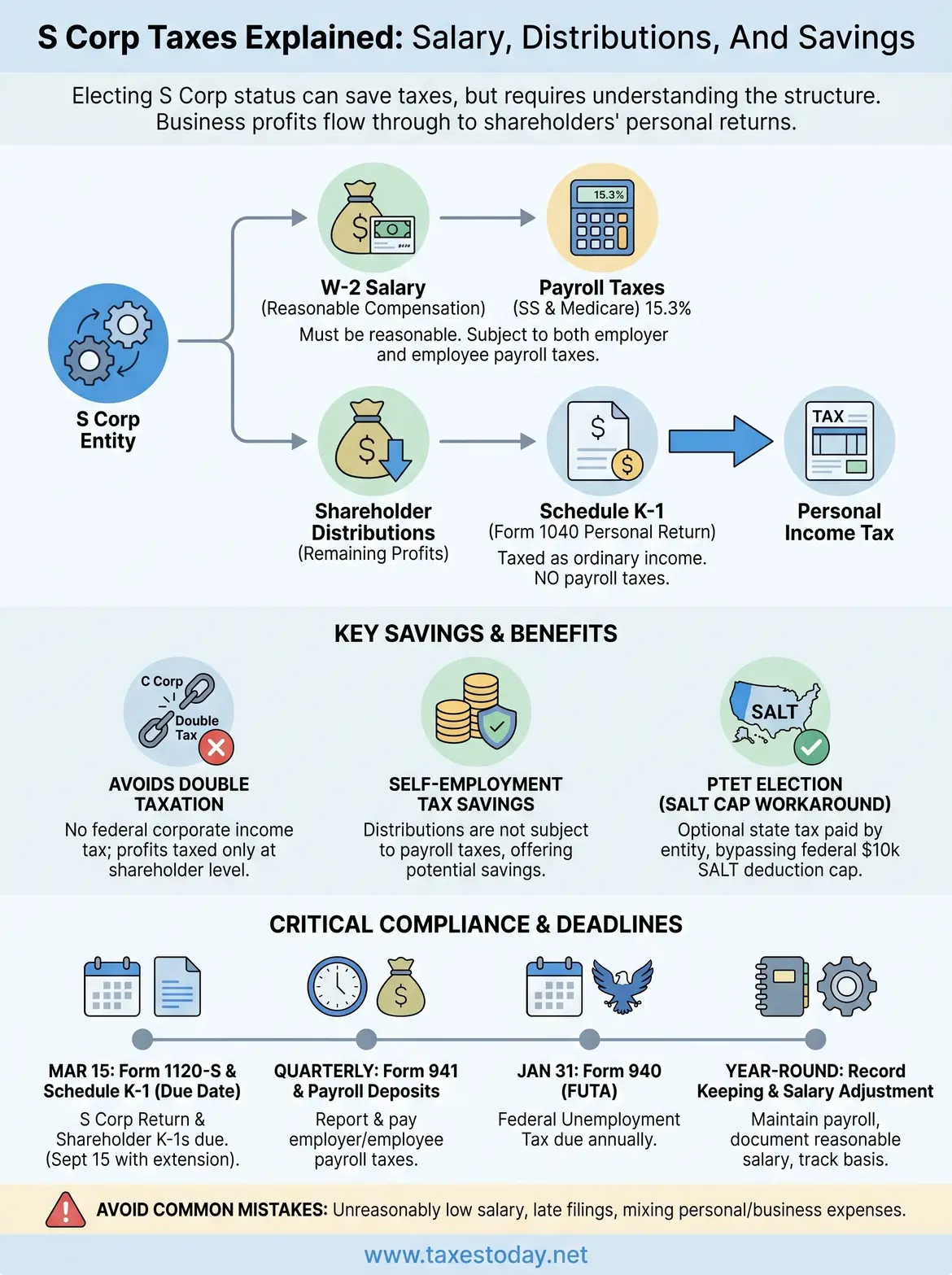
An S corp doesn't pay federal income tax at the entity level. Instead, profits and losses flow through to shareholders' personal tax returns. That sounds straightforward, but the mechanics, splitting income between salary and distributions, handling payroll taxes, meeting compliance requirements, get complicated fast. The difference between a well-structured S corp and a poorly managed one can mean thousands of dollars gained or lost each year. It also determines whether you stay on the right side of IRS rules or end up fielding letters you'd rather not open.
At TaxesToday, our CTEC-certified and IRS-registered tax preparers work with S corp owners across California and nationwide, handling everything from payroll tax filings to distribution planning. With over 15 years of experience preparing small business returns, we've seen firsthand what works and what creates problems. This guide breaks down exactly how S corp taxation functions, from salary requirements to self-employment tax savings, so you can make informed decisions about your business structure and your money.
What an S corp is and what the election changes
An S corporation is not a separate type of business entity you form at the state level. It is a federal tax designation you apply for with the IRS after you already have a corporation or, in some states, an LLC in place. The "S" comes from Subchapter S of the Internal Revenue Code, which sets the rules for how this election changes the way your business is taxed. Before you make the election, a standard corporation is taxed as a C corporation by default, meaning the IRS treats it as a completely separate taxpayer from its owners. Once you elect S corp status, that treatment shifts entirely.
The S corp election: Form 2553 and eligibility rules
To elect S corp status, you file Form 2553 with the IRS, and the timing of that filing matters. You need to submit it no later than two months and 15 days after the start of the tax year you want the election to take effect. For a business with a January 1 start date, that deadline falls on March 15 of the same year. Miss that window, and you generally have to wait until the following tax year, though the IRS does grant late election relief in certain situations.
Not every business qualifies. The IRS sets specific eligibility rules you must meet before the election is approved:
- Your business must be a domestic corporation or an eligible LLC
- You can have no more than 100 shareholders
- All shareholders must be US citizens, permanent residents, or certain qualifying trusts and estates
- You can only issue one class of stock
- Partnerships, other corporations, and most non-resident aliens cannot be shareholders
If your shareholder structure or business setup does not meet these requirements, the IRS will reject the S corp election and your entity stays a C corporation by default.
What the S corp status actually changes
Once the IRS approves the election, the most significant change is how your business income gets taxed. A C corporation pays corporate income tax on its profits at the entity level, currently at a flat 21% federal rate. When you then distribute those after-tax profits to yourself as dividends, you pay personal income tax on that same money again. That double layer of taxation is exactly what the S corp election removes.
With S corp status, the entity itself no longer owes federal income tax on business profits. Income, losses, deductions, and credits pass through to your personal tax return based on your ownership percentage. If you own 100% of an S corp that earns $150,000 in net profit, all $150,000 flows to your Form 1040, and you pay tax on it at your individual income tax rate. No corporate-level tax comes out first.
Understanding this shift is the foundation of getting S corp taxes explained accurately. The structure does not make income tax disappear. It changes who reports the income and when, moving the tax obligation from the business to you personally. That shift also creates new compliance responsibilities, including running payroll and filing separate business returns, that would not apply if you operated as a sole proprietor or a single-member LLC. Those are the specifics this guide covers in the sections ahead.
Why S corps avoid double taxation but still owe taxes
The S corp structure eliminates a specific tax problem that every C corporation owner faces: paying tax on the same dollar twice. With a C corp, the business pays corporate income tax on profits, and then when the owner takes those profits out as dividends, the IRS taxes them again at the individual level. The S corp election cuts out that first layer of corporate-level tax entirely, which is why business owners find the structure attractive. But avoiding double taxation does not mean avoiding all taxes.
How C corps create double taxation
A C corporation is a separate legal taxpayer in the eyes of the IRS. It reports its own income, files its own return, and pays federal income tax at a flat 21% rate on net profits. Once the company pays that tax, the remaining after-tax profit sits inside the business. When you take money out as a shareholder dividend, the IRS treats that dividend as ordinary income on your personal return, and you owe tax on it again. That second hit is what people mean when they say "double taxation," and it can significantly reduce what you actually keep.
If your business generates $200,000 in profit, double taxation under a C corp structure could cost you tens of thousands of dollars more than the same income reported through an S corp.
What taxes S corps still owe at the entity and owner level
The S corp itself pays no federal income tax on business profits. That part is straightforward. What most owners miss is that the entity still has other tax obligations depending on the state and on how you compensate yourself. At the federal level, your salary as a shareholder-employee triggers payroll taxes, which means the business owes employer-side Social Security and Medicare taxes, and you owe the employee side. Those do not disappear with the S corp election.
Some states also impose their own taxes on S corps directly, regardless of the pass-through treatment the IRS applies. California, for example, charges an S corp a 1.5% franchise tax on net income, with a minimum of $800 per year. Getting S corp taxes explained accurately requires understanding that the election eliminates federal entity-level income tax, not every tax the structure creates.
How S corp income flows to your personal return
The S corp itself does not file a personal income tax return, but its financial results still land on yours. Every year, your S corp files Form 1120-S, the S corporation income tax return, which reports total income, deductions, and credits for the business. That return produces the document that connects your business results to your personal tax situation, and understanding how that connection works is central to getting S corp taxes explained in a way that actually helps you plan.
Schedule K-1: The bridge between your S corp and your 1040
The S corp issues you a Schedule K-1 (Form 1120-S) at the end of each tax year. This document shows your share of the company's income, losses, deductions, and credits based on your ownership percentage. If you own 100% of the S corp, the K-1 reflects 100% of the net results. If you own 60%, you receive 60% of each item. The K-1 is not just a summary document; it is the official IRS mechanism for passing taxable amounts from the business to your individual return.
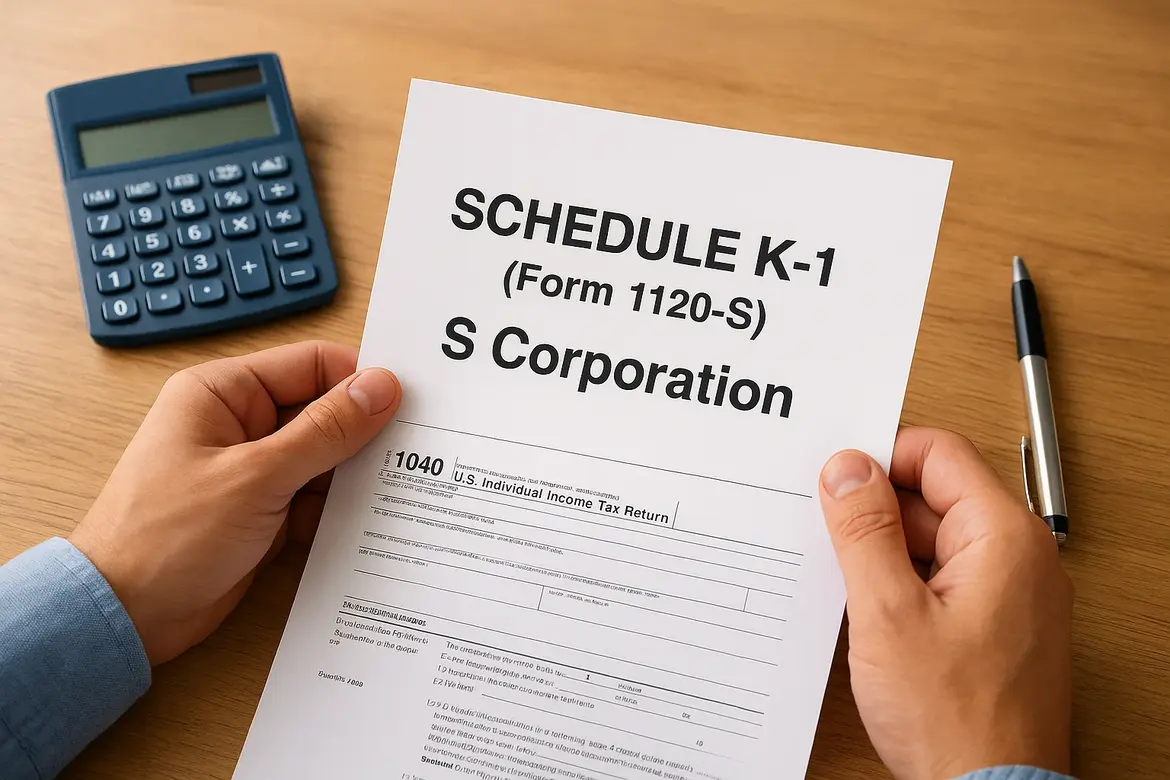
Breaking income into separate line items rather than one combined figure is how the K-1 works. Ordinary business income or loss sits on one line, while items like capital gains, rental income, interest, or Section 179 deductions each get their own line. That separation matters because different types of income carry different tax treatment on your Form 1040. Your tax preparer uses each line from the K-1 to correctly report amounts on the right schedules and forms within your personal return.
How losses and credits also pass through
Your S corp's losses can reduce your personal taxable income, but only up to your basis in the company.
Pass-through treatment applies to losses as well as income. If your S corp has a net loss for the year, that loss flows to your K-1 and can offset other income on your personal return, subject to basis limitations and at-risk rules. Similarly, tax credits generated by the business pass through to you and can directly reduce your personal income tax liability, which makes the pass-through structure valuable beyond just profit reporting.
How S corp owners pay themselves legally
As an S corp owner who actively works in the business, the IRS requires you to pay yourself through two distinct channels: a W-2 salary and shareholder distributions. You cannot simply transfer money from the business account to your personal account and call it done. The IRS treats owner-employees differently from passive investors, and failing to follow the correct payment structure is one of the fastest ways to invite IRS scrutiny or penalties.
Two payment methods: salary and distributions
Your salary is the portion of your compensation that goes through official payroll processing. The S corp withholds federal and state income taxes, Social Security, and Medicare from each paycheck, just as any employer would for a regular employee. You receive a W-2 at year-end reflecting your wages, and those wages are deductible as a business expense on your S corp's Form 1120-S.

Distributions are separate from salary and work differently. After the business pays your salary and covers its other expenses, remaining profits can be distributed to you as a shareholder. Those distributions pass through to your Schedule K-1 and appear on your personal return as ordinary income, but they do not go through payroll and are not subject to Social Security or Medicare taxes. That tax treatment difference between salary and distributions is the core of S corp taxes explained as a tax savings strategy.
The IRS does not allow you to take all of your compensation as distributions to avoid payroll taxes. You must receive a reasonable salary first.
Why you must run actual payroll
Running payroll is not optional for active S corp owner-employees. The IRS specifically requires that you process salary payments through a payroll system, calculate withholdings correctly, make timely payroll tax deposits, and file quarterly payroll returns using Form 941. Skipping payroll and taking only distributions is a known audit trigger.
Your payroll obligations also include paying employer-side payroll taxes, which means your S corp owes 7.65% on your wages for Social Security and Medicare, in addition to the 7.65% withheld from your paycheck. These employer taxes are deductible as a business expense, which partially offsets the cost. Setting up a reliable payroll system from the start keeps you compliant and makes year-end reporting far simpler.
Salary vs distributions and the reasonable salary rule
The split between salary and distributions sits at the heart of how S corp owners reduce their tax burden legally. Your salary runs through payroll and triggers Social Security and Medicare taxes on both sides. Distributions pass through to your personal return without those payroll taxes attached. That difference is what makes S corp taxes explained so relevant for business owners: the less you pay in payroll taxes, the more you keep. But the IRS watches this balance closely, and if your salary is unreasonably low, the agency can reclassify your distributions as wages and hit you with back payroll taxes, interest, and penalties.
What "reasonable salary" actually means
The IRS does not publish a specific dollar amount or formula that defines reasonable compensation. Instead, the standard requires that you pay yourself what a comparable business would pay an outside employee to perform the same services. That judgment depends on several factors:
- Your industry and the going market rate for your role
- The time you actually spend working in the business
- Your qualifications, experience, and responsibilities
- The overall revenues and profits of the S corp
- What similar businesses pay for comparable positions
The IRS has challenged and won cases where owners paid themselves $0 or nominal salaries while pulling out large distributions. Courts have consistently held that disguising compensation as distributions to avoid payroll taxes violates the intent of the law.
Paying yourself a reasonable salary is not optional; it is a legal requirement the IRS actively enforces through audits and reclassification.
How to set and document your salary
Setting your salary starts with researching what the market pays for your specific role. The Bureau of Labor Statistics Occupational Employment and Wage Statistics data gives you a credible, government-sourced benchmark you can reference. Once you land on a number, document your reasoning in writing. Record the sources you reviewed, the comparable roles you examined, and how you determined the amount matches the work you actually perform in the business.
Your salary should also shift when your business changes. If your revenue grows significantly, a salary set three years ago may no longer hold up under IRS scrutiny. Reviewing your compensation annually alongside your overall tax plan keeps your S corp structure both compliant and financially efficient.
What tax forms S corps file and key due dates
Running an S corp means taking on a specific set of filing obligations that go beyond what a sole proprietor or single-member LLC handles. Getting S corp taxes explained fully requires knowing which forms your business must submit, who files them, and when the IRS expects to receive them. Missing a deadline or filing the wrong form can result in penalties that wipe out a significant chunk of the tax savings the structure is supposed to provide.
Form 1120-S and the March 15 deadline
Your S corp files Form 1120-S each year to report the company's income, deductions, and credits. This is the main S corporation income tax return, and it is due on March 15 for calendar-year businesses, which is one month earlier than the individual return deadline. Along with the 1120-S, your S corp issues a Schedule K-1 to each shareholder by the same date, since shareholders need those figures to complete their own Form 1040 filings.
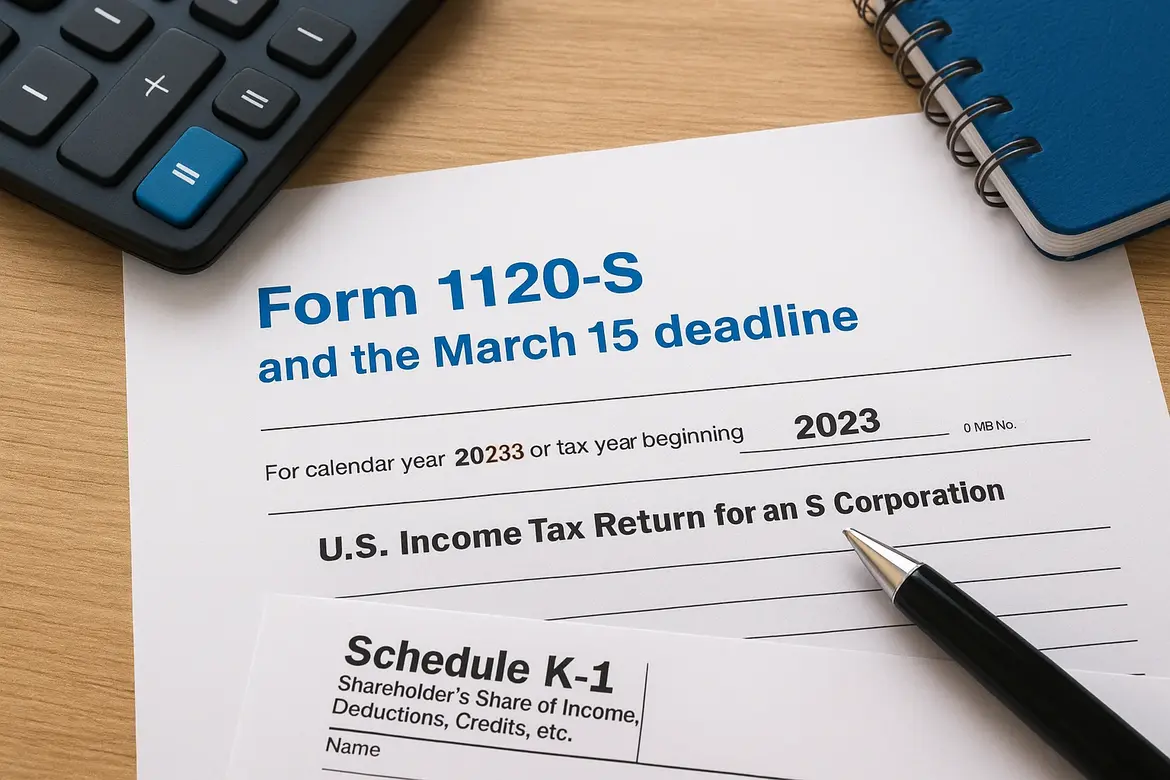
Filing Form 1120-S on time protects each shareholder's ability to file their personal return accurately and without delays.
If your S corp needs more time, you can file Form 7004 to request an automatic six-month extension, moving the deadline to September 15. The extension gives you more time to file, but it does not extend the time to pay any taxes owed at the shareholder level. Shareholders still need to account for their expected pass-through income when estimating personal tax payments.
Quarterly payroll and estimated tax filings
Because your S corp runs payroll for you as an owner-employee, Form 941 is due quarterly to report wages paid, taxes withheld, and employer payroll tax contributions. The filing deadlines fall on April 30, July 31, October 31, and January 31. You must also make federal payroll tax deposits through the Electronic Federal Tax Payment System on a schedule the IRS sets based on your total tax liability.
As a shareholder, you report your K-1 income on your personal Form 1040, which is due April 15. If your pass-through income is substantial, the IRS expects you to make quarterly estimated tax payments using Form 1040-ES throughout the year to avoid underpayment penalties at filing time.
Payroll taxes and other federal taxes S corps may owe
The S corp election eliminates federal income tax at the entity level, but it does not remove every federal tax obligation your business carries. Payroll taxes remain a real cost, and understanding which federal taxes apply to your S corp directly versus which ones flow through to you personally is a core part of getting S corp taxes explained in a way that supports accurate financial planning. Your compliance picture is broader than just filing Form 1120-S each year.
FUTA and the federal unemployment tax obligation
Your S corp owes FUTA, the Federal Unemployment Tax, on wages paid to employees, including wages paid to you as a shareholder-employee. The standard FUTA rate is 6% on the first $7,000 of each employee's wages, though a credit of up to 5.4% applies if you pay state unemployment taxes on time, which brings the effective federal rate down to 0.6% in most cases. You report and pay FUTA using Form 940, which is due January 31 each year. If your FUTA liability exceeds $500 in any quarter, the IRS requires you to deposit that amount before the annual filing deadline.
FUTA is the employer's tax entirely. You do not withhold it from employee paychecks, which means the full cost lands on the S corp as a business expense. For most small S corps with one or two shareholder-employees, the total FUTA liability stays relatively small because the $7,000 wage base cap is reached quickly. Still, missing deposits or failing to file Form 940 triggers penalties, so building this into your payroll calendar from the start matters.
How the S corp structure affects self-employment taxes
Sole proprietors and partners pay self-employment tax on all net business income, which covers both the employee and employer sides of Social Security and Medicare at a combined 15.3% rate. Your S corp changes that equation. As a shareholder-employee, you pay the 15.3% payroll tax only on your W-2 salary, not on the distributions you receive.
The portion of your S corp profits you take as distributions avoids payroll taxes entirely, which is the primary mechanism behind the tax savings the structure delivers.
That savings is real, but it requires maintaining a legitimate, documented salary to hold up under IRS review. The higher your total business income relative to your salary, the greater the potential payroll tax reduction, as long as your compensation remains genuinely reasonable.
State taxes, PTET elections, and the SALT cap workaround
State-level tax treatment of S corps varies significantly, and federal pass-through status does not automatically mean your state follows the same rules. Some states fully conform to the federal S corp election, others require a separate state-level election, and a few impose entity-level taxes on S corps regardless of how the IRS treats them. California, for example, charges S corps a 1.5% franchise tax on net income, with a minimum annual payment of $800. When you add state obligations on top of federal compliance requirements, the full picture of S corp taxes explained becomes more complex than the federal rules alone suggest.
How states tax S corps differently
Every state handles S corp taxation through its own set of rules, and your home state may treat your S corp very differently from how the IRS does. Most states that have an individual income tax allow pass-through income to flow to your personal state return, similar to federal treatment. However, some states, including California and New York, impose franchise or minimum taxes directly on the S corp entity, regardless of profitability. You need to review your specific state's rules or work with a tax professional to confirm which taxes your S corp owes at the entity level versus the owner level.
What PTET elections are and how they work
The Pass-Through Entity Tax, commonly called PTET, is a state-level election that allows your S corp to pay state income tax at the business level on behalf of its shareholders. More than 30 states have enacted some version of this provision since 2021. The significance of the PTET comes from how it interacts with the federal $10,000 cap on the state and local tax deduction, known as the SALT cap, that the 2017 Tax Cuts and Jobs Act introduced for individual taxpayers.
By paying state income tax through the S corp rather than personally, you effectively deduct state taxes as a business expense on your federal return, which bypasses the SALT cap entirely.
When your S corp pays the PTET, that payment reduces the company's net income, which flows through to your federal return as a lower taxable amount. In return, the state typically gives each shareholder a credit on their personal state return to offset the tax the entity already paid. California's PTET lets qualifying S corps make this election annually, and the potential federal tax savings can be substantial for owners in high-tax states.
Deductions, benefits, and planning moves that matter
Your S corp structure unlocks specific deductions and planning opportunities that sole proprietors and single-member LLCs cannot access in the same way. Understanding which moves are available to you is the part of S corp taxes explained that directly increases what you keep each year, and it starts with knowing how the IRS treats your compensation, benefits, and business expenses differently once you operate through the entity.
Health insurance premiums and retirement contributions
Your S corp can pay your health insurance premiums directly, and those premiums get reported as wages on your W-2. You then deduct them on your personal Form 1040 as a self-employed health insurance deduction, which reduces your adjusted gross income without requiring you to itemize. This treatment is more favorable than what a sole proprietor gets, especially if you cover premiums for your family.
Retirement plan contributions offer another significant planning tool. Your S corp can establish a SEP-IRA, Solo 401(k), or SIMPLE IRA, and the contributions the business makes on your behalf are deductible as a business expense on Form 1120-S. A Solo 401(k) allows particularly high contribution limits because you contribute both as an employee and as an employer, which can shelter a substantial portion of your income from federal tax each year.
Maxing out retirement contributions through your S corp is one of the most effective and fully legal ways to reduce your total taxable income.
Strategic timing of income and deductions
Your S corp gives you more control over timing than most other structures. If your business is having a strong year, you can accelerate deductible expenses before December 31 to reduce net income that passes through to your personal return. Office equipment, software subscriptions, professional fees, and Section 179 expensing on qualifying property all offer timing flexibility when planned intentionally.
Your salary also provides a planning lever. If you have a lower-income year, adjusting your compensation within a defensible range helps you match payroll taxes to actual business performance. On the flip side, tracking your shareholder basis matters for years when your S corp takes a loss, because losses only reduce your personal taxable income to the extent you have sufficient basis. Working with a tax professional throughout the year, not just at filing time, keeps these moves coordinated and defensible.
Mistakes that trigger penalties and IRS attention
Even a well-structured S corp can create serious problems when basic compliance steps get skipped or mishandled. The IRS has specific patterns it looks for when auditing S corps, and several common mistakes put your business directly in that crosshair. Understanding what gets flagged is as important as understanding how S corp taxes explained in the rest of this guide actually works in practice.
Skipping or understating your required salary
Taking little or no salary while pulling large distributions is the single most common mistake S corp owners make, and the IRS has pursued this aggressively in tax court for decades. If your business generates strong profits and your W-2 shows wages that clearly fall below what someone else would earn for the same work, the IRS can reclassify those distributions as wages. When that happens, back payroll taxes, interest, and penalties all come due at once, and the financial hit often exceeds whatever payroll taxes you were trying to avoid in the first place.
Watch out for these specific red flags the IRS targets:
- Paying yourself $0 in salary during a profitable year
- Reporting compensation well below the Bureau of Labor Statistics median for your role
- Failing to document how you determined your salary amount
- Changing your salary dramatically year to year without a documented business reason
Other compliance failures that draw IRS scrutiny
Filing Form 1120-S late triggers an automatic penalty of $235 per shareholder per month as of 2025, and those charges accumulate fast if you miss the March 15 deadline without filing for an extension. Beyond the business return, failing to issue Schedule K-1s to shareholders on time disrupts their personal filing and can generate additional notices.
Mixing personal and business expenses is another problem the IRS notices. Deducting personal travel, meals, or equipment without clear documentation that ties each expense to a legitimate business purpose invites disallowance and potential fraud flags. Your S corp's books need to reflect actual business activity, supported by receipts, records, and a clear paper trail. Working with a licensed tax professional throughout the year, rather than scrambling at filing time, is the most straightforward way to stay on the right side of these rules.
Final takeaways and next steps
Getting S corp taxes explained clearly comes down to understanding a few core mechanics: the pass-through structure, the mandatory salary requirement, the split between wages and distributions, and the filing deadlines that apply at both the entity and personal level. Each piece connects to the others, and a mistake in one area ripples into the rest of your tax picture.
Your S corp can deliver real, measurable tax savings when you run it correctly. That means paying yourself a documented, reasonable salary, filing Form 1120-S by March 15, and tracking your shareholder basis year over year. It also means staying current on state-level rules, especially if you operate in California where the franchise tax and PTET election both affect your bottom line.
If you want a licensed professional to review your S corp setup or handle your business tax filing, reach out to our certified tax preparers at TaxesToday for accurate, affordable support.