


LLC vs S Corp Taxes: Which Structure Saves You More?
If you're a single-member LLC owner or a freelancer whose business income has finally outgrown a hobby, you've probably heard someone say you should
Why your tax structure choice affects your bottom line
How you're taxed matters more than what your business card says. LLC s corporation taxes work on two completely different systems, and picking the wrong one can cost you thousands of dollars a year in taxes you didn't have to pay. Most freelancers and small business owners default into an LLC because it's cheap to form and simple to run, then never revisit the decision once their income climbs. That's the mistake. The structure that made sense when you were earning $30,000 a year often stops making sense once you clear $70,000 or $80,000 in net profit.
The 15.3% self-employment tax problem
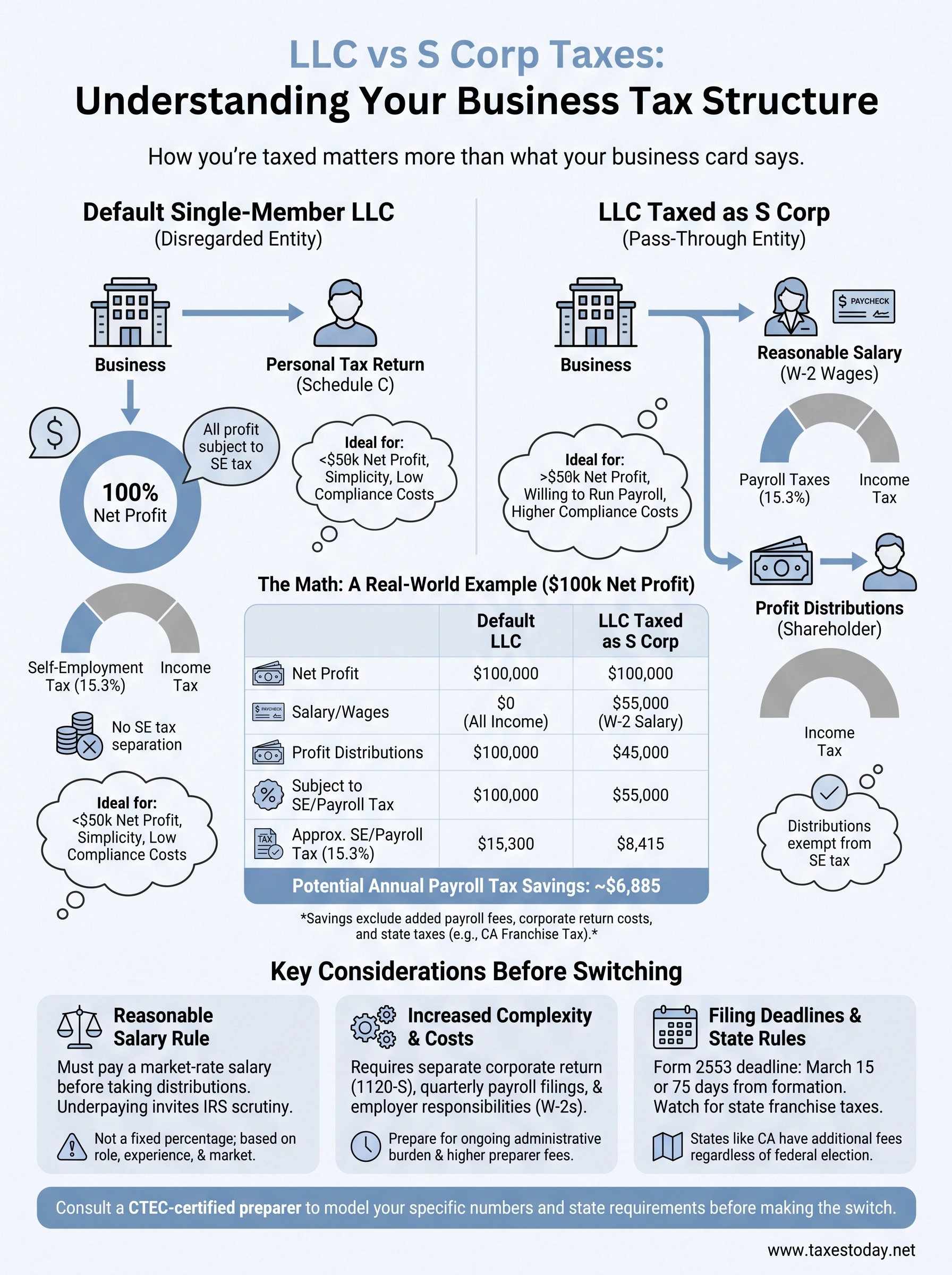
By default, the IRS treats a single-member LLC as a disregarded entity, meaning your business income flows straight to your personal return on Schedule C. That's simple, but it comes with a catch: every dollar of net profit is subject to self-employment tax at 15.3%, covering Social Security and Medicare. There's no separation between what you pay yourself and what the business earns. If your LLC nets $100,000, you owe self-employment tax on the full $100,000, on top of your regular income tax.

The single biggest reason business owners elect S corp status is to stop paying self-employment tax on every dollar of profit.
How S corp election changes the math
Electing S corp taxation for your LLC splits your income into two buckets: a reasonable salary, which is subject to payroll taxes, and remaining profit distributions, which are not. That distinction is the entire reason people compare s-corp vs LLC taxes in the first place. The IRS lays out the framework for this pass-through treatment in its S corporations guidance, and the payroll tax savings can be substantial once your profit passes a certain threshold.
| Scenario | Net Profit | Subject to SE/Payroll Tax | Approx. Tax at 15.3% |
|---|---|---|---|
| Default LLC (Schedule C) | $100,000 | $100,000 | $15,300 |
| LLC taxed as S corp ($55,000 salary) | $100,000 | $55,000 | $8,415 |
Suddenly the $45,000 in distributions escapes self-employment tax entirely, saving roughly $6,885 in this example. That's real money, and it's why so many owners search for taxes LLC vs S corp comparisons the moment their side hustle turns into a full-time income stream.
Why this isn't a one-size-fits-all decision
Numbers on a spreadsheet don't tell the whole story. Running payroll costs money, whether you use a service or hire a bookkeeper, and the IRS requires you to pay yourself a defensible wage before taking any distributions. Add in the cost of a separate corporate tax return, potential state-level franchise taxes, and the administrative burden of quarterly payroll filings, and the savings shrink for businesses still earning under roughly $40,000 to $50,000 in net profit. Below that line, the extra compliance costs often eat up most of what you'd save.
Questions worth asking before you commit:
- Does your net profit consistently exceed $50,000 a year?
- Can you justify a reasonable salary that leaves meaningful profit for distributions?
- Are you prepared to run payroll, even for yourself, every pay period?
- Will the state you operate in add extra fees or franchise taxes for S corp status?
Getting this comparison right from the start saves you from an expensive do-over later, and it's exactly the kind of decision where a second set of experienced eyes, like the CTEC-certified preparers at TaxesToday, pays for itself many times over.
How to elect S corp tax status for your LLC
Electing S corp status doesn't create a new legal entity. Your LLC stays an LLC in the eyes of your state, but you file paperwork telling the IRS to tax it differently. This is the mechanism behind every LLC vs S corp taxes comparison you've read, and it's simpler than most owners expect once you know the steps.
Filing Form 2553 with the IRS
You make the election by filing Form 2553, Election by a Small Business Corporation, directly with the IRS. The form asks for basic entity information, your tax year, and signatures from all LLC members consenting to the election. You can find the current version and instructions on the IRS Form 2553 page. No separate corporate charter or new EIN is required if you already have one for your LLC, though single-member LLCs that were previously disregarded entities sometimes need to confirm their EIN setup with the IRS first.

Filing Form 2553 late by even a few weeks can push your S corp savings back an entire tax year.
Timing deadlines you can't miss
Timing is where most owners trip up. The IRS gives you two windows: within 75 days of forming your LLC, or by March 15 of the tax year you want the election to apply to. Miss both, and you're waiting until next January 1 unless you qualify for late-election relief.
| Situation | Deadline | Effective Date |
|---|---|---|
| New LLC | Within 75 days of formation | Current tax year |
| Existing LLC | By March 15 | Current tax year |
| Missed both deadlines | File with late-election relief statement | Current or next year, if approved |
The IRS does allow late relief under Revenue Procedure 2013-30 if you have reasonable cause and file within three years and 75 days of your intended effective date. It's not automatic, so don't count on it as your plan A.
State-level requirements you shouldn't skip
Getting the federal election right isn't the finish line. Some states, California included, require a separate state-level acknowledgment or impose their own franchise tax once you're taxed as an S corp, regardless of your federal filing. Confirm your state's rules before you assume the federal Form 2553 covers everything, because a gap here can trigger penalty notices months later.
Before you file, walk through this checklist:
- Confirm your LLC's EIN is active and correctly registered
- Get signed consent from every member on Form 2553
- Calculate your reasonable salary structure in advance
- Check your state's separate S corp acknowledgment requirements
- Set a calendar reminder for the March 15 deadline every year going forward
Getting this filing right the first time avoids a full year of lost payroll tax savings, which is often the entire point of making the switch.
Reasonable salary rules for LLC owners taxed as S corps
Once you elect S corp treatment, the IRS expects you to pay yourself a reasonable salary before you touch a dollar of distributions. This single rule is the guardrail on the entire strategy behind s corp vs LLC taxes planning, and ignoring it is the fastest way to turn a smart tax move into an audit target. The IRS doesn't hand you a salary calculator or a fixed percentage. Instead, it expects your wage to reflect what you'd pay someone else to do your job.
What counts as reasonable compensation
Guidance from the IRS on S corporation compensation points to factors like your training, the time and effort you put into the business, comparable salaries in your industry, and what your company actually pays other employees for similar work. A freelance graphic designer netting $90,000 a year can't reasonably pay themselves a $20,000 salary and call the rest distributions. Examiners compare that number against what a staffing agency would charge to place a designer with your experience in your market.

Pay yourself less than the market rate for your role, and you're inviting the exact IRS scrutiny the S corp election was supposed to help you avoid.
Building a defensible salary number
Documentation is what separates an owner who survives an audit from one who doesn't. Keep a simple file with your reasoning, and update it every year as your profit and role change:
- Job title and description of your actual day-to-day work
- Comparable salary data from sites like the Bureau of Labor Statistics for your role and region
- Hours worked per week and whether the role is full-time or part-time
- Company profitability and cash flow available to support the wage
- Prior-year salary figures, so you can show a consistent, documented pattern
Saving that paper trail costs you almost nothing now and can save your entire S corp election later.
What happens when you underpay
Examiners who catch an unreasonably low salary don't just adjust your current return. They reclassify distributions as wages, which means back payroll taxes, penalties, and interest stacked on top of what you thought you'd saved. In practice, this wipes out years of the exact savings shown in the earlier $6,885 example, plus adds a real compliance headache you didn't have before. There's no bright-line safe harbor percentage the IRS publishes, despite what you might read in forum threads claiming a 60/40 salary-to-distribution split is automatically safe. That ratio can be a reasonable starting point for some businesses, but it's not a rule, and relying on it blindly is a common mistake among owners comparing llc vs s corp taxes without professional guidance.
Working through this calculation with someone who reviews reasonable compensation cases regularly, rather than guessing at a round number, keeps your S corp election defensible if the IRS ever asks you to justify it.
Advantages and disadvantages of S corp election for LLCs
Weighing s corp vs LLC taxes isn't just about payroll savings. Every advantage on the S corp side comes paired with a cost or a restriction that a plain LLC never has to deal with, and pretending otherwise is how owners end up disappointed after the first year. The right call depends on your profit level, your appetite for paperwork, and whether you're willing to run payroll for yourself every pay period.
The advantages that make the switch worth it
Savings on self-employment tax is the headline benefit, but it's not the only one. Once you're structured as an S corp, you also get a cleaner separation between business and personal finances, which makes bookkeeping and eventual lending decisions easier. Retirement plan contributions, like a Solo 401(k), can sometimes be structured more favorably around W-2 wages than around Schedule C profit. And because distributions aren't subject to self-employment tax, your take-home percentage on strong years can climb noticeably compared to staying a default LLC.
- Lower overall payroll tax burden once profit clears roughly $50,000
- Clear salary and distribution records that simplify future loan or mortgage applications
- Potential retirement contribution flexibility tied to W-2 wages
- A more credible appearance to banks, landlords, and business partners
The tax savings only materialize if you're disciplined enough to run payroll correctly every single quarter.
The disadvantages that catch owners off guard
Complexity is the trade-off nobody mentions until you're living it. Running payroll means quarterly Form 941 filings, state unemployment insurance, and workers' comp considerations in some states, even when you're the only employee. Preparation costs rise too, since you now need a separate Form 1120-S corporate return alongside your personal 1040, which typically means a higher preparer fee than a simple Schedule C. Additionally, some states pile on their own S corp franchise taxes or fees regardless of your federal election, eating into the savings you calculated on paper.
| Factor | Default LLC | LLC Taxed as S Corp |
|---|---|---|
| Tax return complexity | Single Schedule C | Separate 1120-S plus personal return |
| Payroll required | No | Yes, even for owner |
| Self-employment tax on profit | Full amount | Only on salary portion |
| Annual compliance cost | Low | Moderate to higher |
| State franchise/fee exposure | Varies | Often additional |
Understanding these disadvantages before you file Form 2553 keeps you from treating S corp election as a free lunch. It's a legitimate strategy for many profitable businesses, but it works best when the payroll tax savings clearly outweigh the added filing costs and administrative time, not when you're chasing a number you saw quoted in a forum thread.
Filing requirements and deadlines for LLC S corp taxes
Once your election is in place, the filing calendar gets busier. Running LLC S corp taxes means juggling federal payroll deposits, quarterly filings, and a corporate return that a default LLC never has to touch. Missing any one of these dates doesn't just risk a penalty, it can jeopardize the S corp status you worked to set up in the first place.
The annual returns you owe
Your LLC now files Form 1120-S, the U.S. Income Tax Return for an S Corporation, reporting business income, deductions, and each owner's share of profit on a Schedule K-1. That K-1 then flows onto your personal Form 1040. The 1120-S is due March 15, a full month before the personal filing deadline, so your tax preparer needs your books closed earlier than you're probably used to as a Schedule C filer. Full instructions live on the IRS Form 1120-S page.
Miss the March 15 corporate deadline, and you're looking at a penalty of $220 per shareholder for every month the return sits late.
Payroll filings that come with owner wages
Paying yourself a salary means you're now an employer, even if you're the only person on the payroll. That triggers a set of recurring obligations:
- Form 941, filed quarterly, reporting withheld income tax and payroll taxes
- Form 940, filed annually, covering federal unemployment tax
- State unemployment insurance filings, which vary by state
- W-2 issuance to yourself by January 31 each year
- Timely payroll tax deposits, either monthly or semiweekly depending on your deposit schedule
Skipping or delaying these isn't a minor paperwork slip. The IRS treats late payroll deposits as a serious compliance failure, often with steeper penalties than a late income tax return.
Deadlines at a glance
| Filing | Due Date | Frequency |
|---|---|---|
| Form 1120-S | March 15 | Annual |
| Personal Form 1040 (with K-1) | April 15 | Annual |
| Form 941 | End of month following quarter | Quarterly |
| Form 940 | January 31 | Annual |
| W-2 to owner | January 31 | Annual |
| Estimated tax payments | Apr, Jun, Sep, Jan | Quarterly |
State-level obligations you can't ignore
Federal deadlines are only half the picture. California, for example, layers on its own franchise tax and requires state-level S corp filings separate from your federal return, and other states have similar add-ons for s corporation vs LLC taxes. Check your state's Secretary of State and tax agency websites early in the year, because a state deadline missed by a few weeks can undo much of what you saved on payroll taxes. Building a shared calendar with your preparer, covering both federal and state dates, is the simplest way to keep an S corp election from becoming a liability instead of an asset.
LLC vs S corp taxes: a real-world savings example
Numbers stick better than theory, so let's run an actual case instead of talking in generalities. Meet a marketing consultant in Orange County who nets $120,000 a year after expenses, all of it currently taxed through a default single-member LLC. She's exactly the kind of freelancer who starts googling s corp vs LLC taxes the first time she sees her self-employment tax bill on Schedule SE. Her situation is common enough that the math below applies to a lot of readers with similar profit levels, whether you run a consulting practice, a design studio, or a small trade business.

Running the numbers side by side
On the default LLC path, the full $120,000 is subject to the 15.3% self-employment tax up to the Social Security wage base, plus the 2.9% Medicare portion above it, on top of her regular federal and California income tax. Electing S corp status and paying herself a documented, defensible salary of $65,000, with the remaining $55,000 taken as distributions, changes which dollars get taxed at that 15.3% rate.
| Scenario | Net Profit | Salary | Distributions | Approx. SE/Payroll Tax |
|---|---|---|---|---|
| Default LLC | $120,000 | $0 | $120,000 | $18,360 |
| LLC taxed as S corp | $120,000 | $65,000 | $55,000 | $9,945 |
That gap works out to roughly $8,415 in avoided payroll tax in a single year, purely from restructuring how the same $120,000 gets classified. Nothing about her actual work changed. She billed the same clients, worked the same hours, and reported the same total income. Only the tax treatment shifted.
Where the savings actually go
Subtract the real costs of running an S corp before you celebrate that number. Payroll processing through a service typically runs $500 to $1,000 a year for a single owner-employee. A separate Form 1120-S return usually adds $400 to $800 to her preparer fee compared to a Schedule C alone. California also charges its own minimum franchise tax on S corps, which the California Franchise Tax Board sets at $800 annually regardless of profit. Even after those costs, she nets somewhere around $6,000 to $6,500 in genuine savings for the year.
A savings estimate that ignores payroll fees, preparer costs, and state franchise taxes isn't a real number, it's a guess.
Examples like this are exactly why generic llc vs s corp taxes calculators floating around online can mislead you. They rarely account for state-specific fees or your actual preparer costs. Once profit climbs past $150,000 or $200,000, the same math produces even larger savings, since the salary portion grows slower than the distribution portion relative to total profit, making the S corp election increasingly worthwhile the longer you stay profitable at that level.
Single-member LLC taxed as S corp: what changes
A single-member LLC with no other owners faces the biggest identity shift of anyone electing S corp status. Before the election, you and the business are legally the same entity for tax purposes, so there's no line between "you" and "the LLC." After the election, the IRS treats you as an employee of your own company, which changes almost every routine task, from how you pay yourself to how you deduct health insurance. This is the version of s corp vs llc taxes planning that surprises solo owners most, because the paperwork burden lands entirely on one person with no partner to split the work.
You become your own employee, not just the owner
Suddenly you're issuing yourself a paycheck, withholding taxes from it, and filing payroll forms on a schedule the IRS sets, not one you choose. That means direct deposit or a payroll service, a W-2 at year-end, and quarterly Form 941 filings even though you're the only name on the payroll. Skipping a pay period because cash is tight isn't really an option once you've made the election, since inconsistent wage payments are one of the first things an examiner flags when reviewing reasonable compensation.
Once you elect S corp status, paying yourself becomes a legal obligation, not a personal choice you make when convenience allows.
Health insurance and retirement contributions work differently
Deducting your health insurance premiums no longer happens the way it did on Schedule C. As a greater-than-2% shareholder-employee, your premiums must run through the S corp, get added to your W-2 wages for income tax purposes, then get deducted on your personal return as [self-employed health insurance](https://www.taxestoday.net/1099-contractor-deductions.html). Retirement contributions shift too. A Solo 401(k) contribution now gets calculated off your W-2 salary rather than your total net profit, which sometimes lowers your maximum contribution compared to what a default LLC allowed.
What stays the same and what disappears
Getting a clear picture of the changes helps before you commit to the switch:
- Stays the same: your LLC's legal structure, liability protection, and state registration
- Stays the same: your business name, EIN, and bank accounts, assuming they're already properly separated
- Changes: you now run payroll and file quarterly employer tax forms
- Changes: health insurance and retirement deductions route through W-2 wages instead of net profit
- Disappears: the simplicity of a single Schedule C attached to your personal return
Working through this list with a preparer who handles single-member LLC S corp elections regularly catches the small administrative details that otherwise turn into January surprises. Nothing here should scare you away from the election if your profit supports it, but going in blind on the payroll and benefits side is how solo owners end up frustrated by a decision that was financially sound on paper.
Choosing the right tax structure for your business
Deciding between a default LLC and an S corp election isn't a decision you make once and forget. Your tax structure should get revisited every year as your profit grows, your state changes, or your business adds employees, because the math that favored a plain LLC at $40,000 in profit rarely holds at $90,000. Treat this like an annual checkup rather than a one-time fork in the road, and you'll catch the moment your numbers cross into S corp territory instead of overpaying self-employment tax for another twelve months.
Profit thresholds that signal it's time to switch
General rules of thumb exist for a reason, and profit level is the clearest signal available. Most preparers start seriously modeling s corp vs llc taxes once net profit clears $50,000, since that's typically where payroll costs and preparer fees stop eating the entire savings.
- Under $40,000 net profit: a default LLC almost always wins on simplicity and cost
- $40,000 to $60,000: run the numbers, but savings are often marginal after fees
- $60,000 to $100,000: S corp election usually starts producing meaningful savings
- Above $100,000: the case for S corp treatment gets stronger nearly every year you stay profitable
The right structure isn't the one with the lowest tax bill on paper, it's the one that still makes sense after payroll, filing fees, and your own time are subtracted.
Factors beyond the tax bill
Numbers only tell part of the story. Consider whether your state adds its own franchise tax or S corp fee, since that changes your break-even point regardless of federal savings. Think about whether you have the discipline to run payroll every pay period without fail, because a missed deposit creates penalties that erase savings fast. Growth plans matter too: a business planning to bring on partners or raise outside investment may outgrow both structures and need to look at a C corp down the line. And if you're a single-member LLC with no employees and modest, steady income, the administrative load of an S corp election may simply not be worth it yet, even if the raw tax math looks favorable.
When to bring in a professional
Spreadsheets get you close, but they don't catch state-specific fees, reasonable compensation red flags, or timing rules like the 75-day and March 15 deadlines covered earlier. A preparer who works through llc vs s corp taxes decisions regularly can model your actual numbers, not a generic online calculator's assumptions, and flag whether your state adds costs that change the outcome entirely. That review typically costs far less than a single year of miscalculated payroll tax, making it one of the cheapest insurance policies available to a growing small business.
Making the best tax choice for your LLC
Weighing LLC s corporation taxes always comes down to the same question: does the payroll tax savings outweigh the added paperwork and fees? Below roughly $50,000 in net profit, stick with your default LLC and keep things simple. Above that, run the actual numbers for your state and industry before assuming an S corp election pays off. Every example in this article, from the $8,415 payroll savings case to the reasonable salary rules, points to one lesson: the right structure depends on your specific profit, not a rule of thumb from a forum post.
Guessing here gets expensive fast, whether through overpaid self-employment tax or an underpaid salary that draws IRS attention. If you're ready to find out whether electing S corp status actually saves you money this year, talk to a CTEC-certified preparer at TaxesToday and get a real answer before your next filing deadline.