


Filing Business Taxes for LLC: How To Do It in 2026
If you own an LLC, you already know that tax season comes with more questions than answers. Filing business taxes for LLC entities isn't as straightforward as submitting a single form, the process depends on how your LLC is structured, how many members it has, and whether you've made any elections with the IRS. Get it wrong, and you're looking at penalties, missed deductions, or an unwanted audit.
The good news? Once you understand what the IRS expects from your specific LLC type, the process becomes much more manageable. Whether you're a single-member LLC reporting on Schedule C or a multi-member LLC filing a partnership return, there's a clear path forward. The key is knowing which forms apply to you, what deadlines to hit, and where most LLC owners leave money on the table.
This guide walks you through the entire process step by step, from determining your LLC's tax classification to choosing between self-filing and working with a professional. At TaxesToday, our CTEC-certified and IRS-registered preparers have spent over 15 years helping LLC owners across California and all 50 states file accurately, claim every deduction they're entitled to, and stay fully compliant. Below, you'll find the practical answers you came here for, whether you're filing for the first time or cleaning up a return from a previous year.
What an LLC must file in 2026
The IRS does not have a single "LLC tax form." What you file depends entirely on your LLC's tax classification, and getting that wrong means filing the wrong forms, which can trigger IRS notices or financial penalties. Before anything else, you need to know how your LLC is currently classified and whether that classification matches the forms you're about to submit.
Federal Forms by LLC Type
Your federal filing requirement comes down to four scenarios, based on how many members your LLC has and whether you've made any elections with the IRS. Filing business taxes for LLC owners correctly starts with identifying which bucket your business falls into. Each classification uses a completely different set of forms and deadlines.
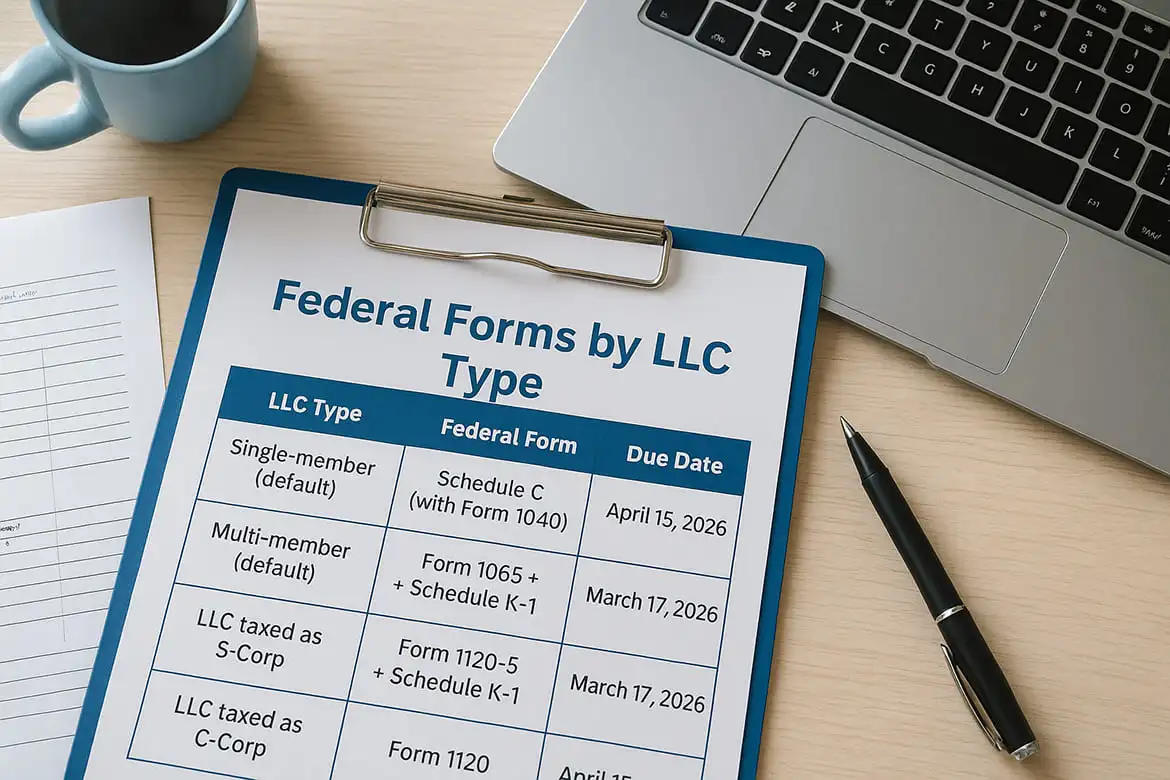
| LLC Type | Federal Form | Due Date |
|---|---|---|
| Single-member (default) | Schedule C (with Form 1040) | April 15, 2026 |
| Multi-member (default) | Form 1065 + Schedule K-1 | March 17, 2026 |
| LLC taxed as S-Corp | Form 1120-S + Schedule K-1 | March 17, 2026 |
| LLC taxed as C-Corp | Form 1120 | April 15, 2026 |
If your LLC elected S-Corp or C-Corp status, confirm that election is on record with the IRS before you file. Submitting as a default LLC when an election is already in place creates a mismatch the IRS will flag.
State Filing Requirements
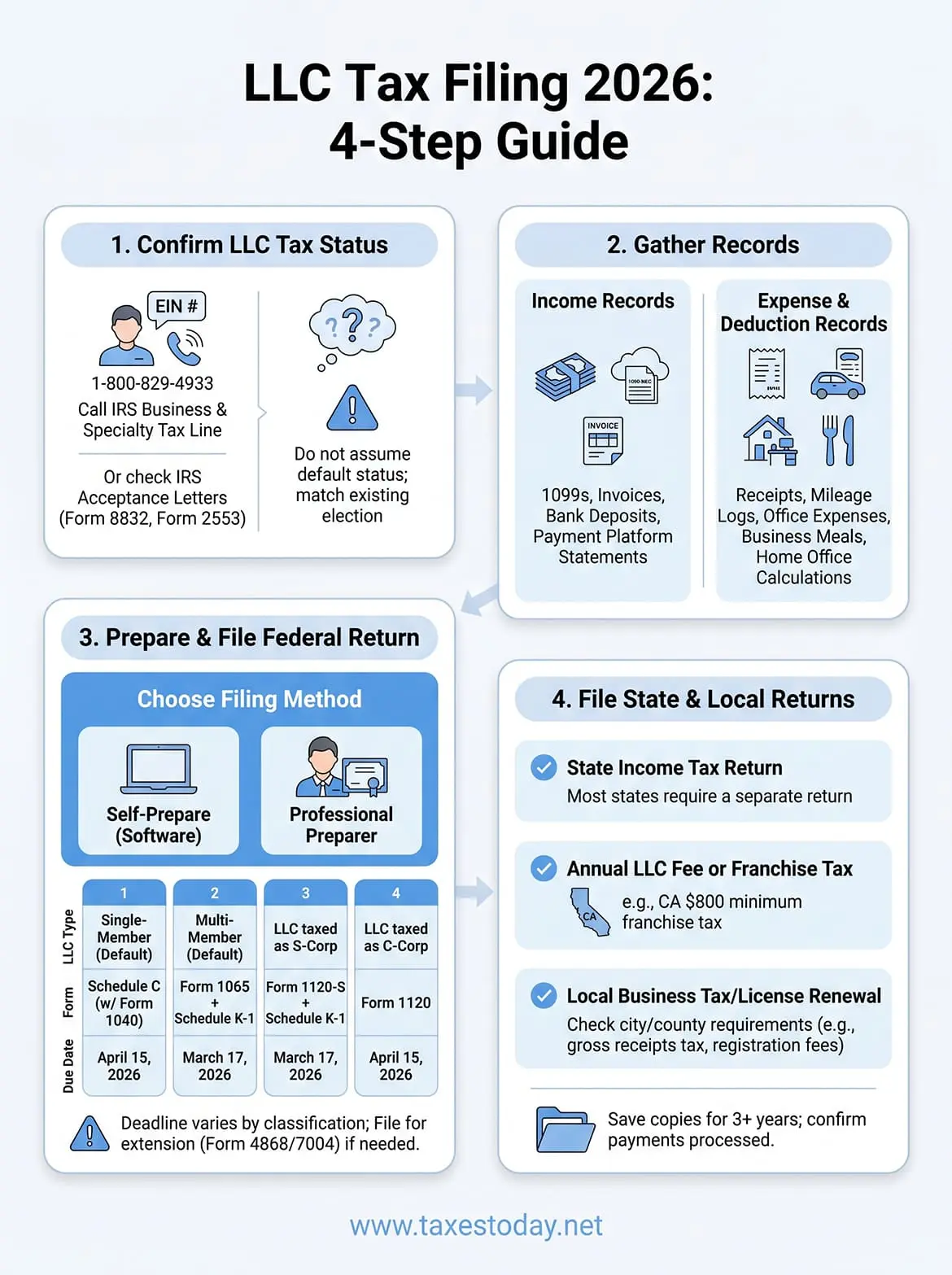
Most states require a separate state income tax return, and many also charge an annual LLC fee or franchise tax on top of that. California, for example, hits LLCs with a minimum $800 franchise tax every year, regardless of whether your business turned a profit. Check your specific state's requirements before assuming a federal return is all you owe. Skipping a required state filing carries its own set of penalties, completely separate from any federal issues.
Step 1. Confirm your LLC tax status
Your LLC's tax classification controls everything else in the filing process. Before you pull a single form or open any tax software, check your IRS records to confirm how your LLC is currently classified. If you filed Form 8832 (to elect C-Corp status) or Form 2553 (to elect S-Corp status), the IRS has you on record under that classification, and filing as a default LLC would create a mismatch the IRS will flag.
How to Check Your Current Classification
The fastest way to verify your status is to call the IRS Business & Specialty Tax Line at 1-800-829-4933. Have your EIN ready before you call. The representative can confirm which classification is currently on file. You can also review any IRS acceptance letters you received after submitting Form 8832 or 2553, since those letters confirm the effective date of your election.
If you're unsure whether you ever filed an election, call the IRS before you file anything. Assuming default status when an active election is on record is one of the most common errors in filing business taxes for LLC owners.
If your current classification no longer fits your business structure, you can change it, but doing so requires a separate election form and strict timing rules around when that change takes effect.
Step 2. Gather the records you need
Before you open any tax form, pull together every document that reflects what your LLC earned and spent during the tax year. Missing records are the main reason filing business taxes for LLC owners takes longer than it should, and gaps in your documentation can mean missed deductions or an unwanted IRS inquiry.
Income Records
Your income documentation needs to account for every dollar your LLC received. Gather all 1099-NEC forms from clients who paid you $600 or more, plus any invoices, bank deposits, or payment platform statements (such as PayPal or Stripe) that capture additional revenue.
Keep records of income even when no 1099 was issued. The IRS expects you to report all revenue, not just what appears on a form.
Expense and Deduction Records
Deductions reduce your taxable income, but you need receipts and supporting records to back them up. Collect documentation for:
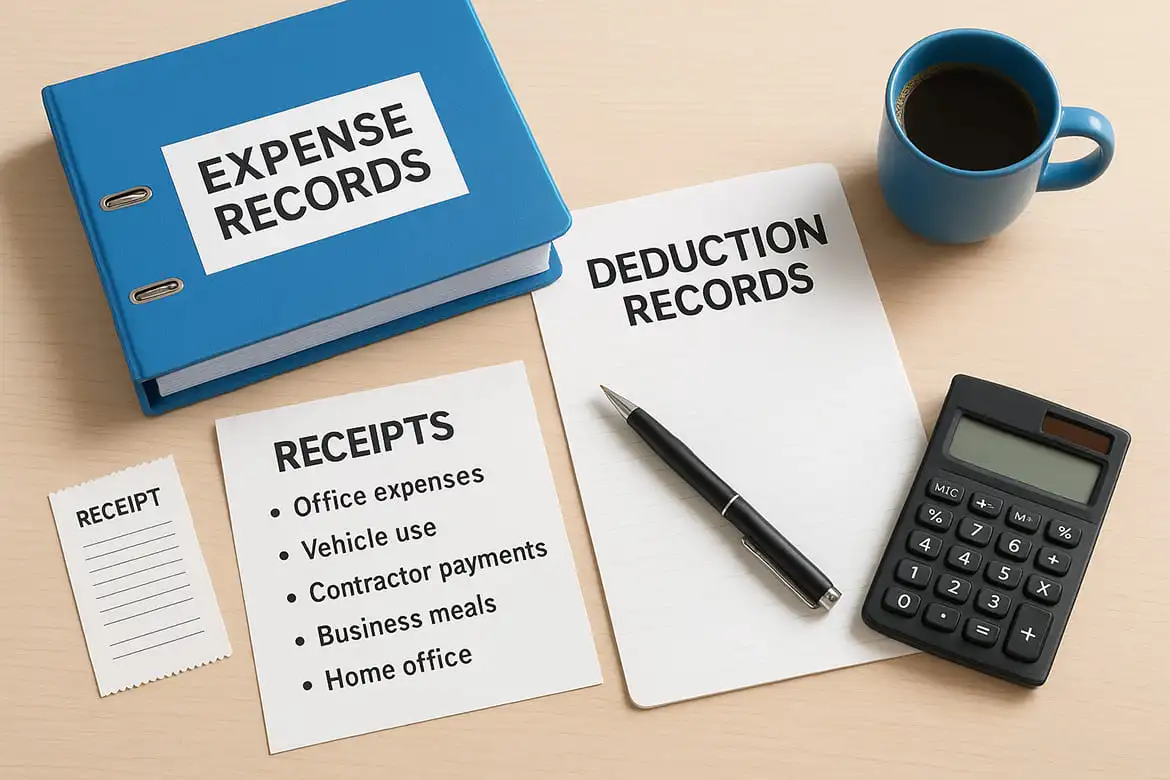
- Office expenses: rent, utilities, and supplies
- Vehicle use: mileage logs or actual expense records
- Contractor payments: copies of 1099-NEC forms you issued
- Business meals: receipts showing date, amount, and business purpose
- Home office: square footage calculations and total housing costs
Step 3. Prepare and file your federal return
Once your records are organized, you're ready to prepare the actual return. The form you use depends on your LLC's tax classification from Step 1, so confirm that before you start entering any numbers. Filing business taxes for LLC owners accurately means matching every entry on your return to a supporting document you gathered in Step 2.
Choose Your Filing Method
You have two main options: self-prepare using tax software or work with a licensed tax professional. Software like IRS Free File works well for simple single-member LLCs with straightforward income and expenses. For multi-member LLCs, S-Corp elections, or any year with significant deductions, a certified tax preparer will catch items that software routinely misses.
A missed deduction costs you real money, while a professional's fee often pays for itself in tax savings alone.
Submit on Time
Deadlines vary based on your LLC's tax classification. Multi-member LLCs and S-Corps must file by March 17, 2026, while single-member LLCs and C-Corps have until April 15, 2026. If you need more time, file Form 4868 (for individuals) or Form 7004 (for businesses) before your original deadline to get an automatic extension without penalty.
Step 4. File your state and local returns
After submitting your federal return, your state filing comes next. Most states tie their LLC requirements to your federal tax classification, so the structure you used federally guides your state filing as well. Every state has its own rules, and skipping a required filing results in penalties that stack up fast.
California-Specific Requirements
California LLCs must file Form 568 with the Franchise Tax Board and pay the annual $800 minimum franchise tax regardless of whether your business turned a profit. If your LLC earned more than $250,000 in California, you also owe an additional LLC fee on top of that. Deadlines generally align with federal due dates, but verify the current year's dates directly on the California FTB website.
Filing business taxes for LLC owners in California means accounting for both the franchise tax and the income return separately, missing either one triggers its own penalty.
Local and City Taxes
Some cities and counties require a separate local business tax return or annual business license renewal in addition to your state filing. Check with your local city or county revenue office to confirm what you owe before you consider the filing season complete.
Common local requirements include:
- Business license renewal fees due annually
- Gross receipts taxes based on your LLC's local revenue
- City-specific registration filings
What to do after you file
Filing your return is not the finish line. Once your return is submitted, save copies of everything, including your filed return, all supporting schedules, and any confirmation numbers from e-filing. The IRS recommends keeping tax records for at least three years from the date you filed, and up to seven years if you reported a loss or underreported income.
After saving your records, check that any tax payments due were actually processed by your bank. If you owe a balance, confirm the payment cleared before your deadline to avoid interest charges. Estimated quarterly taxes for the next year should also go on your calendar now, since missing a quarterly payment triggers underpayment penalties that add up by year-end.
Filing business taxes for LLC owners gets easier every year once you have a system in place. If you want a licensed professional to handle the details and make sure nothing gets missed, get your LLC taxes prepared by a certified expert at TaxesToday.