


Filing Business Taxes for Your LLC for the First Time
You formed your LLC, made some money, and now the first tax season as a business owner is staring you down. Filing business taxes for LLC for the first time feels different from the W-2 returns you're used to, and one wrong move on your form choice or deductions can cost you a refund or trigger an IRS notice down the road.
Here's the direct answer: which forms you file depends on how your LLC is taxed. A single-member LLC usually reports on Schedule C attached to your personal 1040, while multi-member LLCs and those electing S-Corp status file separate business returns with different deadlines. Add in self-employment tax, quarterly estimates, and deductions for home office or mileage, and the process gets complicated fast.
This guide walks you through the whole process step by step, from figuring out your filing status to gathering the right documents, claiming deductions you're entitled to, and deciding whether DIY software or a licensed preparer makes more sense for your situation. Whether you're a freelancer who just formed an LLC or a small business owner filing solo for the first time, you'll leave knowing exactly what to do next.
What to know before filing LLC taxes for the first time
The IRS doesn't actually see "LLC" as a tax status at all. Your LLC is a state-level legal structure, and the federal government taxes it based on a default classification tied to how many owners you have, unless you file paperwork to change it. A single-member LLC is automatically treated as a disregarded entity, meaning your business income and expenses flow straight onto your personal Form 1040 through Schedule C. A multi-member LLC defaults to partnership taxation and files its own return, Form 1065, with each owner receiving a Schedule K-1. Nothing about this happens automatically in your favor. If you never filed an election, you're on the default track, and that shapes every form you'll touch this season.
Federal and state deadlines rarely line up
Deadlines trip up more first-time filers than any deduction ever will. Partnerships and LLCs taxed as S-Corps owe their returns a full month before sole proprietors and C-Corps, and missing that earlier date triggers penalties even if you don't owe a dime. California and most other states layer their own due dates and minimum franchise taxes on top of the federal calendar, so check your state's requirements separately, including the California LLC return on Form 568.

| LLC tax treatment | Federal form | Typical due date |
|---|---|---|
| Single-member (disregarded entity) | Schedule C with Form 1040 | April 15 |
| Multi-member (partnership) | Form 1065 | March 15 |
| Elected S-Corp | Form 1120-S | March 15 |
| Elected C-Corp | Form 1120 | April 15 |
Miss the wrong deadline and you'll owe a penalty before you've even calculated a dollar of tax.
Your first return needs more paperwork than a W-2 ever did
Gathering documents now saves you from a frantic search in April, and a document checklist for tax season keeps the process from turning into guesswork. At minimum, pull together your EIN confirmation letter, business bank and credit card statements for the full year, a mileage log if you drove for the business, and receipts for any equipment, software, or supplies you bought to get things running. If you formed the LLC partway through the year, dig up your formation date and any startup costs you paid before you technically opened, since those often qualify for a special deduction you'd otherwise miss.
Self-employment tax surprises almost everyone
Self-employment tax is the line item that catches new LLC owners off guard every single year, so it helps to see how the 15.3% is calculated step by step before you file. As an LLC owner taxed as a sole proprietor or partner, you're on the hook for both the employer and employee share of Social Security and Medicare, which adds up to 15.3% on top of your regular income tax. There's no employer withholding it from a paycheck this time, so if you cleared a decent profit and haven't set aside cash, you could be staring at a bill you didn't budget for. The IRS explains how this tax works in detail on its self-employment tax page, and it's worth a read before you file.
Know what you don't know yet
Recognizing the gaps in your own knowledge matters more this year than any other, because a first-time mistake tends to repeat itself for years if nobody catches it. Small business owners who electing S-Corp status, for example, often don't realize they need to run payroll for themselves, complete with withholding and quarterly payroll filings, not just take draws whenever cash is available, which is where understanding owner salary versus distributions matters. Others miss that home office deductions require consistent, exclusive use of the space, not just a desk in the corner of a shared room. None of this means you need to become a tax expert overnight. It means going into the process with your eyes open about what applies to your specific setup, which is exactly what the rest of this guide walks through step by step.
Step 1. Confirm your LLC's tax classification
Before you touch a single tax form, pin down exactly how the IRS treats your LLC. This sounds obvious, but plenty of first-time filers assume their business structure and their tax classification are the same thing. They're not. A single-owner LLC defaults to a disregarded entity, taxed like a sole proprietorship, unless you've filed paperwork saying otherwise. A multi-owner LLC defaults to partnership taxation. Neither of those defaults is permanent, and you may have already filed an election without realizing its full implications, especially if your accountant or a business formation service recommended S-Corp status when you set up the LLC.
Check your records for two specific forms before you assume anything. If you or a previous preparer filed Form 8832, you elected corporate taxation, either as a C-Corp or, combined with Form 2553, as an S-Corp. If you filed Form 2553 alone, you elected S-Corp status on top of your default classification. No paperwork on file means you're on the default track for your ownership structure. Call the IRS Business & Specialty Tax Line at 800-829-4933 if you genuinely don't know, since guessing wrong here cascades into every other step of this guide.
Your LLC's legal paperwork and its tax classification are two different documents, and confusing them is the single most common first-year mistake.
Weigh whether an election makes sense this year
Deciding whether to elect S-Corp status isn't a first-year requirement, but it's worth comparing which structure saves you more, an LLC or an S Corp before deadlines close in. Generally, electing S-Corp treatment only pays off once your net self-employment income clears roughly $40,000 to $60,000 a year, because the tax savings need to outweigh the cost of running payroll and filing a separate business return. Owners with modest first-year profits usually come out ahead staying on the default classification and revisiting the election next year once income stabilizes.
Timing matters if you do decide to elect. Here's what applies depending on your situation:
- New LLCs: file Form 2553 within 75 days of formation to have S-Corp treatment apply to your first tax year.
- Existing LLCs: file by March 15 for the election to apply to the current tax year; later filings apply to the following year.
- Missed deadlines: late election relief exists under Revenue Procedure 2013-30, but it requires a reasonable cause statement and isn't guaranteed.
Once you've confirmed your classification, or made a deliberate choice about it, everything downstream, from which forms you file to how you pay yourself, follows from that single decision.
Step 2. Get an EIN and set up your recordkeeping
Every LLC that plans to hire employees, open a business bank account, or elect corporate taxation needs an Employer Identification Number (EIN), and even single-member LLCs without employees benefit from getting one instead of using a personal Social Security number on business paperwork. Applying costs nothing and takes about ten minutes through the IRS EIN application if you finish it in one sitting, since the online system times out after inactivity and won't save partial progress.
Apply for your EIN the right way
Gather your LLC formation documents and the responsible party's Social Security number before you start, since the IRS requires a real person, not another entity, listed as the responsible party. Follow these steps:
- Confirm your LLC is officially registered with your state before applying; the IRS checks formation dates against your application.
- Complete the online application on IRS.gov between 7 a.m. and 10 p.m. Eastern, Monday through Friday.
- Download and save the confirmation letter (CP 575) immediately; the IRS won't mail a replacement copy if you lose it.
- Use your EIN, not your Social Security number, on all business bank accounts, contracts, and vendor forms going forward.
An EIN costs nothing and keeps your Social Security number off every invoice and contract you sign.
Build a recordkeeping system before the receipts pile up
Separating business and personal finances matters more than almost any other habit you build this year, because commingled accounts make accurate small business tax return preparation nearly impossible and raise red flags if the IRS ever questions your deductions. Open a dedicated business checking account and a business credit card the same week you get your EIN, then route every dollar of income and every business expense through those accounts exclusively.
Pick a bookkeeping method now rather than reconstructing a year of transactions in March. Options include:
| Method | Best for | Typical cost |
|---|---|---|
| Spreadsheet | Very simple, low-volume LLCs | Free |
| Accounting software | Most first-year LLCs | $0-$30/month |
| Bookkeeper | LLCs with employees or inventory | $200+/month |
Whichever method you pick, save digital copies of every receipt as you go instead of stuffing them in a shoebox. If organizing a year of transactions already feels overwhelming, affordable small business tax preparation services can take the recordkeeping and filing off your plate entirely.
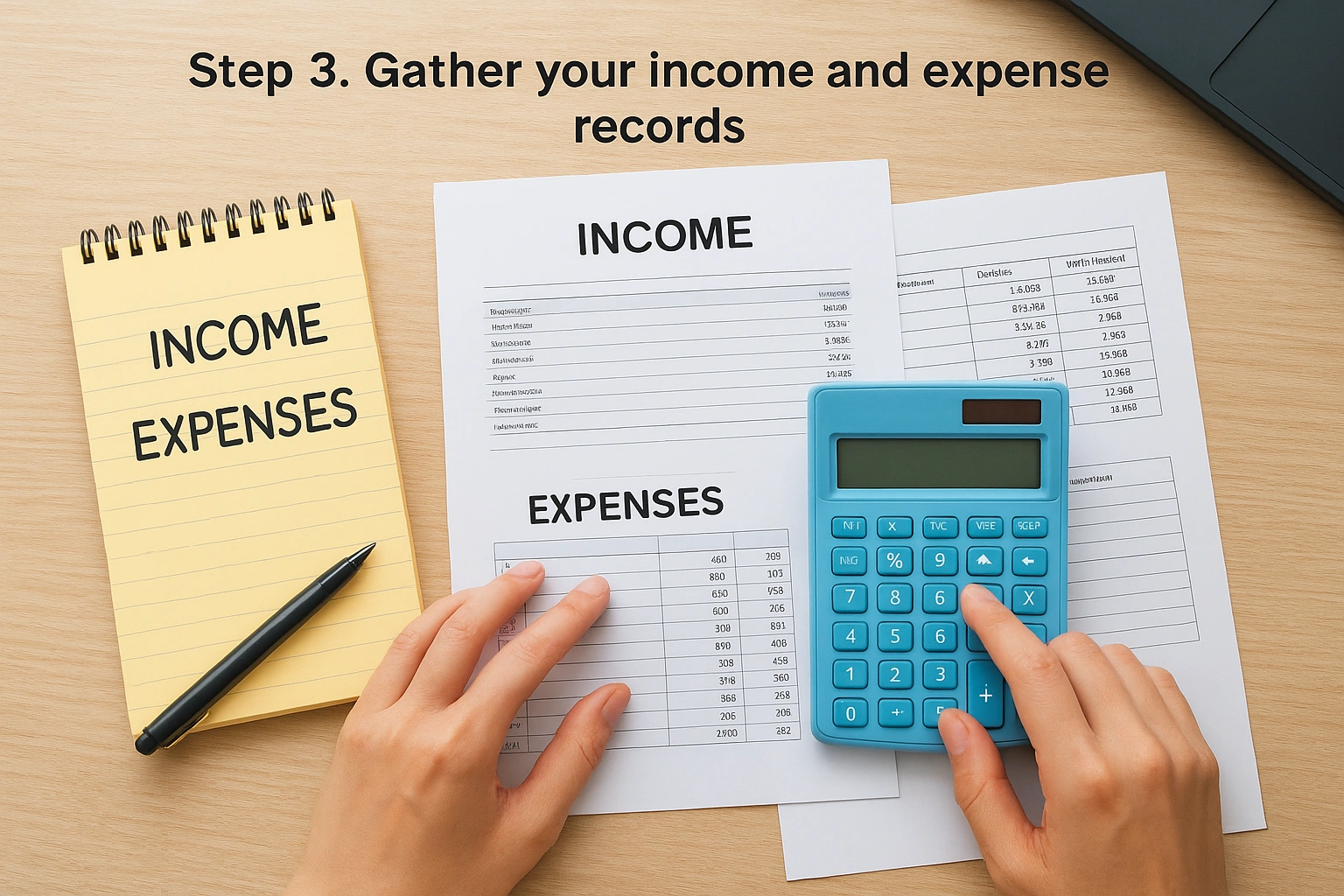
Step 3. Gather your income and expense records
Once you know your classification and have your EIN in hand, the real legwork starts: pulling together a full year of income and expenses before you can put a single number on a form. Most first-time filers underestimate how scattered this information is, especially if you didn't set up a dedicated business account until partway through the year. Start early, because reconstructing months of transactions from memory in April is where errors creep in.
Track every income source, not just your 1099s
Don't assume your 1099-NEC and 1099-K forms capture everything you earned. Clients who paid you less than $600 aren't required to send a 1099 at all, but you still owe tax on that money, and the IRS expects you to report it. Pull a full income picture from these sources:
- 1099-NEC and 1099-K forms from clients and payment platforms
- Bank deposits into your business account for the year
- Invoices you sent, paid or not, if you use accrual accounting
- Cash or check payments that never generated a 1099
Reconcile these against your bank statements line by line. Gaps between what your 1099s show and what actually hit your account are exactly what an IRS notice looks for.
Your tax return needs your total income, not just the portion someone else reported to the IRS.
Sort your expenses into IRS categories as you go
Expenses matter just as much as income, since every dollar you can document and categorize correctly lowers your taxable profit. Schedule C and Form 1065 both organize deductions into specific IRS categories, so working from a list of Schedule C expense categories now saves you from guessing later.
| Expense category | Examples | Documentation needed |
|---|---|---|
| Supplies and materials | Office supplies, inventory | Receipts, invoices |
| Vehicle and mileage | Client visits, deliveries | Mileage log with dates |
| Home office | Portion of rent, utilities | Square footage records |
| Professional services | Legal, accounting fees | Invoices |
| Software and subscriptions | Accounting tools, apps | Statements |
A mileage log deserves special attention here. The IRS wants dates, destinations, business purpose, and miles driven for each trip, not a single estimated total scribbled at year-end. Apps that track mileage automatically beat a paper log for accuracy, and they hold up better if the IRS ever asks for proof.
Match records to whichever accounting method you use
Cash-basis LLCs count income when received and expenses when paid, which is simpler and what most first-year filers default to. Accrual-basis LLCs count income when earned and expenses when incurred, regardless of when cash actually moves. Confirm which method applies to you before you start pulling numbers, since mixing the two methods within one return is a common and entirely avoidable mistake.
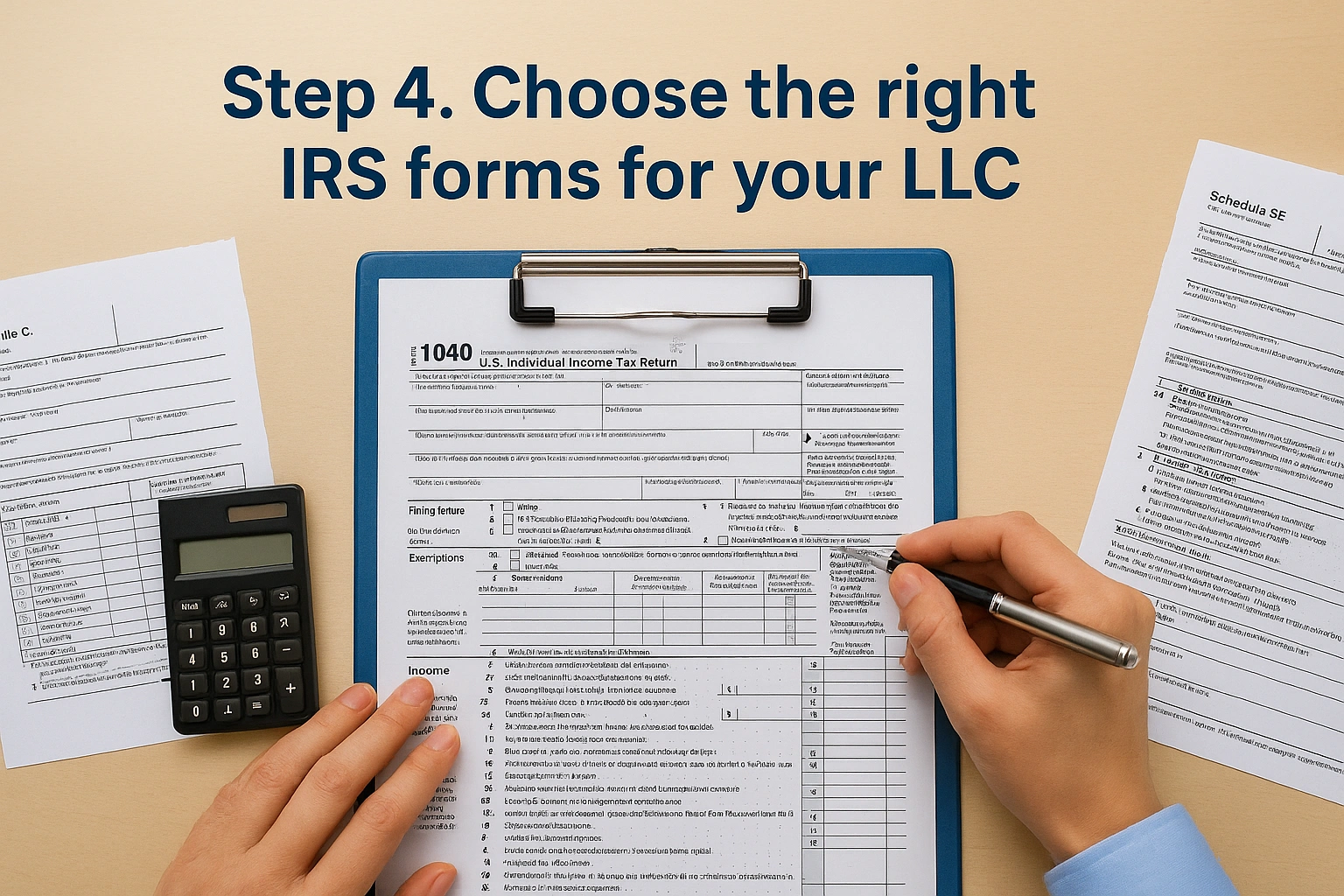
Step 4. Choose the right IRS forms for your LLC
Now that your classification is settled and your records are sorted, matching the right paperwork to your situation becomes the next hurdle. Each classification pulls in its own set of schedules and attachments, and using the wrong one delays processing or triggers a mismatch notice from the IRS. Think of this step as translating everything you gathered in Step 3 into the specific forms the IRS expects from your exact setup.
Forms for single-member LLCs
A single-member LLC taxed as a disregarded entity files Schedule C alongside your personal Form 1040, reporting gross income and every deductible expense on one continuous form. If your net profit exceeds $400, you'll also attach Schedule SE to calculate self-employment tax, since that liability doesn't calculate itself just because you filled out Schedule C. Owners with rental income, investment income, or a home office deduction may need Schedule E or Form 8829 layered on top, so don't assume Schedule C alone covers everything your LLC touched during the year.
Forms for multi-member LLCs and elected corporations
Multi-member LLCs taxed as partnerships file Form 1065, an informational return that reports the business's total income and expenses without calculating any tax owed. Each member then receives a Schedule K-1 showing their share of profit or loss, which flows onto their personal 1040, and reporting K-1 income correctly is its own small process. LLCs that elected S-Corp status file Form 1120-S instead, also issuing K-1s to each shareholder, while those taxed as C-Corps file Form 1120 and pay corporate tax directly rather than passing income through to owners.
The form you file isn't a choice you make in April, it's a consequence of the classification decision you made back in Step 1.
Match your forms to your classification
| LLC classification | Primary federal form | Additional attachments |
|---|---|---|
| Single-member (disregarded) | Schedule C (Form 1040) | Schedule SE, Form 8829 |
| Multi-member (partnership) | Form 1065 | Schedule K-1 for each member |
| Elected S-Corp | Form 1120-S | Schedule K-1, Form 1120-S Schedule B |
| Elected C-Corp | Form 1120 | Form 1125-A if reporting cost of goods sold |
Don't rely on memory to pick forms correctly; cross-check this table against Step 1's classification before you start data entry. Solid small business income tax preparation starts with confirming this match, because every deduction and credit you claim in the next step gets reported on whichever form applies to your structure. Software built for small businesses usually asks classification questions upfront and routes you to the right forms automatically, but it's still worth verifying the output against what you expected before you submit anything.
Step 5. Claim your LLC deductions and credits
With your forms picked out, the next job is lowering your taxable profit by claiming everything you're legally owed. Most first-time filers leave money on the table simply because they don't know a deduction exists, which is why a checklist of write-offs LLC owners can claim is worth reading before you finish. This step is where solid recordkeeping from Step 3 pays off directly, since every deduction below requires documentation the IRS can request later.
Don't miss these commonly overlooked deductions
Startup costs trip up more new owners than any other line item, because the IRS lets you deduct up to $5,000 in expenses you paid before you officially opened, things like market research, legal fees, and initial marketing. Beyond that, run through this list before you finalize your return:
- Home office deduction: either $5 per square foot (simplified method) or actual expenses based on the percentage of your home used exclusively for business; the rules, methods, and forms for writing off a home office spell out what qualifies.
- Vehicle expenses: the standard mileage rate or actual costs, whichever produces the bigger deduction for your situation.
- Health insurance premiums: self-employed owners can often deduct their own premiums directly, separate from Schedule C.
- Retirement contributions: a SEP-IRA or Solo 401(k) reduces taxable income while building your own retirement savings.
- Professional services: what you pay an accountant, attorney, or bookkeeper is fully deductible.
A dollar of deductions you forget to claim is a dollar of tax you paid for nothing.
Understand the Qualified Business Income deduction
Most LLC owners taxed as pass-through entities qualify for the Qualified Business Income deduction and its eligibility rules under Section 199A, which lets you deduct up to 20% of your net business income before it even hits your personal tax rate. The math gets more complicated once your taxable income crosses roughly $191,950 for single filers or $383,900 for joint filers in 2024, since certain service businesses face phase-out limits at that point. The IRS Section 199A overview explains the thresholds and exceptions in more detail, and it's worth checking against your actual income before you assume the full 20% applies.
Keep proof for every deduction you claim
Claiming a deduction and being able to defend it are two separate things, so match each expense category to its supporting documentation as you go. A home office deduction needs square footage records, a vehicle deduction needs a mileage log, and a retirement contribution needs the account statement showing the deposit actually happened before your filing deadline. Businesses working through tax preparation for small business owners for the first time often assume a bank statement alone is enough proof, but the IRS generally wants the underlying receipt or invoice too. Building that habit now, rather than scrambling for proof during an audit two years from now, is worth the extra ten minutes per transaction.
Step 6. Calculate and pay estimated taxes
Once you know your forms and deductions, the next question is when you actually hand money to the IRS. LLC owners taxed as sole proprietors or partners don't have an employer withholding tax from a paycheck, so the IRS expects you to pay quarterly estimated taxes throughout the year instead of one lump sum in April, and it's worth knowing who owes estimated taxes, when, and how much. Skip this step and you'll owe an underpayment penalty even if you pay your full balance by the filing deadline, since the IRS expects the money as you earn it, not all at once.
Figure out how much to send each quarter
Quarterly amounts don't need to be exact, but they do need to clear a safe harbor threshold to avoid a penalty. The IRS generally won't penalize you if you pay the smaller of these two amounts across the year:
- 90% of your current year's total tax liability, spread across four payments
- 100% of last year's tax liability (110% if your prior year adjusted gross income topped $150,000)
First-year filers usually rely on the 90% estimate since there's no prior return to compare against. Add up your projected net profit, run it through a self-employment tax calculator, and divide the total by four, following the same math used to work out each quarterly payment.
Paying nothing until April doesn't save you money, it just adds a penalty on top of the tax you already owed.
Know your deadlines and how to pay
Quarterly deadlines don't line up neatly with actual calendar quarters, so mark these dates now rather than guessing later:
| Payment period | Due date |
|---|---|
| January 1 - March 31 | April 15 |
| April 1 - May 31 | June 15 |
| June 1 - August 31 | September 15 |
| September 1 - December 31 | January 15 (following year) |
Send payments through the IRS Direct Pay system or enroll in EFTPS if you'd rather schedule payments in advance for the whole year. Both options generate an immediate confirmation number, which matters if a payment ever gets questioned later.
Adjust as your income changes
Income rarely stays flat during a first year in business, so revisit your estimate every quarter rather than locking in one number in January and forgetting about it. Underpaying because your business grew faster than expected still triggers a penalty, even though the extra income is good news. Recalculating each quarter based on actual profit, not your original projection, keeps you closer to the safe harbor, and the annualized income method for uneven earnings avoids a surprise bill when you finally sit down to file your return.
Step 7. File your return and pay what you owe
Everything up to this point has been preparation. Now you actually submit the return and settle up with the IRS. Filing your return online is the standard path for nearly every LLC classification, and the IRS processes electronic returns faster than paper ones, which matters if you're expecting a refund or want quick confirmation that your first business return went through cleanly. Whether you're working through tax preparation for small business owners on your own or handing it to a preparer, the mechanics of this final step stay the same: submit, pay, and keep proof.
Pick your filing method
Single-member LLCs filing Schedule C submit through the same e-file system as any personal 1040, either through tax software or a preparer's account. Multi-member LLCs and S-Corps need software or a preparer that supports Form 1065 or 1120-S specifically, since not every consumer tax product handles business returns. Before you submit, run through this checklist:
- Confirm your EIN and business name match IRS records exactly, since a mismatch bounces the return.
- Double-check that every Schedule K-1 (if applicable) went out to each member or shareholder.
- Verify your bank routing and account numbers if you're requesting direct deposit or scheduling a direct debit.
- Save a PDF copy of the complete return before you hit submit, not after.
A rejected e-file because of a typo in your EIN still counts as filing late if you don't catch it before the deadline.
Pay what you owe without missing the deadline
Owing money on your first business return catches a lot of new owners off guard, especially after estimated payments didn't quite cover the full self-employment tax bill. If you can't pay the full amount, file the return anyway and pay as much as you can, since the failure-to-file penalty runs far steeper than the failure-to-pay penalty. The IRS offers short-term and long-term payment plans through its online payment agreement tool if you need more than a few weeks to settle the balance.
Keep your confirmation and copies
Saving proof of filing matters as much as the filing itself. Download your e-file acceptance confirmation the moment you get it, and store a complete copy of the return, every attached schedule, and your payment confirmation somewhere you can find it again. The IRS generally has three years to audit a return, longer if it suspects a substantial understatement of income, so treat this year's paperwork as something you'll need to produce again down the road. If any of this still feels shaky, TaxesToday's tax preparation services can file the return, calculate what you owe, and hand you clean records for next year in one pass.
Tax prep options: software, free filing, or a pro
Deciding how to actually file my business taxes comes down to how complex your LLC's situation is and how comfortable you are reading IRS instructions without panicking. A single-member LLC with modest income and no employees can often get away with consumer software, while multi-member LLCs, S-Corps, or anyone juggling multiple income streams usually needs more firepower than a $50 program provides. Match the tool to the complexity you actually have, not the complexity you wish you had.
When software gets the job done
Generally, best online tax preparation for small business software works well for straightforward Schedule C filers who kept clean books all year and don't have payroll, inventory, or multi-state income to untangle. These programs, like TurboTax's self-employed edition, walk you through income and expense entry, calculate self-employment tax automatically, and e-file directly to the IRS. Their weak spot is judgment calls: software won't tell you whether an S-Corp election makes sense or catch a missed deduction it never thought to ask about.
Free filing has real limits
Free options exist, but check the fine print before you rely on one for a business return. The IRS Free File program covers simple Schedule C situations for filers under a certain income threshold, but most free tiers exclude self-employment income entirely or charge extra once Schedule SE enters the picture. Don't assume free stays free once your LLC's income shows up.
Free filing works great for a W-2 return; it rarely covers a business return without an upgrade fee attached.
When a professional earns their fee
Complexity is the signal that tells you to stop DIYing it and compare the top filing services for 1099 and small business owners. Multi-member LLCs, S-Corp elections, back taxes, or any year where you're genuinely unsure which forms apply are exactly the situations where business tax filing services pay for themselves through deductions you'd have missed and penalties you avoid.
| Option | Best for | Typical cost |
|---|---|---|
| DIY software | Simple single-member LLC, clean records | $50-$150 |
| Free filing | Very low income, no self-employment tax | $0 (limited eligibility) |
| Licensed preparer | Multi-member, S-Corp, back taxes, complex deductions | Varies by return |
Choosing the right tax preparer service also catches things software can't flag, like whether your recordkeeping actually supports the deductions you claimed. TaxesToday's tax preparation for small business owners pairs CTEC-certified preparers with both virtual and in-person options, so you get a second set of eyes on your first return without adding another confusing tool to your plate.
Heading into your first LLC tax season prepared
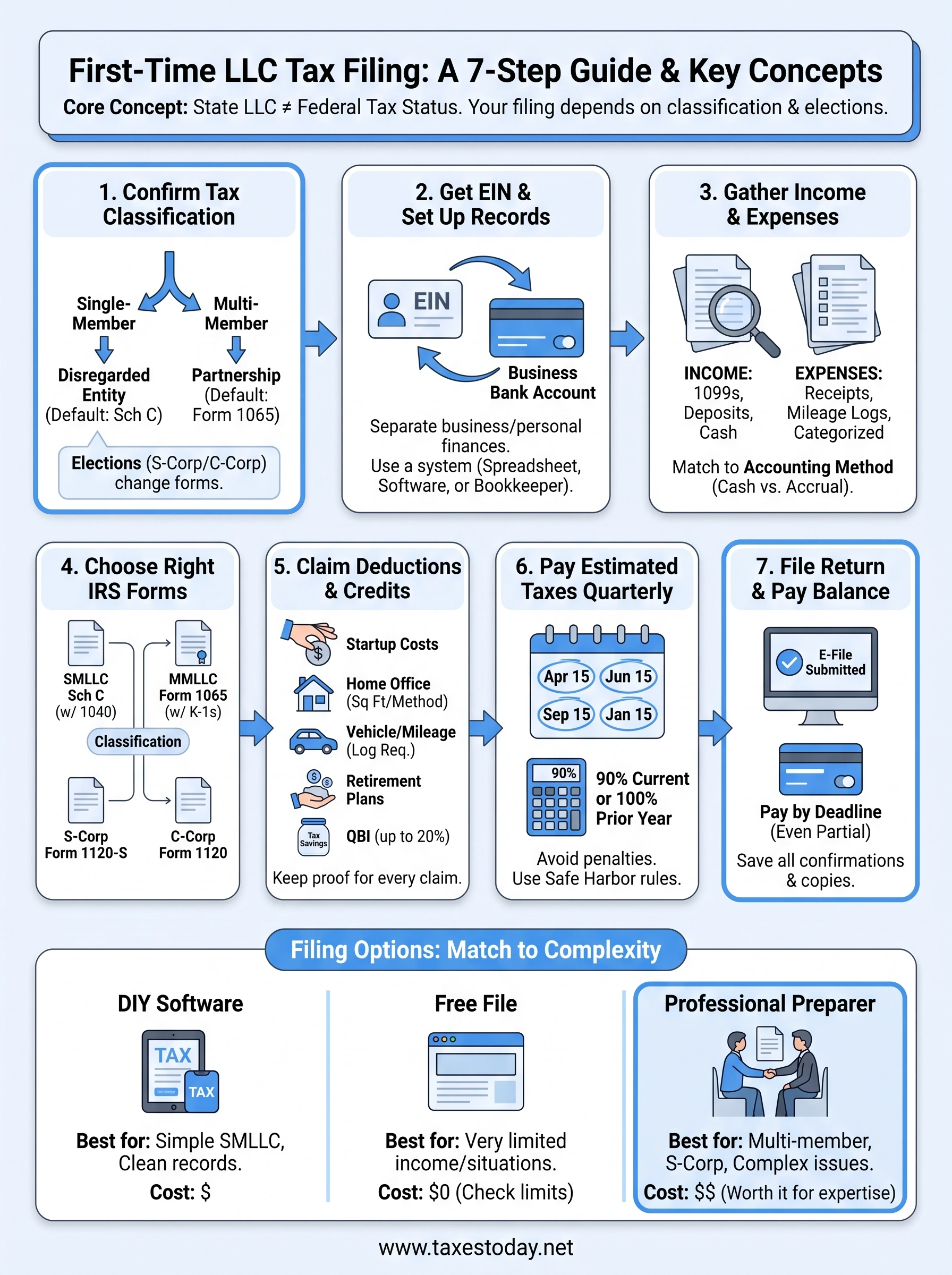
Your first LLC tax season boils down to seven moves: confirm your classification, get organized with an EIN and clean books, gather every dollar of income and expense, pick the right forms, claim what you're owed, pay quarterly, and file with proof in hand. None of these steps are optional, and skipping one usually shows up as a penalty or a missed deduction later. Filing business taxes for LLC for the first time feels heavier than it actually is once you break it into pieces this way.
Getting through this correctly matters more than getting through it fast, since this year's forms and habits set the pattern for every return after it. If you'd rather have a CTEC-certified preparer double-check your classification, forms, and deductions instead of guessing alone, get your LLC return prepared and e-filed from $99 with TaxesToday, covering LLCs at every stage.