


Estimated Tax Payments: How To Calculate Quarterly Taxes
If you've ever worked more than 40 hours in a single week, you've probably wondered whether your paycheck actually reflected those extra hours. Knowing how to calculate overtime pay isn't just useful, it's essential for making sure you're getting what you're legally owed. Under the Fair Labor Standards Act (FLSA), most hourly employees earn 1.5 times their regular rate for every hour beyond 40 in a workweek. But the math isn't always as straightforward as it sounds, especially when bonuses, multiple pay rates, or state-specific rules come into play.
Overtime earnings also have a direct impact on your taxes. Extra hours mean extra income, which can shift your tax bracket, change your withholding, and affect the refund or balance due on your return. At TaxesToday, we help individuals, freelancers, and small business owners across California and nationwide file accurate returns that account for every dollar earned, overtime included.
This guide breaks down the FLSA overtime formula step by step, walks through real examples, and covers the exceptions you need to watch for. Whether you're double-checking your own paycheck or calculating wages for employees, you'll have a clear method by the end. Let's get into the numbers that matter.
What counts as overtime under the FLSA
The Fair Labor Standards Act (FLSA) sets the federal baseline for overtime pay in the United States. Understanding how to calculate overtime pay starts with knowing when overtime actually kicks in. Under this law, any non-exempt employee who works more than 40 hours in a single workweek must receive pay at a rate of at least 1.5 times their regular rate for those extra hours. The FLSA does not define overtime by the day, so working 10 hours on a Monday does not automatically trigger overtime if your total weekly hours stay at or below 40.
The 40-hour workweek rule
A workweek under the FLSA is any fixed, regularly recurring period of 168 hours, which equals seven consecutive 24-hour days. Your employer sets the start and end day, and that schedule stays consistent. Hours do not carry over from one workweek to the next, so if you work 50 hours one week and 30 the next, only the first week triggers overtime.
The FLSA calculates overtime strictly on a workweek basis, not a biweekly or monthly pay period.
Your employer can choose any day as the start of the workweek, but once set, that schedule cannot change just to avoid paying overtime. If your employer shifts the workweek boundaries in a way that eliminates overtime hours, that practice can violate the FLSA.
Who qualifies for FLSA overtime protection
Not every worker qualifies automatically. The FLSA splits workers into exempt and non-exempt categories, and your classification determines whether you're entitled to overtime at all. Non-exempt workers are covered; exempt workers are not. Common exempt categories include:

- Executive, administrative, and professional employees who meet a salary threshold
- Outside sales employees
- Certain computer-related workers earning above a specified hourly rate
Some states, including California, go beyond the FLSA. California requires overtime for hours exceeding eight in a single workday, not just 40 in a week. Always check your state rules alongside federal law, because whichever standard gives you greater pay is the one that applies. You can verify current federal thresholds directly through the U.S. Department of Labor.
Step 1. Find your regular rate of pay
Your regular rate of pay is the foundation of the entire overtime calculation. Before you can figure out how to calculate overtime pay correctly, you need to pin down this number precisely, because the FLSA does not always allow you to use your base hourly rate alone.
Simple hourly workers
If you earn a single hourly wage with no bonuses or extra compensation, your regular rate equals that hourly rate. The core formula is:
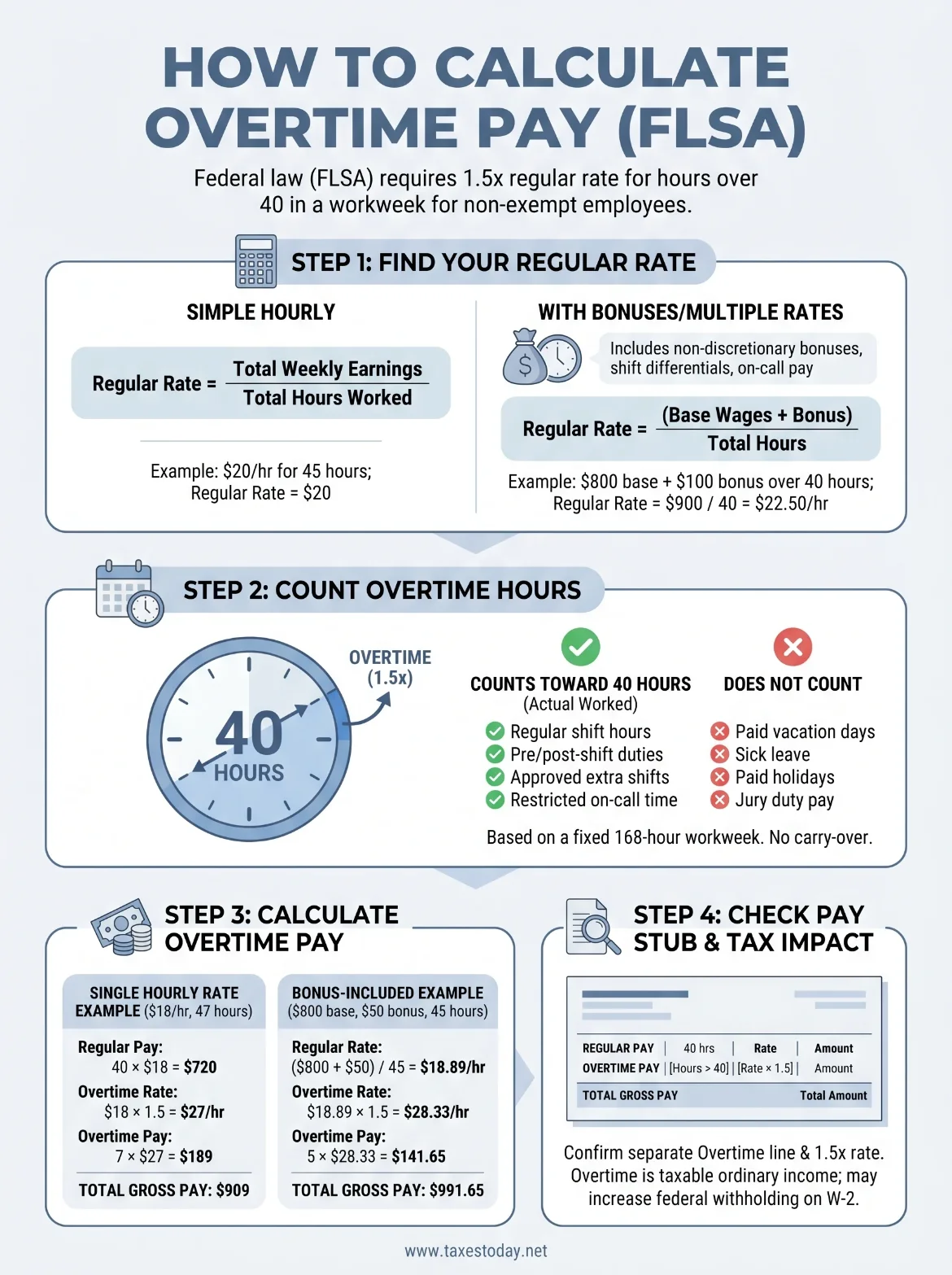
Regular Rate = Total Weekly Earnings / Total Hours Worked
For example, if you earn $20 per hour and work 45 hours, your regular rate stays at $20. Your overtime rate becomes $20 × 1.5 = $30 per hour for each of the five overtime hours.
Your regular rate must reflect all forms of compensation earned that week, not just your base hourly wage.
Workers with bonuses or multiple rates
Non-discretionary bonuses (those tied to performance or hours worked) must be factored into your regular rate. Add the bonus to your total weekly wages, then divide by total hours worked.

Common items that count toward your regular rate:
- Non-discretionary bonuses
- Shift differentials
- On-call pay
If you earned $800 in base wages plus a $100 performance bonus over 40 hours, your regular rate is $900 / 40 = $22.50 per hour, not the flat $20 hourly wage alone.
Step 2. Count overtime hours for the workweek
Once you know your regular rate, the next step is counting your overtime hours accurately. This sounds simple, but errors here are common and costly. Only hours worked beyond 40 in a single workweek count as overtime under the FLSA, so your total must reflect actual time on the job, not paid leave, holidays, or sick days.
What hours count toward the 40-hour threshold
Hours that count toward overtime include all time your employer requires or allows you to work. This covers pre-shift setup, post-shift cleanup, and any approved remote work. Paid time off, sick leave, and holidays do not count toward the 40-hour total, even if your employer pays you for those hours. Knowing this distinction is essential when you're working out how to calculate overtime pay correctly.
Track your actual hours worked each day in writing so you have a clear record if your paycheck ever looks wrong.
Here's a quick reference for what counts and what does not:
| Counts Toward 40 Hours | Does NOT Count |
|---|---|
| Regular shift hours | Paid vacation days |
| Pre/post-shift duties | Sick leave |
| Approved extra shifts | Paid holidays |
| Restricted on-call time | Jury duty pay |
Step 3. Calculate overtime pay in real situations
Knowing how to calculate overtime pay in theory is useful, but working through actual numbers makes the formula stick. The examples below cover the two most common situations you'll run into: a straight hourly rate and a rate that includes a non-discretionary bonus.
Single hourly rate example
Suppose you earn $18 per hour and work 47 hours in one workweek. Your regular pay covers the first 40 hours, and the remaining seven are overtime.
| Component | Calculation | Amount |
|---|---|---|
| Regular pay | 40 × $18.00 | $720.00 |
| Overtime rate | $18.00 × 1.5 | $27.00/hr |
| Overtime pay | 7 × $27.00 | $189.00 |
| Total gross pay | $909.00 |
Bonus-included rate example
Now suppose you earn $800 in base wages over 45 hours and also received a $50 non-discretionary bonus that week. You must fold the bonus into your regular rate before multiplying.
Skipping the bonus when calculating your regular rate is one of the most common overtime errors employers make.
Your regular rate is ($800 + $50) / 45 = $18.89 per hour. Your overtime rate becomes $18.89 × 1.5 = $28.33 per hour for each of the five overtime hours.
Step 4. Check your pay stub and tax impact
Once you've worked out how to calculate overtime pay, comparing your result against your actual pay stub is the final check. Your pay stub should show regular hours and overtime hours as separate line items. If the overtime line is missing or the rate looks wrong, raise it with your payroll department immediately and request a correction in writing.
Reading your pay stub
Your pay stub breaks down gross pay, taxes withheld, and net pay. Look for these specific line items to confirm overtime was calculated correctly:
- Regular hours and rate
- Overtime hours and rate (should be 1.5x your regular rate)
- Total gross pay before deductions
If your pay stub combines regular and overtime hours into one line, ask your employer for a detailed breakdown.
How overtime affects your taxes
Overtime income is taxable at your ordinary income rate, just like regular wages. A higher gross pay week can increase the federal income tax withheld because payroll systems often project your annual income based on that single paycheck. You won't necessarily owe more overall, but your W-2 will reflect all overtime earned, and your tax preparer needs that full picture to file accurately.
Wrap-up and next step
You now have everything you need to work through how to calculate overtime pay accurately. Start with your regular rate of pay, fold in any non-discretionary bonuses, count only actual hours worked beyond 40, and apply the 1.5x multiplier to those extra hours. Compare the result against your pay stub, and flag any discrepancy with your payroll department right away.
Overtime income has real tax consequences. Every extra dollar shows up on your W-2 and gets taxed as ordinary income, so your annual return needs to reflect the full picture. A filing error here can mean a bigger balance due or a smaller refund than you deserve. If you want a professional to review your return and make sure every dollar of wages is counted correctly, get your taxes prepared by a certified tax professional and file with confidence this year.