


Taxes With an LLC: How They Work and How to File
You formed an LLC to protect your personal assets and look more legit to clients, but nobody warned you how confusing taxes with an LLC would get. The IRS doesn't actually have a special LLC tax form. Instead, your LLC gets taxed based on how you set it up and elect to be treated, and that choice changes your forms, your deadlines, and how much you owe.
Here's the short answer: a single-member LLC is taxed like a sole proprietorship by default, a multi-member LLC is taxed like a partnership, and either one can elect S-Corp or C-Corp status to potentially lower self-employment tax. Which setup makes sense depends on your income, your state, and whether you're paying yourself a salary or taking distributions.
Below, we break down each LLC tax classification, walk through exactly which forms you'll file (Schedule C, Form 1065, Form 1120-S, and more), and cover the deductions self-employed owners miss most often. If your business situation already feels more complicated than a standard W-2 return, that's normal for LLC owners, and it's exactly the kind of filing our CTEC-certified preparers at TaxesToday handle every day.
Why LLC taxes work differently than you might expect
Most new owners assume forming an LLC changes how they get taxed. It doesn't, at least not automatically. Legal structure and tax structure are two separate things, and the IRS treats your LLC as one of four existing tax categories depending on how many owners you have and what election, if any, you file. This mismatch between what your state calls your business and what the IRS calls it is where most of the confusion around llc and taxes starts.
Pass-through taxation is the default, not a special perk
Unless you elect otherwise, your LLC doesn't pay federal income tax at the business level. Profits and losses "pass through" to your personal return, and you report them on your Form 1040 whether you withdrew the cash or left it sitting in the business bank account. That last point trips people up constantly. If your LLC made $60,000 in profit but you only paid yourself $30,000, you still owe income tax on the full $60,000.
Your LLC's profit is taxable the year it's earned, not the year you take it out of the business.
Self-employment tax is the part nobody warns you about
Here's where taxes on an llc get expensive fast for sole owners. On top of regular income tax, single-member LLC owners and general partners in multi-member LLCs owe self-employment tax, currently 15.3% covering Social Security and Medicare, on their net earnings. A W-2 employee splits that 15.3% with an employer. A self-employed LLC owner pays the whole thing. The IRS explains the mechanics of this tax on its self-employment tax page, and it's worth reading before you file your first return as an LLC owner.
Your state adds its own rules on top
Besides federal rules, plenty of states charge LLCs separately, and California is a good example of why you can't ignore this. California requires most LLCs to pay an $800 annual franchise tax regardless of profit, plus an additional fee if gross receipts exceed $250,000. Skip that payment and you'll rack up penalties even if your federal return is spotless.
A few numbers make the gap concrete
Consider two freelancers who each net $70,000 in LLC profit:
| Scenario | Federal income tax owed | Self-employment tax owed | Total tax burden |
|---|---|---|---|
| W-2 employee, $70,000 salary | Based on bracket | Employer pays half of FICA | Lower out-of-pocket |
| Single-member LLC, $70,000 net profit | Same bracket | Full 15.3% on owner | Noticeably higher |
That gap is exactly why owners start asking about S-Corp elections once profit climbs past roughly $40,000 to $50,000 a year.
Given all this, treating llc taxes like a simple extension of personal filing is the most common mistake we see. The entity you formed with your state changes your liability protection, not your tax bill, and the two get conflated constantly. Once you understand that your classification, not your LLC status, drives your forms and your rate, the rest of the filing process makes a lot more sense.
How your LLC's tax classification is determined
Your LLC's classification isn't something you pick once and forget. The IRS decides it by default based on how many owners you have, and you can override that default by filing an election form. Understanding this sequence answers the question a lot of new owners ask us directly: how are LLC taxes actually assigned in the first place?
The default rules based on ownership
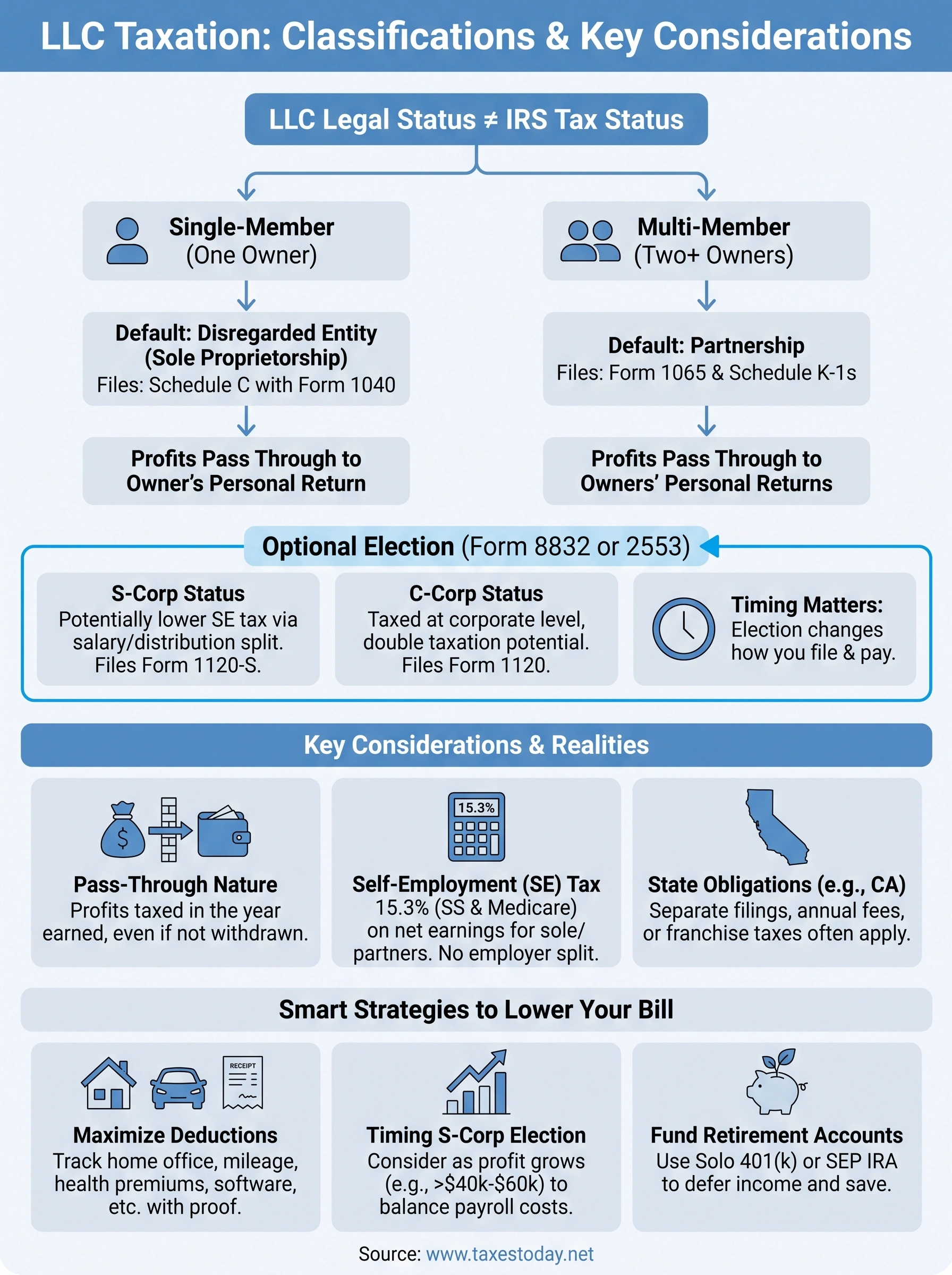
A single-member LLC is automatically a disregarded entity, meaning the IRS ignores the LLC for tax purposes and taxes you like a sole proprietor on Schedule C. A multi-member LLC defaults to partnership taxation, filing Form 1065 and issuing each owner a Schedule K-1. Neither default requires you to file anything extra with the IRS. It just happens the moment you start operating with that ownership structure.
| Ownership | Default classification | Primary form |
|---|---|---|
| One owner | Disregarded entity (sole proprietor) | Schedule C with Form 1040 |
| Two or more owners | Partnership | Form 1065 and Schedule K-1 |
| Either, with election | S-Corporation | Form 1120-S |
| Either, with election | C-Corporation | Form 1120 |
Electing a different classification
Owners aren't stuck with the default. Filing Form 8832 lets an LLC choose C-Corp treatment, while filing Form 2553 elects S-Corp status, provided you meet the IRS's ownership and residency requirements. The IRS entity classification guidance walks through exactly which forms apply to each scenario, and it's worth reading before you commit, since switching classifications later usually means waiting a full tax year before the change takes effect.
The number of owners sets your default tax status, but a timely election is what actually changes it.
Most owners we work with elect S-Corp status specifically to reduce self-employment tax once profit is steady and substantial, not because it's automatically better. Filing taxes with an LLC under S-Corp rules means paying yourself a reasonable salary through payroll, then taking remaining profit as a distribution that skips the 15.3% self-employment tax. That split only pays off once your net profit clears the cost of running payroll and filing a separate corporate return, which is why we recommend running the numbers before making the election rather than after.
How to file taxes for your LLC step by step
Once you know your classification, filing taxes for an LLC follows a predictable sequence. Skipping a step, like forgetting quarterly payments or missing a K-1 deadline, is what creates penalties, not the actual math on the return.
Gather your records early
Before you touch a form, pull together everything that documents income and expenses for the year. Missing records is the number one reason LLC returns get delayed or filed with guesses instead of numbers.
- Profit and loss statement or bookkeeping export from the full tax year
- All 1099-NEC, 1099-K, and 1099-MISC forms received
- Business bank and credit card statements
- Mileage logs, home office square footage, and receipts for deductions
- Prior-year return, especially if you're carrying forward a loss
File the return that matches your classification
This is where filing taxes for an LLC actually diverges by structure. A single-member LLC attaches Schedule C to Form 1040. A multi-member LLC files Form 1065 first, then each partner reports their K-1 amount on their personal return. An S-Corp election means filing Form 1120-S and running owner payroll through the year, not just at filing time.
The form you file follows your classification. Get the classification wrong and every downstream form is wrong too.
Don't forget quarterly estimated payments
Because no employer withholds tax from LLC profit, the IRS expects quarterly estimated payments using Form 1040-ES if you expect to owe $1,000 or more for the year. Missing these payments triggers an underpayment penalty even if you pay everything owed by April 15. The IRS estimated tax guidance lays out the exact due dates, typically mid-April, mid-June, mid-September, and mid-January.
Handle your state return separately
Your federal return doesn't cover state obligations. California LLCs, for example, still owe the $800 franchise tax and possibly an LLC fee regardless of what your federal Schedule C or 1065 shows, so build that payment into your planning rather than discovering it in April.
Smart ways to lower your LLC's tax bill
Once you understand how taxes with an LLC actually work, the real question becomes how to legally shrink what you owe. Most savings come from three places: claiming deductions you're already entitled to, timing your classification election correctly, and sheltering income through retirement accounts. None of these require aggressive tricks, just consistent bookkeeping and a bit of planning ahead of the deadline.
Claim every deduction your business actually earned
Self-employed owners routinely underclaim because they're not tracking expenses in real time. Common deductions that get missed include:
- Home office square footage, using either the simplified or actual expense method
- Mileage on business trips, tracked with a log, not an estimate at tax time
- Health insurance premiums for self-employed owners
- Software subscriptions, business insurance, and professional fees like tax prep
- A portion of your phone and internet bill used for business
Deductions only lower your tax bill if you can prove them, so the receipt matters as much as the expense itself.
Revisit the S-Corp election as profit grows
We touched on this earlier, but it deserves repeating here: filing taxes with an LLC under the default classification means paying self-employment tax on every dollar of profit. Electing S-Corp status lets you split income between a reasonable salary and a distribution, and only the salary portion gets hit with payroll taxes. Owners netting $60,000 or more typically save enough to cover the added cost of payroll and a separate corporate return.
Fund a retirement account before you file
A Solo 401(k) or SEP IRA lets LLC owners defer a meaningful chunk of income, sometimes tens of thousands of dollars depending on profit, while building retirement savings at the same time. Contributions reduce your taxable income for the year, and a SEP IRA can often be opened and funded right up until your extended filing deadline. The IRS retirement plans page for small business compares the contribution limits across each plan type, which matters since a Solo 401(k) generally allows higher contributions than a SEP IRA at the same income level.
Staying on top of your LLC's taxes
Getting taxes with an LLC right comes down to three things: knowing your classification, filing the matching forms on time, and claiming every deduction you've earned. Miss any one of those, and you either overpay or trigger penalties you didn't need to risk. Your classification drives everything else, so nail that down first, then build your quarterly payments and recordkeeping around it.
None of this requires guesswork once you understand the sequence. Track expenses as they happen, revisit your S-Corp election once profit climbs, and treat your state return as a separate obligation from your federal one. That's the whole system, and it works the same way year after year once you've set it up correctly.
If your LLC's situation feels more tangled than a simple Schedule C, don't gamble on software that doesn't know your industry. Get your LLC taxes filed correctly by a CTEC-certified preparer who handles self-employed and small business returns every day.