


Self-Employed Babysitter Taxes Calculator: How Much You Owe
If you babysat this year and got paid in cash, Venmo, or Zelle, you're not off the IRS's radar just because nobody sent you a W-2. A self-employed babysitter taxes calculator helps you figure out exactly what you owe before the IRS figures it out for you, and the number is usually bigger than people expect once you account for self-employment tax on top of regular income tax.
Here's the direct answer: if you earned $400 or more babysitting as an independent worker, you owe 15.3% in self-employment tax, plus federal and possibly state income tax, calculated on your net earnings after deductible expenses. This article walks through the exact math, the thresholds that trigger filing, and the deductions babysitters commonly miss.
You'll learn how to estimate your quarterly tax payments, what counts as taxable babysitting income, and when Schedule C actually applies to you. And if the numbers still feel overwhelming, TaxesToday's licensed preparers handle Schedule C filings for self-employed workers like babysitters every day, at prices that won't eat up your earnings.
Why babysitters owe self-employment tax
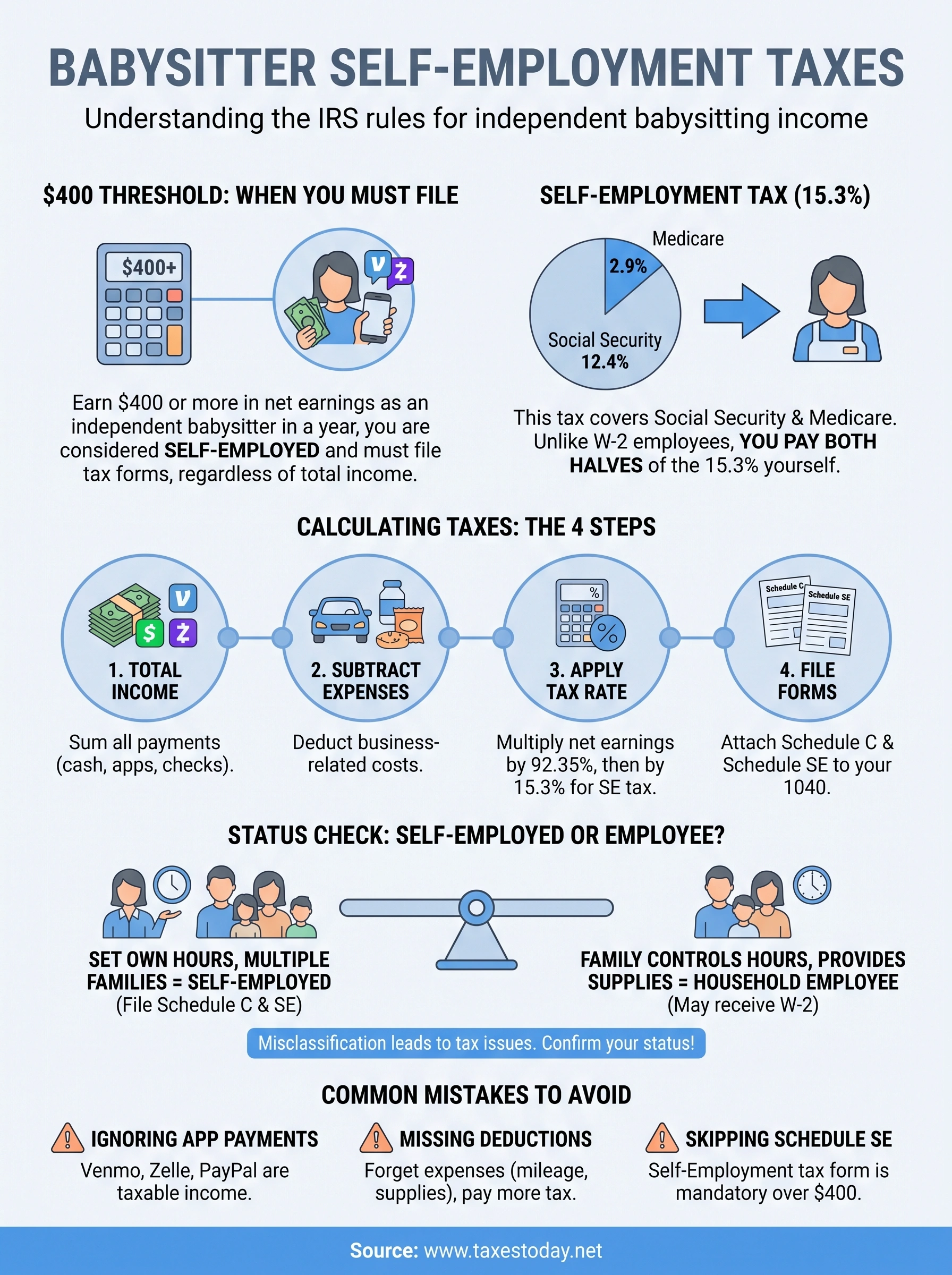
Most babysitters assume that if nobody handed them tax paperwork, the IRS doesn't know or care about the money. That's wrong. Once you earn $400 or more babysitting in a calendar year as an independent worker rather than a household employee, the IRS classifies you as self-employed and expects you to follow the rules for filing taxes as a self-employed worker, regardless of whether you got a 1099 form or just cash in an envelope.
The $400 rule the IRS actually enforces
That $400 figure isn't a suggestion. It's the legal threshold at which net self-employment earnings trigger a mandatory filing requirement, separate from the standard income tax filing thresholds tied to your total income and filing status. You can owe self-employment tax even in a year when your total income is too low to owe regular income tax. Babysitters, dog walkers, and other gig workers get caught off guard by this every year because they're used to thinking about taxes only in terms of income tax brackets.
Why the tax rate feels steep
Here's the part that surprises people. Self-employment tax runs 15.3% of your net earnings, covering both the Social Security and Medicare portions of self-employment tax (12.4% and 2.9%). When you work as a W-2 employee, your employer pays half of that automatically and it never touches your paycheck. As a self-employed babysitter, you're both the employer and the employee, so you cover the entire 15.3% yourself.
A W-2 job splits Social Security and Medicare tax with your employer. Self-employment means you pay both halves.
What counts as babysitting income
Cash isn't the only payment method the IRS cares about. Any money you receive for babysitting counts as taxable self-employment income, including:
- Cash payments handed to you directly
- Venmo, Zelle, Cash App, or PayPal transfers
- Personal checks from parents
- Payments through babysitting or nanny apps
Going forward, third-party payment apps report transactions to the IRS once you cross certain reporting thresholds, so treating this income as invisible is a losing strategy. Reporting it accurately, and knowing what deductions offset it, is what a self-employed babysitter taxes calculator actually helps you figure out before you file.
How to calculate and report your self-employment tax
Running the numbers yourself takes four steps: total your income, subtract expenses, apply the tax rate, and file the right forms. Skip any of these steps and you either overpay or underreport, both of which cause headaches later. A self-employed babysitter taxes calculator automates this math, but understanding each step helps you double-check the result and catch mistakes before you submit anything to the IRS.

Step 1: Total your income and expenses
Start by adding up every payment you received for babysitting during the year, then subtract the business expenses you can write off like mileage driven between jobs, supplies you bought for the kids, or a portion of your phone bill used for scheduling. What's left is your net earnings, the number that actually gets taxed, not your gross income.
Step 2: Apply the self-employment tax rate
Working through the self-employment tax math starts by multiplying your net earnings by 92.35%, since the IRS lets you exclude a small portion representing the employer-equivalent share, then multiplying that result by 15.3%. This gives you your self-employment tax owed, separate from any income tax you'll calculate afterward using your regular tax bracket.
Your self-employment tax is calculated on 92.35% of net earnings, not the full amount.
Step 3: File the correct forms
Once you know the numbers, reporting them requires two forms working together:
- Schedule C reports your babysitting income and expenses, arriving at net profit (line-by-line Schedule C instructions)
- Schedule SE takes that net profit and calculates your self-employment tax
Both attach to your Form 1040. Missing either form is a common reason self-prepared returns get flagged or corrected by the IRS.
Example: estimating taxes on your babysitting income
Numbers make this concrete faster than any explanation. Say you babysat throughout the year and collected $5,000 total between cash payments and Venmo transfers from three families. You also spent $300 on supplies, snacks, and gas driving between jobs, which count among the expenses independent contractors can deduct. Running this through a self-employed babysitter taxes calculator, or doing it by hand, shows exactly where your tax bill comes from.
The math, step by step
Subtract your $300 in expenses from the $5,000 gross, leaving $4,700 in net earnings. Multiply that by 92.35% to get $4,340.45, then multiply by 15.3% to find your self-employment tax owed: roughly $664. That's before any federal income tax, which gets calculated separately based on your total income, filing status, and standard deduction.
| Item | Amount |
|---|---|
| Gross babysitting income | $5,000 |
| Deductible expenses | $300 |
| Net earnings | $4,700 |
| Taxable base (92.35%) | $4,340.45 |
| Self-employment tax (15.3%) | ~$664 |
A $5,000 babysitting side gig can still owe over $600 in self-employment tax alone, even before income tax.
Why the total surprises most people
Often, babysitters expect a small tax bill because $5,000 doesn't feel like real income compared to a full-time job. Yet that $664 self-employment tax is fixed regardless of your tax bracket, since it's calculated as a flat percentage of net earnings rather than sliding with your income level like federal tax brackets do. Layer on federal income tax, and possibly state tax if you live somewhere like California, and the total owed climbs higher than most first-time babysitters budget for when they set their rates.
Self-employed sitter or household employee?
Not every babysitter is among the people who actually file a Schedule C. The IRS draws a line between a self-employed sitter and a household employee, and which side you fall on changes everything about how you calculate and report taxes. Get this classification wrong and your self-employed babysitter taxes calculator will spit out numbers that don't match your actual filing requirement.
The control test that decides your status
Generally, if a family sets your schedule, tells you how to care for the kids, and provides the workspace and supplies, you're likely a household employee, not an independent contractor. Independent babysitters, by contrast, set their own hours, work for multiple families, bring their own supplies, and decide how they run each job. That distinction determines whether the family should be issuing you a W-2 or whether you're responsible for self-employment tax on your own.
If a family controls how and when you work, you're probably a household employee, not self-employed.
Why the difference matters for your wallet
Question this classification carefully, because it changes both your paperwork and your tax bill.
| Status | Who pays Social Security/Medicare | Form you receive |
|---|---|---|
| Household employee | Split with employer | W-2 (if paid $2,700+ in 2024) |
| Self-employed sitter | You pay both halves | 1099-NEC or none |
Regularly babysitting for one family under their direction usually points toward employee status, even without formal paperwork. TaxesToday's preparers can review your specific arrangement and confirm which category applies before you file, so you're not guessing between a Schedule C and a missing W-2.
Keeping your babysitting taxes in order
Running the numbers through a self-employed babysitter taxes calculator only helps if you follow through with accurate filing. You now know the $400 threshold, the 15.3% rate, the Schedule C and Schedule SE forms, and how to tell whether you're actually self-employed or a household employee in disguise. That's more than most first-time sitters ever learn before tax season catches up with them.
Getting the classification wrong, missing a deduction, or skipping quarterly payments creates problems that cost more to fix than getting it right the first time. Licensed preparers deal with these situations year-round, and they catch errors a calculator alone can't flag.
If you'd rather have a professional confirm your numbers and file correctly the first time, file your babysitting income with a CTEC-certified preparer starting at $99.