



16 Deductible Expenses For Independent Contractors In 2026
If you're a 1099 worker, every dollar you spend running your business could put money back in your pocket at tax time, but only if you know what qualifies. Deductible expenses for independent contractors directly reduce your taxable income, which means a lower self-employment tax bill and more cash you actually get to keep. The problem? Most freelancers and self-employed workers miss legitimate write-offs simply because no one told them what counts.
At TaxesToday, we prepare taxes for independent contractors, freelancers, and small business owners across California and all 50 states, and we see missed deductions on self-prepared returns constantly. Common expenses like mileage, home office costs, and even health insurance premiums are routinely overlooked or calculated incorrectly. That's money left on the table, and it adds up fast. Our CTEC-certified and IRS-registered preparers have spent 15+ years helping 1099 workers claim every deduction they're entitled to.
This guide breaks down 16 deductible expenses you can claim on your 2025 tax return (filed in 2026), with clear explanations of what qualifies, what doesn't, and how to document each one. Whether you're a rideshare driver, a consultant, or a graphic designer, this list will help you stop overpaying the IRS.
1. Tax preparation, accounting, and bookkeeping fees
The money you spend to manage your finances and file your taxes correctly is itself deductible. Accounting fees, bookkeeping costs, and tax preparation fees all qualify as ordinary and necessary business expenses, which is the IRS standard for any deduction a self-employed person claims. Paying a professional to keep your records clean or file your return is a real cost of running your business, and the IRS recognizes it as such.
What counts as deductible fees
You can deduct any professional fees you pay to manage the business side of your finances. This includes fees paid to a CPA, enrolled agent, or tax preparer for your Schedule C preparation, bookkeeping software subscriptions used for business records, and payments to a bookkeeper or accountant who tracks your income and expenses throughout the year. Payroll service fees also qualify if you have employees or run payroll for your business in any capacity.
The portion of your tax preparation fee that relates specifically to your business return is deductible, not the entire fee if your preparer handles your personal return at the same time.
Key rules and limits to know
The IRS requires that the expense be ordinary and necessary for your business, so you can only deduct the portion of any fee that covers your business finances. If you pay one flat fee for a combined personal and business return, ask your preparer to break out the business portion so you can document it accurately. Personal financial planning or investment advisory fees are not deductible under current tax law, so keep those separate from your business accounting costs.
Proof to keep and how to track it
Keep every invoice and receipt from your accountant, bookkeeper, or tax preparer. For software subscriptions, save your confirmation emails and bank or credit card statements that show the charges. A dedicated expense category in your bookkeeping app or a simple email folder works well to stay organized throughout the year. If you pay an individual bookkeeper directly, log each payment with a date and a brief note describing the service rendered.
Where to claim it on your tax return
You report these fees on Schedule C (Form 1040) under "Legal and professional services," which is Line 17. Bookkeeping software subscriptions can also go under "Other expenses" in Part V of Schedule C. Getting this right is one reason working with an experienced preparer pays off, since they know exactly where each of your deductible expenses for independent contractors belongs on the return.
2. Home office expenses
If you work from home, the IRS lets you deduct a portion of your housing costs as a business expense. The home office deduction is one of the most valuable deductible expenses for independent contractors, and it applies to both homeowners and renters alike.
What qualifies as a home office
Your home office must be used regularly and exclusively for business, and it must serve as your principal place of business. A dedicated desk in a shared living room won't qualify, but a separate room or a clearly defined space used only for work does meet the IRS standard.
What expenses you can include
Under the regular method, you can deduct a proportional share of rent or mortgage interest, utilities, home insurance, and repairs. Under the simplified method, you deduct $5 per square foot, up to 300 square feet, for a maximum deduction of $1,500 per year.

The simplified method is easier to calculate and still delivers a solid deduction if your dedicated workspace is 300 square feet or less.
How to calculate the deduction
To use the regular method, divide your office square footage by your home's total square footage to get your business-use percentage. Multiply that percentage by each eligible home expense for the year. Keep utility bills, insurance statements, and your lease or mortgage documents on file to support the calculation if the IRS asks.
Where to claim it on your tax return
You report home office expenses on Form 8829, which then flows to Schedule C, Line 30. The simplified method skips Form 8829 and lets you enter the deduction directly on Schedule C.
3. Vehicle and mileage expenses
If you drive for your business, your vehicle costs are among the most commonly missed deductible expenses for independent contractors. The IRS gives you two methods to calculate this deduction, and picking the right one can make a meaningful difference in how much you write off.
Standard mileage vs actual expenses
You have two options when deducting vehicle costs. The standard mileage rate for 2025 is 70 cents per mile, and you simply multiply that rate by your total business miles. The actual expense method lets you deduct a percentage of your real costs, including gas, oil changes, tires, insurance, registration fees, and depreciation, based on the share of miles driven for business.

If you plan to use the actual expense method, you must choose it in the first year you place the vehicle in service for business use, or you lose the option.
What driving counts as business use
Business driving includes trips to client meetings, job sites, supply stores, and other business-related destinations. Commuting from your home to a regular office does not qualify. However, if your home office is your principal place of business, then trips from home to meet clients or run business errands do count.
Proof to keep and mileage log basics
The IRS requires a contemporaneous mileage log that records the date, destination, business purpose, and miles driven for each trip. Apps like Google Maps can help you verify distances, but you still need a written or digital log entry for every business trip to satisfy IRS documentation rules.
Where to claim it on your tax return
Report vehicle expenses on Schedule C, Part II, Line 9. You also complete Part IV of Schedule C to provide the IRS with details about your vehicle, including total miles driven and whether you have written documentation.
4. Business travel away from home
Business travel is one of the more substantial deductible expenses for independent contractors, covering costs that go well beyond a simple mileage log. When your work takes you away from your tax home overnight, many of those trip expenses become fully deductible.
What qualifies as business travel
The IRS defines business travel as any trip that takes you away from your tax home long enough to require sleep or rest before you can return. Your tax home is generally the city or area where you conduct most of your business, not necessarily where you live. A day trip without an overnight stay does not qualify as business travel, even if you drive several hours.
The trip must have a clear, genuine business purpose, such as meeting a client, attending a conference, or visiting a job site.
Common deductible travel costs
When you qualify for the business travel deduction, you can write off airfare, train tickets, rental cars, taxis, and rideshares used for business purposes. Hotel or lodging costs, baggage fees, and tips related to deductible travel services also qualify. Meals while traveling away from home are deductible too, though the 50 percent limit still applies to those.

Mixed business and personal trips
If you combine a business trip with personal activities, you can only deduct expenses that are directly tied to the business portion. Transportation costs may still be fully deductible if the primary purpose of the trip is business, but hotel nights spent on personal days are not deductible, so keep your itinerary well-documented.
Where to claim it on your tax return
Report business travel costs on Schedule C, Part II. Lodging and transportation go on Line 24a, while meals from the trip go on Line 24b.
5. Business meals
Meals can qualify as deductible expenses for independent contractors, but the IRS applies specific rules to this category that many self-employed workers get wrong. You cannot deduct every lunch you eat while working, so understanding exactly when a meal qualifies matters before you start tracking receipts.
When meals qualify as a deduction
A meal is deductible when it is directly connected to your business and you are present at the meal with a client, customer, referral partner, or business associate. The conversation must have a genuine business purpose, meaning you discussed work, a project, or a business relationship during the meal. Simply eating alone at your desk does not qualify, unless you are traveling away from home on a business trip.
What the 50 percent limit usually means
Even when a meal clearly qualifies, you can only deduct 50 percent of the cost under current IRS rules. That limit applies to the meal itself and any beverages included, but it also covers taxes and tips on the bill. If you paid $80 for a client dinner including tip, your deductible amount is $40, not the full expense.
Keep this 50 percent limit in mind when estimating your annual deduction, since many contractors overestimate this category.
What records you need for meals
For each meal, save the receipt and record four things: the date, the total cost, the name and business relationship of the person you dined with, and the business purpose of the meeting. A short note added to a photo of the receipt covers all of this in seconds.
Where to claim it on your tax return
Report business meals on Schedule C, Line 24b, and enter only the 50 percent deductible portion of your total qualified meal expenses.
6. Cell phone, internet, and software subscriptions
Technology costs are real deductible expenses for independent contractors, and they cover more ground than most 1099 workers realize. If you use your phone, your home internet, or any digital tool to run your business, a portion of those costs likely qualifies as a write-off on your Schedule C.
Cell phone and internet expenses you can deduct
Your monthly cell phone bill and home internet service both qualify as deductible business expenses when you use them for work. You can deduct the business-use percentage of each bill, so if you use your phone 60 percent for work, 60 percent of that monthly bill is deductible.
Software and app subscriptions you can deduct
Project management tools, invoicing apps, accounting software, and design programs you pay for to run your business all qualify. Common examples include:
- Accounting and invoicing software
- Industry-specific platforms you use for client deliverables
- Cloud storage services used primarily for business files
- Video conferencing tools and scheduling apps
Subscription fees for tools you rely on for active client work are legitimate business expenses the IRS recognizes without question.
If you subscribe to a tool that serves both personal and professional purposes, only the business-use portion is deductible, not the full subscription cost.
How to handle mixed personal and business use
When a device or service covers both personal and business use, calculate and document your business-use percentage before claiming the deduction. A reasonable, consistent method, such as tracking work hours on a device relative to total use, is what the IRS expects you to apply.
Proof to keep and how to track usage
Save monthly statements and subscription invoices for every service you deduct. A simple spreadsheet noting each service, the monthly cost, and your documented business-use percentage gives you solid backup if the IRS ever questions the deduction.
7. Office supplies and postage
Everyday business supplies and shipping costs are straightforward deductible expenses for independent contractors, but many 1099 workers skip them because the amounts feel too small to bother tracking. Those small purchases add up across a full year, and every dollar you document is a dollar that reduces your taxable income.
What counts as supplies vs equipment
Supplies are items you use up in the normal course of business, such as printer paper, pens, notebooks, sticky notes, toner cartridges, and folders. These are fully deductible in the year you buy them. Equipment, by contrast, has a useful life beyond one year and typically requires a different deduction method, which the next section covers in detail.
If you buy something that costs under $2,500 and would otherwise qualify as equipment, you can generally elect to deduct it as a supply in the year of purchase under the IRS de minimis safe harbor rule.
Postage, shipping, and delivery costs
Any money you spend mailing documents, shipping products, or sending packages for business purposes qualifies as a deductible expense. This includes postage stamps, courier fees, Priority Mail and FedEx charges, and delivery service fees when the purpose is business-related.
Proof to keep and best tracking habits
Save every receipt from office supply stores and shipping carriers, whether physical or digital. A dedicated folder in your email for online order confirmations works well, and a simple spreadsheet with the date, vendor, amount, and business purpose covers everything the IRS expects to see.
Where to claim it on your tax return
Report office supplies on Schedule C, Line 22 and postage or shipping costs under "Other expenses" in Part V of Schedule C.
8. Computers, equipment, and tools
When you buy hardware or tools to run your business, those purchases count among the most valuable deductible expenses for independent contractors. The IRS treats these differently from consumable supplies, so understanding which rules apply to your purchase determines how and when you get the deduction.
What counts as equipment vs supplies
Equipment refers to any item with a useful life of more than one year, such as laptops, monitors, cameras, printers, power tools, or specialized industry tools. Supplies, as covered in the previous section, are consumed quickly. Your laptop, external hard drive, and professional-grade camera all fall under equipment and follow separate deduction rules.
Depreciation, Section 179, and bonus depreciation
Normally, the IRS expects you to spread the cost of equipment across its useful life through annual depreciation. However, two options let you deduct the full cost faster. Section 179 lets you deduct the entire purchase price of qualifying equipment in the year you place it in service, up to the annual limit. Bonus depreciation works similarly and may cover a percentage of the cost depending on current law.
For most independent contractors buying a single laptop or set of tools, Section 179 is the simplest path to a full first-year deduction.
Repairs vs improvements
You can deduct ordinary repairs that keep equipment functioning, such as fixing a cracked screen or replacing a broken part. Improvements that extend the equipment's life or add new capability are treated more like a new asset purchase and may need to be depreciated separately rather than expensed all at once.
Where to claim it on your tax return
Report equipment deductions on Schedule C, Part II, Line 13, and attach Form 4562 if you are claiming depreciation, Section 179, or bonus depreciation.
9. Advertising and marketing
Whatever you spend to attract clients and promote your services is likely deductible, and the category covers more than you might expect. Advertising and marketing costs are among the most straightforward deductible expenses for independent contractors because the IRS broadly recognizes that finding and keeping clients is a core part of running a business.
Common marketing costs you can deduct
You can deduct printed materials like business cards, flyers, and brochures, along with fees paid to graphic designers or photographers for marketing work. If you pay someone to manage your social media or write marketing copy, those contractor fees qualify as well. Common deductible marketing costs include:
- Business cards, flyers, and branded print materials
- Graphic design and photography fees for marketing use
- Branded merchandise distributed to clients or prospects
- Social media management fees paid to contractors
Website costs and online ads
Building and maintaining a business website is fully deductible, including domain registration fees, hosting costs, and web design expenses. Paid advertising through search engines and social platforms also qualifies, so any budget you put toward pay-per-click campaigns or sponsored posts to reach potential clients is a legitimate write-off.
Keep your ad platform invoices and hosting receipts organized by month so you have clean documentation if the IRS asks.
What does not qualify
Personal branding that lacks a clear business connection does not qualify. Donations to political campaigns or political organizations are never deductible, even if you believe they benefit your business indirectly. Sponsorships that serve primarily a personal interest rather than a business purpose also fall outside what the IRS allows.
Where to claim it on your tax return
Report all advertising and marketing costs on Schedule C, Part II, Line 8. Keep invoices and receipts for every expense you claim in this category.
10. Business insurance premiums
Premiums you pay to protect your business qualify as deductible expenses for independent contractors, as long as the policy covers a legitimate business risk. The IRS recognizes business insurance as an ordinary and necessary expense, which means you can write off what you pay to stay covered without any percentage limit applied to the deduction.
Types of business insurance that usually qualify
Most policies that protect your work, your clients, or your business property are deductible. General liability insurance, professional liability (errors and omissions) insurance, and commercial property insurance all qualify. If you carry commercial auto insurance on a vehicle used for business, that premium is deductible as well, separate from any personal-use portion of the vehicle.
What does not qualify as a business insurance deduction
Life insurance premiums where you or your estate are the beneficiary do not qualify as a business expense under IRS rules. Health, dental, and vision insurance premiums fall under a different deduction category entirely, which the next section covers in detail. Disability insurance that replaces your personal income is also not deductible as a business expense.
The IRS draws a clear line between insurance that protects your business operations and insurance that primarily benefits you personally.
Proof to keep and policy documentation
Save your annual policy declarations pages and premium payment receipts for every business insurance policy you carry. A folder with each insurer's billing statements organized by year gives you solid documentation if the IRS questions any premium you deducted.
Where to claim it on your tax return
Report business insurance premiums on Schedule C, Line 15. Enter only the portion of any premium that covers your business operations, not any personal coverage bundled into the same policy.
11. Self-employed health, dental, and long-term care premiums
Health insurance premiums represent one of the most significant deductible expenses for independent contractors, and unlike most Schedule C deductions, this one reduces your adjusted gross income directly rather than just your business profit. That placement makes it especially powerful for lowering your total tax bill, not only your self-employment tax.
Who can take the self-employed health insurance deduction
You can claim this deduction if you were self-employed and paid for your own health coverage during the year, and you were not eligible to participate in a subsidized health plan through a spouse's employer.
If your spouse's employer offered you coverage and you declined it, you lose the right to claim this deduction for any month that employer-sponsored coverage was available to you, even if you never used it.
What premiums can qualify
Health, dental, and vision premiums for yourself, your spouse, your dependents, and children under age 27 all qualify. You can also deduct qualified long-term care insurance premiums, though the IRS caps the deductible amount based on your age each year.
The deduction cannot exceed your net self-employment income for the year, so a business loss eliminates it entirely for that tax period.
Key limits and eligibility rules
Your deduction is capped at your net profit from self-employment for the year. You also cannot claim more than you actually paid in premiums.
If you received any premium tax credits through the Health Insurance Marketplace, you must reduce your deductible premium amount by the credit you received to avoid double-dipping.
Where to claim it on your tax return
Report this deduction on Schedule 1 (Form 1040), Line 17, not on Schedule C. Because it sits above the line, it reduces your adjusted gross income, which makes it more valuable than a typical business expense deduction on Schedule C.
12. Retirement plan contributions
Contributing to a retirement account is one of the most valuable deductible expenses for independent contractors because it lowers your taxable income today while building long-term savings. The IRS allows you to deduct contributions made to qualifying plans, and the annual limits are often far higher than most 1099 workers expect.
Retirement plans that often work for contractors
Three plans are most commonly used by self-employed individuals: the SEP-IRA, the Solo 401(k), and the SIMPLE IRA. A SEP-IRA allows contributions up to 25 percent of your net self-employment income. A Solo 401(k) lets you contribute as both employee and employer, which can push your total annual contribution significantly higher when your income allows it.

A Solo 401(k) is particularly useful if your income is strong, since the combined employee and employer contribution structure often allows a larger total deduction than a SEP-IRA at the same income level.
Contribution limits and timing basics
For 2025, the Solo 401(k) total contribution cap is $70,000, while SEP-IRA contributions are limited to 25 percent of net self-employment earnings or $70,000, whichever is lower. You must establish most plans by December 31 of the tax year, though a SEP-IRA can be opened as late as your tax filing deadline, including any extensions.
Proof to keep and plan paperwork
Save your annual contribution statements from your plan provider along with your account opening documents. These records confirm both the amount contributed and that the plan existed before the applicable deadline. Key documents to retain include:
- Plan establishment agreement or adoption agreement
- Annual contribution confirmation statements
- Form 5498, which your plan provider issues each year
Where to claim it on your tax return
You deduct retirement contributions on Schedule 1 (Form 1040), Line 16, which reduces your adjusted gross income directly rather than flowing through Schedule C. This above-the-line placement makes the deduction available regardless of whether you itemize.
13. Contractor payments and contract labor
When you hire other freelancers or independent contractors to help with your business, the payments you make to them qualify as deductible expenses for independent contractors running their own operations. This deduction directly reduces your Schedule C profit, and it covers any situation where you pay a non-employee to perform services for your business, from a subcontractor who handles overflow work to a virtual assistant who manages your inbox.
What counts as contract labor
Contract labor includes payments to any individual or business you hire to perform services without treating them as an employee. Graphic designers, writers, web developers, bookkeepers, and subcontractors who help you fulfill client work all fall into this category. You must not control how they do the work, only the result, which is the key distinction the IRS uses to separate contractors from employees.
1099 filing and recordkeeping basics
If you pay any individual contractor $600 or more in a calendar year, you are required to issue them a Form 1099-NEC by January 31 of the following year. Collect a completed Form W-9 from every contractor before you pay them so you have their name, address, and taxpayer identification number on file. Keep copies of all W-9s and 1099s for at least four years.
Failing to issue required 1099s does not eliminate your deduction, but it creates IRS scrutiny you want to avoid.
Common mistakes that create audit risk
Paying contractors in cash without documentation or skipping the W-9 collection step are the two most common errors that draw IRS attention. Always pay through a traceable method like a bank transfer or check and keep a brief written description of the services performed.
Where to claim it on your tax return
Report contract labor payments on Schedule C, Line 11, labeled "Contract labor." This line is separate from other wages and is specifically designed for payments made to non-employee contractors who helped you run your business.
14. Business interest and bank fees
Interest charges and banking costs are easy-to-overlook deductible expenses for independent contractors, but they belong on your Schedule C just like any other ordinary business expense. If you borrow money to fund your business or use a bank account dedicated to your work, those associated costs reduce your taxable income and should be tracked and claimed every year.
Deductible interest for business debt
You can deduct interest paid on loans used for business purposes, including business credit card interest, a line of credit used for operating expenses, or a loan taken out to purchase business equipment. The key requirement is that the borrowed funds must have been used exclusively for your business, not for personal expenses.
If you use a single credit card for both personal and business purchases, only the interest that corresponds to your business charges is deductible, not the full monthly interest charge.
Common bank fees that qualify
Monthly maintenance fees, wire transfer fees, and transaction fees on a business bank account all qualify as deductible business expenses. ATM fees incurred while conducting business transactions and payment processing fees charged by platforms like Stripe or PayPal for receiving client payments also count.
Separating business and personal accounts
Keeping a dedicated business checking account makes it straightforward to identify which fees and interest charges are deductible. Mixing personal and business transactions in a single account forces you to sort through every line item, which creates more room for errors and missed deductions when you file.
Where to claim it on your tax return
Report business interest on Schedule C, Line 16 and bank service fees under "Other expenses" in Part V of Schedule C.
15. Licenses, permits, and professional dues
Fees you pay to stay legally authorized to work and to maintain professional memberships are legitimate deductible expenses for independent contractors. The IRS treats these as ordinary and necessary costs of operating, so most annual fees you pay to keep your business running qualify without much complexity.
Common deductible fees for contractors
You can deduct state and local business licenses, contractor permits, and professional association dues required to do your work. If your field requires an active license to take on clients, such as a contractor's license or a real estate license, the renewal fees you pay each year are fully deductible. Professional organization memberships that are directly related to your trade or industry also qualify, including annual dues paid to industry groups or certification bodies.
Dues paid to social clubs or organizations where the primary purpose is personal networking rather than professional development do not qualify under IRS rules.
What fees you may need to amortize
Most annual license and permit fees are fully deductible in the year you pay them. However, fees that cover multiple years or fees paid to obtain a new license may need to be spread across the benefit period rather than deducted all at once. A one-time licensing fee or franchise-type authorization fee is the most common situation where amortization applies instead of an immediate full deduction.
Proof to keep and renewal reminders
Save your payment receipts and confirmation letters for every license, permit, and membership you renew. Setting a calendar reminder before each renewal date helps you capture every eligible expense without missing a payment you later forget to document.
Where to claim it on your tax return
Report deductible licenses and professional dues on Schedule C, Part V, under "Other expenses," with a clear description next to each line entry.
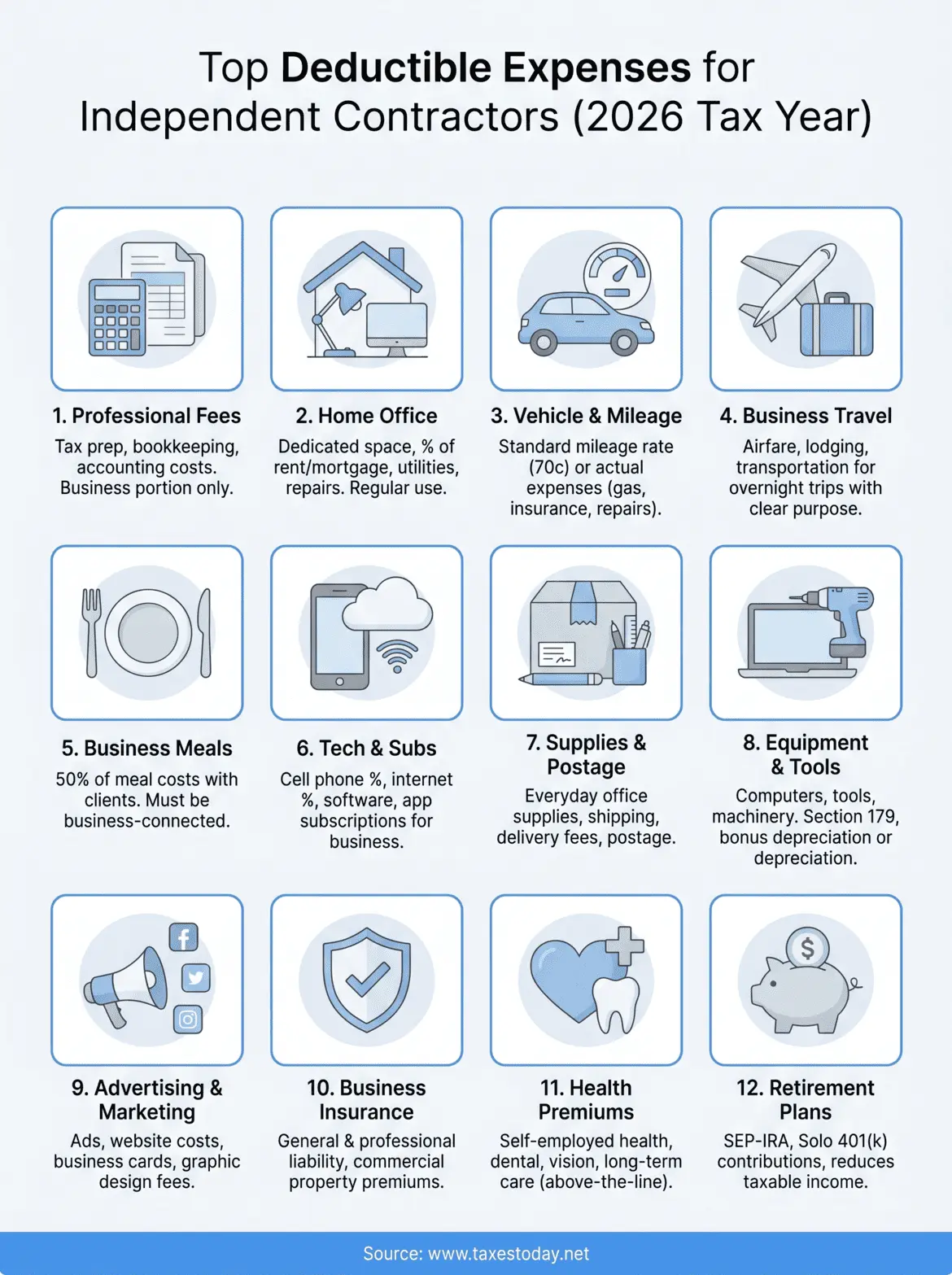
Quick wrap up
You now have a complete picture of the deductible expenses for independent contractors that apply to your 2025 return. From mileage and home office costs to retirement contributions and contractor payments, each category on this list puts real money back in your pocket when you document it correctly and claim it on the right line of your Schedule C. The difference between a well-prepared return and a rushed one often comes down to knowing these categories exist in the first place.
Tracking every expense throughout the year is the single best habit you can build as a 1099 worker. Keep your receipts, log your business miles consistently, and separate your personal and business finances so nothing falls through the cracks. If you want a professional to review your situation and make sure you are claiming every deduction you qualify for, work with a certified tax preparer at TaxesToday and stop leaving money on the table.