



IRS Schedule K-1 Instructions: How To Report K-1 Income
If you're a partner in a business, an S-corporation shareholder, or a beneficiary of a trust or estate, you've likely received a Schedule K-1 at tax time. This form reports your share of income, deductions, and credits, and knowing how to handle it correctly matters. The IRS Schedule K-1 instructions can feel dense and technical, but understanding them is the difference between filing accurately and triggering an IRS notice you'd rather not deal with.
Schedule K-1 comes in three versions depending on the entity type: Form 1065 for partnerships, Form 1120-S for S-corporations, and Form 1041 for trusts and estates. Each version has its own reporting rules, and the income it shows doesn't always land on the same line of your personal return. Miss a detail, and you could underreport income, lose out on deductions, or face penalties. The stakes are real, especially if you're a freelancer or small business owner juggling multiple income streams.
At TaxesToday, we prepare taxes for individuals, self-employed professionals, and small business owners across California and all 50 states, and K-1 reporting is something we handle regularly. This guide walks you through each version of the Schedule K-1, explains what each box means, and shows you exactly how to report that income on your personal tax return. Whether you want to file with confidence on your own or hand it off to a licensed professional, you'll have the clarity you need by the end.
What Schedule K-1 is and why it matters
Schedule K-1 is a federal tax document that pass-through entities use to report each owner's or beneficiary's share of the entity's income, deductions, and credits. Pass-through entities don't pay income tax at the entity level. Instead, income flows through to each individual, who then reports it on their personal tax return. That's why you receive a K-1 rather than a simple 1099 or W-2.
The IRS requires partnerships, S-corporations, and trusts and estates to file informational returns each year. The K-1 is the portion of that return that belongs specifically to you. Your business partner receives their own K-1 showing their share, which may be different from yours depending on your ownership percentage or the terms of your partnership agreement.
The three types of Schedule K-1
Each type of K-1 comes from a different entity and follows its own rules. The IRS Schedule K-1 instructions vary by form, so knowing which version you received determines which boxes apply to you and where those numbers go on your personal 1040.
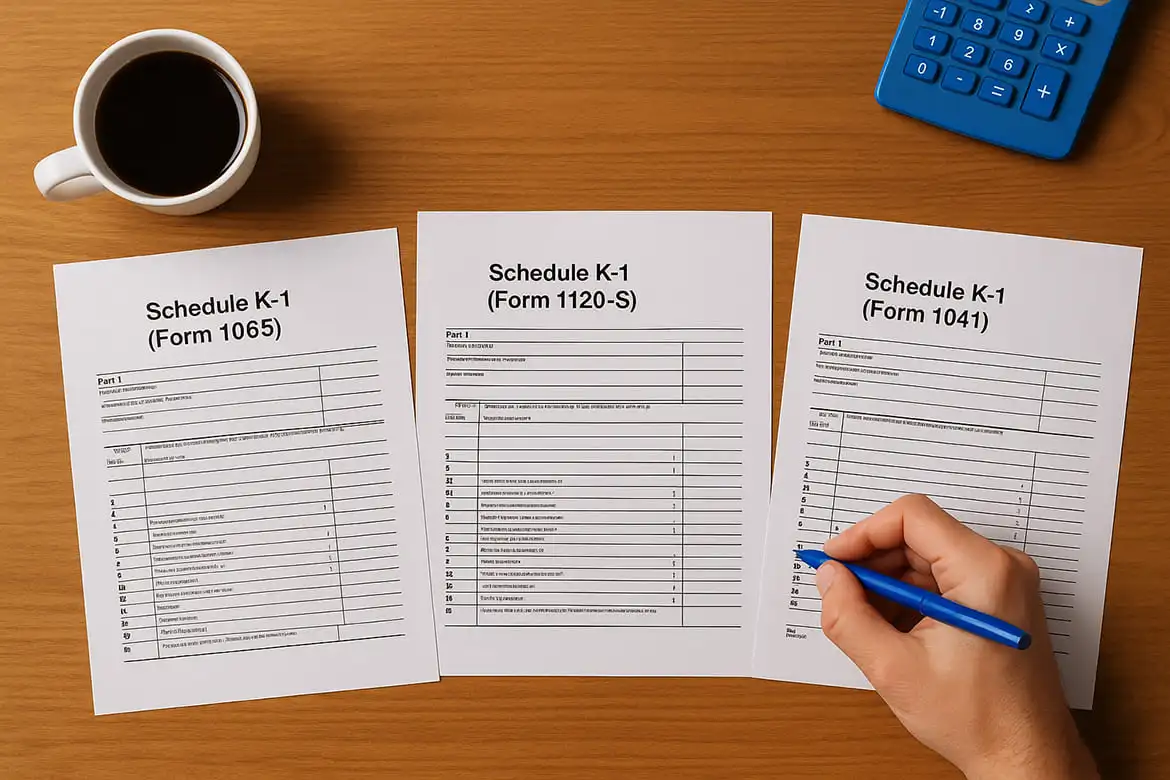
| Form | Issued by | Filed with |
|---|---|---|
| Schedule K-1 (Form 1065) | Partnerships and multi-member LLCs | Form 1065 |
| Schedule K-1 (Form 1120-S) | S-corporations | Form 1120-S |
| Schedule K-1 (Form 1041) | Trusts and estates | Form 1041 |
All three versions share a similar layout, but the box numbers and their contents differ significantly. Box 1 on a Form 1065 K-1 shows ordinary business income from a partnership, and Box 1 on a Form 1120-S K-1 shows ordinary business income from an S-corp. However, the self-employment tax treatment of those two boxes is completely different, which is where many filers go wrong.
How K-1 income differs from W-2 or 1099 income
When you earn wages, your employer withholds federal and state taxes before the money reaches you. When you receive a 1099, at least the income arrives as one clean number. K-1 income works differently because it breaks your share of the entity's activity into multiple categories: ordinary income, rental income, interest, dividends, capital gains, and various deductions and credits, all listed in separate boxes.
Your K-1 might show positive income in one box and a deductible loss in another, which means you can't simply plug a single total into your return. You need to trace each box to the correct line on the correct IRS form. For example, ordinary business income from a partnership K-1 generally flows to Schedule E, Part II of your 1040, not directly onto the front page.
Because K-1 income is not subject to withholding, you may owe estimated quarterly taxes if your K-1 consistently shows income throughout the year.
Why getting K-1 reporting right matters
The IRS cross-references the K-1 figures the entity reports on its informational return with what you report on your personal return. If those numbers don't match, the IRS issues a notice and asks you to explain the discrepancy, a process that can take months and result in additional taxes, interest, and penalties.
Beyond IRS notices, incorrect K-1 reporting can cost you money in the other direction too. Loss limitations, basis rules, and passive activity rules can each reduce or eliminate losses you'd otherwise be entitled to deduct. If you don't track your basis and apply the applicable rules correctly, you might either pay more tax than you legally owe or claim losses the IRS will later disallow.
Step 1. Identify which K-1 you received
The first thing you need to do before touching any tax form is figure out which version of the K-1 you have. The form number appears at the top of your document, and it determines everything: the boxes that apply to you, where those amounts go on your personal return, and which IRS Schedule K-1 instructions govern your situation. Skipping this step leads to reporting income on the wrong form, which is one of the most common K-1 mistakes.
How to read the top of your K-1
Look at the top-left corner of the document. You'll see one of three form numbers printed there: Form 1065, Form 1120-S, or Form 1041. That single detail changes your entire reporting path.
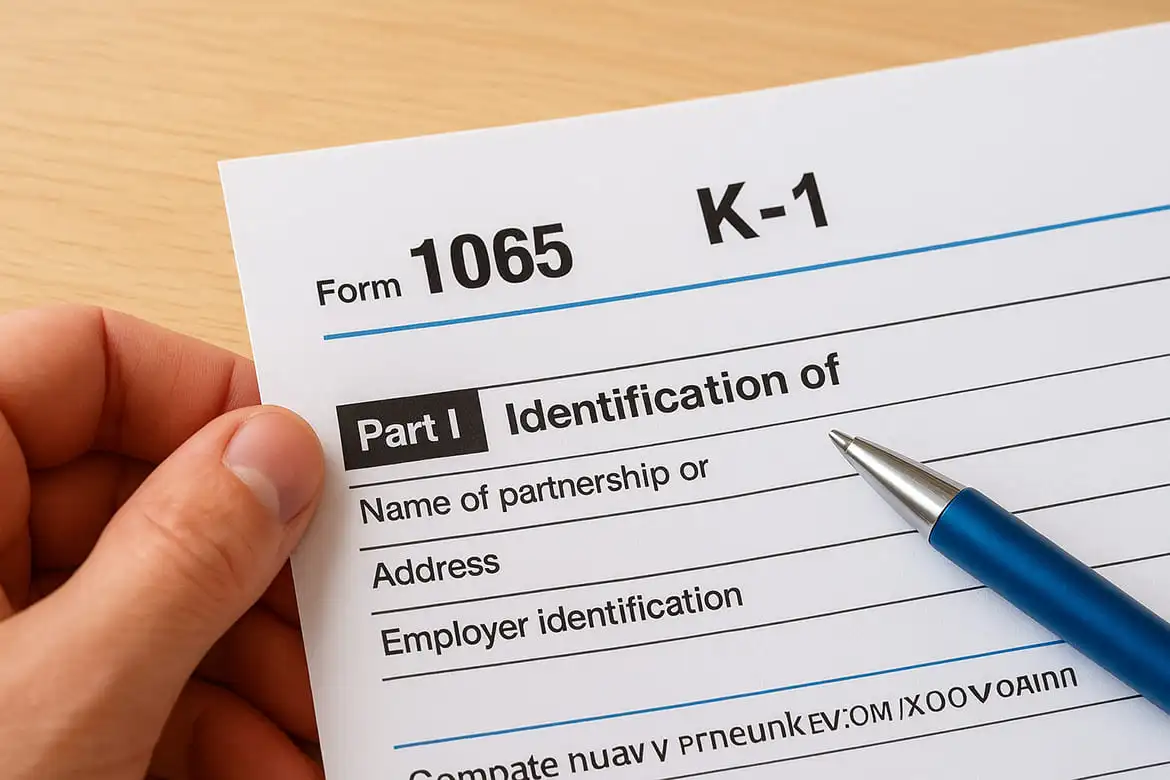
- Form 1065 K-1: You are a partner in a partnership or a member of a multi-member LLC taxed as a partnership.
- Form 1120-S K-1: You are a shareholder in an S-corporation.
- Form 1041 K-1: You are a beneficiary of a trust or estate.
Below the form number, you'll find two key sections: Part I identifies the entity (its name, address, and EIN), and Part II identifies you as the recipient (your name, address, SSN or TIN, and your ownership percentage). Confirm that both the entity's EIN and your Social Security number appear correctly before you do anything else. If either is wrong, contact the issuer immediately and request a corrected K-1 before you file.
A K-1 with an incorrect SSN or EIN can cause the IRS to flag your return as a mismatch, even if every dollar amount is right.
What to do if you receive multiple K-1s
You might receive more than one K-1 in the same tax year, particularly if you hold interests in multiple partnerships, are a shareholder in an S-corp, and are also a beneficiary of a family trust. Each K-1 gets reported separately on your personal return, so keeping them organized by entity type from the start saves significant time later.
Label each K-1 as soon as it arrives with the entity type and tax year, for example: "Partnership K-1, 2025, Smith & Jones LLC." This prevents confusion when you're working through Schedule E and need to match each K-1 to the correct reporting section. Store them together in one folder so nothing gets missed at filing time.
Step 2. Collect the right documents and statements
Once you know which K-1 you received, gather every supporting document before you open a tax form. The K-1 itself rarely tells the full story. You'll need additional records to verify the numbers, apply loss limitations, and calculate your basis in the entity, which directly determines how much of any loss you can actually deduct this year. Filing without these documents in hand leads to guessing, and guessing leads to errors.
Documents you need alongside your K-1
The IRS Schedule K-1 instructions for each form type reference several statements and supplemental schedules that the issuing entity may attach to your K-1. These attachments explain amounts that don't fit neatly inside a single box, such as Section 199A qualified business income information or foreign tax credit details. Don't assume the K-1 form alone contains everything you need to file correctly.
Collect the following before you start reporting:
- The K-1 itself, including all attached statements, footnotes, and supplemental pages from the entity
- Your prior-year basis worksheet for the partnership, S-corp, or trust interest you hold
- Prior-year passive activity loss carryover records, since suspended losses from earlier years directly affect what you can claim now
- Your capital account information from the partnership agreement or prior K-1s, particularly if Box L on the Form 1065 K-1 changed
- Any Section 179 expense statements attached to the K-1, which carry over to your Form 4562
- Foreign tax statements, if Box 16 on a Form 1065 K-1 or Box 14 on a Form 1120-S K-1 shows foreign taxes paid
Why basis records matter
Your outside basis in a partnership or your stock basis in an S-corp acts as a hard ceiling on the losses and distributions you can deduct or receive tax-free. If you can't document your basis, you can't claim a loss even when the K-1 clearly shows one. The IRS expects you to track this number yourself because the entity does not report your individual basis directly to the IRS.
Keep a running basis worksheet starting from the year you first acquired your interest, and update it each year using the current K-1 figures, any contributions you made, and any distributions you received.
If prior-year records are missing, start with your original investment amount and reconstruct forward using each available K-1. A licensed tax preparer can help fill the gaps, but building this tracking habit now prevents serious problems down the road when losses or large distributions come into play.
Step 3. Verify the K-1 for errors before you file
Before you transfer a single number from your K-1 onto your personal return, verify the K-1 itself for accuracy. Entities make mistakes: wrong ownership percentages, transposed EINs, or income allocated to the wrong partner. Filing a return based on an incorrect K-1 creates a mismatch the IRS will catch, and the burden falls on you to sort it out even if the error originated with the issuer.
Common errors to check on your K-1
The IRS Schedule K-1 instructions for each form type specify what each box should contain, which gives you a clear standard to check against. Work through the following items before you accept the K-1 as correct:
- Your name, address, and SSN or TIN: Even one transposed digit triggers an IRS mismatch.
- The entity's EIN: Confirm it matches the EIN on any prior K-1s you received from this entity.
- Your ownership or profit-sharing percentage (Box J on Form 1065): This should align with your partnership agreement or shareholder agreement.
- The beginning and ending capital account balances (Box L on Form 1065): The ending balance from last year's K-1 should match the beginning balance on this year's.
- The tax year covered: K-1s for fiscal-year entities sometimes arrive mid-year and cover a period that doesn't match the calendar year, which affects when you report the income.
- Total income and loss amounts: Add the boxes that represent income and cross-reference them against any financial statements or K-1 summaries the entity provided.
If you spot an error on your K-1, do not file your return using the incorrect numbers. Contact the entity's accountant or administrator, request a corrected K-1, and wait for it before submitting your 1040.
How to confirm the numbers are internally consistent
Ordinary income in Box 1 should not include amounts that also appear in other boxes, such as rental income or interest income. Each category of income has its own box because each carries different tax treatment. If a number looks like it belongs in two places, that's a red flag worth questioning before you file.
Your distributions reported in Box 19 (Form 1065) should not exceed your ending capital account balance unless the entity deliberately made a distribution in excess of basis, which carries its own tax consequences. Catching this discrepancy now prevents a much harder conversation with the IRS later.
Step 4. Report K-1 amounts on the right tax forms
Once you've verified your K-1 is accurate, you need to transfer each box to the correct line on your personal tax return. The IRS Schedule K-1 instructions for each form type specify exactly where each amount belongs, and the mapping depends on both the form version and the type of income or deduction inside each box. Getting this step right keeps your return consistent with what the IRS already received from the issuing entity.
Where each K-1 type flows on your 1040
The starting point for all three K-1 versions is Schedule E of your Form 1040, but each type feeds into a different part of that schedule. Partnership and S-corp income land on Schedule E, Part II, while trust and estate income lands on Schedule E, Part III. From Schedule E, the totals flow to the front page of your 1040, where they combine with your other income sources.
| K-1 Type | Primary Reporting Location | Secondary Forms |
|---|---|---|
| Form 1065 (Partnership) | Schedule E, Part II | Schedule SE, Form 8582, Form 4952 |
| Form 1120-S (S-corp) | Schedule E, Part II | Form 8582, Form 4562 |
| Form 1041 (Trust/Estate) | Schedule E, Part III | Schedule B, Schedule D |
Not every box on your K-1 goes to Schedule E. Capital gains flow to Schedule D, self-employment income flows to Schedule SE, and foreign taxes flow to Form 1116.
Box-by-box reporting for common K-1 items
Each box on your K-1 represents a distinct category of income, deduction, or credit that carries its own tax treatment. The table below shows where the most commonly populated boxes land on your personal return, using the Form 1065 K-1 as the primary reference since partnerships issue the largest volume of K-1s each filing season.
| K-1 Box (Form 1065) | Description | Where It Goes |
|---|---|---|
| Box 1 | Ordinary business income/loss | Schedule E, Part II |
| Box 2 | Net rental real estate income/loss | Schedule E, Part I |
| Box 5 | Interest income | Schedule B |
| Box 6a | Ordinary dividends | Schedule B |
| Box 9a | Net long-term capital gain/loss | Schedule D |
| Box 14, Code A | Net earnings from self-employment | Schedule SE |
| Box 16, Code B | Foreign tax paid | Form 1116 |
Work through each populated box on your specific K-1 one at a time rather than trying to handle all boxes at once. Combining amounts that belong on separate forms creates reporting gaps that the IRS catches when it matches your return against the entity's informational filing.
Step 5. Handle common K-1 items that trip people up
Certain boxes on a K-1 generate more confusion and filing errors than others, not because the IRS Schedule K-1 instructions are deliberately unclear, but because the underlying tax rules are complex and the instructions assume a baseline of knowledge most taxpayers don't have. Knowing which items cause the most trouble lets you slow down and give them the attention they require before you finalize your return.
Section 199A qualified business income
If you receive a Form 1065 or Form 1120-S K-1, look for a Section 199A statement attached to it. This statement supports the qualified business income (QBI) deduction, which can reduce your taxable income by up to 20% of your share of qualified business income. The deduction does not appear inside a single numbered box. Instead, the entity attaches a supplemental statement that breaks down your allocable share of qualified business income, W-2 wages paid by the entity, and unadjusted basis of qualified property.
You need all three figures from the Section 199A statement to calculate your deduction correctly on Form 8995 or Form 8995-A, depending on your total taxable income.
Carry the amounts from that statement to the appropriate QBI deduction form before you finalize Schedule E. Skipping this step means you leave a legitimate deduction on the table, and no IRS notice will remind you to claim it.
Separately stated items and their tax treatment
Many filers see a number in a K-1 box and assume it flows directly to their ordinary income total, but separately stated items each carry their own character and their own destination on your return. Interest income, dividends, royalties, Section 1231 gains, charitable contributions, and investment interest expense each get reported on a different form or schedule because each receives distinct tax treatment.
For example, if your partnership K-1 shows a charitable contribution in Box 13, Code A, you carry that amount to Schedule A as an itemized deduction, not to Schedule E. If your K-1 shows a net Section 1231 gain in Box 10, that flows to Form 4797, not to Schedule D. Work through each populated box individually using the specific instructions for your K-1 form type to confirm where each amount belongs. Treating separately stated items as a lump sum with your ordinary income is one of the most common K-1 reporting mistakes, and it produces a return that does not match what the entity reported to the IRS.
Step 6. Apply limits on losses and deductions
When your K-1 shows a loss, you cannot automatically deduct the full amount on your personal return. Three separate limitation systems operate in sequence, and each one can reduce or suspend the losses you claim. The IRS Schedule K-1 instructions make clear that these rules apply in a specific order: basis limitations first, at-risk rules second, and passive activity rules third. Applying them out of order produces an incorrect result and a return that does not hold up to IRS scrutiny.

Basis limitations
Your outside basis in a partnership, or your stock basis in an S-corp, sets the first ceiling on any deductible loss. You cannot deduct a loss that exceeds your current basis in the entity. If the K-1 shows a $15,000 loss but your basis is only $8,000, you may deduct only $8,000 this year. The remaining $7,000 carries forward and becomes deductible in a future year when you increase your basis through additional contributions or your allocable share of entity income.
Keep a running basis worksheet and update it each year by adding income allocations and contributions, then subtracting distributions and loss allocations before you calculate your deductible amount.
At-risk rules
The at-risk rules under IRC Section 465 apply after you clear the basis test. Even with sufficient basis, you can only deduct losses up to the amount you have actually at risk in the activity. Nonrecourse financing generally does not increase your at-risk amount, with a narrow exception for qualified real estate nonrecourse debt.
Your at-risk amount includes:
- Cash you contributed to the entity
- The adjusted basis of property you contributed
- Loans for which you are personally liable (recourse debt)
- Your share of qualified nonrecourse financing in real estate activities
If your at-risk amount reaches zero and the K-1 shows a loss, that loss suspends and carries forward until your at-risk amount increases in a future year.
Passive activity loss rules
The passive activity loss rules under IRC Section 469 form the final layer of limitation. Losses from passive activities can only offset income from other passive activities in the same year. If you don't materially participate in the entity that issued your K-1, the IRS treats your loss as passive, and any excess suspends until you have passive income to absorb it or you sell your entire interest in a taxable transaction.
Complete Form 8582 each year to calculate your passive activity loss limitations and carry forward suspended losses accurately before you finalize Schedule E.
Step 7. Understand self-employment tax and NIIT
Two additional taxes can apply to your K-1 income depending on the entity type and your level of participation: self-employment (SE) tax and the net investment income tax (NIIT). The IRS Schedule K-1 instructions address both, but they do so in different sections, which causes many filers to miss one or both obligations until the IRS sends a notice. Understanding which applies to your situation before you file saves you from surprise tax bills and accuracy-related penalties.
Self-employment tax on partnership K-1 income
Partners in a partnership pay self-employment tax on their share of ordinary business income reported in Box 1 of a Form 1065 K-1, as well as on guaranteed payments shown in Box 4. The entity reports your net earnings from self-employment in Box 14, Code A, and you carry that amount to Schedule SE to calculate the 15.3% SE tax (12.4% for Social Security up to the annual wage base and 2.9% for Medicare with no income cap).
S-corporation shareholders do not pay SE tax on K-1 income from an S-corp. The IRS treats you as an employee of the S-corp, and SE tax applies only to the W-2 wages the S-corp pays you directly, not to your share of pass-through income on the Form 1120-S K-1. This distinction is one reason many business owners choose S-corp status over partnership taxation when their income is consistently profitable.
If your net SE income exceeds $200,000 as a single filer or $250,000 as a married filer, an additional 0.9% Medicare surtax applies on top of the standard SE tax calculation on Schedule SE.
Net Investment Income Tax on K-1 income
The NIIT imposes a 3.8% tax on the lesser of your net investment income or the amount by which your modified adjusted gross income exceeds $200,000 for single filers or $250,000 for married filing jointly. Passive K-1 income, including your share of partnership or S-corp income from activities where you do not materially participate, counts as net investment income subject to NIIT.
You calculate and report NIIT on Form 8960, which you attach to your 1040. Interest, dividends, and capital gains reported on your K-1 generally count as net investment income regardless of your participation level, while ordinary business income from an activity where you materially participate does not. Review each income category on your K-1 and apply the material participation test separately before completing Form 8960.
Step 8. Deal with amended, late, or corrected K-1s
K-1s arrive on a different timeline than W-2s and 1099s. Partnerships and S-corporations have until March 15 to file their informational returns, but many file extensions, which pushes your K-1 delivery to September or later. Trusts and estates follow a similar pattern. If your K-1 arrives late, gets corrected after you've already filed, or contains errors the issuer catches mid-season, you need a clear plan to handle each scenario without compounding the problem.
When your K-1 arrives after you've already filed
If you haven't submitted your personal return yet and you're waiting on a late K-1, your best option is to file for an extension using Form 4868. This gives you until October 15 to submit your return without a late-filing penalty. An extension does not extend your time to pay taxes owed, so estimate your liability using the information you already have and pay that amount by April 15 to avoid underpayment interest.
Filing with an estimated K-1 amount and correcting it later creates more work than filing on extension and waiting for the actual document.
Once your K-1 arrives and you've already filed, compare the corrected version against the original line by line. Write down every box where the amount changed and determine whether the difference increases or decreases your tax liability. A small correction that produces no change in tax owed may not require action, but any change that materially affects your income or deductions requires an amended return.
How to file an amended return after a corrected K-1
You file an amended federal return using Form 1040-X. The IRS Schedule K-1 instructions do not prescribe a specific amendment process, but the Form 1040-X instructions cover it clearly. Follow this sequence to complete your amendment correctly:
- Pull your original return and the corrected K-1 side by side.
- Identify every line on your 1040 and supporting schedules affected by the K-1 changes.
- Complete corrected versions of Schedule E, Schedule D, or any other affected form using the new K-1 figures.
- Transfer the corrected totals to the appropriate columns on Form 1040-X.
- Attach a written explanation in Part III of Form 1040-X stating that the amendment reflects a corrected K-1 from the issuing entity.
- Mail or e-file the 1040-X within three years of the original filing deadline to preserve your right to any refund.
Keep copies of both the original and corrected K-1, your original return, and the completed 1040-X together for at least seven years.
Step 9. Plan for state taxes and next year's K-1
Federal reporting gets most of the attention when you work through the IRS Schedule K-1 instructions, but state tax obligations can add a meaningful layer of complexity, especially if the entity operates in multiple states or a different state than the one where you live. Addressing both issues before you close out this filing cycle saves you from scrambling in the same spot twelve months from now.
How states treat K-1 income
State tax treatment of K-1 income varies widely, and you cannot assume your state follows federal rules exactly. Some states, including California, require the partnership or S-corp to withhold state tax on your behalf if you are a nonresident partner or shareholder, and the withheld amount appears on your K-1 or an attached statement. Other states require you to file a nonresident state return and pay tax directly on your allocable share of income sourced to that state.
If the entity operates in California and you are a nonresident, look for Form 592-B attached to your K-1, which reports the withholding amount you can claim as a credit on your California nonresident return.
When your K-1 shows income from activities in multiple states, you may need to file separate nonresident returns in each of those states. Check the K-1's supplemental statements for any state-specific income allocation details the entity provided, then compare each state's rules against your home state's rules before you finalize your state filings.
Track your K-1 data now to simplify next year
The most practical thing you can do after filing this year's return is start a K-1 tracking document immediately. Record your ending basis, any suspended passive losses carried forward, your at-risk amount, and the distributions you received during the year. Updating this document while the current K-1 is still fresh takes under thirty minutes and prevents hours of reconstruction work next spring.
Store digital copies of every K-1, supporting statement, and basis worksheet in a single organized folder labeled by tax year and entity name. When next year's K-1 arrives, you will have the prior-year ending balances ready to verify the opening figures without digging through old files. A clean record from this year makes every subsequent filing faster, more accurate, and easier to handle whether you prepare it yourself or work with a professional.
Next steps for a clean filing
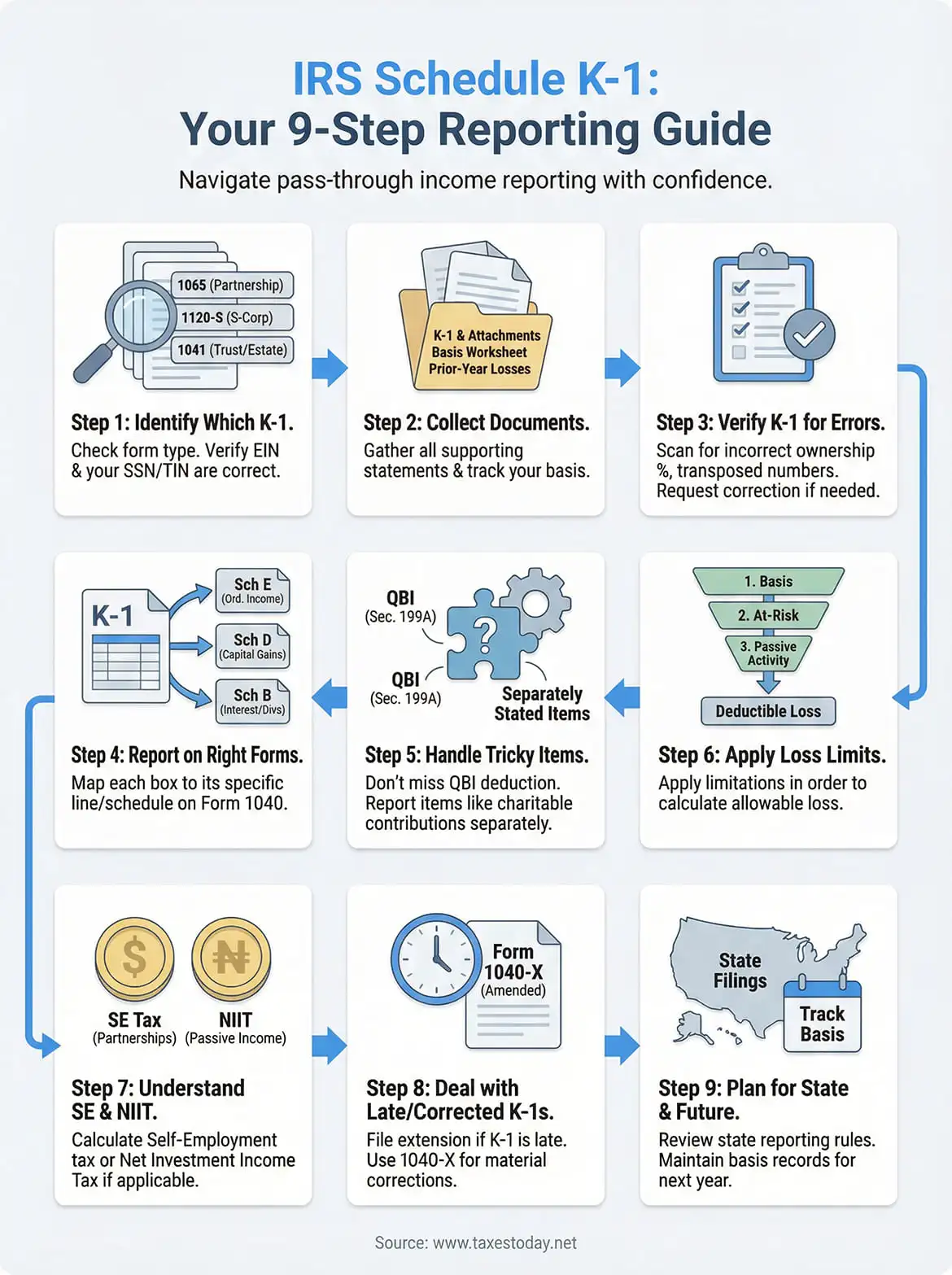
You now have a complete path through the IRS Schedule K-1 instructions, from identifying which form you received to handling corrected K-1s and planning ahead for state taxes. The key is treating each box as a separate item with its own reporting destination rather than treating the K-1 as a single income figure. Skipping any of the nine steps above creates gaps that the IRS notices when it cross-references your return against the entity's informational filing.
Start by pulling your K-1 and verifying it against the checklist in Step 3 before you enter a single number. Then work through each populated box using the tables in Step 4 as your guide. If your situation involves multiple K-1s, passive losses, or multistate income, the reporting complexity adds up fast. The licensed professionals at TaxesToday handle K-1 filing for individuals and small business owners across all 50 states, starting at $99.