


IRS Form 1040X Instructions: How To Amend A Tax Return
You filed your tax return, hit submit, and then realized something was wrong. Maybe you forgot to report freelance income, missed a deduction, or entered the wrong filing status. It happens more often than you'd think, and the IRS built Form 1040-X specifically for situations like this. If you're searching for IRS Form 1040X instructions, you're already on the right track toward fixing the mistake before it becomes a bigger problem.
Amending a tax return doesn't have to be stressful, but it does require accuracy and attention to detail. The form itself has its own set of rules, what to include, what to recalculate, and how to explain your changes to the IRS. Getting any of these steps wrong can delay your amendment or trigger additional scrutiny. That's why understanding the process fully, before you start filling anything out, matters so much.
This guide walks you through every section of Form 1040-X, line by line, so you know exactly what to do and what to avoid. At TaxesToday, our CTEC-certified and IRS-registered tax preparers handle amended returns regularly, helping clients across California and nationwide correct errors and get back into compliance. Whether you decide to file on your own or want professional help with your amendment, this article gives you the knowledge you need to move forward with confidence.
What Form 1040-X does and when to use it
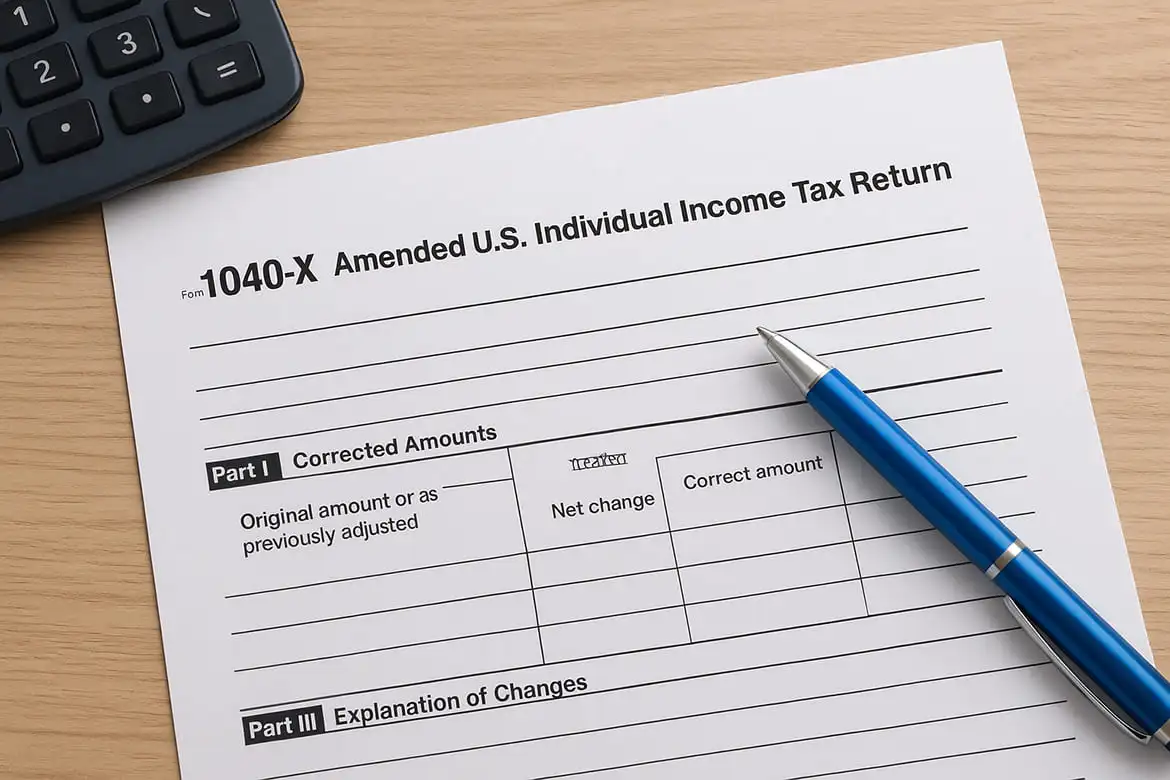
Form 1040-X is the IRS's official form for correcting a previously filed federal income tax return. It works as a replacement for your original return, not just a correction slip, meaning you restate the entire return with corrected figures displayed side by side with original figures so the IRS can see exactly what changed and why. Understanding what this form does before you start filling it out will save you time and reduce the chance of delays.
What Form 1040-X actually does
When you submit Form 1040-X, you give the IRS a three-column comparison of your tax return. Column A shows your originally reported amounts, Column B shows the net change (positive or negative), and Column C shows the corrected totals. The form also includes Part III, where you write a plain-language explanation of each change you made. This structure lets IRS reviewers process your amendment without pulling up your entire original return.
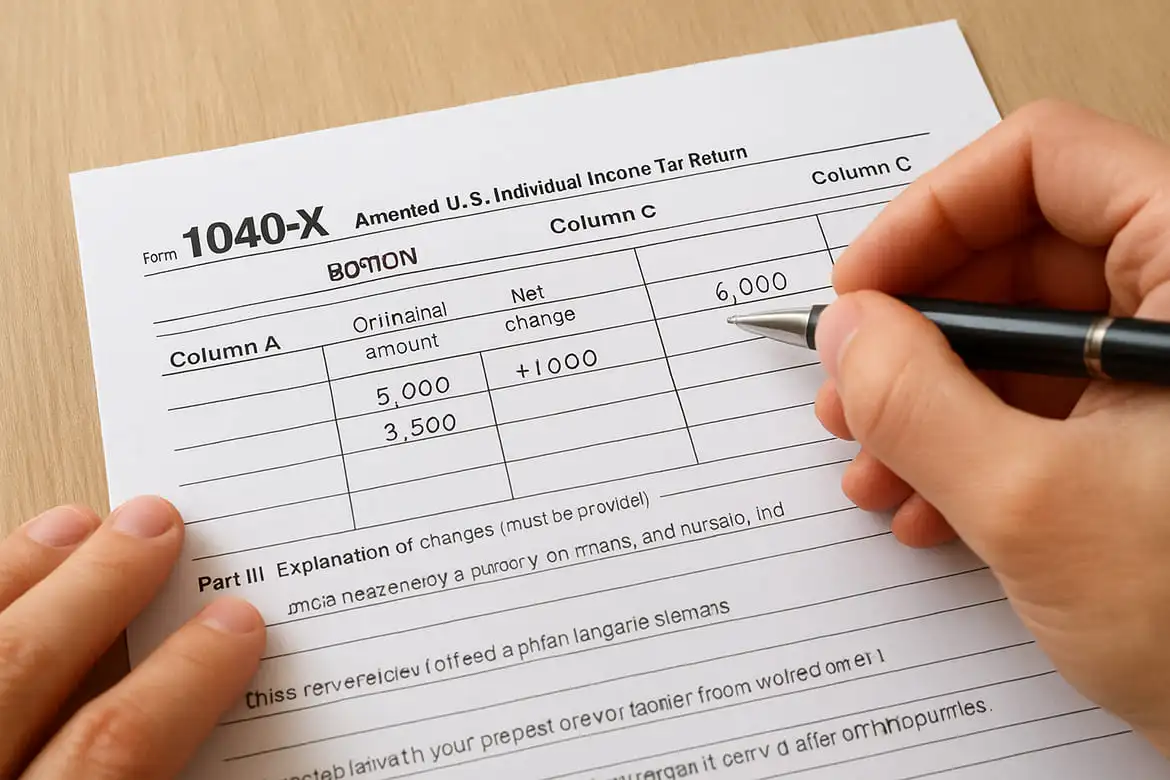
The explanation you write in Part III carries real weight: a vague or incomplete description can slow down processing or prompt the IRS to request more documentation.
Working through the irs form 1040x instructions with this structure in mind helps you stay organized. You are not re-filing your taxes from scratch. Instead, you are identifying the specific lines that changed, recalculating the impact of those changes on your tax liability or refund, and explaining the reason for each correction clearly and concisely.
When you should file Form 1040-X
You need to file Form 1040-X any time your original return contains an error or omission that affects your tax liability, refund amount, or filing status. The following situations are the most common reasons people file an amendment:
- You forgot to report income, such as 1099 earnings or freelance payments, received during the tax year
- You claimed a deduction or credit that you were not actually eligible for
- You missed a deduction or credit you were eligible for, such as the Child Tax Credit, education credits, or retirement contribution deductions
- You used the wrong filing status, for example filing as Single when you qualified as Head of Household
- You reported an incorrect Social Security number or entered wrong dependent information
- You need to add or remove a dependent from your original return
- A corrected W-2, amended 1099, or Schedule K-1 arrived after you filed, changing your reported income or deductions
Each of these scenarios changes one or more lines on your original return, which shifts the tax you owe or the refund you should receive. Filing Form 1040-X corrects the official record and keeps your IRS account accurate.
When you should NOT file Form 1040-X
Not every post-filing issue requires an amendment, and filing one unnecessarily can actually create more work for you. You do not need to submit Form 1040-X in these situations:
- You made a math error on your original return. The IRS automatically catches and corrects math errors during processing and sends you a notice if the change affects your balance.
- You forgot to attach a supporting document like a W-2 or 1099, but the income was still reported correctly. The IRS will contact you separately if they need the document.
- Your original return is still being processed. The IRS cannot accept an amendment for a return that hasn't cleared its system yet.
If the IRS sends you a CP2000 notice about unreported income, respond directly to that notice rather than filing Form 1040-X. The CP2000 process is separate from the amendment system, and using the wrong response method can complicate your account. Knowing the difference between these situations helps you take the right action from the start.
Deadlines and timing rules
The IRS gives you a specific window to file Form 1040-X, and missing it can cost you a refund or create additional liability. The rules differ depending on whether your amendment results in a refund or means you owe additional tax, so understanding each scenario helps you act at the right time.
The three-year rule for refunds
If your amendment produces a refund or credit, you must file Form 1040-X within three years from the date you filed your original return, or within two years from the date you paid the tax on that return, whichever is later. The IRS will not issue a refund on an amendment filed outside this window, even if the numbers clearly show you were owed money.

If you filed your original return before the April 15 deadline, the IRS still treats the three-year clock as starting on April 15, not the date you actually submitted.
When you use an extension, the three-year period starts from the extended due date, not the original April 15 deadline. For example, if you filed on October 15 under an extension for tax year 2022, your deadline to claim a refund via Form 1040-X falls on October 15, 2025. Reviewing the irs form 1040x instructions on the IRS website confirms this rule and reminds you to verify your exact filing dates before you begin.
When you owe additional tax
If your amendment shows that you underreported income or claimed a deduction incorrectly, the IRS can generally assess the additional tax within three years of the original filing deadline. However, if you understated income by more than 25 percent of your gross income, the IRS has six years to assess. There is no filing deadline on your end when submitting an amendment that increases your tax balance, but acting quickly reduces the interest and penalties that accumulate on any unpaid amounts from the original due date forward.
State amendment deadlines
Most states follow a similar three-year window for amended state returns, but each state sets its own rules. California, for example, generally allows you to file an amended state return within four years of the original filing deadline. Filing your federal 1040-X first is standard practice, since most states require you to attach a copy of your accepted federal amendment when submitting the state version. Check your state's revenue agency directly for the exact deadline that applies to your situation before you finalize anything.
Before you start: what you need to gather
Jumping straight into Form 1040-X without organizing your documents first leads to mistakes, missing information, and multiple rounds of corrections. The irs form 1040x instructions from the IRS recommend having everything in front of you before you touch the form, because each section of the amendment depends on accurate figures from your original filing and the documents that support your specific changes.
Your original return and IRS correspondence
Your complete original return is the starting point for everything on Form 1040-X. You need the actual copy you filed, including all schedules and attachments, so you can reference the exact numbers that go into Column A of the form. If you no longer have a copy, you can request a tax return transcript directly from the IRS at irs.gov using the "Get Transcript" tool at no cost.
If the IRS sent you any notices related to your original return, pull those out as well, since they may reference specific line items you need to address on your amendment.
Along with your return, gather any IRS processing confirmation, such as your e-file acceptance notice or the date your payment cleared. You need this to verify that your original return was fully processed before you submit the amendment, which is a required step covered in detail in the next section.
Financial documents that support your changes
The documents you need depend entirely on what changed between your original return and your corrected return. Pulling the right records before you start prevents you from guessing at figures midway through the form.
Here is a reference table of the most commonly needed documents based on amendment type:
| Reason for amendment | Documents to gather |
|---|---|
| Unreported income | Corrected or late-arriving W-2, 1099, or Schedule K-1 |
| Missed deduction | Receipts, statements, or contribution confirmations |
| Wrong filing status | Household expense records, dependent information |
| Incorrect dependent | Social Security card, birth certificate, or school records |
| Education credits | Form 1098-T from your school |
| Retirement contributions | Form 5498 from your IRA custodian |
| Business expenses | Bank statements, invoices, or mileage logs |
Gathering every document listed above for your specific situation before you open Form 1040-X keeps you from stopping midway through to hunt for numbers. Each record you pull now directly feeds into the line-by-line recalculation you will complete in the steps ahead.
Step 1. Confirm the IRS processed your original return
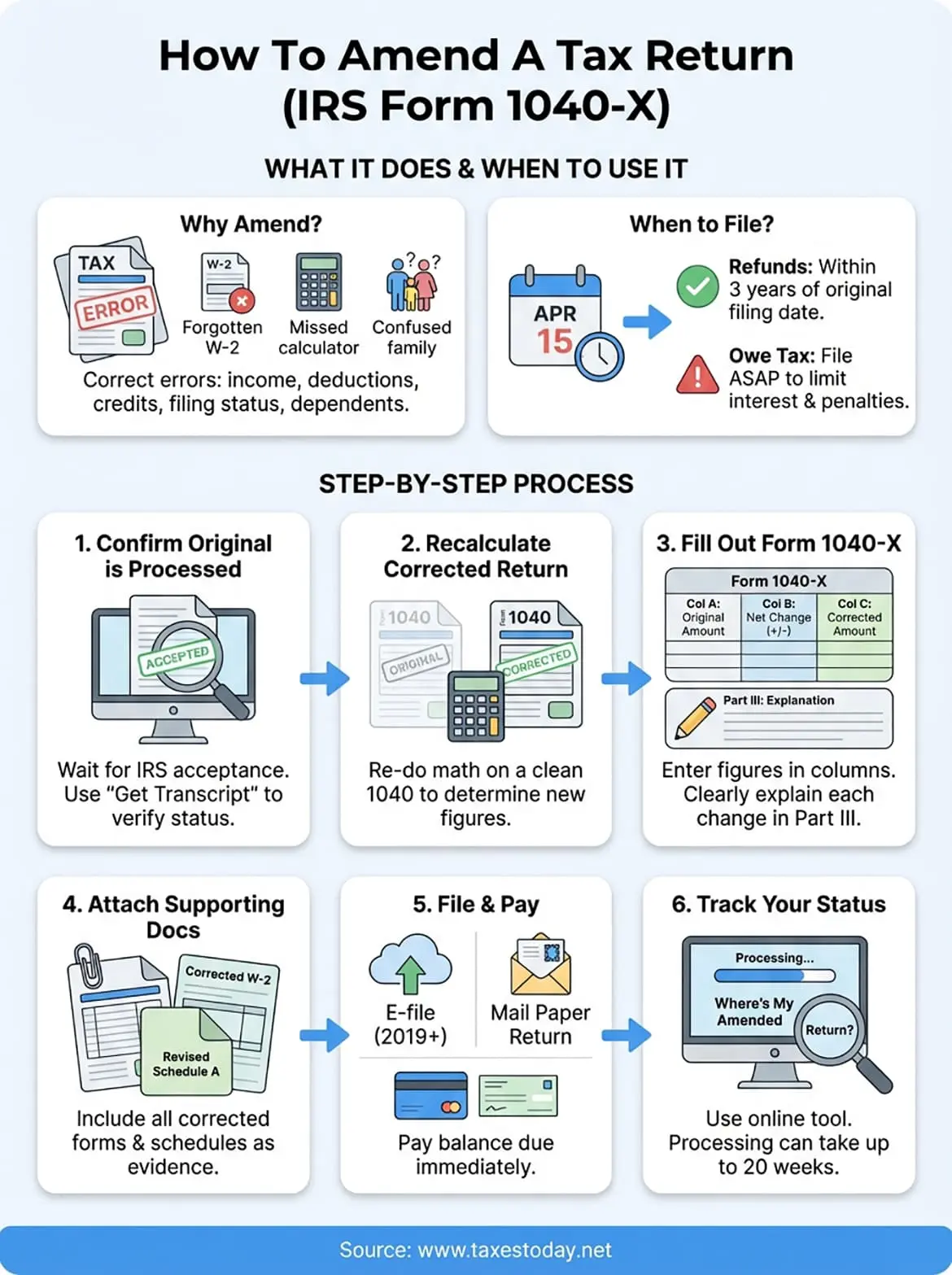
Before you fill out a single line on Form 1040-X, verify that the IRS fully accepted and processed your original return. Submitting an amendment against a return that is still in the processing queue creates a conflict in the system, and the IRS will reject your 1040-X outright. This confirmation step takes only a few minutes but prevents a significant delay if your amendment comes back unprocessed.
How to check your original return's status
The IRS offers a free tool called "Where's My Amended Return?" at irs.gov, but that tool tracks 1040-X amendments specifically, not original returns. To confirm your original return cleared the system, use the "Get Transcript" tool at irs.gov instead. If a transcript is available for the tax year you want to amend, the IRS processed your return and you can move on to the next step.
A transcript showing "No record of return filed" means your original return has not cleared yet, and you must wait before submitting Form 1040-X.
Three methods let you confirm your original return's status:
- Get Transcript online at irs.gov: Results appear within approximately three weeks of e-filing, or immediately if your return processed months ago
- Get Transcript by mail: Available from irs.gov if you cannot access the online system; delivery takes five to ten calendar days
- IRS phone line at 1-800-829-1040: A representative can confirm processing status, though wait times during filing season often exceed thirty minutes
Your tax software or preparer also sent you an acceptance confirmation showing the date the IRS acknowledged receipt of your e-filed return. Keep in mind that acknowledgment of receipt is not the same as full processing, so always verify with one of the methods above before you proceed.
What to do while you wait
Should the transcript tool show no record yet, do not file Form 1040-X. The standard processing window for e-filed returns runs about three weeks, while paper-filed returns take eight to twelve weeks. Set a calendar reminder and recheck the transcript tool once that window closes.
Use the waiting period to organize your supporting documents and recalculate your corrected figures so you are ready to move fast once processing confirms. The irs form 1040x instructions published by the IRS confirm that amended returns submitted before the original is processed will be rejected. Downloading your transcript the moment it becomes available also gives you a clean, documented record of the original figures you will enter in Column A of Form 1040-X.
Step 2. Recalculate your corrected tax return
Before you open Form 1040-X, you need to rebuild your corrected return from scratch using your original figures as the baseline. This step is where most people slow down, because Form 1040-X does not ask you to fill in every line on a fresh 1040. Instead, it asks you to identify only the lines that changed and show the corrected totals. Doing the math correctly here is what makes the rest of the form straightforward.
Identify which lines changed
Start by pulling up your original Form 1040 alongside the documents that triggered your amendment. Go line by line through your original return and mark every line that carries a different number under the corrected scenario. For example, if a late-arriving 1099-NEC adds $3,200 to your income, your gross income line changes, your adjusted gross income changes, and your tax liability changes. Each of those shifts must appear in Column B of Form 1040-X.
Here is a quick reference showing common amendment reasons and the lines they typically affect on Form 1040:
| Amendment reason | Lines most likely to change |
|---|---|
| Added income (1099, W-2 correction) | Line 1–8, Line 11 (AGI), Line 15 (tax) |
| New deduction or missed credit | Schedule A or relevant credit schedule, Line 12–14 |
| Filing status change | Line 1 checkbox, standard deduction, Line 15 |
| Added or removed dependent | Line 19 (Child Tax Credit), Line 27 (EITC) |
Work through the corrected numbers
Once you know which lines changed, recalculate the full return using those corrected inputs. The clearest method is to fill out a clean copy of the original Form 1040 with the corrected numbers entered. This gives you a complete corrected return to reference when you transfer figures into Form 1040-X, rather than trying to track isolated line changes in your head.
A completed corrected Form 1040 sitting next to your original return makes Column A, B, and C on Form 1040-X nearly self-explanatory, since you are simply comparing the two documents line by line.
Pay particular attention to cascading changes, where one correction shifts multiple downstream lines. If your income increases, your standard deduction stays fixed, but your tax bracket may shift, your estimated tax penalty may change, and certain credits that phase out at higher income levels may shrink. The irs form 1040x instructions published by the IRS note this interconnected nature explicitly, which is why rebuilding the full corrected return rather than patching individual numbers gives you the most reliable figures to carry forward.
Step 3. Fill out Form 1040-X correctly
With your corrected figures in hand, you are ready to complete the actual form. Form 1040-X is a three-page document organized into columns, numbered lines, and a written explanation section. Working through it in order, rather than skipping around, keeps your numbers consistent and prevents the kind of mismatches that slow down IRS processing. The irs form 1040x instructions included in the IRS PDF walk through each line, but the overview below gives you a practical framework before you dive in.
Columns A, B, and C: the core of the form
The top portion of Form 1040-X contains the three-column layout you prepared for in Step 2. Each column has a specific role, and entering the wrong figure in the wrong column is one of the most common errors on amended returns.
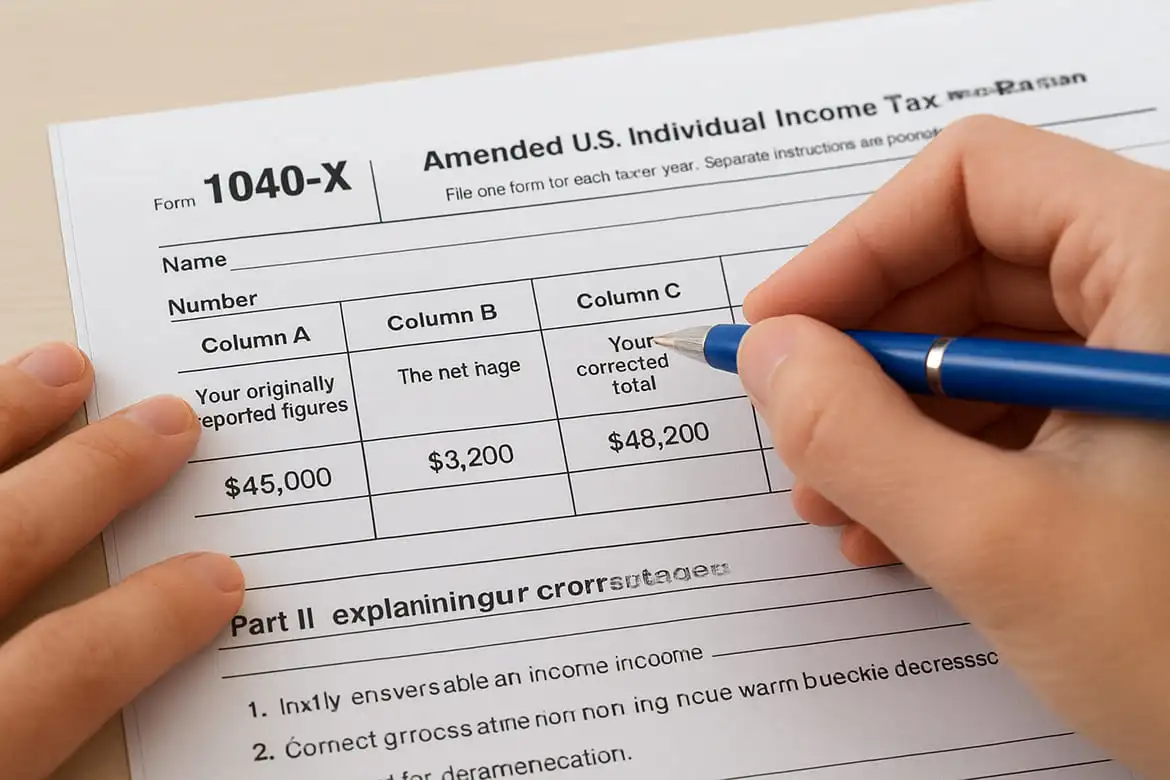
Getting Column B right is critical: it represents the net difference between your original and corrected amounts, and the IRS uses it to calculate any refund owed or balance due.
Here is how to fill each column accurately:
| Column | What to enter | Example |
|---|---|---|
| Column A | Your originally reported figures from your filed return | $45,000 gross income |
| Column B | The net change (increase shown as positive, decrease shown in parentheses) | $3,200 added income |
| Column C | Your corrected total (Column A plus or minus Column B) | $48,200 corrected income |
After completing the column entries, move to Part I, which covers exemptions and dependents if those changed. Skip any section that has no changes. Lines 1 through 9 on the form map directly to the major income and deduction categories from your original Form 1040, so your completed corrected return from Step 2 should make each entry straightforward.
Part III: explaining your changes
Part III is a required written explanation of every change you made on the form. The IRS reviewer reading your amendment relies on this section to understand what happened and why, without having to guess from the numbers alone. Write one to three clear sentences for each change, stating what the error was, what the correct information is, and what document supports the correction.
A strong Part III entry looks like this:
"Line 1 income increased by $3,200 because a Form 1099-NEC from [Payer Name] arrived after the original return was filed. The correct gross income is $48,200, supported by the attached 1099-NEC."
Avoid vague language like "correction to income" without specifics. If you made three separate changes, write a separate explanation for each one. A detailed, specific Part III significantly reduces the chance that the IRS contacts you for additional clarification.
Step 4. Attach forms and supporting documents
After you complete Form 1040-X, the documents you attach determine whether the IRS accepts your amendment as-is or sends you a follow-up request for more information. The irs form 1040x instructions specify that you must include any form or schedule that directly supports a change you reported, and skipping this step is one of the most common reasons amendments stall in processing. Think of your attachments as the evidence file behind your corrected return.
What to always include with your 1040-X
Every amended return needs specific documents attached regardless of what changed. Start by placing Form 1040-X on top of the stack, followed by any corrected or updated forms that generated the change. If a new or corrected information document arrived after your original filing, include a copy of it so the IRS can match it to the line you corrected.
Attaching a cover sheet that lists each document in order helps IRS reviewers process your package without needing to contact you for clarification.
Here is a quick-reference table of the documents most commonly required based on the type of change you made:
| Change you made | Document to attach |
|---|---|
| Added income from late 1099 or corrected W-2 | Copy of the corrected 1099 or W-2 |
| Claimed a missed education credit | Form 8863 and Form 1098-T from your school |
| Added retirement contribution deduction | Form 5498 from your IRA custodian |
| Changed filing status | Revised Form 1040 schedules affected by the change |
| Claimed a missed business deduction | Revised Schedule C with supporting receipts |
| Added or removed a dependent | Revised Schedule 8812 if Child Tax Credit changed |
When amended schedules are required
Any schedule from your original Form 1040 that carries different numbers after your correction must be refiled in its corrected form and attached to your 1040-X. You do not re-attach schedules that had no changes, only the ones where at least one figure shifted. For example, if you added freelance income, attach a revised Schedule C showing the corrected net profit, because that figure feeds directly into your adjusted gross income.
Paper filers should arrange the package with Form 1040-X first, followed by corrected schedules in numerical order, then supporting documents such as 1099s, receipts, and statements. If you file electronically through a tax software program, the software handles the attachment process, but you should still confirm that every required form appears in the final review screen before you submit.
Step 5. File your 1040-X and pay if you owe
Once your form is complete and your supporting documents are organized, you have two options to submit your amendment: electronic filing or paper mail. Your choice depends on the tax year you are amending and which method your tax software supports. Getting the submission right on the first attempt avoids reprocessing delays that can push your case back by weeks.
Electronic filing vs. paper filing
The IRS now accepts electronically filed 1040-X amendments for tax years 2019 and later, which covers most amendments people file today. E-filing through IRS-authorized tax software is faster, generates a confirmation number, and moves your amendment into the processing queue significantly quicker than mailing a paper package. If your tax software supports it, use the e-file option.

If you are amending a return for tax year 2018 or earlier, the IRS requires you to mail a paper Form 1040-X, since electronic filing is not available for those years.
For paper filers, the irs form 1040x instructions include a full table of IRS mailing addresses organized by state and whether you are enclosing a payment. Use the address that matches your state of residence and your payment situation precisely, since sending your package to the wrong address adds weeks to processing. Print clearly, use a large enough envelope to keep documents flat, and send via certified mail with return receipt so you have documented proof of delivery.
How to pay if your amendment shows a balance due
If Column C on your Form 1040-X shows a higher tax liability than your original return, you owe the difference plus any interest that has accrued since the original due date of the return. The IRS calculates interest automatically from the original filing deadline, not from the date you submit your amendment, so paying quickly keeps the total amount as low as possible.
You have several reliable payment methods available through IRS Direct Pay at irs.gov, which lets you pay directly from your checking or savings account at no cost. Other accepted methods include:
- IRS Direct Pay: Free bank transfer, available at irs.gov
- Electronic Federal Tax Payment System (EFTPS): Free, requires advance enrollment
- Debit or credit card: Accepted through IRS-approved payment processors, though a processing fee applies
- Check or money order: Made payable to "United States Treasury," mailed with a payment voucher or a note showing your Social Security number, tax year, and "Form 1040-X"
Do not send cash through the mail under any circumstances. Attach a check or money order directly to the front of your paper 1040-X package if you choose that payment route.
Step 6. Track your amended return and next steps
After you submit Form 1040-X, the waiting period begins. Amended returns take significantly longer to process than original returns, so knowing how to check your status and what to expect at each stage keeps you from second-guessing whether your amendment went through. The irs form 1040x instructions note that paper-filed amendments can take up to 20 weeks to process, and e-filed versions typically move faster but still require several weeks.
How to use the "Where's My Amended Return?" tool
The IRS provides a free online tracking tool called "Where's My Amended Return?" at irs.gov. You can access it three weeks after mailing a paper amendment or 72 hours after the IRS acknowledges your e-filed 1040-X. To use it, you need your Social Security number, date of birth, and zip code exactly as they appear on your amendment.
The tool shows your amendment moving through three stages:
- Received: The IRS has your 1040-X in the system and has begun reviewing it
- Adjusted: The IRS completed its review and made changes to your account
- Completed: The IRS finished processing and mailed you a notice explaining the outcome
If the tool shows no record of your amendment three weeks after mailing, contact the IRS at 1-800-829-1040 to confirm your package arrived before assuming you need to refile.
What to do while you wait
Your main job during the processing window is to watch your mail for an IRS notice, not to call the IRS or submit a second amendment. The IRS sends a CP21 or CP22 notice when it finishes processing your 1040-X, which confirms the changes it made and either explains your refund timeline or shows a remaining balance. Keep your copy of the filed 1040-X and all attachments accessible in case the IRS requests additional documentation.
Expect your refund check or direct deposit to arrive within three to four weeks after the tracking tool shows "Completed," provided the IRS accepted your amendment as filed. If the IRS adjusted your figures during review, the notice will explain the difference between what you claimed and what the agency approved.
If the IRS contacts you
Should the IRS send a notice requesting additional information, respond promptly and attach the exact documents the notice requests. Read the notice carefully, because it will specify a response deadline, typically 30 to 60 days from the notice date. Missing that deadline can result in the IRS closing your case without processing your amendment, which means you would need to start the entire process over.
A quick wrap-up
Following the irs form 1040x instructions step by step gives you the best chance of a smooth amendment with no back-and-forth from the IRS. You now know when to file, what documents to gather, how to fill in each column accurately, and how to write a clear explanation in Part III that holds up to scrutiny. Each step in this guide builds directly on the one before it, so skipping ahead creates gaps that slow down processing.
Amended returns require precise recalculation and complete documentation, and even small errors in Column B can cause delays or trigger a follow-up notice. If your situation involves multiple changes, added income sources, or a filing status correction, working with a professional reduces the risk considerably. Our CTEC-certified team at TaxesToday handles amended returns for individuals, freelancers, and small businesses across the country. Get professional help with your amended tax return and file with confidence.