


How Does A Tax Extension Work? Deadlines, Steps, And Payment
The April deadline is approaching, and your tax documents are scattered across your desk. Maybe you're waiting on a K-1 from a partnership, or perhaps life simply got in the way. Whatever the reason, you're wondering how does a tax extension work and whether it's the right move for your situation. The good news: filing for an extension is straightforward, and millions of Americans do it every year.
Here's what most people get wrong, though. A tax extension gives you more time to file your return, not more time to pay what you owe. Miss that distinction, and you could face penalties and interest charges that add up quickly. Understanding the rules before you file can save you money and stress when October rolls around.
At TaxesToday, our CTEC-certified tax preparers have helped clients across California and nationwide navigate extensions for over 15 years. In this guide, we'll walk you through the exact steps to file Form 4868, explain the deadlines you need to know, and clarify what happens with any taxes you owe. Whether you're a W-2 employee, a freelancer juggling 1099s, or a small business owner, you'll leave with a clear understanding of your options and how to stay compliant with the IRS.
Why tax extensions matter
You face a choice every April: rush through your return and risk mistakes, or take the time you need to file accurately. Tax extensions provide a six-month window to gather documents, verify deductions, and ensure your return reflects your actual financial situation. This breathing room matters more than many taxpayers realize, especially when you consider that the IRS processed over 19 million extensions in recent years. These aren't just procrastinators or people trying to game the system. They're individuals and business owners who recognize that accuracy beats speed.
Filing on time with errors creates problems that cost far more than taking an extension. When you submit an incomplete return, you might miss deductions worth hundreds or thousands of dollars, or worse, report income incorrectly and trigger an audit. The pressure of the April 15 deadline pushes some taxpayers to make quick decisions about complex tax situations, like how to report cryptocurrency transactions or whether a home office qualifies for deductions. Extensions give you time to research these questions properly or consult with a tax professional who can guide you through the details.
A tax extension is not a sign of failure. It's a strategic tool that helps you file a complete, accurate return instead of a rushed one filled with gaps.
Protection from failure-to-file penalties
The failure-to-file penalty runs at 5% per month of your unpaid taxes, up to a maximum of 25%. This penalty applies when you miss the April deadline entirely without requesting an extension. By filing Form 4868, you eliminate this penalty completely, even if you still owe money. You'll still face interest and a late-payment penalty of 0.5% per month on any balance due, but that's significantly less than the combined hit from both penalties. If you owe $5,000 and miss the deadline by three months without an extension, you'd rack up $750 in failure-to-file penalties alone. Filing the extension removes that $750 charge entirely.
Time to organize complex tax situations
Your tax situation rarely fits neatly into simple categories. Self-employed individuals juggling multiple 1099 forms, small business owners tracking expenses across categories, and investors managing capital gains all benefit from the extra time an extension provides. You might be waiting on corrected forms from employers or brokers who initially sent inaccurate 1099s. Perhaps you sold property, started a side business, or got married during the tax year, and you need time to understand how these life changes affect your filing status and deductions. Extensions let you handle these complexities without the anxiety of an approaching deadline breathing down your neck.
Common scenarios that warrant filing
Certain situations make extensions particularly valuable. You're missing key documents like partnership K-1s that typically arrive after April 15, or you discovered an error on a W-2 that requires a corrected form. Maybe you experienced a major life change, such as divorce, inheritance, or significant medical expenses, and you need time to gather supporting documentation. International taxpayers or those with foreign accounts often face additional reporting requirements that demand careful attention to detail. Small business owners filing Schedule C might need extra weeks to categorize expenses properly or determine which home office deductions they qualify for. In each case, rushing increases your risk of mistakes that cost money or invite IRS scrutiny.
What an IRS tax extension does and does not do
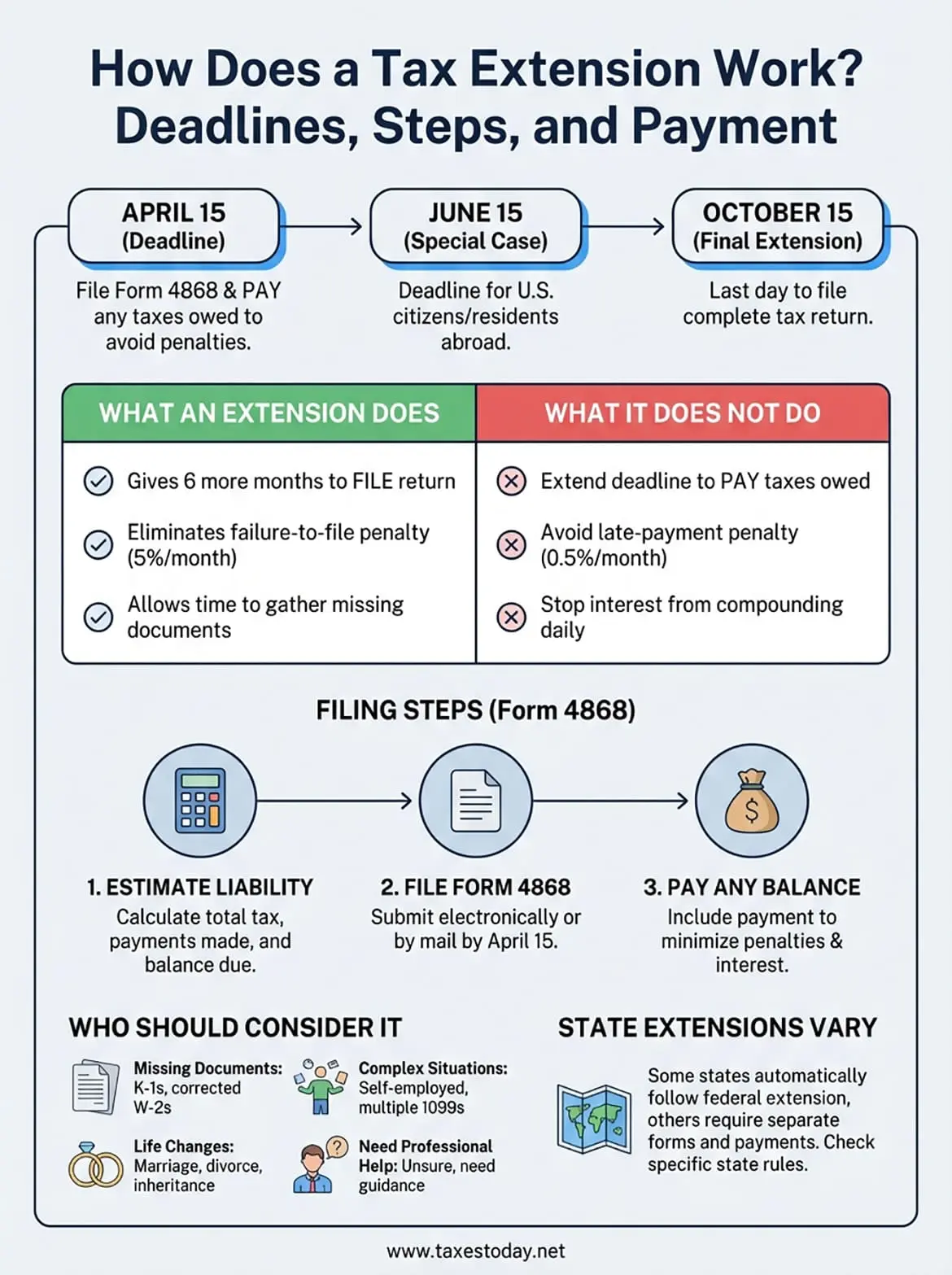
Understanding how does a tax extension work starts with knowing exactly what you gain and what you don't when you file Form 4868. The IRS grants you an automatic six-month extension to submit your tax return, moving your deadline from April 15 to October 15. This additional time applies only to filing your return, not to paying any taxes you owe. Many taxpayers confuse these two separate obligations, leading to unexpected penalties and interest charges that could have been avoided with proper planning.

What the extension covers
Filing Form 4868 gives you six additional months to prepare and submit your complete tax return. You can use this time to gather missing documents, organize complex financial records, or work with a tax professional who can identify deductions you might have missed. The extension eliminates the failure-to-file penalty completely, which otherwise charges 5% of your unpaid taxes per month, up to 25%. You also gain flexibility to respond to unexpected life events without the pressure of the April deadline. If you discover errors in documents you've already received, or if you need to wait for corrected forms from employers or financial institutions, the extension provides breathing room to address these issues properly.
Filing an extension protects you from the steep failure-to-file penalty, even if you still owe taxes.
What the extension does not cover
The extension does not extend your payment deadline for taxes owed. You must still pay any taxes you owe by April 15, or you'll face a late-payment penalty of 0.5% per month on your unpaid balance, plus interest that compounds daily. The IRS expects you to estimate your tax liability and submit payment when you file Form 4868, even though you haven't completed your full return yet. This requirement catches many first-time extension filers off guard. If you owe $3,000 and pay nothing by April 15, you'll accumulate $15 per month in late-payment penalties plus interest on the growing balance. The extension also doesn't protect you from estimated tax penalties if you're required to make quarterly payments throughout the year and failed to do so. Your extension covers the return filing deadline only, nothing more.
Key deadlines for 2026 and common exceptions
You need to mark three critical dates on your calendar when you're considering filing an extension. The first deadline is April 15, 2026, when you must submit Form 4868 to the IRS. This same date represents when any taxes you owe must be paid, regardless of whether you're filing an extension. The final date, October 15, 2026, gives you the full six-month period to submit your complete tax return. Missing any of these dates triggers specific penalties that vary based on which deadline you fail to meet and how much you owe.

Standard extension deadline for 2026
Filing Form 4868 by April 15, 2026 gives you until October 15, 2026 to submit your complete return. You don't need to provide a reason or justify why you need the extension. The IRS grants this additional time automatically as long as you file the form correctly. If you estimate you owe taxes, you must include payment with your extension request. No payment requirement exists if you expect a refund or believe you've already covered your tax liability through withholding or estimated payments.
The six-month extension is automatic, but it only works if you file Form 4868 by the original April deadline.
When exceptions apply to the October deadline
Certain circumstances push your deadline beyond the standard October date. U.S. citizens and resident aliens living abroad automatically receive a two-month extension to June 15, 2026 to file and pay, without submitting Form 4868. If you need more time beyond June, you can still file Form 4868 by June 15 to extend until October 15. Military personnel serving in combat zones get their deadline extended to 180 days after leaving the combat zone, plus any unused portion of their original filing period. Taxpayers affected by federally declared disasters receive extensions announced by the IRS that vary based on the specific event and location.
Special situations that shift your filing date
Your filing status and location create additional deadline variations. Fiscal year taxpayers who don't follow the standard calendar year must file by the 15th day of the fourth month after their fiscal year ends. Their extension moves the deadline six months forward from that date. Residents of Maine or Massachusetts get until April 17, 2026 (instead of April 15) because of state holidays that fall on the 15th. These two extra days apply to both filing your extension and paying any taxes owed. Understanding how does a tax extension work for your specific situation requires checking whether any of these exceptions apply to you before you assume the standard April 15 deadline applies.
Who should consider filing an extension
Filing an extension makes sense for specific groups of taxpayers who face unique challenges that the standard April deadline doesn't accommodate. You don't need an elaborate excuse or special circumstances to request one, but certain situations naturally align with the extra time an extension provides. Recognizing whether you fall into one of these categories helps you make an informed decision about whether to file Form 4868 or push through to meet the original deadline.
Self-employed individuals and business owners
Your Schedule C requires detailed expense tracking that often takes longer than gathering W-2s and 1099s. If you run a side business, operate as a freelancer, or manage a single-member LLC, you need time to categorize expenses properly, calculate depreciation on equipment, and determine which home office deductions you qualify for. Business owners frequently receive corrected 1099-NEC forms after the initial deadline because clients discover reporting errors. Partnership and S-corp owners typically wait until late March or early April for K-1 forms that detail their share of business income, making an extension almost necessary to file accurately.
People waiting on crucial tax documents
Missing documents create impossible situations when April 15 approaches. You might be waiting on corrected W-2s from an employer who initially reported your income or withholding incorrectly. Financial institutions sometimes send amended 1099-INT or 1099-DIV forms after discovering errors in interest or dividend reporting. Foreign account holders often receive FBAR-related documents later than domestic taxpayers because international financial institutions follow different reporting schedules. Filing without these documents means guessing at numbers or leaving income unreported, both of which create audit risks you can avoid by taking the extension.
Understanding how does a tax extension work helps you recognize when incomplete information makes filing early more risky than filing late.
Taxpayers facing major life changes
Significant life events complicate your tax situation in ways that demand careful attention. Getting married or divorced during the tax year changes your filing status and affects your standard deduction, tax brackets, and eligibility for various credits. Inheritance brings capital gains considerations and potential estate tax issues that require professional guidance. Medical expenses exceeding 7.5% of your adjusted gross income create deduction opportunities, but calculating and documenting these expenses takes time. Moving to a new state introduces questions about resident versus non-resident status and how to split income between jurisdictions.
Anyone who needs professional help but hasn't found it
You recognize that your tax situation exceeds your comfort level, but you haven't yet connected with a qualified tax preparer. Finding a CTEC-certified professional, gathering your documents, and scheduling an appointment often pushes you past the April deadline. Rather than rushing through a complex return on your own, the extension gives you time to secure proper guidance and ensure your return maximizes deductions while maintaining compliance.
How to file a federal tax extension step by step
Filing Form 4868 requires only a few pieces of information and takes most taxpayers less than 15 minutes to complete. You report your estimated total tax liability for the year, any payments you've already made through withholding or estimated taxes, and your balance due or refund amount. The IRS doesn't require you to explain why you need the extension or provide supporting documentation. Once you understand how does a tax extension work, the actual filing process becomes straightforward, whether you choose to submit electronically or by mail.
Choose your filing method
You have three main options for submitting your extension request. IRS Free File provides electronic filing at no cost if your adjusted gross income falls below the annual threshold, which changes each year. Most commercial tax software programs like TurboTax, H&R Block, or TaxAct include extension filing as part of their services, often allowing you to file the extension separately from your full return. You can also complete paper Form 4868 and mail it to the IRS processing center for your state, though this method takes longer and provides no immediate confirmation of receipt.
Electronic filing gives you instant confirmation that the IRS received your extension request, eliminating uncertainty about whether you met the deadline.
Complete Form 4868 accurately
The form itself asks for basic identifying information: your name, address, and Social Security number (or spouse's information if filing jointly). You estimate your total tax liability for the year on line 4, enter any payments you've already made on line 5 through withholding or estimated taxes, and calculate your balance due on line 6. If you owe money, you include payment with your extension to avoid late-payment penalties. Getting your estimate close to your actual liability matters because significant underpayment can trigger penalties even with a valid extension. Round numbers work fine; the IRS doesn't expect perfect precision at this stage.
Submit by the April deadline
Your extension request must reach the IRS by April 15, 2026 to be valid. Electronic submissions process immediately, giving you a confirmation number you should save with your tax records. Paper forms need adequate mailing time to arrive by the deadline, so send them at least a week early if you're using regular mail. The IRS recommends certified mail with return receipt if you're filing by paper close to the deadline, providing proof of timely filing if questions arise later. Once submitted, you have until October 15 to file your complete return without penalty.
How to estimate and pay what you owe by April 15
Understanding how does a tax extension work means recognizing that the extension only delays your filing deadline, not your payment deadline. You must estimate what you owe and submit payment by April 15, 2026 to avoid late-payment penalties and minimize interest charges. The IRS expects you to make a reasonable effort to calculate your tax liability based on the information you have available, even though you haven't completed your full return yet. Your estimate doesn't need to be perfect, but getting close protects you from unnecessary penalties when October arrives.
Calculate your estimated tax liability
Start by reviewing last year's tax return to understand your baseline tax liability. If your income and deductions remained relatively stable, last year's numbers provide a solid starting point. Add or subtract based on major changes this year, such as a salary increase, new 1099 income, or significant deductible expenses like mortgage interest or charitable donations. Your pay stubs show year-to-date withholding through February, giving you a clear picture of how much tax you've already paid. Multiply your current withholding by the number of pay periods remaining to project your total withholding for the year.
Making a good-faith estimate and paying at least 90% of what you ultimately owe helps you avoid underpayment penalties, even with an extension.
Most taxpayers who owe money fall short by $1,000 to $5,000, but your situation depends on factors like self-employment income, capital gains, or significant changes in filing status. If you received a large refund last year, you might not owe anything this year since your withholding likely exceeded your actual tax liability. Conversely, if you paid a balance due last April, expect a similar amount this year unless your circumstances changed substantially.
Payment methods the IRS accepts
The IRS offers multiple electronic payment options that process faster than mailing a check. IRS Direct Pay lets you transfer funds directly from your checking or savings account at no cost, and the transaction completes within minutes. You can also pay by debit card, credit card, or digital wallet through IRS-approved payment processors, though these methods charge convenience fees ranging from 1.85% to 1.99% of your payment amount. Some taxpayers use credit cards strategically to earn rewards points, but the fees usually exceed any rewards value unless you have a special promotional rate.
Mailing a check or money order remains an option if you prefer traditional payment methods. Include Form 4868 with your payment and send it to the IRS processing center for your state. Write your Social Security number and "2025 Form 4868" on the check to ensure proper crediting to your account.
What happens if you cannot pay in full
You can still file your extension even if you cannot pay your full tax liability by April 15. The key is to pay as much as you can when you submit Form 4868, because every dollar you pay now reduces the penalties and interest that accumulate on your unpaid balance. Many taxpayers face this situation each year, and the IRS provides several options to help you manage the debt. Filing the extension protects you from the failure-to-file penalty, which charges 5% per month and quickly overshadows the smaller late-payment penalty of 0.5% per month on what you owe.
IRS payment plans and installment agreements
The IRS offers short-term payment plans for balances you can pay within 180 days and long-term installment agreements for larger amounts that need more time. You qualify for automatic approval of a short-term plan if you owe less than $100,000 in combined tax, penalties, and interest. Setting up either plan is free if you agree to automatic monthly withdrawals from your bank account, though the IRS charges a setup fee of $130 to $225 for other payment methods. You can apply online through the IRS website, which processes most requests immediately without requiring you to speak with an agent or submit additional documentation.
The late-payment penalty drops from 0.5% to 0.25% per month once you have an approved installment agreement, cutting your penalty accumulation in half.
Long-term agreements let you spread payments across up to 72 months, making large tax debts manageable through monthly installments. Your monthly payment amount depends on your balance and the length of your agreement, but the IRS typically requires you to pay enough each month to clear the debt before the collection statute expires, which is generally 10 years from the date they assessed the tax.
Penalty and interest charges you will face
Interest compounds daily on your unpaid tax balance, currently running around 8% annually, though the rate adjusts quarterly based on the federal short-term rate plus 3%. The late-payment penalty adds 0.5% per month to your balance, capping at 25% of your original tax debt. If you owe $3,000 and take six months to pay it off, you will accumulate roughly $90 in penalties plus $120 in interest on the declining balance. These charges continue until you pay the full amount, and understanding how does a tax extension work includes recognizing that the extension only eliminates the failure-to-file penalty, not these other charges.
Ways to minimize what you owe
Paying anything by April 15 reduces your total penalty and interest charges for the six months before you file your return in October. Consider putting unexpected income, a tax refund from your state return, or funds from a side project toward your federal tax debt. You might qualify for penalty abatement if you have a clean compliance history and can demonstrate reasonable cause for not paying on time, such as a medical emergency or natural disaster. The IRS reviews these requests individually, and while approval is not guaranteed, taxpayers who file their extension on time and make partial payment show good faith that strengthens their case.
State tax extensions: how they work and where they differ
Your federal extension typically covers your state return, but not all states handle extensions the same way. Some states automatically grant you extra time when you file Form 4868 with the IRS, while others require you to submit a separate state extension form. The complexity increases when you discover that payment deadlines and penalty structures differ from state to state, creating situations where you might have extra time to file your federal return but still owe immediate payment to your state tax authority.

States that automatically follow the federal extension
Most states simplify the process by automatically extending your state filing deadline when you file a federal extension. California, for example, grants you until October 15 to file your state return once you submit Form 4868 to the IRS, without requiring any additional paperwork. No separate state extension form exists in these jurisdictions because they tie their extension policy directly to the federal system. You still must pay any state taxes you owe by the original April deadline to avoid penalties, but the filing extension applies automatically. New York, Illinois, and roughly 30 other states follow this same approach, making it easier to handle both federal and state obligations with a single extension request.
Understanding how does a tax extension work at the state level prevents you from missing a separate filing requirement that could trigger penalties.
States requiring separate extension forms
Several states demand that you file a specific state extension form even when you have a valid federal extension. Virginia requires Form 760IP, Massachusetts asks for Form M-4868, and Hawaii has its own Form N-301. These forms typically mirror the federal version, requesting your estimated tax liability and any payment you're submitting with the extension. Missing this separate filing means you lose the extension protection at the state level, even though your federal extension remains valid. Delaware and Oregon also maintain separate extension systems, and each state publishes its forms on their revenue department website with instructions for electronic or paper filing.
Payment requirements that vary by state
State payment rules create additional wrinkles in your extension strategy. Some states like Michigan and Pennsylvania require you to pay at least 90% of your state tax liability by April 15 to avoid underpayment penalties, which exceeds the federal requirement. Others calculate penalties differently, charging higher or lower rates than the IRS uses for late payment. Connecticut assesses a 10% penalty on unpaid taxes if you file an extension but don't pay what you owe, while California's penalty structure closely mirrors federal rates. You need to check your specific state's requirements because assuming all states follow federal rules creates costly surprises when penalty notices arrive in the mail.
What to do after you file the extension
Filing Form 4868 marks the beginning of your six-month extension period, not the end of your tax responsibilities. You need to treat this time as active preparation, not a vacation from thinking about taxes. The IRS expects you to use these months productively, gathering documents and organizing your financial information so you can file an accurate return by October 15. Many taxpayers make the mistake of forgetting about their taxes entirely after filing the extension, only to face a scramble in early October that defeats the purpose of requesting extra time in the first place.
Keep your confirmation and payment records
Your extension confirmation serves as proof that you requested additional time before the April deadline. Save the electronic confirmation number if you filed online, or keep a copy of your mailed Form 4868 along with certified mail receipts if you submitted by paper. This documentation protects you if the IRS later questions whether you filed your extension on time. Payment receipts from April 15 also belong in your tax file, showing exactly how much you paid toward your estimated liability and when the funds transferred. You will reference these amounts when you complete your full return in October, ensuring you get credit for every payment you made.
Mark your calendar for the October deadline
Setting calendar reminders prevents last-minute panic as October 15 approaches. Schedule alerts for September 1 to begin your final document review, October 1 to start working with a tax professional if needed, and October 10 to give yourself a five-day buffer before the deadline. Understanding how does a tax extension work includes recognizing that the October date carries the same weight as the original April deadline. Missing it triggers the failure-to-file penalty you avoided by requesting the extension, along with continued accumulation of late-payment penalties and interest if you still owe money.
The extension period works best when you use it strategically to gather missing documents and verify deductions, not as permission to postpone thinking about taxes until October.
Continue gathering documents throughout the extension period
Tax documents arrive throughout the year, and your extension period lets you collect corrected forms without rushing. Partnership K-1s often show up in late summer, amended 1099s arrive when financial institutions discover reporting errors, and foreign account statements may take months to process. Create a dedicated folder for these materials as they arrive, whether physical or digital, so you have everything organized when you sit down to complete your return. Review each document as it comes in rather than waiting until October to discover discrepancies that require follow-up with employers or financial institutions.
Next steps
You now understand how does a tax extension work, from filing Form 4868 by April 15 to paying what you owe and meeting the October deadline. The extension gives you six additional months to file, but remember that payment remains due on the original deadline regardless of when you submit your return. Your next move depends on your situation: estimate your tax liability, gather missing documents, and decide whether you need professional guidance to maximize deductions and ensure compliance.
Filing accurately matters more than filing quickly. If your tax situation involves self-employment income, multiple 1099s, or complex deductions, working with an experienced tax preparer helps you avoid costly mistakes and missed opportunities. TaxesToday provides affordable tax preparation starting at $99, handled by CTEC-certified professionals who understand extensions, amended returns, and everything in between. Taking the time to get it right saves money and eliminates stress when October arrives.