



Who Qualifies for a Tax Extension? Eligibility Explained
Tax deadline creeping up and you're nowhere near ready to file? Here's the good news: who qualifies for a tax extension is a shorter list of requirements than most people expect. The IRS doesn't ask why you need more time or dig into your finances before granting one. If you're a US taxpayer with a filing obligation, you almost certainly qualify, and that includes freelancers, small business owners, and even non-residents.
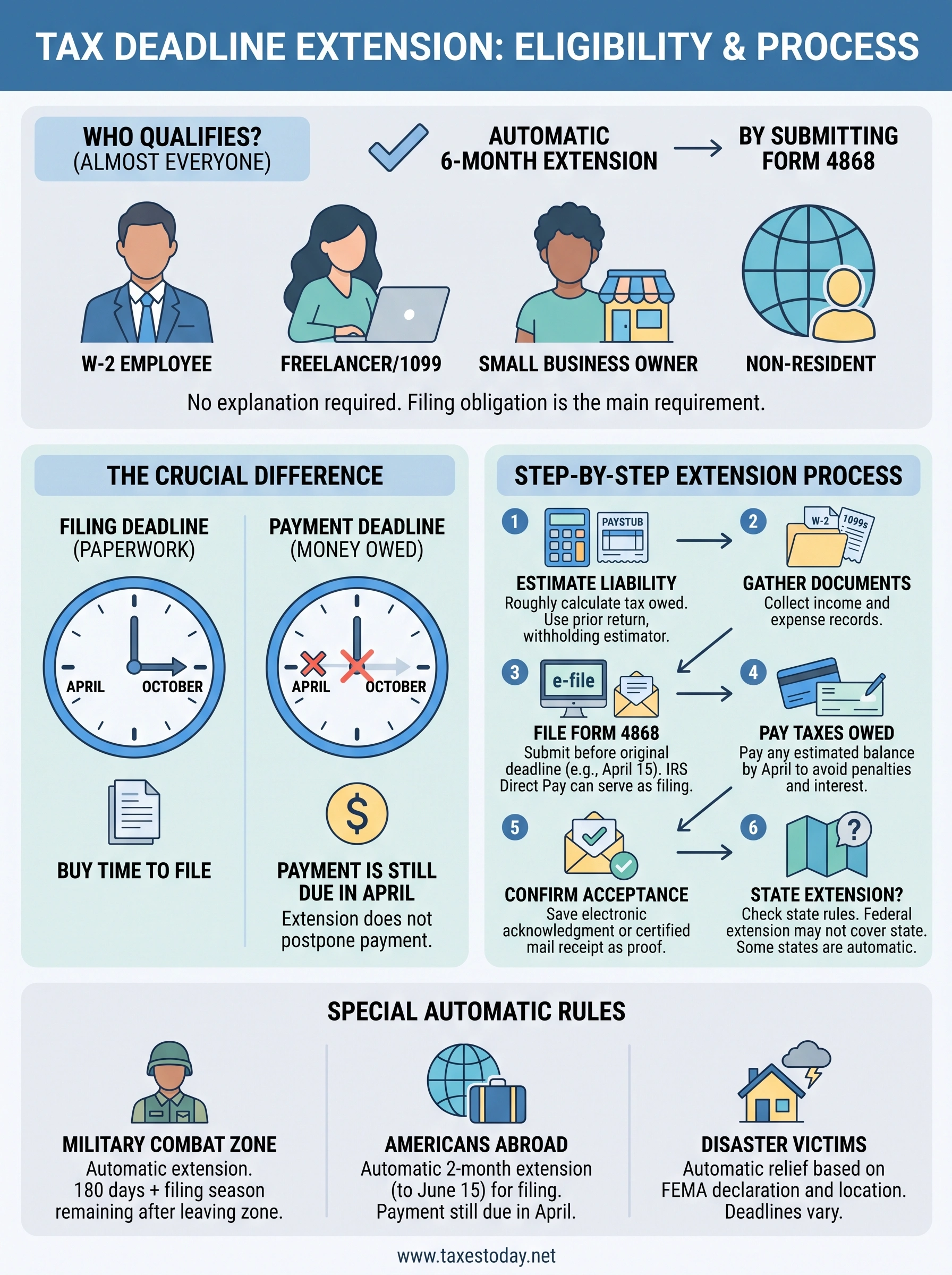
The real answer is simple: nearly everyone qualifies for an automatic six-month extension, no explanation required, as long as you submit Form 4868 before the original deadline. This holds true whether you owe zero dollars or a substantial balance. What changes is what the extension actually covers. It buys you time to file, not time to pay, and that distinction trips up a lot of filers every year.
Below, we break down exactly who qualifies, what happens if you owe taxes versus expect a refund, and the step-by-step process for filing your extension correctly before the deadline hits. If your situation feels more complicated than a standard extension, our team at TaxesToday.net handles this daily and can walk you through it.
What is a tax extension and who automatically qualifies
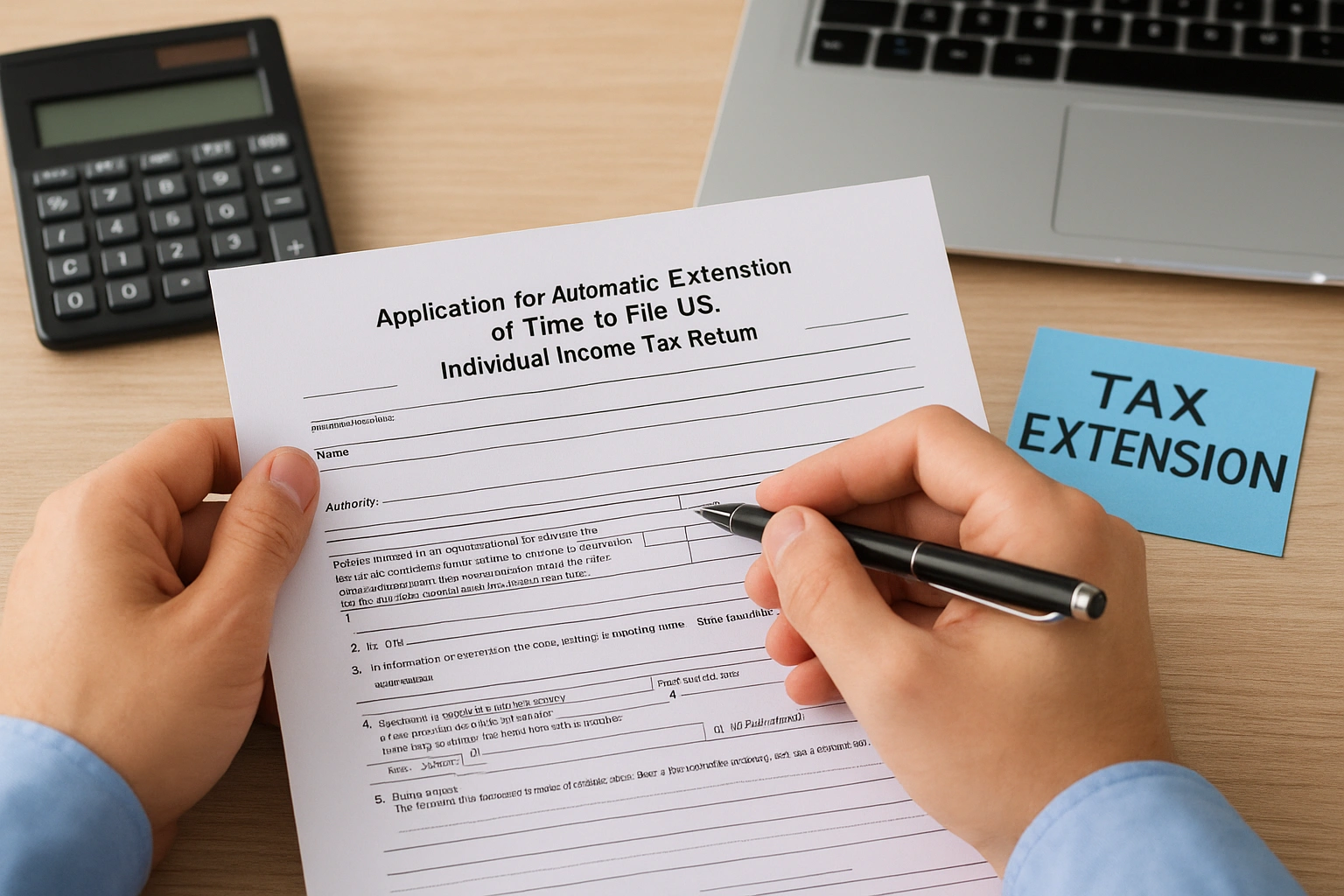
A tax extension is a formal request to push your filing deadline back six months, from mid-April to mid-October. It's not a favor the IRS grants selectively. It's a built-in mechanism available to nearly every taxpayer who asks for it correctly. Form 4868, officially titled the Application for Automatic Extension of Time to File US Individual Income Tax Return, is the document that makes this happen. Submit it before the original due date and the extension is automatic. There's no approval process, no waiting for a letter back, and no box where you explain your reasons.
Who actually qualifies
Here's the part that surprises people: eligibility requirements for a tax extension are almost nonexistent. You qualify if you have a US tax filing obligation, whether that's as a W-2 employee, a 1099 contractor, a small business owner, or a nonresident with US-source income. Income level doesn't matter. Filing status doesn't matter. Whether you owe the IRS money or you're expecting a refund doesn't matter either. The only real requirement is that you file the request on time.
Nearly every US taxpayer qualifies for a six-month extension automatically, no explanation or approval needed, as long as Form 4868 gets filed by the original deadline.
Compare that to how other IRS processes work, like requesting a payment plan or disputing a notice, where you often need to justify your situation with documentation. An extension request skips all of that. The IRS assumes good faith and grants the extra time by default.
Quick eligibility snapshot
| Filer type | Qualifies for extension? | Notes |
|---|---|---|
| W-2 employee | Yes | Same automatic process as anyone else |
| Freelancer / 1099 contractor | Yes | Common group that needs extra time for Schedule C prep |
| Small business owner (LLC, S-Corp) | Yes | Business entities file separate extension forms (Form 7004) |
| Nonresident (1040NR filer) | Yes | Same six-month extension applies |
| Someone who owes zero tax | Yes | Owing nothing doesn't disqualify you |
| Someone who owes a large balance | Yes | Extension covers filing time, not payment time |
The one thing an extension doesn't cover
This is where most confusion starts. An extension to file is not an extension to pay, and understanding how the extension actually works keeps that straight. If you owe money to the IRS, that balance is still due on the original April deadline, regardless of whether you've filed Form 4868. Miss that payment deadline and you'll start accruing interest and a failure-to-pay penalty, even though your paperwork extension is perfectly valid. The IRS treats these as two entirely separate obligations: one for submitting your return, one for settling what you owe.
People who expect a refund face zero risk here, since there's no balance for penalties to attach to. But if you're not sure whether you'll owe, the safest move is to estimate your liability and send a payment with your extension request. We'll walk through exactly how to do that estimate in the next section.
Why nearly everyone should just file one
Given how low the bar is, there's rarely a good reason to skip filing an extension if you're not ready by the deadline. Filing late without an extension triggers a failure-to-file penalty, which the IRS calculates as 5% of your unpaid taxes per month, capping at 25%. That's a much steeper cost than the interest you'd owe on an unpaid balance under a properly filed extension. Requesting more time costs you nothing but a form and a few minutes of effort.
Self-employed filers and small business owners tend to benefit the most from this cushion, since Schedule C returns often require gathering receipts, mileage logs, and 1099s from multiple clients. Six extra months turns a rushed, error-prone filing into one where you actually catch every deduction you're entitled to. If your return involves rental income, foreign accounts, or a K-1 from a partnership, that extra runway matters even more, since those documents often arrive later than a standard W-2.
Nonresidents and international filers qualify under the same rules, though they sometimes have additional considerations tied to residency status and treaty positions. We'll cover those separately later in this guide, since the process looks a little different for F-1 and J-1 visa holders filing Form 8843 alongside their extension.
Step 1. Estimate your tax liability
Before you touch Form 4868, spend fifteen minutes figuring out roughly what you owe. This step gets skipped constantly, but it's the difference between an extension that actually protects you and one that just delays a penalty. Remember, the extension covers your paperwork, not your payment, so the IRS still expects a good-faith estimate of your tax liability submitted with the form, even if you can't file the full return yet.
An extension without an accurate payment estimate just postpones the penalty instead of preventing it.
Pull together rough numbers, not exact ones
You don't need a finished return to estimate what you owe. Grab your last pay stub, your prior year's tax return, and any 1099s or bank statements you've already received. Add up your total income for the year, subtract the standard deduction for your filing status, and run that number through last year's tax brackets as a rough guide. This isn't precise, but it gets you close enough to avoid a nasty surprise in October.
Three ways to estimate quickly
- Use last year's return as a baseline. If your income and deductions haven't changed much, your tax liability probably hasn't either. Adjust up or down based on any major life changes like a new job, a home purchase, or a business launch.
- Use the IRS Tax Withholding Estimator. This free tool at IRS.gov walks through your income, withholding, and credits to spit out a reasonable projection. It's built for exactly this situation.
- Have a preparer run a quick projection. If your finances are more complex, self-employment income, multiple states, rental property, a professional can calculate a solid estimate in under an hour, often faster than you'd manage on your own.
What happens if your estimate is off
Nobody expects your extension estimate to match the final return dollar for dollar. The IRS cares that you made a reasonable, good-faith effort, not that you hit the number exactly. If you underpay slightly, you'll owe interest on the difference starting from the original deadline, but you won't face the harsher failure-to-file penalty as long as you actually filed the extension and paid a reasonable amount. If you overpay, the extra comes back as part of your refund once you file the completed return.
Self-employed filers need extra care here
Gig workers and small business owners tend to underestimate this step because income can be irregular throughout the year. Look at your total 1099 income received so far, factor in the self-employment tax on top of regular income tax, and don't forget deductible business expenses that reduce your taxable base. Skipping self-employment tax in your estimate is the single most common mistake we see among freelancers filing extensions, and it's an easy one to avoid once you know to check for it.
Step 2. Gather your tax documents and information
Filing Form 4868 doesn't require a stack of paperwork, but you still need enough information to fill it out accurately and back up the estimate you calculated in Step 1. Grabbing these pieces before you sit down to file saves you from stopping halfway through and hunting for a document you forgot existed.
What Form 4868 actually asks for
The form itself is short, just one page, and it only needs a handful of details. Basic identifying information covers most of it: your name, address, and Social Security number, plus your spouse's SSN if you're filing jointly. Beyond that, you're entering your estimated total tax liability for the year, the total payments you've already made through withholding or estimated taxes, and the balance due, if any. That last number is what you'd ideally pay along with the extension request.
A completed extension form needs your identifying details and one solid number: your best estimate of what you owe.
Documents that make the estimate accurate
Having the right paperwork on hand turns your estimate from a guess into something defensible, and a full tax preparation checklist makes that easier. Pull together:
- Your most recent pay stub or W-2 if you're a wage earner, so you know your year-to-date withholding.
- 1099 forms from clients, banks, or investment accounts, especially 1099-NEC or 1099-K forms if you're self-employed.
- Last year's tax return, which gives you a baseline for deductions, credits, and your effective tax rate.
- Records of estimated tax payments you've already sent the IRS this year, since those reduce your remaining balance.
- Business expense records like mileage logs, receipts, or a bookkeeping export if you run a Schedule C business.
Surveying these documents doesn't mean preparing your full return early. It just means you're pulling the handful of numbers that feed into the extension form and your payment estimate.
Information specific to certain filers
Taxpayers with more complex situations need a slightly wider net. Business owners filing under an LLC or S-Corp should have their entity's EIN handy, along with any K-1 forms already received from partnerships, and a small business document checklist covers the rest. Nonresidents filing Form 1040NR need their visa status documentation and any treaty-related paperwork close by, since those details affect the underlying tax calculation even though they don't go directly on Form 4868. Parents claiming dependents should have Social Security numbers for each child ready too, since that information ties into credits that affect your liability estimate.
Assembling this folder, digital or physical, takes maybe twenty minutes if you're organized, longer if you're digging through email attachments from three different clients. Either way, do it before you open the form. Trying to estimate your liability while simultaneously hunting for a missing 1099 is how people end up rushing the number and either overpaying unnecessarily or underpaying enough to trigger interest charges later.
Step 3. File Form 4868 before the deadline
Once you've got your estimate and your documents in order, filing itself takes about ten minutes. The hard part is remembering that the deadline for submitting Form 4868 is the same as the original tax filing deadline, typically April 15, not some later date tied to the extension itself. Miss that window and there's no form that fixes it retroactively.
Pick a filing method that fits your situation
You've got a few legitimate ways to submit Form 4868, online or by mail, and none of them require paying a filing fee to the IRS itself. Choose based on how comfortable you are with the process and whether you're making a payment at the same time.
| Method | How it works | Best for |
|---|---|---|
| IRS Free File | Submit Form 4868 electronically through IRS.gov at no cost | Anyone comfortable filing online without software |
| Tax software e-file | Most major software packages include a free extension filing option | Filers who already use software for their return |
| Paper mail | Print Form 4868, mail it to the IRS address for your state | Filers without reliable internet access |
| Pay and check the box | Make an estimated payment through IRS Direct Pay and mark it as an extension payment | Anyone who owes money and wants to skip the separate form |
That last option surprises people. If you're making a payment through IRS Direct Pay or the Electronic Federal Tax Payment System and indicate it's for an extension, the IRS automatically processes it as your Form 4868 submission. You don't need to file anything separately. This works well if you already know roughly what you owe from Step 1.
Filing electronically beats paper mail
Filing your extension online gives you something paper mail can't: immediate confirmation. When you submit through IRS Free File or tax software, you get an electronic acknowledgment within 24 to 48 hours confirming the IRS received your extension request. Paper filers have no such safety net beyond a certified mail receipt, and if the form gets lost or delayed in processing, proving you filed on time gets a lot harder.
File electronically whenever possible. It's the only method that gives you proof the IRS actually received your extension request before the deadline.
What to double-check before you submit
A rejected extension usually comes down to a small mismatch, not a major error. Before you hit submit or seal the envelope, verify:
- Your Social Security number matches exactly what's on file with the IRS, including your spouse's if filing jointly.
- Your name matches your Social Security card, especially after a recent marriage or legal name change.
- Your estimated tax liability and payment figures are filled in, even if you're paying zero.
- You've selected the correct tax year if your software defaults to something else.
Get these details right and the extension processes without a hitch, giving you until mid-October to file the completed return.
Step 4. Pay any taxes you owe
Filing Form 4868 handles your paperwork deadline, but it does nothing for the money you owe. If Step 1 showed a balance due, that payment is still expected by the original April deadline, extension or not. Skip this step and you'll owe interest plus a failure-to-pay penalty even though your extension itself went through cleanly.

The extension moves your filing deadline, not your payment deadline. Owe money by April, or the penalties start regardless of your paperwork status.
How the IRS wants you to pay
You've got several ways to send a payment, and picking the right one mostly comes down to speed and whether you want a paper trail. IRS Direct Pay lets you pay the IRS straight from your bank account at no cost and gives you instant confirmation. The Electronic Federal Tax Payment System, or EFTPS, works similarly and suits people who make estimated payments throughout the year anyway. Credit and debit card payments go through third-party processors the IRS approves, though those charge a small processing fee. Mailing a check works too, just make sure it's postmarked by the deadline and made out to the United States Treasury, not the IRS directly.
What happens if you can't pay in full
Owing more than you can cover right now doesn't disqualify you from the extension, and it shouldn't stop you from filing one. Pay what you can by the deadline, even a partial amount, since that reduces the balance that accrues interest. The failure-to-pay penalty runs at 0.5% of your unpaid balance per month, capped at 25%, which is far cheaper than the 5% monthly failure-to-file penalty you'd face without an extension at all. If the remaining balance feels unmanageable, the IRS offers installment agreements you can set up separately through IRS.gov once you've filed your return.
Quick reference for payment penalties
| Scenario | Penalty risk | Interest accrues? |
|---|---|---|
| Extension filed, full payment made | None | No |
| Extension filed, partial payment made | Failure-to-pay penalty on remainder | Yes |
| Extension filed, no payment made | Failure-to-pay penalty on full balance | Yes |
| No extension filed, no payment made | Failure-to-file penalty (much steeper) | Yes |
Keep proof of whatever you send
Whichever method you choose, save your confirmation number, screenshot, or mailed receipt somewhere you'll actually find it in October. If a payment gets misapplied or delayed in processing, that record is what proves you paid on time. This matters even more for self-employed filers juggling estimated quarterly payments made online alongside an extension payment, since the IRS sometimes needs help distinguishing which payment covers which obligation. A folder with your Step 2 documents plus this payment confirmation gives you everything you'd need if an IRS notice ever shows up asking questions about your balance.
Step 5. Confirm your extension was accepted
Submitting Form 4868 isn't the finish line. You need proof the IRS actually processed it, because a rejected or lost extension leaves you exposed to the same failure-to-file penalty as if you'd never filed anything at all. Confirming acceptance takes a few minutes and closes the loop on the whole process.
What confirmation looks like for each filing method
How you find out varies depending on how you submitted the form back in Step 3. E-filers get the fastest answer, while paper filers wait the longest and get the least reassurance along the way.
| Filing method | How you'll know it was accepted | Typical timeframe |
|---|---|---|
| IRS Free File | Email confirmation with an acceptance status | Within 24 hours |
| Tax software e-file | In-app or emailed acknowledgment from the software provider | 24 to 48 hours |
| Paper mail | No automatic confirmation; certified mail receipt is your only proof of submission | No formal acceptance notice |
| Payment marked as extension | Payment confirmation number serves as your extension record | Immediate |
If you e-filed, don't assume acceptance just because you clicked submit. Wait for the actual confirmation email before crossing this off your list.
What to do if it gets rejected
Rejections almost always trace back to a data mismatch, usually a Social Security number that doesn't match IRS records or a name that changed after marriage without an updated Social Security card. If your software or IRS Free File flags a rejection, you typically get a short window, often five days, to fix the error and resubmit without being treated as late. Check the rejection code carefully, correct the specific field it points to, and refile immediately rather than waiting to see if the problem resolves on its own.
Paper filers need a different kind of proof
Mailing your extension means you won't get an acceptance notice the way e-filers do. The IRS doesn't send a confirmation letter just because your Form 4868 arrived and processed correctly. Your only real evidence is the certified mail receipt or delivery confirmation from the post office, so use certified mail with a return receipt whenever you're mailing anything with a hard deadline attached. Without that receipt, you have no way to prove timely filing if a penalty notice shows up months later.
Save your confirmation somewhere you'll find it
Whatever proof you get, whether it's an email, a confirmation number, or a certified mail slip, store it in the same folder as your Step 2 documents and Step 4 payment records. This becomes your entire paper trail if the IRS ever questions whether you filed on time. Six months from now, when you're finally sitting down to complete your full return in October, that folder saves you from scrambling to reconstruct what happened back in April. It's a small habit that costs nothing and protects you if paperwork ever gets disputed.
Step 6. File a state tax extension if required
Filing Form 4868 handles your federal deadline, but it does nothing for your state return. Most states run a completely separate extension process, and assuming your federal extension automatically covers you at the state level is one of the most common mistakes we see, especially among people who moved states mid-year or work remotely for an out-of-state employer. Checking your state's rules takes five minutes and prevents a state-level penalty that catches people off guard every October.
A federal extension doesn't automatically extend your state deadline. Check your specific state's rules separately, every single year.
California makes this easier than most states
Good news if you're filing in California: the state grants an automatic extension to file, with no form required at all, as long as you're not underpaying what you owe. California's Franchise Tax Board pushes the filing deadline to October 15 automatically for anyone in good standing, mirroring the federal extension without any separate paperwork. That said, just like the federal rules, this only extends your time to file, not your time to pay. If you owe California tax, that payment is still due by the original April deadline, and you'll want to submit it using the FTB's Form 3519 payment voucher if you're not paying California state taxes electronically.
Other states vary widely
Not every state works like California, and the differences matter if you've got income or residency ties elsewhere. Some states automatically honor your federal extension, some require a separate state form, and a handful have no state income tax at all, making the whole question irrelevant.
| State type | Extension process | Action needed |
|---|---|---|
| California | Automatic, no form required | Pay any balance owed by April deadline |
| States that piggyback on federal extension (e.g., many states) | Federal Form 4868 counts as state extension | Confirm with state tax agency, keep a copy of federal confirmation |
| States requiring separate extension form | Must file state-specific form | File before state deadline, which may differ from federal |
| No state income tax (e.g., Texas, Florida, Nevada) | Not applicable | Nothing to file |
Check before you assume anything
Given how much this varies, verify your specific state's filing requirements directly through its Department of Revenue or equivalent agency website rather than guessing based on what a friend in another state told you. This matters even more for nonresident filers and people who earned income in more than one state during the year, since each state where you owe tax may have its own extension rules running on its own timeline. Freelancers who took on clients across state lines during the year should pay particular attention here, since a single missed state extension can trigger a penalty even when your federal and home-state filings are both handled correctly. If your situation touches multiple states, our team at TaxesToday.net can sort out exactly which extensions apply and file them alongside your federal request, so nothing slips through while you're focused on the bigger federal deadline.
Special extension rules for military, expats, and disaster victims
Standard rules cover most taxpayers, but three groups get treated differently, and knowing which bucket you fall into can save you from filing paperwork you never needed. Military service members, Americans living abroad, and disaster victims each qualify for extensions that go beyond the standard six months, sometimes without lifting a finger to request them. Understanding who qualifies for a tax extension under these special provisions matters because the deadlines, and the actions required to trigger them, look nothing like Form 4868.

Combat zone service comes with automatic extensions
Active duty military members serving in a combat zone get an extension that starts the day they leave the combat zone, not a fixed calendar date. The IRS extends both filing and payment deadlines for 180 days after leaving the combat zone, plus the number of days that were left in the filing season when deployment started. No form is required to claim this. The IRS identifies combat zone service through information the Department of Defense provides, though spouses filing jointly should still note the deployment on the return to avoid processing delays.
Living abroad grants two extra months automatically
US citizens and resident aliens living outside the country on the regular tax deadline get an automatic two-month extension to June 15, no form required, just like the combat zone rule. This covers Americans working overseas, military personnel stationed abroad, and expats who've relocated permanently. Interest still accrues on any unpaid balance starting in April, so this extension helps with the paperwork deadline more than the payment one.
Living overseas or serving in a combat zone can push your deadline back automatically, but the IRS still expects interest on any unpaid balance from April onward.
Expats who need more time beyond June can still file Form 4868 to reach the standard October deadline, and in some cases request a further extension to December through a written request to the IRS, something an international tax accountant can handle for you.
Disaster victims get relief tied to the disaster declaration
When the Federal Emergency Management Agency declares a major disaster, the IRS typically announces matching tax relief for affected areas, extending both filing and payment deadlines for individuals and businesses in designated counties. This happens automatically based on your address of record; you don't file anything to request it. Check the disaster relief announcements on IRS.gov if you live in an area recently hit by a hurricane, wildfire, or flood, since the extended deadline varies by disaster and can run months beyond the standard date.
Quick comparison of these special categories
| Group | Extension length | Action required |
|---|---|---|
| Combat zone military | 180 days after leaving zone, plus days left in filing season | None, automatic |
| Americans living abroad | Automatic 2 months to June 15 | None, automatic |
| Disaster area residents | Varies by declaration | None, automatic based on address |
If your situation overlaps more than one of these categories, or you're unsure whether your address qualifies for disaster relief, our team at TaxesToday.net can confirm the exact deadline that applies to you.
Giving yourself the time to file it right
Qualifying for a tax extension isn't the hard part. Almost every taxpayer clears that bar automatically just by filing Form 4868 on time. The real work is in the details: estimating your liability honestly, paying what you owe by April, and confirming the IRS actually accepted your request. Skip any of those steps and the extension stops protecting you the way it should.
Treat the six extra months as a chance to file a return you're actually confident in, not just a way to push off a deadline you're dreading. Whether you're a freelancer sorting through 1099s, a small business owner waiting on a K-1, or a nonresident navigating treaty rules, getting this process right now saves you penalties and stress later.
If your situation feels more complicated than a standard extension, don't guess. Get your extension and full return filed by CTEC-certified preparers who handle these cases every day.