


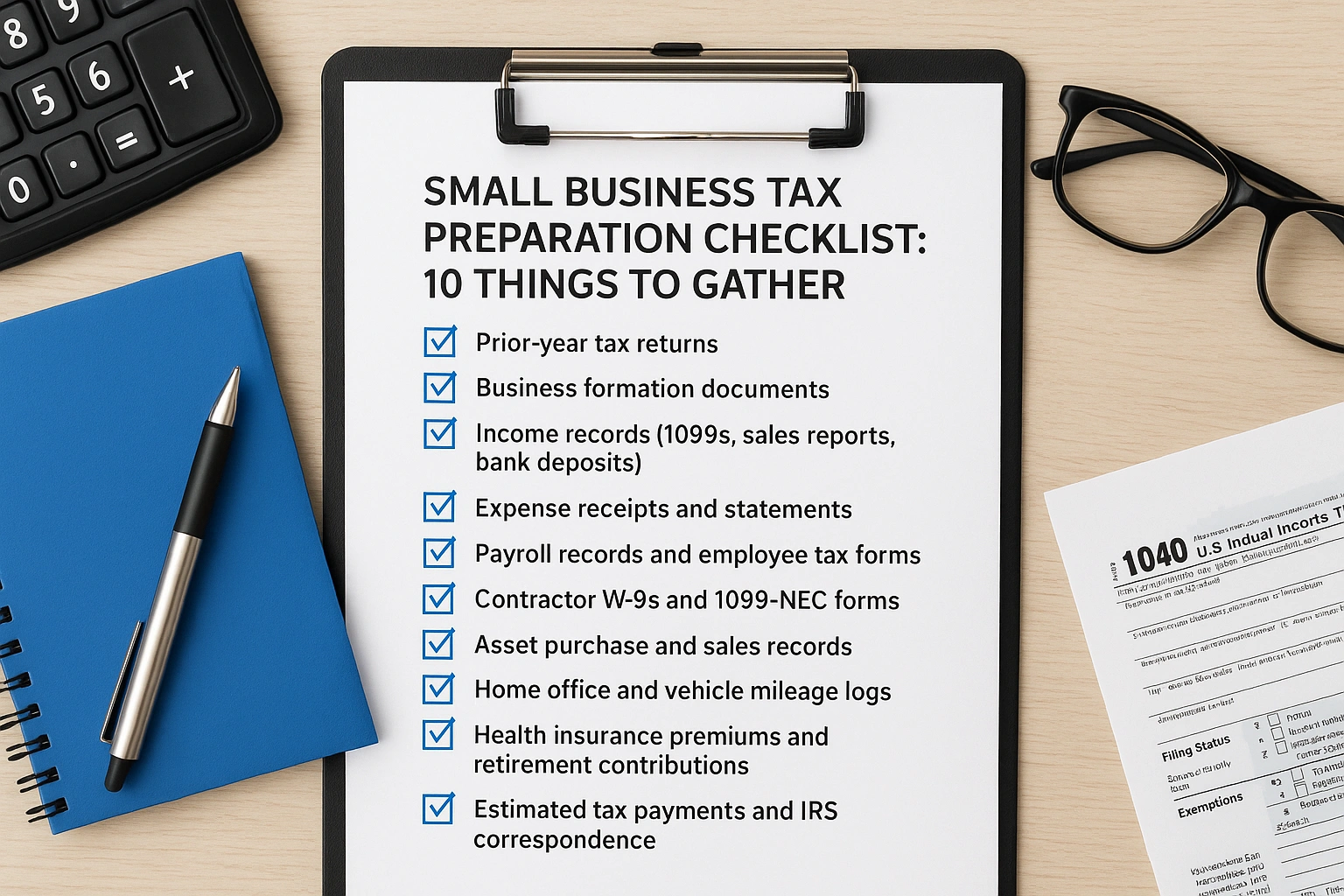
Small Business Tax Preparation Checklist: 10 Things to Gather
Tax season hits small business owners differently. You're not just gathering W-2s, you're chasing down receipts, mileage logs, and that one invoice you swore you saved somewhere. A solid small business tax preparation checklist turns that scramble into a straightforward process you can actually finish in an afternoon.
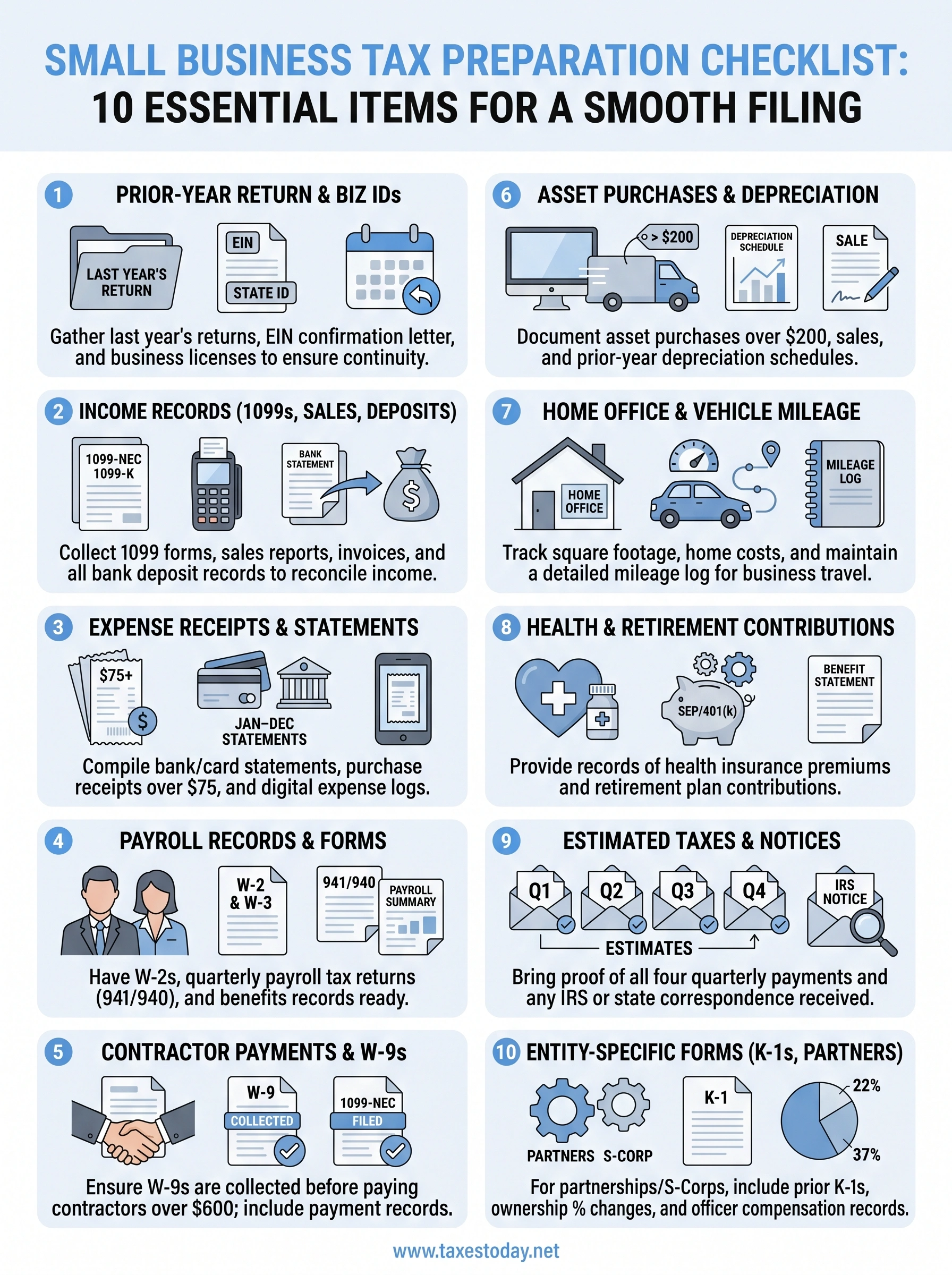
This article gives you exactly that: a tax preparation checklist for small business filing, broken into 10 concrete items you need before you sit down with a preparer or open your software. No fluff about "getting organized" in the abstract. You'll know precisely which income records, expense categories, and forms to pull, whether you run a Schedule C side business, a single-member LLC, or an S-Corp.
We put this list together from what we see every filing season at TaxesToday, working with freelancers and small business owners across Orange County and remotely nationwide. Missing documents are the number one reason returns get delayed or deductions get missed. Work through these 10 items, and you'll walk into your appointment ready, whether that's with us or anyone else, with everything needed to file accurately and claim every deduction you're owed.
1. Prior-year tax return and business identification documents
Start with the paperwork that anchors everything else. Your prior-year tax return gives your preparer a map of your business: carryover losses, depreciation schedules already in motion, and the accounting method you used last time. Skip this step and you risk your preparer rebuilding your business history from scratch, which costs you time and money.
What to gather
Pull together these documents before your appointment:
- Last year's federal and state business tax returns (complete copies, not just the summary page)
- Your EIN confirmation letter from the IRS (Form SS-4 confirmation)
- Articles of incorporation or organization, if you're an LLC, S-Corp, or corporation
- Your business license and any state or local registration numbers
- Prior-year depreciation schedules for equipment or vehicles
- Any IRS or state tax ID notices you've received
Why your preparer needs it
A tax preparation checklist for small business filing always starts here because continuity matters. Depreciation on a piece of equipment doesn't start over each year, it follows a schedule your preparer needs to see to calculate this year's deduction correctly. Your entity documents also confirm how the IRS classifies your business, which determines which forms you file. A single-member LLC taxed as a sole proprietorship files differently than one that elected S-Corp status, which matters a lot if you're filing business taxes for your LLC for the first time, and that election paperwork proves which route you're on.
Your prior-year return isn't just a formality, it's the foundation every other number in this year's filing builds on.
Common mistakes to avoid
New clients frequently show up with only the current year's paperwork, assuming last year is irrelevant now that it's filed. That assumption creates real problems:
- Losing carryover deductions. Net operating losses and unused depreciation don't disappear, but your preparer can't apply them without seeing where they came from.
- Mismatched EINs. Businesses that changed their legal structure sometimes keep using an old EIN, which flags inconsistencies with the IRS.
- Forgetting entity elections. If you filed Form 2553 to elect S-Corp status, your preparer needs a copy on file, not just your word that you made the switch.
Gathering these documents takes twenty minutes and prevents hours of back-and-forth later. It's the single easiest item on this list to knock out first.
2. Income records: 1099s, sales reports, and bank deposits
Every dollar your business brought in needs to show up somewhere in your small business tax preparation checklist, and income is where the IRS looks hardest. Underreporting income, even by accident, is one of the fastest ways to trigger a notice, so this category deserves more attention than most owners give it.
What to gather
Collect these records before your appointment:
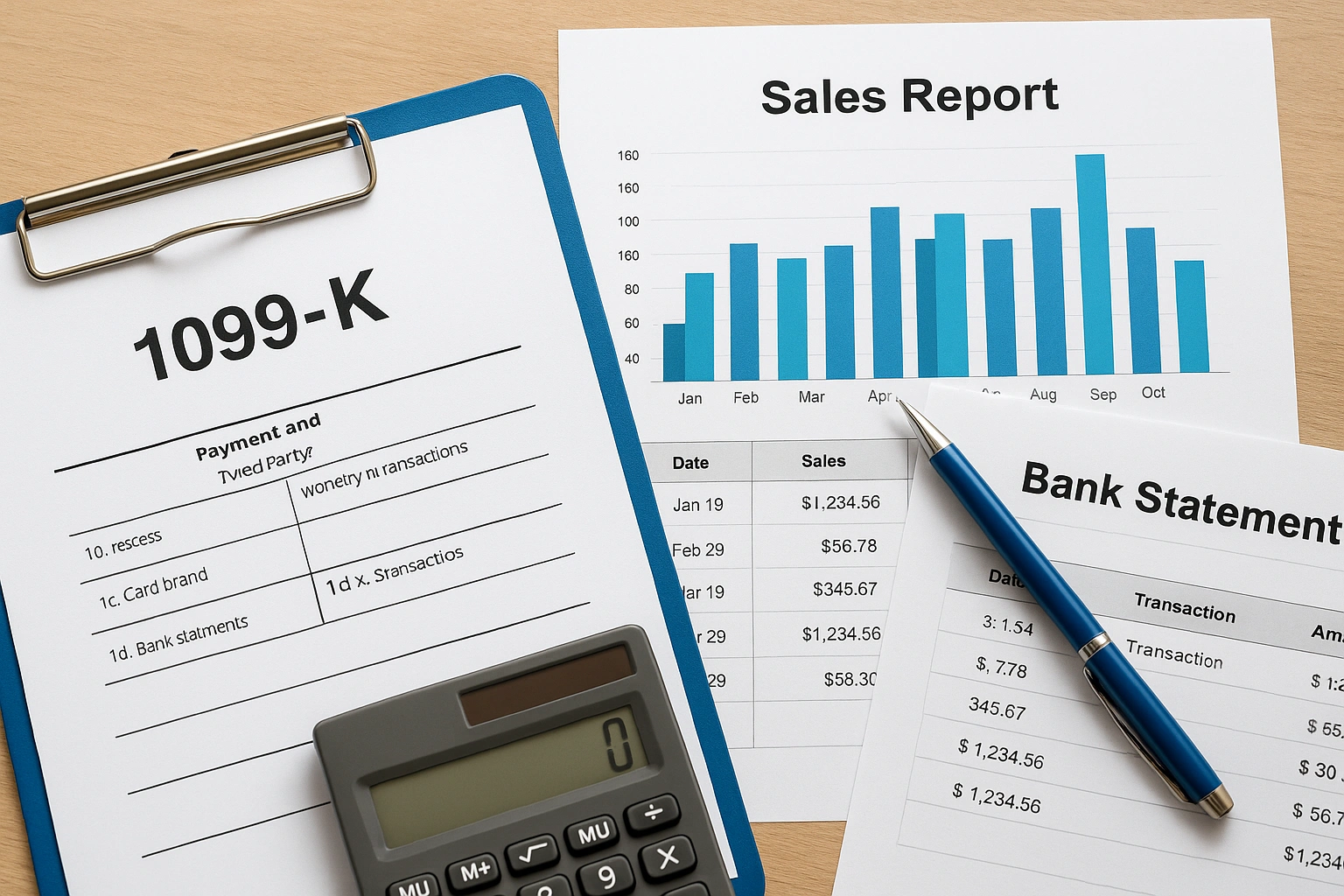
- All 1099-NEC and 1099-K forms you received from clients or payment processors
- Sales reports from point-of-sale systems, Shopify, Square, or similar platforms
- Bank statements showing business deposits for the full year
- Invoices you issued, paid or unpaid
- Records of cash payments received
Why your preparer needs it
Your preparer cross-references these sources against each other to build an accurate income tax preparation worksheet and to report your business income on Schedule C correctly. Payment processors now report to the IRS at lower thresholds than before, so a 1099-K you never expected to receive might already be on file with the agency. Bank deposits matter too, because they catch cash income that never generated a form at all.
If your reported income doesn't match what third parties already told the IRS, expect a letter asking why.
Common mistakes to avoid
Owners often report only the income shown on 1099s and skip cash sales or unpaid invoices they've already earned. Others double-count income when a 1099-K overlaps with sales already logged through their point-of-sale system. Reconcile every source against your bank deposits before handing anything over, and flag duplicates yourself rather than letting your preparer guess.
3. Expense receipts and business bank or credit card statements
Deductions lower your tax bill, but only if you can prove them, so it helps to know which business costs count as write-offs before you start sorting paperwork. Your expense receipts and monthly statements form the backbone of every deduction you'll claim, from office supplies to software subscriptions. Without this paperwork, even legitimate business costs get left off your return simply because there's nothing to back them up.
What to gather
Bring these items to your appointment:
- Business bank and credit card statements for all twelve months
- Receipts for purchases over $75, which the IRS specifically expects documented
- Digital receipts from apps like Expensify or QuickBooks if you track expenses electronically
- Utility, rent, and subscription bills tied to the business
- A simple spreadsheet or worksheet categorizing expenses by type
Why your preparer needs it
A thorough small business tax preparation worksheet separates deductible costs by category, supplies, travel, advertising, professional fees, because each lands on a different Schedule C expense category or line of your business return. Bank and credit card statements let your preparer verify that a claimed expense actually happened and wasn't a personal charge that slipped onto the business card.
Every deduction you skip because you couldn't find the receipt is money you're voluntarily handing back to the IRS.
Common mistakes to avoid
Mixing personal and business expenses on one card is the most common problem preparers see. It forces line-by-line sorting that eats up appointment time and increases the odds something gets missed. Estimating expenses without receipts is another risk. The IRS can disallow deductions that lack documentation, so guessing costs you more than gathering paperwork ever would.
4. Payroll records and employee tax forms
Once you've hired employees, your tax filing gets more complex, and this part of the small business tax preparation checklist doesn't leave room for error. Payroll touches both your business return and each employee's personal filing, so mistakes here ripple outward fast.
What to gather
Have these payroll documents ready before your appointment:
- W-2s and W-3 transmittal forms for all employees
- Quarterly payroll tax returns (Form 941) filed throughout the year
- Annual federal unemployment return (Form 940)
- State payroll tax filings and unemployment insurance records
- Payroll register or year-end summary from your payroll provider
- Records of any employee benefits, like health insurance premiums or retirement matching
Why your preparer needs it
Your preparer reconciles what you paid employees against what you reported to the IRS quarterly. Gaps between your payroll records and your filed 941s raise red flags, since the agency already has those quarterly numbers on file. Benefit contributions also affect your deductible expenses, so leaving them out understates your write-offs.
Payroll numbers have to match across every form you filed this year, or the IRS notices before you do.
Common mistakes to avoid
Businesses that switch payroll providers mid-year often lose track of records from the earlier system, leaving gaps your preparer has to chase down. Others forget to reconcile owner draws against payroll if they're an S-Corp shareholder-employee, which creates confusion about reasonable compensation. Pull every quarterly filing yourself before your appointment so nothing falls through the cracks.
5. Contractor payments, 1099-NEC forms, and W-9s
If you paid freelancers or independent contractors this year, this part of the checklist protects you from IRS penalties that catch owners off guard every season. The rule is simple: pay someone $600 or more for services, and you likely owe them a 1099-NEC by January 31, a deadline that's easiest to meet with online 1099 filing.
What to gather
Pull these records together before your appointment:
- Copies of every W-9 you collected from contractors before paying them
- Total payments made to each contractor for the year, sorted by name
- Copies of 1099-NEC forms you already filed, if any
- Invoices or contracts showing the nature of the work performed
- Records of payments made by check, cash, or direct deposit
Why your preparer needs it
Your preparer uses these records to confirm you met your filing obligations and to calculate your deductible contractor payments correctly. Missing a W-9 means missing a Taxpayer ID number, which delays filing and can trigger backup withholding requirements you didn't know applied to you.
No W-9 on file means you can't file an accurate 1099, and that gap is exactly what draws IRS attention.
Common mistakes to avoid
Owners frequently pay a contractor throughout the year without ever collecting a W-9 upfront, then scramble in January trying to track down a Social Security number. Others confuse contractor payments with vendor purchases and issue 1099s for products rather than services, which isn't required. Collect a W-9 before the first payment goes out, not after, and you'll never face this problem again.
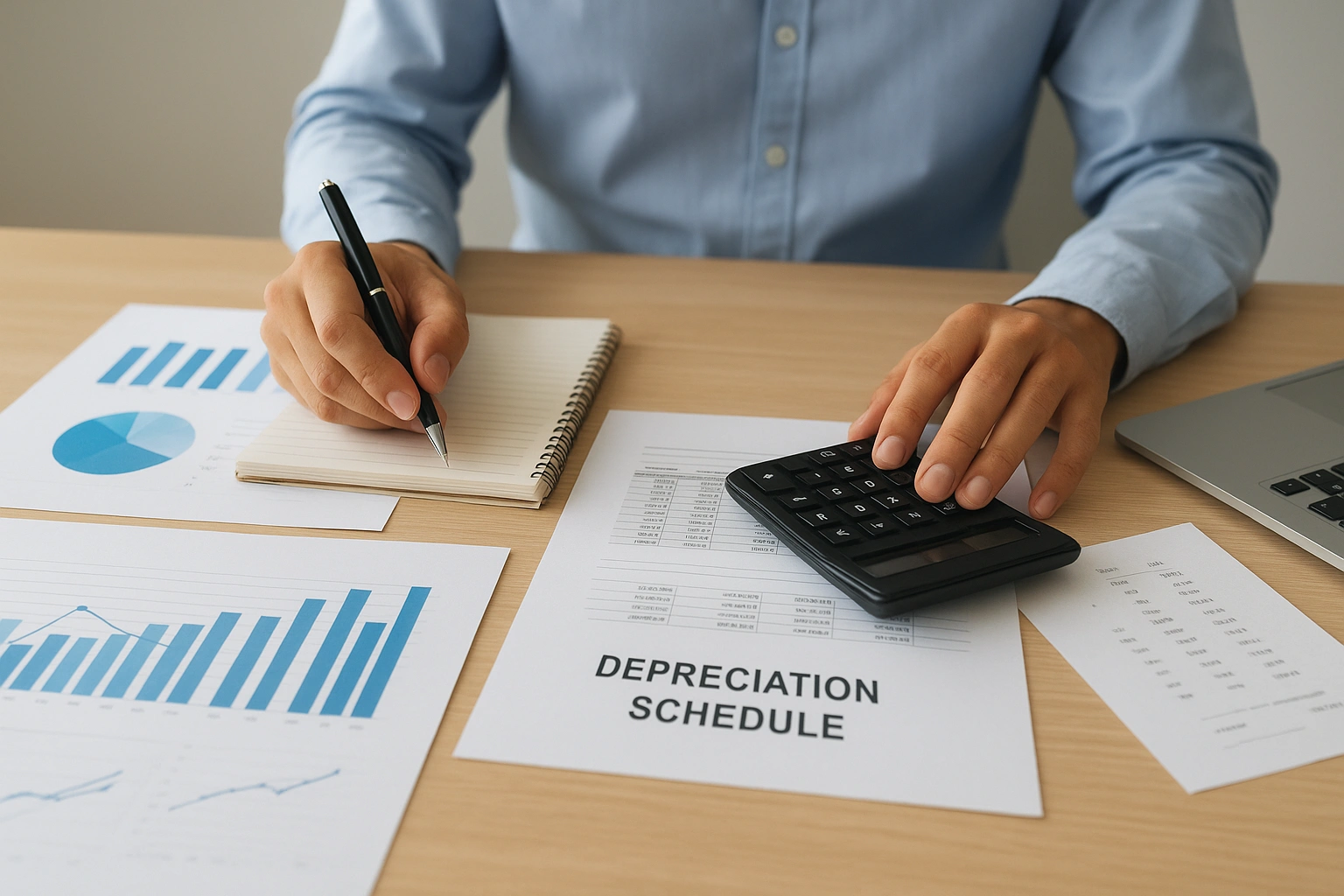
6. Asset purchases, sales, and depreciation schedules
Big-ticket purchases, computers, vehicles, machinery, don't get deducted all at once. They depreciate over years, and that math only works if your preparer knows what you bought, when, and for how much. This part of your small business tax preparation checklist trips up owners who assume a purchase is simply an expense like any other.
What to gather
Bring these records to your appointment:
- Receipts or invoices for any equipment, vehicles, or property bought this year
- Sale documents for any business assets you disposed of
- Prior-year depreciation schedules showing what's already being written off
- Loan documents if you financed a major purchase
- Section 179 election details, if you've used this deduction before
Why your preparer needs it
Your preparer uses purchase dates and costs to calculate depreciation schedules correctly, and to decide whether the Section 179 deduction or bonus depreciation makes more sense for your situation this year. Selling an asset triggers its own reporting requirements too, since gains or losses need to be calculated against its depreciated value, not its original price.
A missed asset purchase this year means missing part of a deduction you'll keep losing for years to come.
Common mistakes to avoid
Owners often expense a laptop or truck outright the year they buy it, not realizing it belongs on a depreciation schedule instead. Others sell equipment without telling their preparer, leaving a gain unreported. List every purchase and sale over $200 before your appointment, even ones that feel too small to matter.
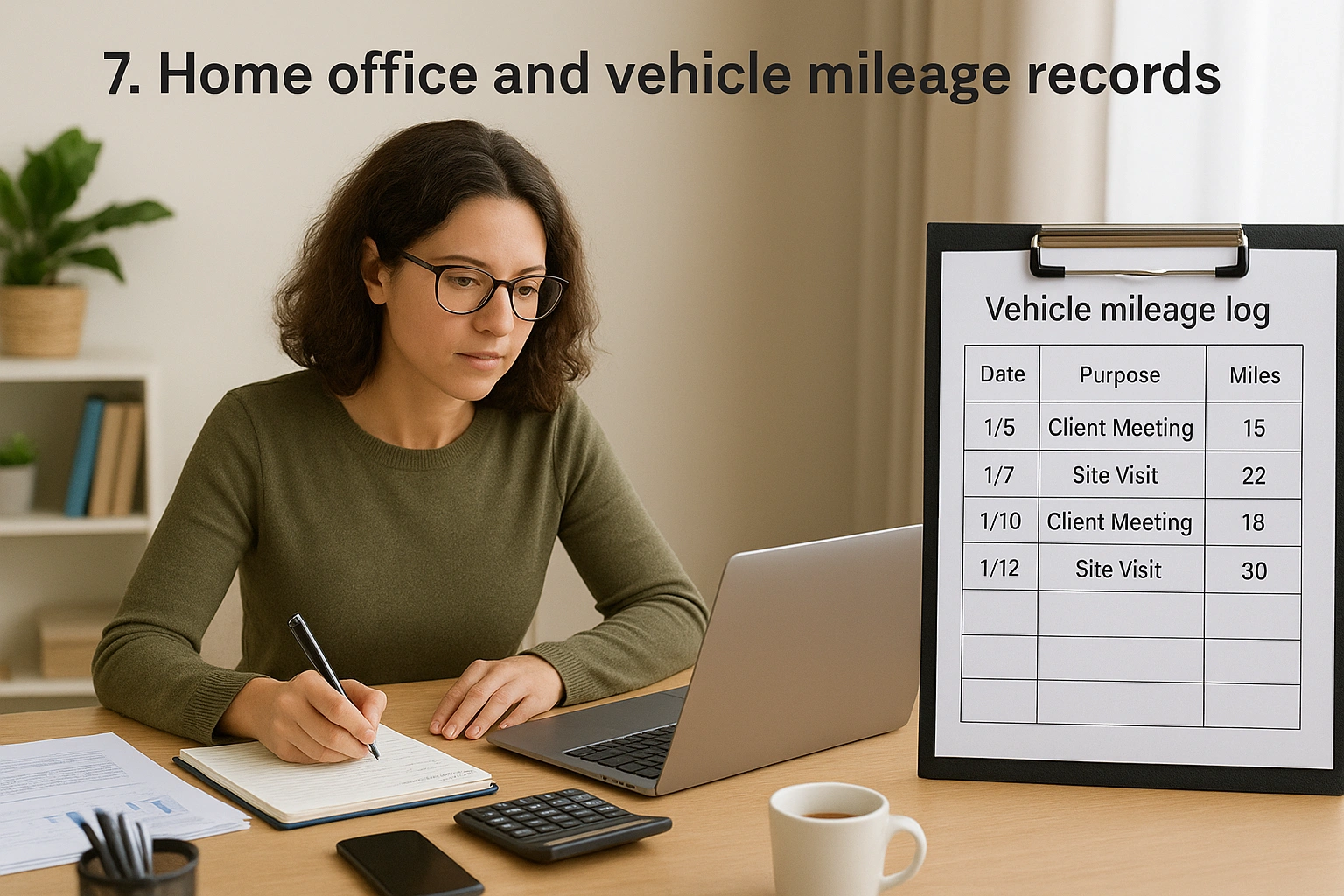
7. Home office and vehicle mileage records
Working from a spare bedroom or driving to client sites all day adds two deduction categories that owners routinely underclaim. Both the home office deduction and vehicle mileage require specific documentation, and knowing the IRS rules and methods for a home office write-off keeps this part of any thorough checklist for small business tax preparation from tripping up owners who assume a rough estimate will do.
What to gather
Bring these records to your appointment:
- Square footage of your home office versus your home's total square footage
- Mortgage interest, rent, utilities, and homeowners or renters insurance statements
- A mileage log showing date, purpose, and miles driven for each business trip
- Total annual mileage for the vehicle, business and personal combined
- Parking and toll receipts tied to business travel
Why your preparer needs it
Your preparer applies your home office percentage against actual housing costs, or uses the simplified square-footage method, whichever nets you a bigger deduction. Vehicle deductions work similarly: your preparer compares actual expenses against the standard mileage rate to see which method saves more.
Without a mileage log, the IRS treats every mile as personal, no matter how much driving you actually did for the business.
Common mistakes to avoid
Owners often reconstruct mileage logs from memory months after the fact, and the IRS rejects estimates that lack contemporaneous records. Others claim 100% business use of a vehicle that clearly serves personal errands too, which invites scrutiny. Track mileage weekly, not annually, and you'll never face this gap.
8. Health insurance and retirement contribution records
Self-employed owners and small business entities can deduct a surprising amount tied to health insurance premiums and retirement contributions, but only if the paperwork backs it up. This step in your checklist for tax preparation small business filing often gets skipped because owners don't realize these payments qualify as deductions at all, not just personal expenses.
What to gather
Pull together these records before your appointment:
- Annual statements showing health insurance premiums paid out of pocket
- SEP-IRA, Solo 401(k), or SIMPLE IRA contribution records for the year
- Form 5498 if your retirement plan custodian issued one
- Proof of payment for any HSA contributions
- Documentation showing the business, not a spouse's employer plan, covered the premiums
Why your preparer needs it
Deducting self-employed health insurance premiums happens above the line on your personal return, which lowers your adjusted gross income directly. Retirement contributions work similarly, and the deduction limits change depending on which plan type you use, so your preparer needs exact contribution amounts to calculate the maximum allowed.
Skipping this documentation means leaving one of the largest above-the-line deductions available to small business owners completely on the table.
Common mistakes to avoid
Owners frequently forget that premiums paid through a spouse's employer plan don't qualify for this deduction, since the business didn't pay them. Others contribute to a retirement account after December 31 for the prior year but forget to tell their preparer which tax year the contribution applies to, creating confusion that delays filing.
9. Estimated tax payments and IRS or state correspondence
Most small business owners don't have taxes withheld from a paycheck, so the IRS expects estimated tax payments four times a year instead, which means knowing how to calculate quarterly taxes before each due date. Forgetting to bring proof of what you already paid means your preparer can't credit those amounts, and you risk overpaying or triggering an underpayment penalty notice you didn't actually deserve.
What to gather
Round up these documents before your appointment:
- Copies of all four quarterly estimated payment vouchers (Form 1040-ES) and proof of payment
- State estimated payment confirmations, if your state requires them separately
- Any IRS notices received this year, including CP2000s or penalty letters
- State tax agency correspondence, including notices about registration or back balances
- Prior-year overpayment amounts applied forward to this year's estimates
Why your preparer needs it
Skipping this step in your small business tax preparation checklist often costs owners money they've already paid. Payment records let your preparer credit what you sent the IRS against your final bill, rather than calculating a balance due as if you paid nothing all year. Correspondence matters too, since an unresolved notice can affect how this year's return gets filed.
A quarterly payment you can't document is a payment the IRS won't credit you for.
Common mistakes to avoid
Owners frequently lose track of which quarters they paid, especially when they paid estimated taxes online without saving confirmation numbers. Others receive an IRS letter and set it aside without mentioning it, assuming it will resolve itself. Bring every notice to your appointment unopened commentary aside, even ones you think are unimportant.
10. Entity-specific forms: K-1s, shareholder, and partner details
Partnerships and S-Corps don't pay tax at the entity level, so income flows through to owners individually. That flow-through only works correctly if your preparer has every partner's or shareholder's details on hand, since one missing K-1 can hold up multiple personal returns at once.
What to gather
Bring these documents to your appointment:
- Prior-year Schedule K-1s for each partner or shareholder
- Current ownership percentages, along with any changes made during the year
- Partner or shareholder capital account records
- Officer compensation and shareholder distribution records for S-Corps
- Operating or partnership agreements showing profit and loss allocation
Why your preparer needs it
Your preparer uses ownership percentages to split income, deductions, and credits correctly across every K-1 issued, and each owner then follows the instructions for reporting K-1 income on a personal return. S-Corp shareholders also need reasonable compensation documented separately from distributions, since the IRS treats salary versus distributions in an S-Corp very differently for payroll tax purposes.
One partner's incomplete information can delay every other partner's personal tax return.
Common mistakes to avoid
Owners often assume ownership percentages stayed the same year over year without checking for a buyout, new partner, or capital shift. Others blend shareholder distributions with payroll wages on the books, which muddies the reasonable compensation question your preparer has to answer for the IRS. Confirm every ownership change and pull each partner's capital account balance before your appointment, since your preparer can't finalize a single K-1 until every partner's numbers are locked in.
Putting your checklist to work this tax season
Ten categories, one folder, zero scrambling. That's the real payoff of working through this small business tax preparation checklist before your appointment instead of during it. Every item above exists because it's the exact document a preparer asks for when a return stalls, so gathering them upfront isn't busywork, it's the difference between a return filed in one sitting and one that drags out over three follow-up emails.
Print this list, work through it category by category, and you'll walk into tax season with everything a preparer needs to file accurately and claim every deduction you've earned. Skip the guesswork on entity elections, depreciation, or contractor rules and let someone who handles this daily double-check your numbers. Hand your finished folder to a CTEC-certified preparer handling LLC and S-Corp returns from $99 and let TaxesToday file it accurately.