


Taxes When Self-Employed: How to Calculate, File, and Pay
Nobody hands self-employed workers a manual. One year you're a W-2 employee with taxes quietly withheld from every paycheck, and the next you're freelancing or running a small business, wondering why your refund turned into a bill. Taxes when self employed work differently, and figuring that out mid-tax-season, with no employer doing the math for you, is stressful.
Here's the direct answer: as a self-employed worker, you owe both income tax and self-employment tax, which covers Social Security and Medicare, usually 15.3% on top of your regular tax bracket. You calculate your profit on Schedule C, pay estimated taxes quarterly instead of waiting until April, and file everything with your Form 1040.
This article walks through exactly how that process works: which forms you need, how to calculate what you owe, when payments are due, and which deductions lower your bill. We prepare self-employed returns for freelancers, contractors, and small business owners every day, and we'll show you the same steps we use to keep clients accurate and compliant.
Why self-employment tax matters for your bottom line
Understanding this tax early saves you from a painful surprise in April. As a W-2 employee, your employer quietly covers half of your Social Security and Medicare taxes and withholds the rest from your paycheck, so you never see the full 15.3% hit. Once you're self-employed, that safety net disappears. You're now both the employer and the employee, which means you owe the entire self-employment tax yourself, on top of your regular federal and state income tax. Many new freelancers don't grasp this until they sit down to file and find a bill instead of a refund.
The hidden 7.65% you now pay yourself
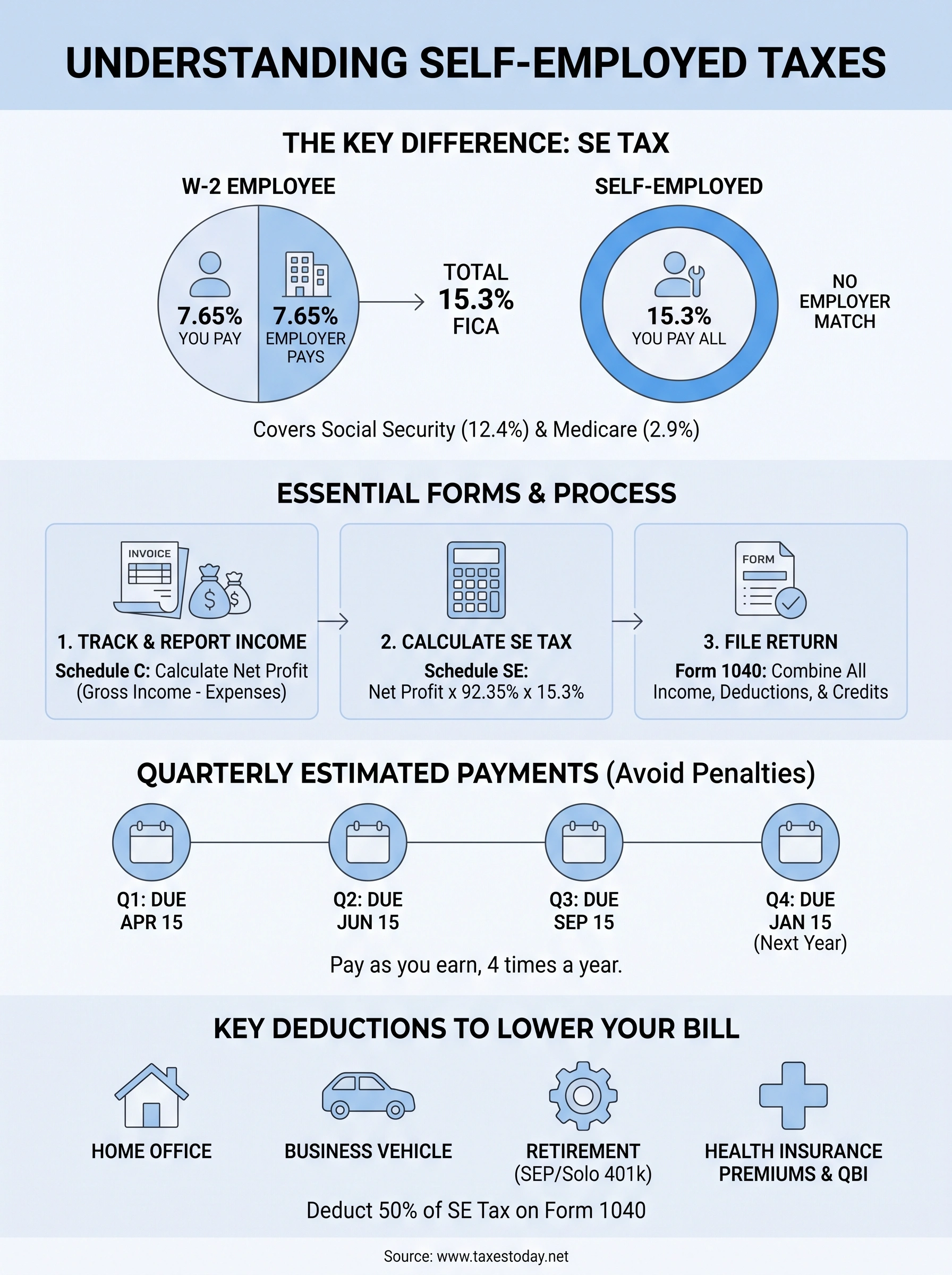
When you worked a traditional job, your paycheck already had 7.65% deducted for Social Security and Medicare, and your employer matched it with another 7.65%. Self-employment folds both halves onto your plate: 12.4% for Social Security (up to the annual wage base limit) and 2.9% for Medicare, for a combined 15.3% on your net earnings, which is what self-employment tax actually covers. The IRS explains the self-employment tax structure in detail, and it applies whether you're a rideshare driver, a freelance designer, or running a single-member LLC, where how single-member LLC taxes work step by step follows the same rules.
Self-employment tax isn't an extra penalty. It's the same Social Security and Medicare tax every worker pays, just without an employer to split the bill.
Comparing W-2 withholding to self-employment tax
Seeing the numbers side by side makes the difference concrete. A W-2 employee earning $60,000 never notices the employer's contribution because it's baked into payroll. A self-employed person earning the same net profit has to budget for it directly, and often forgets until the bill arrives.
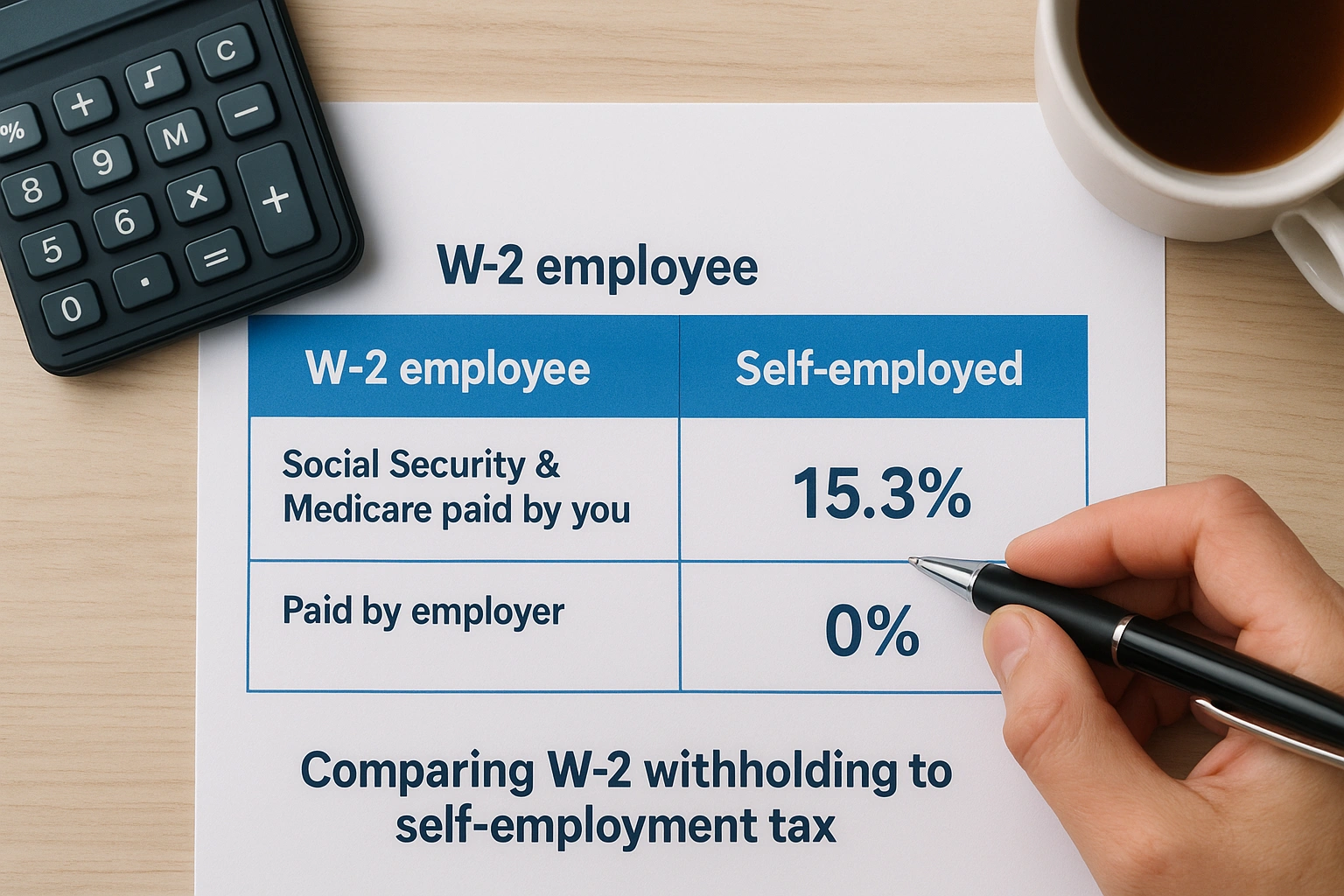
| Scenario | Social Security & Medicare paid by you | Paid by employer |
|---|---|---|
| W-2 employee, $60,000 salary | 7.65% (withheld automatically) | 7.65% |
| Self-employed, $60,000 net profit | 15.3% (your responsibility) | $0 |
This table is exactly why so many people searching for how to file taxes as self-employed are shocked by their first year's total. The tax rate on income didn't change; you simply lost the employer match you had before.
The compounding cost of underpaying
Failing to plan for this tax doesn't just mean a bigger bill, it means penalties too. The IRS expects self-employed workers to pay as they earn, not in one lump sum the following spring. If you don't send in quarterly estimated payments that cover roughly what you'll owe, you can face an underpayment penalty calculated on top of the tax itself. That's a common answer to the question of how do you pay taxes when self employed: not once a year, but four times, with real consequences for skipping a deadline.
Because the math is unforgiving, treating self-employment tax as an afterthought is one of the costliest mistakes new business owners make. A $50,000 profit year can easily generate over $7,000 in self-employment tax alone, before income tax is even calculated. That's why many freelancers and small business owners compare self-employed tax prep options near them to project their liability early, set aside the right amount each month, and avoid an April scramble. Getting ahead of this number changes how you price your work, save your income, and plan your year, which is the whole point of understanding it now rather than discovering it the hard way at filing time.
Who counts as self-employed for tax purposes
The IRS doesn't care what you call yourself. It cares about how you earn money and who controls the work. Self-employed status applies the moment you work for yourself, rather than for an employer who withholds taxes and issues a W-2. That covers a much wider group than people expect, from a part-time Etsy seller to a consultant billing six figures. If you're asking how do i file self employed taxes, the first step is confirming you actually fall into this category, because the forms and deadlines differ sharply from standard employment.
The IRS test for self-employment
According to the IRS definition of self-employment, you're self-employed if you carry on a trade or business as a sole proprietor, an independent contractor, a member of a partnership, or if you're otherwise in business for yourself, including part-time work. The key factor is control: if you decide when, where, and how you complete the work, and you're not on someone else's payroll, you're self-employed for tax purposes even if the job feels casual.
If nobody withholds taxes from your pay and you control how the work gets done, the IRS considers you self-employed, regardless of your job title.
Who typically falls into this category
Self-employment shows up in more places than people assume, and many workers don't realize they qualify until a 1099 arrives instead of a W-2. Common examples include:
- Freelance writers, designers, and developers billing multiple clients
- Rideshare and delivery drivers
- Independent contractors receiving Form 1099-NEC
- Single-member LLC owners with no separate corporate election
- Real estate agents and salespeople working on commission
- Small business owners who haven't formed a corporation
- Anyone with consistent side income from consulting, coaching, or selling goods
Spotting yourself in that list matters because it changes which self-employed form for taxes you'll actually use.
Side income still counts
Occasional side income doesn't get a pass just because it's small. Even a few thousand dollars from freelance gigs or a weekend business triggers self-employment tax obligations once your net earnings hit $400 in a year, per IRS rules. Some people assume a hobby or small side hustle stays off the IRS radar, but that assumption causes real problems later, especially when a client issues a 1099-NEC that the IRS already has on file.
Understanding your status upfront prevents a much bigger headache down the road. Once you confirm you're self-employed, the next question becomes practical: how much of that income actually gets taxed, and how do you calculate it correctly on your return.
How self-employment tax is calculated
The math behind your bill isn't as random as it feels the first time you see it. You start with your net earnings from self-employment, meaning your total business income minus your deductible business expenses, and that number becomes the base for everything else in the step-by-step self-employment tax calculation. The IRS doesn't tax your gross revenue, so tracking expenses accurately from day one directly lowers what you eventually owe.
The 92.35% rule most people miss
Before applying the 15.3% rate, the IRS lets you multiply your net earnings by 92.35%. This adjustment exists because the self-employment tax itself is meant to mirror the employer and employee split, and it slightly shrinks your taxable base to account for that structure. So if you netted $50,000, your taxable self-employment income for this calculation is $46,175, not the full $50,000.
You never pay 15.3% on your full net profit. You pay it on 92.35% of that profit, a detail that quietly saves every self-employed filer a few hundred dollars a year.
Two rates, one wage base limit
That adjusted figure then gets split across two separate taxes with different rules. Social Security tax applies at 12.4%, but only up to an annual wage base limit the IRS updates each year, so high earners stop paying that portion once they cross the threshold. Medicare tax applies at 2.9% with no ceiling at all, and if your income is high enough, an Additional Medicare Tax of 0.9% kicks in on top of that. Here's how the pieces stack up:
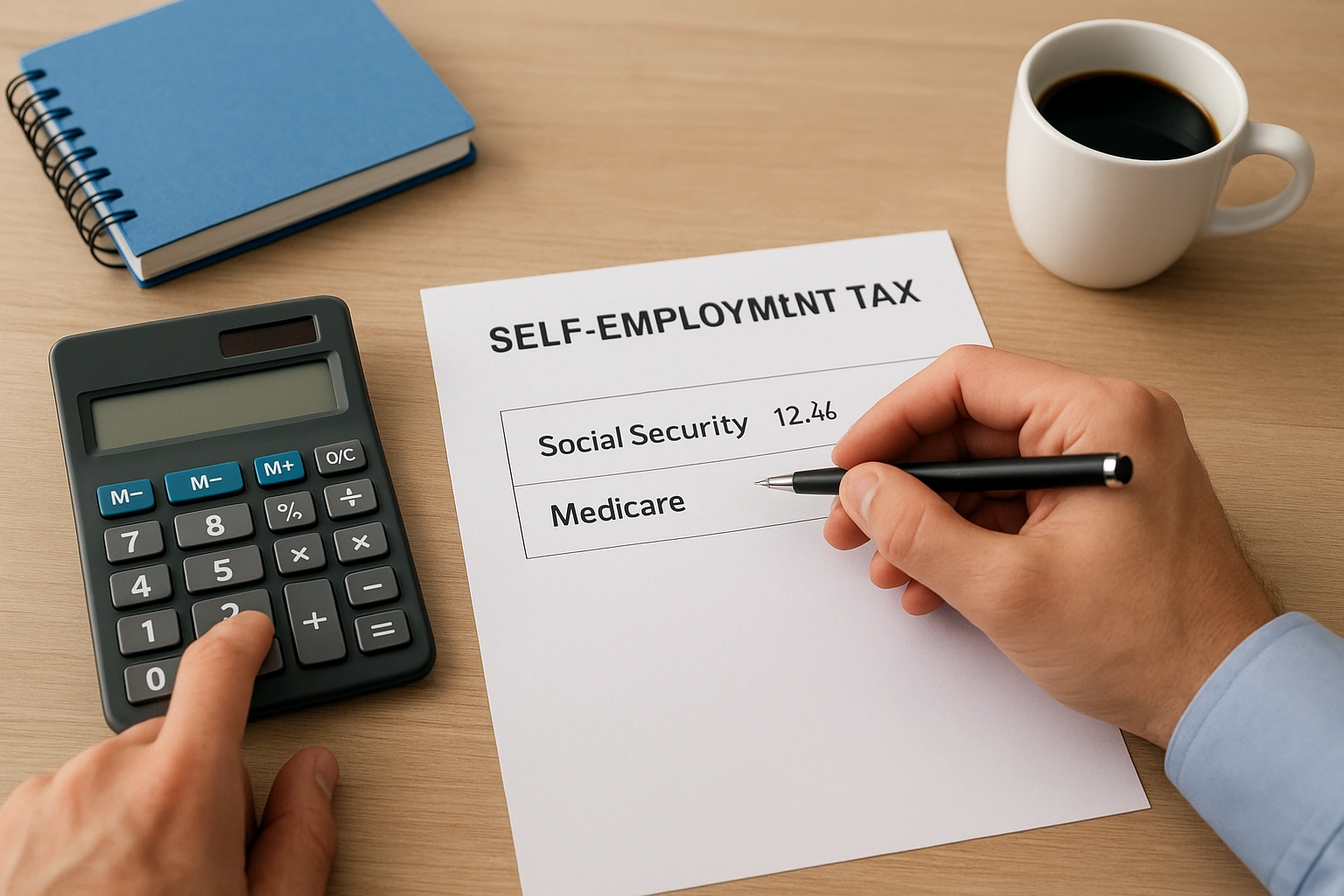
| Component | Rate | Applies to |
|---|---|---|
| Social Security | 12.4% | Net earnings up to the annual wage base limit |
| Medicare | 2.9% | All net earnings, no cap |
| Additional Medicare Tax | 0.9% | Earnings above IRS income thresholds |
This structure is exactly why filers researching how to pay taxes self employed often assume the rate is flat when it isn't quite that simple once income climbs.
The deduction that softens the blow
Once you calculate the total, there's a small silver lining. You get to deduct half of your self-employment tax from your adjusted gross income, which lowers your regular income tax bill even though it doesn't touch the self-employment tax itself. That deduction is claimed directly on Form 1040 and calculated using Schedule SE, the same form that runs the entire calculation described above.
This is the piece most self-prepared returns get wrong, either by skipping the 92.35% adjustment or missing the deduction entirely. Getting the calculation right matters just as much as filing on time, and it's a large part of what a self-employed tax preparation service checks line by line before anything gets submitted.
How to file your self-employed tax return
Filing as a self-employed worker takes more paperwork than the standard 1040 most W-2 employees submit, but the process follows a predictable order once you know which forms belong together. The question of how to file taxes for self employed individuals almost always starts here, and our complete filing guide for self-employed workers follows the same order: gather your income records, calculate your profit, run the self-employment tax, then combine everything on your personal return.
The self-employed form for taxes you'll actually use
Most self-employed filers need the same core set of documents, regardless of industry. Missing one of these is the most common reason a self-prepared return gets rejected or flagged for review.
- Schedule C: reports your business income and expenses, resulting in your net profit or loss (how to fill out Schedule C line by line)
- Schedule SE: calculates your self-employment tax based on that net profit
- Form 1040: your main individual return, where everything gets combined
- Schedule 1: carries your Schedule C profit and your self-employment tax deduction onto Form 1040
- 1099-NEC or 1099-K forms: received from clients or payment platforms, used to verify your reported income (filing 1099 income online)
Filing step by step
Working through the return in order keeps you from missing a form or double-counting income. Here's the sequence we use with clients every filing season:
- Total your gross receipts from all clients, invoices, and 1099 forms received
- Subtract deductible business expenses on Schedule C to arrive at net profit
- Transfer that net profit to Schedule SE and calculate your self-employment tax
- Claim the deduction for half your self-employment tax on Schedule 1
- Combine your Schedule C profit, other income, and deductions on Form 1040
- File your return online or by mail before the deadline, along with any state return required
Filing self-employed taxes correctly isn't about one complicated form, it's about getting several simple forms to line up in the right order.
Deadlines and extensions
Your full return, along with any tax owed, is due by the standard April deadline each year, the same date W-2 filers face. If you need more time, Form 4868 filing steps grant a six-month extension to file, though it doesn't extend the time you have to pay what you owe. Missing that distinction is a frequent mistake among people learning how to file taxes as a self employed worker for the first time, since an extension only postpones paperwork, not payment.
Because a Schedule C return involves more moving pieces than a simple W-2 filing, many self-employed workers choose professional tax preparation rather than risk an error that delays a refund or triggers an IRS notice. Once your return is filed correctly, the next piece to manage is paying throughout the year instead of waiting until the deadline arrives.
How to pay self-employment taxes throughout the year
Once you understand the math, the next challenge is timing. The IRS doesn't want your self-employment tax and income tax in one lump sum next April, it wants quarterly estimated payments made throughout the year as you earn, so it helps to know who owes estimated taxes and how much. This is the practical answer to how do you pay taxes when self employed: four payments, four deadlines, and no employer withholding anything on your behalf.
Quarterly deadlines you can't ignore
Each payment covers roughly three months of income, though the periods aren't perfectly even. Missing a due date, even by a day, can trigger interest charges regardless of how much you eventually pay.
| Payment period | Typical due date |
|---|---|
| January 1 - March 31 | April 15 |
| April 1 - May 31 | June 15 |
| June 1 - August 31 | September 15 |
| September 1 - December 31 | January 15 (following year) |
Waiting until April to pay what you owe isn't just risky, it's a guaranteed penalty if you're self-employed and skipped quarterly payments.
Estimating what to send
Figuring out each payment doesn't require guesswork if you keep decent books. To figure each quarterly payment amount, take your projected net profit for the year, run it through the self-employment tax calculation from the previous section, add your expected income tax, then divide the total by four. Many freelancers set aside 25 to 30 percent of every payment they receive in a separate account specifically for this purpose, which makes the quarterly deadline far less painful. The IRS estimated tax guidance walks through the safe harbor rules that let you avoid penalties even if your final bill is higher than expected, as long as you paid enough based on last year's tax or this year's projected income.
Sending the actual payment
Once you know the amount, sending it takes only a few minutes. Options include:

- IRS Direct Pay, a free option that transfers directly from your bank account (how to pay 1040-ES online)
- The Electronic Federal Tax Payment System (EFTPS), useful if you want to schedule quarterly payments in advance through EFTPS
- Mailing a check with Form 1040-ES vouchers, though this takes longer to process
- The IRS2Go mobile app, which mirrors Direct Pay for people who prefer paying from a phone
Regardless of the method, keep a confirmation record for every payment. If you're still asking how to pay taxes self employed for the first time, start with Direct Pay since it requires no enrollment and posts almost immediately. Consistent quarterly payments, tracked alongside your expenses, set you up for a much smoother filing season and reduce the odds of a surprise balance when your Schedule C and Schedule SE numbers finally come together.
Deductions and credits that reduce what you owe
Every dollar you deduct lowers both your income tax and, in most cases, your self-employment tax base, so this is where careful bookkeeping actually pays off. The Schedule C you file already captures your obvious costs, but plenty of self-employed workers leave money on the table by missing 25 Schedule C write-offs for the self-employed that don't feel like "business expenses" at first glance.
Everyday business expenses you can write off
Anything ordinary and necessary for running your work qualifies, and the 15 deduction categories worth tracking cover more ground than most new freelancers realize:
- Home office space, calculated by square footage or the simplified $5-per-square-foot method
- Business use of your vehicle, tracked by mileage or actual expenses
- Software subscriptions, business phone and internet costs
- Supplies, equipment, and professional development or courses
- Advertising, website hosting, and contractor payments to others
Keeping receipts and a simple mileage log throughout the year turns tax season into a math exercise instead of a guessing game.
Retirement contributions do double duty
Setting aside money for retirement is one of the few moves that shrinks your tax bill while building your own savings at the same time. A SEP IRA or Solo 401(k) lets you contribute far more than a typical employee retirement account allows, and every dollar you put in reduces your taxable income for the year.
| Account type | 2025 contribution limit | Best for |
|---|---|---|
| SEP IRA | Up to 25% of net self-employment income, capped annually by the IRS | Simpler setup, variable income |
| Solo 401(k) | Employee plus employer contributions, higher combined cap | Higher earners wanting to max savings |
A retirement contribution is one of the rare tax moves where the money doesn't disappear, it just moves into your own account instead of the IRS's.
The Qualified Business Income deduction
Most self-employed filers also qualify for the Qualified Business Income (QBI) deduction, and who qualifies for the QBI deduction matters because it allows you to deduct up to 20% of your net business income directly on your Form 1040. The IRS QBI deduction overview explains the income thresholds and limitations that apply once earnings climb into higher brackets, but for most freelancers and small business owners, it's a straightforward reduction worth claiming every year.
Health insurance premiums
If you pay for your own health insurance and aren't eligible for a spouse's employer plan, the rules for the self-employed health insurance deduction generally let you deduct those premiums as an adjustment to income, separate from itemizing. Combined with the self-employment tax deduction covered earlier, these write-offs stack up quickly, and missing even one of them across a full year adds up to a meaningfully larger bill than necessary.
A step-by-step self-employment tax example
Numbers make this easier to trust than theory alone, so let's walk through a real scenario using a freelance web developer. Say she brings in $85,000 in gross receipts for the year from various clients, all reported to her on 1099-NEC forms. She spends $15,000 on software subscriptions, a home office deduction, a portion of her internet bill, and a laptop upgrade, all legitimate Schedule C write-offs.
Calculating net profit and the SE tax base
Subtracting expenses from gross receipts gives her a net profit of $70,000, the figure that flows straight to Schedule SE. Before applying the 15.3% rate, she multiplies that $70,000 by 92.35%, landing on $64,645 as her actual self-employment tax base. That adjustment alone shaves nearly $5,400 off the amount subject to tax, which is exactly the detail people miss when trying to figure out how to do taxes for self employed work by hand.
| Step | Amount |
|---|---|
| Gross receipts | $85,000 |
| Business expenses | $15,000 |
| Net profit (Schedule C) | $70,000 |
| Taxable SE base (92.35%) | $64,645 |
| Social Security (12.4%) | $8,016 |
| Medicare (2.9%) | $1,875 |
| Total self-employment tax | $9,891 |
A $70,000 profit doesn't mean a $70,000 tax bill. Adjustments like the 92.35% rule and deductions shrink the real number every single year.
Applying the deductions
Half of that $9,891 self-employment tax, roughly $4,946, gets deducted from her adjusted gross income on Schedule 1. She also qualifies for the Qualified Business Income deduction, which knocks another 20% off her remaining business income, further lowering the profit subject to regular income tax. Combined, these two deductions mean she's paying income tax on a noticeably smaller number than her original $70,000, even though the full self-employment tax still applies to the $64,645 base calculated earlier.
Splitting the bill into quarterly payments
Given her total projected liability, self-employment tax plus estimated income tax, she divides the combined figure by four and sends a payment each quarter rather than facing one number in April. If her total comes to roughly $18,000 for the year between both taxes, that's about $4,500 per quarterly deadline, an amount she budgets for by setting aside 25% of every invoice she gets paid. Walking through this example shows exactly why filing taxes when self employed rewards careful tracking all year, not a scramble in March.
Common mistakes that trip up self-employed filers
Even organized freelancers stumble on the same handful of errors year after year. Most of these mistakes aren't complicated tax law problems, they're simple habits that snowball once a Schedule C and Schedule SE are involved. Knowing where other self-employed filers go wrong is often the fastest way to avoid repeating their mistakes on your own return.
Blending personal and business expenses
Running both a personal debit card and business purchases through the same account is one of the biggest reasons a Schedule C gets flagged. When business expenses and personal spending mix together, you either overclaim deductions you can't fully justify or underclaim ones you're entitled to because you can't separate them cleanly. A dedicated business checking account and a business credit card, even for a solo freelancer, solves this instantly and makes tax season far less painful.
The fastest way to lose a deduction isn't forgetting an expense, it's failing to prove which account it came from.
Ignoring quarterly payments until it's too late
A huge share of people learning how to file taxes when self employed assume one annual payment covers everything, then get hit with an underpayment penalty they never saw coming. Skipping estimated payments doesn't just delay the bill, it adds interest on top of it. Common missteps we see include:
- Waiting until a tax bill arrives to start saving money for it
- Assuming a slow quarter means no payment is due, instead of using the method built for uneven income across quarters
- Forgetting a payment deadline that doesn't line up with a calendar quarter
- Sending a payment late without checking the safe harbor rules first
Misclassifying workers or income type
Some self-employed business owners hire help and treat everyone as a contractor to avoid payroll paperwork, even when the IRS would classify that person as an employee based on control over the work. This mistake can trigger back taxes and penalties well beyond the current year. Others make the opposite error, reporting 1099 income as a hobby to sidestep self-employment tax entirely, which creates its own compliance risk once the IRS matches the 1099 against an unreported return.
Skipping professional review until there's a problem
Many filers only seek help after receiving an IRS notice, when a quick review earlier could have caught the issue. A tax return review before filing catches missed deductions, misclassified income, and calculation errors while there's still time to fix them, rather than after the IRS has already flagged the return. Catching these mistakes early costs far less than untangling them later.
Getting your self-employed taxes right
Filing taxes when self employed comes down to a handful of habits: track every expense, calculate your profit accurately on Schedule C, run the numbers through Schedule SE, and send quarterly payments instead of waiting for April. Skip any one of those steps and you risk an underpayment penalty, a missed deduction, or a return that raises questions with the IRS. None of this is impossible to handle yourself, but the calculations have enough moving pieces that a small error compounds fast, especially once retirement contributions and the QBI deduction enter the picture.
If you'd rather hand the math to someone who does this daily, that's exactly what we do. Our CTEC-certified preparers handle Schedule C, Schedule SE, and quarterly planning for freelancers and small business owners across the country. Get started with self-employed tax preparation from $99 and file this year's return with confidence instead of guesswork.