


Tax Resolution near Me: What It Is and How to Find Help
An IRS letter about back taxes or a sudden wage garnishment notice has a way of turning an ordinary week upside down. If you've started searching for tax resolution near me, you're probably past the point of wanting general advice. You want someone local, licensed, and ready to look at your actual case and tell you what happens next.
Tax resolution is the process of fixing a tax debt problem with the IRS or your state, whether that means setting up a payment plan, negotiating an offer in compromise, releasing a wage garnishment, or getting penalties reduced. The right specialist reviews your notices, checks what the IRS actually filed on your behalf, and builds a plan to get you back into compliance without paying more than you owe.
This article walks through what tax resolution covers, the situations that call for it, and how to vet a preparer or enrolled agent before you hand over sensitive financial documents. We'll also cover what CTEC-certified professionals like the team at TaxesToday.net can do for California residents and clients filing remotely across the country.
Why tax resolution matters when you owe the IRS
A tax debt problem never resolves itself just because you avoid opening the mail. The IRS collection process runs on a fixed timeline, and every notice you set aside brings you one step closer to a lien, a levy, or a wage garnishment that pulls money straight from your paycheck before you see it. Waiting rarely buys you anything except more interest and a smaller set of options when you finally do act.
The notice ladder before enforcement hits
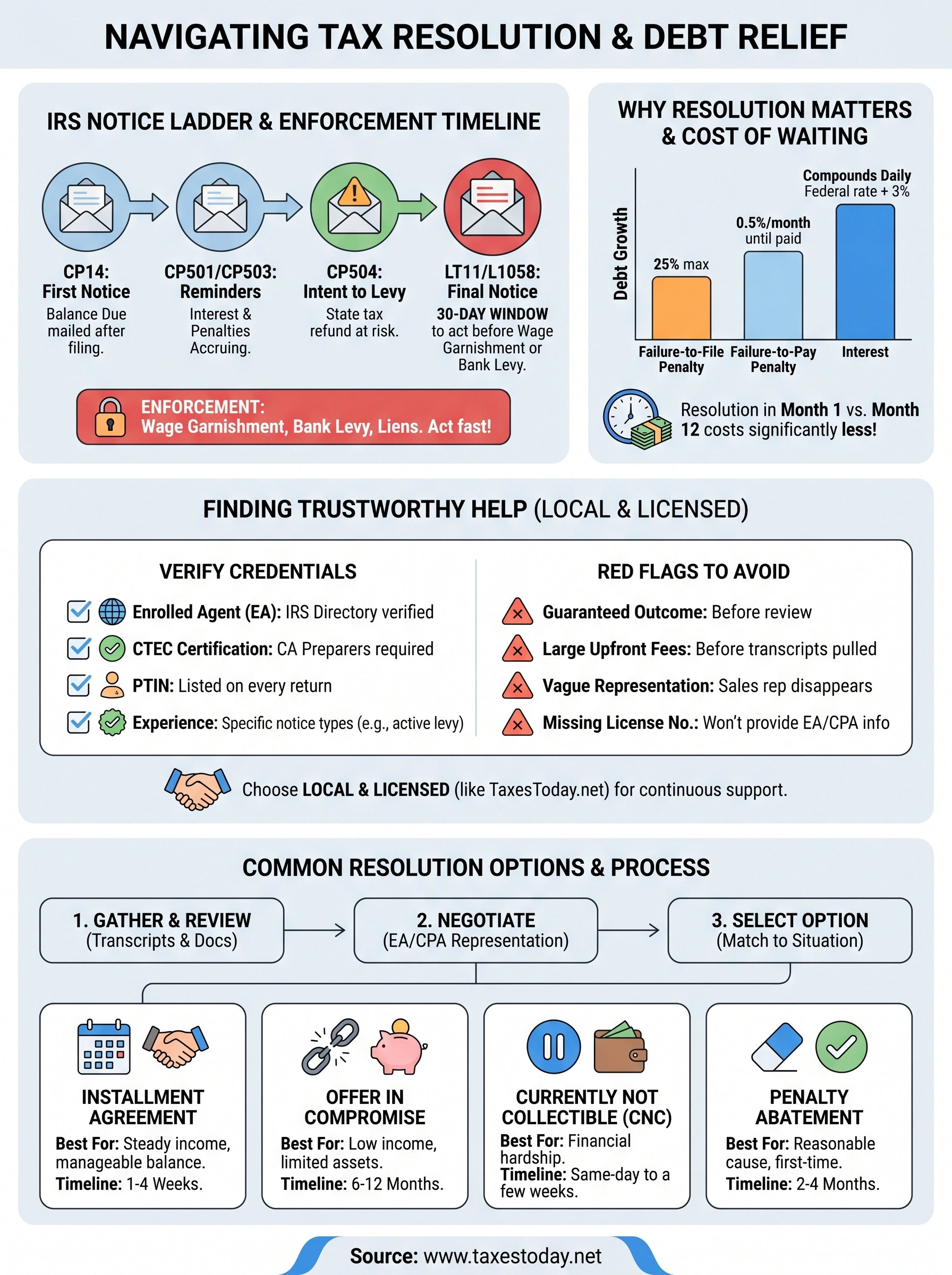
Each unpaid balance moves through a predictable sequence of IRS letters, and knowing what each IRS notice type means tells you how much time you actually have left:
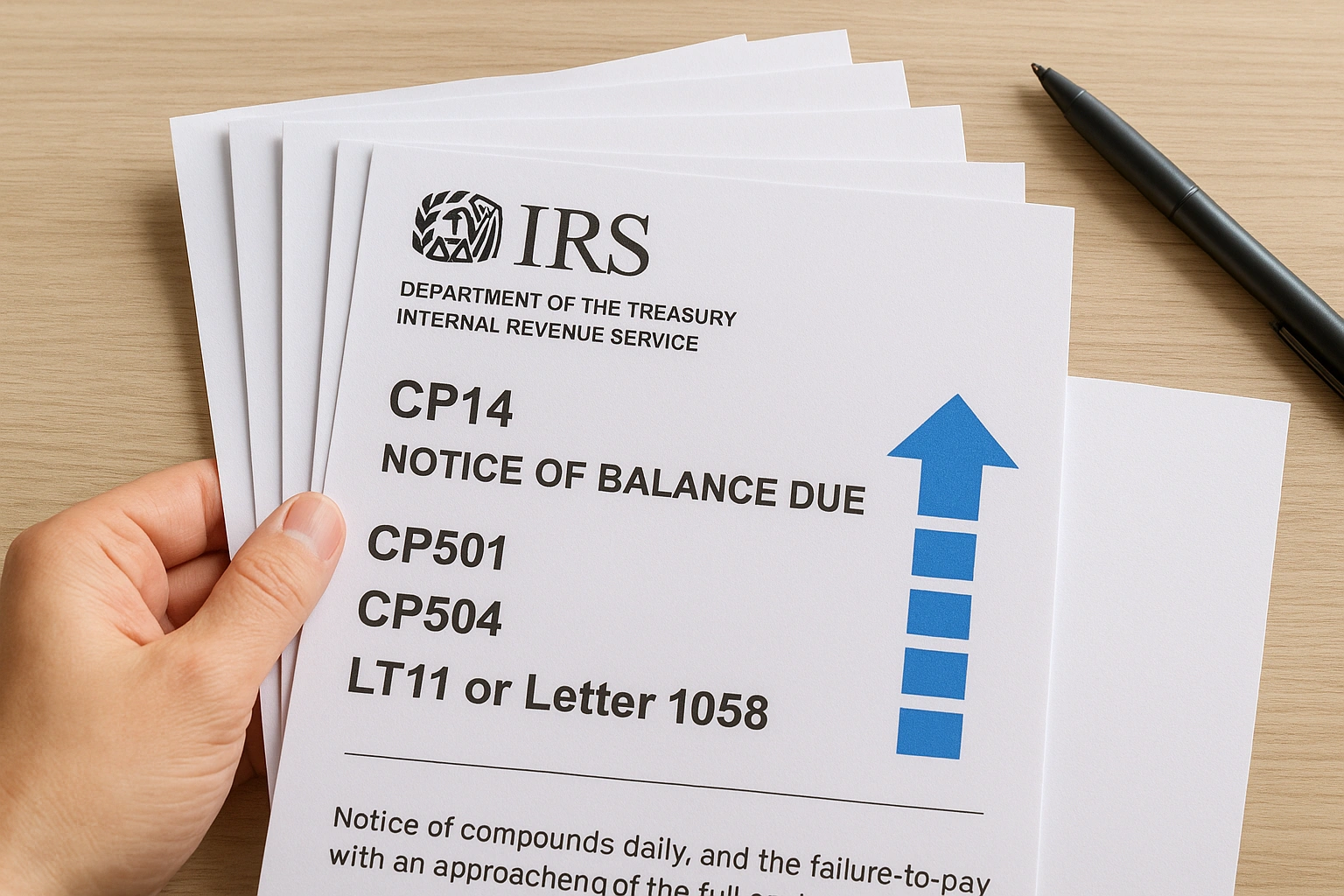
- CP14: the first notice of a balance due, usually mailed within weeks of filing.
- CP501/CP503: reminder notices that interest and penalties are accruing.
- CP504: a warning that the IRS intends to levy your state tax refund.
- LT11 or Letter 1058: the Final Notice of Intent to Levy, which opens a 30-day window to request a Collection Due Process hearing before bank accounts or wages can be seized.
The 30-day window on a Final Notice of Intent to Levy is the last real chance to negotiate before the IRS can legally take your paycheck or bank funds.
Once that window closes, the IRS can act without further warning, and reversing an active levy takes far longer than preventing one in the first place.
What unresolved back taxes cost you
Interest compounds daily, and the failure-to-pay penalty adds up separately from the full cost of never submitting a return at all.
| Charge | Typical Rate | How It Grows |
|---|---|---|
| Failure-to-file penalty | 5% of unpaid tax per month | Caps at 25% of the balance |
| Failure-to-pay penalty | 0.5% of unpaid tax per month | Continues until paid in full |
| Interest | Federal short-term rate + 3% | Compounds daily |
Those numbers stack fast on a five-figure balance, which is why a resolution plan filed in month one costs far less than the same plan filed in month twelve.
Local knowledge closes gaps a national call center misses
California adds another layer, since the Franchise Tax Board runs its own collection and levy process alongside the IRS, with its own penalty and interest charges to estimate. A preparer who only handles federal cases can miss a state lien sitting quietly behind a federal one. Enrolled agents and CTEC-certified preparers who work California cases regularly, like the team at TaxesToday.net, know how to check both agencies at once and coordinate a tax debt relief plan that satisfies each without contradicting the other.
How to find trustworthy tax resolution help near you
Searching "tax resolution near me" pulls up a mix of national call centers, local CPAs, and firms that promise to settle your debt for pennies on the dollar. Before you hand over a Social Security number or a stack of IRS notices, verify the credential behind the promise. Only three types of professionals can legally represent you before the IRS: enrolled agents, CPAs, and tax attorneys, so it helps to know how to choose between a CPA and an EA. A CTEC-certified preparer can file your returns and help you get compliant, but representation authority matters once a case moves to negotiation.
Credentials that actually matter
Check these before you sign anything:
- Enrolled Agent (EA) status, verified on the IRS directory of federal tax return preparers
- CTEC certification for California-based preparers, required by state law for anyone paid to prepare returns
- A PTIN (Preparer Tax Identification Number) listed on every return they file
- Direct experience with the specific notice you received, whether that's a CP504 or an active levy
If a firm won't show you their EA or CPA license number before you pay a dime, that's your answer.
Red flags that should send you elsewhere
Watch for firms that guarantee a settlement amount before reviewing a single document, since no legitimate professional can promise an outcome sight unseen, and use these signs to spot a tax service you can actually trust. Upfront fees in the thousands, paid before any transcripts are pulled from the IRS, are another warning sign worth taking seriously. Vague answers about who will actually work your case, versus a sales rep who disappears after the contract is signed, tell you the follow-through won't be there either.
Working with a local, licensed team like TaxesToday.net gives you someone who answers the phone after the paperwork is signed, not just before.
What to expect during the tax resolution process
Every legitimate tax resolution case starts the same way: with a full review of what the IRS actually has on file, not just what you remember filing. A qualified preparer pulls your account transcripts directly from the IRS, which show every notice sent, every payment posted, and any return the IRS may have filed for you if you never submitted one yourself. Skipping this step is how well-meaning DIY attempts miss liens or unfiled years that make a payment plan fall apart later.
Gathering the full picture
First, expect a list of documents your preparer needs before they can recommend anything:
- The most recent notice you received, whether that's a CP504 or an active levy letter
- Two to three years of prior tax returns, filed or not
- Proof of income: pay stubs, 1099s, or profit and loss statements for self-employed clients
- Bank statements if a levy has already hit an account
With transcripts and documents in hand, your preparer maps out exactly which years are open, which penalties apply, and which resolution options you actually qualify for.
Negotiating with the IRS on your behalf
Once the full picture is clear, the case moves into negotiation, whether that's requesting a Collection Due Process hearing, submitting an offer in compromise, or setting up an installment agreement. This is where representation authority matters most, since only an enrolled agent, CPA, or attorney can speak to the IRS directly on your behalf.
A resolution plan is only as strong as the transcripts it's built on; skip that step and you're negotiating blind.
Timelines vary widely. A simple payment plan can close in a week, while an offer in compromise often takes six to twelve months for IRS review.
Common tax resolution options and how they work
Once transcripts confirm what you owe and which years are open, your preparer matches your situation to one of a handful of proven paths. Each option trades off differently on speed, cost, and long-term impact on your credit and cash flow, so the right choice depends on your income, assets, and how much the IRS is realistically likely to collect.
Installment agreements and offers in compromise
An installment agreement spreads your balance into monthly payments the IRS accepts as reasonable given your income, and it's the fastest option to set up when you can't pay in full but can pay something, often under Fresh Start relief for back taxes. An offer in compromise settles the debt for less than you owe, but only when the IRS agrees your future earning potential and asset value genuinely can't cover the full balance, a case that has to be documented, not just argued.

An offer in compromise isn't a negotiating tactic, it's a math problem the IRS solves using your income and assets.
Currently not collectible status and penalty abatement
If your expenses already outpace your income, currently not collectible (CNC) status pauses IRS collection activity entirely until your finances improve, though interest keeps accruing in the background. Penalty abatement removes failure-to-file or failure-to-pay penalties when you have reasonable cause, like a documented illness or natural disaster, or qualify under the IRS first time penalty abatement rules.
| Option | Best For | Typical Timeline |
|---|---|---|
| Installment agreement | Steady income, manageable balance | 1-4 weeks |
| Offer in compromise | Low income, limited assets | 6-12 months |
| Currently not collectible | Financial hardship | Same-day to a few weeks |
| Penalty abatement | First-time offenders, reasonable cause | 2-4 months |
A preparer who works these cases regularly, like the team at TaxesToday.net, can tell you within one consultation which of these fits your numbers instead of guessing.
Getting back on solid ground with the IRS
Back taxes don't fix themselves, but they also don't require panic once you know the steps. Pull your transcripts, verify the credentials of whoever you hire, and match your situation to the right option, whether that's an installment agreement, an offer in compromise, or penalty abatement. Every day you wait shrinks your options and grows your balance, so the sooner you start, the more choices you'll have on the table.
Getting back into good standing with the IRS isn't about finding a magic settlement. It's about accurate numbers, honest documentation, and a preparer who answers your calls after the paperwork is signed. If you're searching for tax resolution near me and want a licensed, CTEC-certified team that handles both federal and California cases, book a consultation with a CTEC-certified, IRS-registered preparer and find out exactly where you stand before your next notice arrives.