


How to Find a Good Tax Service in California You Can Actually Trust
Every tax season, you face the same gamble: hand your financial life to a stranger and hope they know what they're doing. Maybe you got burned by a preparer who missed deductions, or you're staring at a stack of 1099s with no idea where to start. Finding a good tax service shouldn't feel like a coin flip, but for most people, it does.
Here's the direct answer: a trustworthy tax preparer has verifiable credentials, a transparent pricing structure, and a track record with situations like yours, whether that's self-employment income, an amended return, or a first-time filing as a non-resident. The right preparer explains your return instead of just asking for a signature, and they stand behind their work if the IRS comes calling. Vague promises of huge refunds are a red flag, not a selling point.
In this guide, you'll get a step-by-step approach to vetting preparers before you hand over your Social Security number. We'll cover the credentials that actually matter, the questions to ask during a consultation, and the warning signs that mean you should walk away. By the end, you'll know exactly what separates a licensed, CTEC-certified professional from someone who's just good at filling out forms.
What makes a tax service reliable
Reliability in a tax preparer comes down to three things: who they are legally allowed to be, how they treat you before you sign anything, and what happens if the IRS ever questions your return. A lot of people judge a preparer by how fast they can finish a return or how big a refund they promise. That's backwards. Speed and refund size are outcomes, not qualifications. If you want a good tax service, you need to look at the structure behind the person doing your taxes, not just the sales pitch.
Credentials you can verify
Anyone can call themselves a "tax expert." Not everyone can legally sign your return or represent you before the IRS. The IRS requires every paid preparer to hold a Preparer Tax Identification Number (PTIN), and you can ask for it on the spot. Beyond that baseline, credentials tell you how much authority and training a preparer actually has.
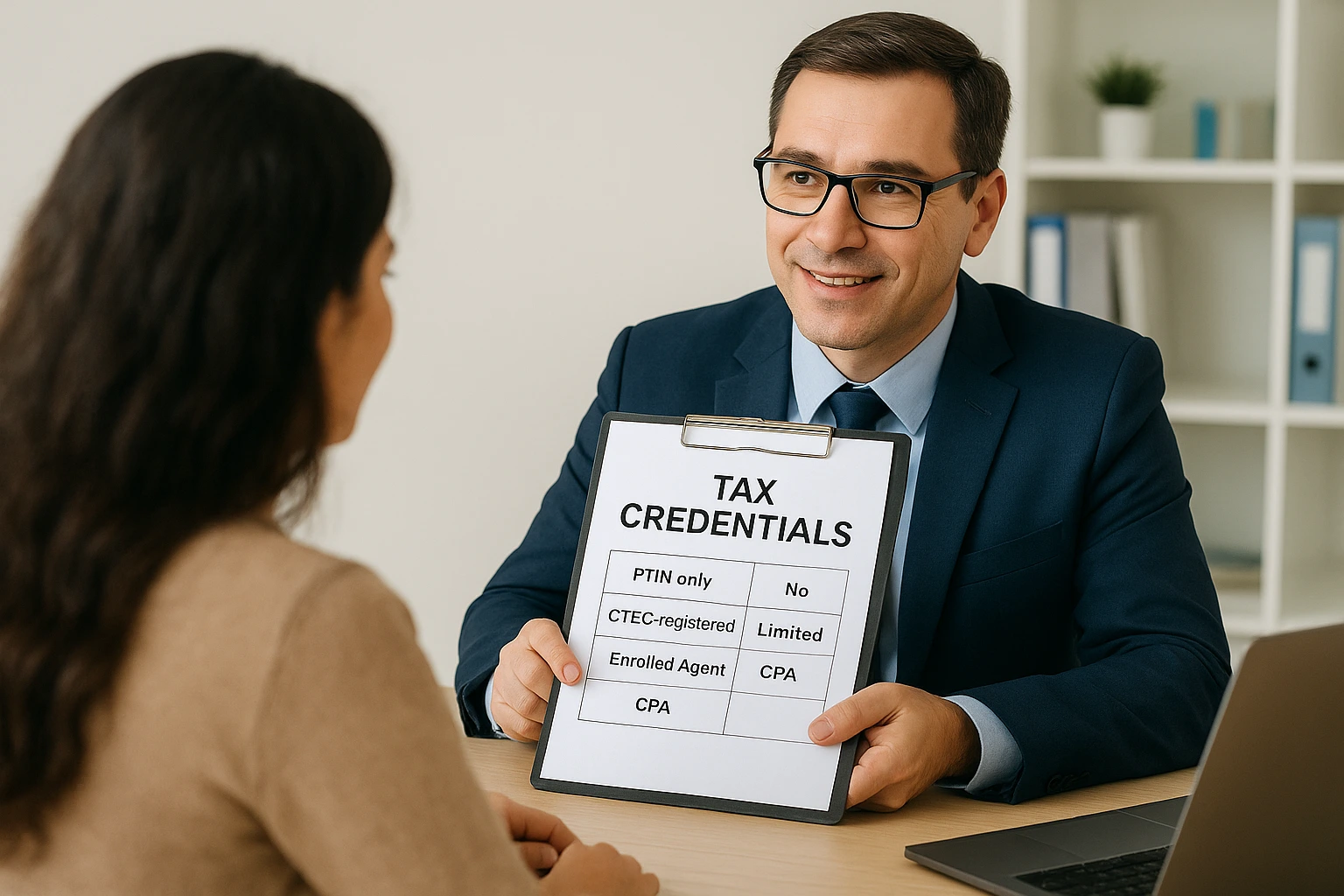
| Credential | Can represent you in an IRS audit? | Typical training |
|---|---|---|
| PTIN only | No | Minimal, no exam required |
| CTEC-registered (California) | Limited | State-mandated continuing education |
| Enrolled Agent (EA) | Yes, unlimited | IRS exam, federal licensing |
| CPA | Yes, unlimited | State board exam, accounting degree |
A preparer without verifiable credentials can't stand behind your return if the IRS ever asks questions.
California specifically requires non-exempt preparers to register with the California Tax Education Council (CTEC), so if you're filing in Orange County or anywhere else in the state, that registration should be non-negotiable. You can confirm any preparer's status through the IRS Directory of Federal Tax Return Preparers.
Transparency in pricing and process
Reliable preparers quote you a price range before they touch your documents, not after they've already started. Ask these questions during your first conversation:
- What's included in the base price, and what triggers an extra charge?
- Will you review my return with me line by line before filing?
- Do you e-file, and how do you confirm the IRS accepted my return?
- Who signs the return, and does that person hold a PTIN?
If a preparer dodges these questions or gives you a number only after they've seen your refund amount, that's a warning sign worth taking seriously. Fee structures tied to your refund size violate IRS ethics rules for many credentialed preparers and usually signal someone chasing commission rather than accuracy.
Accountability after filing
Good service doesn't end when your return gets accepted. Something inevitably needs clarification, a missing form shows up, or the IRS sends a notice questioning a deduction. A trustworthy tax service tells you upfront how they handle these situations, whether that's free amendments for their own errors or paid support for IRS correspondence.
Most importantly, they should still be reachable in July, not just during the three months leading up to April 15. Preparers who vanish after tax season, or who operate seasonal pop-up locations with no permanent office, leave you stranded if a problem surfaces later. Look for a service with year-round availability and a real, verifiable business address, whether that's a physical office or a clearly documented virtual practice.
Step 1. Verify credentials and licensing
Start your search by confirming the preparer can legally do what you're paying them for. This sounds obvious, but plenty of people skip it because asking for credentials feels awkward. Don't let that stop you. A legitimate tax preparer expects the question and answers it without hesitation.
Ask for the PTIN first
Every paid preparer must have an active Preparer Tax Identification Number, issued by the IRS. It's the baseline requirement, and if someone can't produce one, walk away immediately. You can verify a PTIN is active and check whether the preparer holds additional credentials through the IRS's public directory. Do this before your appointment, not during it, so you're not put on the spot in the room.
No PTIN, no deal. It's the one requirement that has zero exceptions.
Confirm state-specific registration
If you're filing in California, the preparer also needs to be registered with the California Tax Education Council unless they're exempt as an attorney, CPA, or Enrolled Agent. CTEC registration means they've completed required continuing education and carry a bond, which gives you some financial protection if something goes wrong. You can look up any preparer's CTEC status directly on the council's site in about thirty seconds. Skipping this step is common, and it's exactly how people end up with unlicensed preparers operating out of strip-mall pop-ups every February.
Match credentials to your tax situation
Not every situation needs an Enrolled Agent or a CPA, but some absolutely do. Use this quick checklist to figure out what level of credential you actually need:
- Simple W-2 return, no dependents: CTEC-registered or PTIN-holding preparer is usually sufficient.
- Self-employment income, 1099s, or Schedule C: Look for someone with demonstrated small-business experience and at least CTEC registration.
- Non-resident or foreign student filings (F-1, J-1, OPT): Prioritize a preparer who explicitly lists 1040NR and Form 8843 experience.
- Back taxes, amended returns, or an active IRS notice: An Enrolled Agent or CPA is worth the extra cost, since they can represent you directly.
Higher credentials generally mean higher fees, so there's no reason to pay for an EA if your return is a straightforward single-filer W-2 situation. The goal isn't the fanciest title on the wall. It's matching the preparer's legal authority and training to the complexity sitting in your folder. Get this step right, and everything else in your search gets easier, because you've already filtered out anyone who can't legally back up their work.
Step 2. Check experience, reviews, and reputation
Credentials tell you what a preparer is legally allowed to do. Experience tells you whether they're actually good at it. Once you've confirmed the PTIN and any state registration, dig into how long they've handled situations like yours and what past clients say about the results. A good tax service should have a track record you can verify in less than ten minutes online.
Look for relevant, not just general, experience
General tax experience matters less than specific experience with your situation. A preparer who's spent fifteen years doing simple W-2 returns isn't automatically qualified to handle a Schedule C with home office deductions or a 1040NR for an F-1 student. Ask directly: "How many returns like mine have you filed this year?" A confident answer with a real number is a good sign. A vague "lots" or a change of subject is not.
Read reviews with a critical eye
Online reviews are useful, but only if you know what to look for. Star ratings alone don't tell you much. Read the actual text of several reviews, especially the negative ones, and check for patterns rather than isolated complaints.
- Specificity: Does the review mention a real service (amended return, back taxes, LLC filing) or just "great experience!"
- Recency: Are there reviews from the current or previous tax season, or is everything three years old?
- Response to complaints: Does the business reply professionally to negative reviews, or ignore them entirely?
- Volume and consistency: A handful of five-star reviews posted the same week is a red flag for fake reviews.
A pattern of specific, recent reviews tells you more than any five-star average ever will.
Verify reputation beyond the review page
Don't stop at Google or Yelp. Check whether the preparer or firm has any disciplinary history with the IRS Office of Professional Responsibility if they're an Enrolled Agent, or with the state board if they're a CPA. For California preparers, the CTEC website also lists registration status, which confirms the business is currently active and in good standing, not just present in the past.
Word of mouth still counts for something too. Ask friends, coworkers, or neighbors with similar tax situations, self-employed, small business owners, or non-residents, who they use and whether they'd go back. A preparer who's built a solid local reputation in Orange County or wherever you're located, largely through repeat clients rather than advertising, usually has less to hide than one relying entirely on paid ads and flashy signage every February.
Step 3. Compare pricing, services, and communication
Once you've confirmed credentials and dug into reputation, it's time to talk numbers. Pricing for a good tax service varies widely based on complexity, and comparing quotes only works if you're comparing apples to apples. A $99 flat fee for a simple W-2 return is reasonable. That same $99 for a Schedule C with home office deductions and quarterly estimated payments usually means corners are getting cut somewhere.
Get itemized quotes, not ballpark numbers
Ask every preparer you're considering for a written breakdown before you commit. A vague "it depends" isn't good enough once they know your basic situation. Request pricing for your specific forms: a 1040 with a Schedule C, a state return, an amended filing, whatever applies to you.
| Situation | Typical fee range | What should be included |
|---|---|---|
| Simple W-2, single filer | $99–$150 | Federal + state e-file |
| Self-employed, Schedule C | $200–$450 | Deduction review, quarterly estimate guidance |
| Small business (LLC/S-Corp) | $350–$800+ | Entity return, K-1 prep |
| Amended return (1040-X) | $150–$300 | Original return review, correction filing |
The cheapest quote isn't a deal if it doesn't include the forms your return actually needs.
Match services to your actual filing needs
Beyond the base return, ask what's bundled in versus billed separately. Does the price include e-filing confirmation? A line-by-line review with you before submission? Support if the IRS sends a notice six months later? Bundled services that sound identical on a website often differ once you ask direct questions about what's covered.
Compare service lists side by side using a simple checklist:
- Federal and state e-filing included
- Prior-year or back tax filing available
- Amended return support if errors surface
- Extension filing (Form 4868) offered if you run out of time
- Non-resident or international filing expertise, if relevant to you
Judge communication before you hire, not after
How a preparer communicates during your first call tells you almost everything about how they'll handle a problem later. Do they respond to messages within a day or two? Do they explain things in plain language, or bury you in jargon to sound impressive? Test this directly: email a specific question, like how they'd handle a missed 1099, and time the response.
A preparer who answers clearly and promptly before you've paid a dime is one who's showing you exactly how future issues will get handled. If communication already feels slow or evasive during the sales conversation, it won't magically improve once you're a paying client buried in their busy season.
Step 4. Spot red flags and confirm audit support
By this point you've checked credentials, reputation, and pricing. The final step is making sure you're not walking into a trap that only reveals itself after your return is already filed. Certain behaviors should end the conversation immediately, no matter how good the preparer looked on paper. A good tax service never needs to cut corners to get you a bigger refund, and if one seems to, that's the clearest signal you'll get before you sign anything.
Know the warning signs before you sign
Certain patterns show up again and again with preparers who end up causing trouble. Watch for these specifically during your consultation:
- Refund-based fees: Charging a percentage of your refund instead of a flat rate for the work.
- Guaranteed refund amounts: Promising a specific dollar figure before they've seen your documents.
- Blank-return signing: Asking you to sign a return before it's fully completed or before you've reviewed the numbers.
- Cash-only payment with no receipt: A sign the business isn't reporting income properly, which reflects poorly on how they'll treat your return.
- No physical or verifiable address: Especially risky for seasonal pop-up locations that disappear after April.
If a preparer guarantees your refund before reviewing a single document, that's not confidence, it's a sales tactic.
Ask directly about audit support
Even a perfectly accurate return can get flagged by the IRS. What happens next depends entirely on what your preparer agreed to upfront, so ask before you file, not after you get a notice in the mail. Specific questions to raise during your consultation:
- If the IRS sends a notice, will you respond to it, and is that included in my original fee?
- Can you represent me directly in an audit, or will I need to hire someone else?
- Do you keep a copy of my return and supporting documents for at least three years?
- What's your process if you made an error, versus if I provided incomplete information?
Only Enrolled Agents, CPAs, and attorneys have unlimited rights to represent you before the IRS, per the IRS's own guidance on practitioner rights. A CTEC-registered preparer without one of those credentials can still help you gather documents, but they can't sit across from an auditor on your behalf. Know which category your preparer falls into before you need that support, because finding out during an actual audit is the worst possible time to learn the answer.
Choosing a tax preparer with confidence
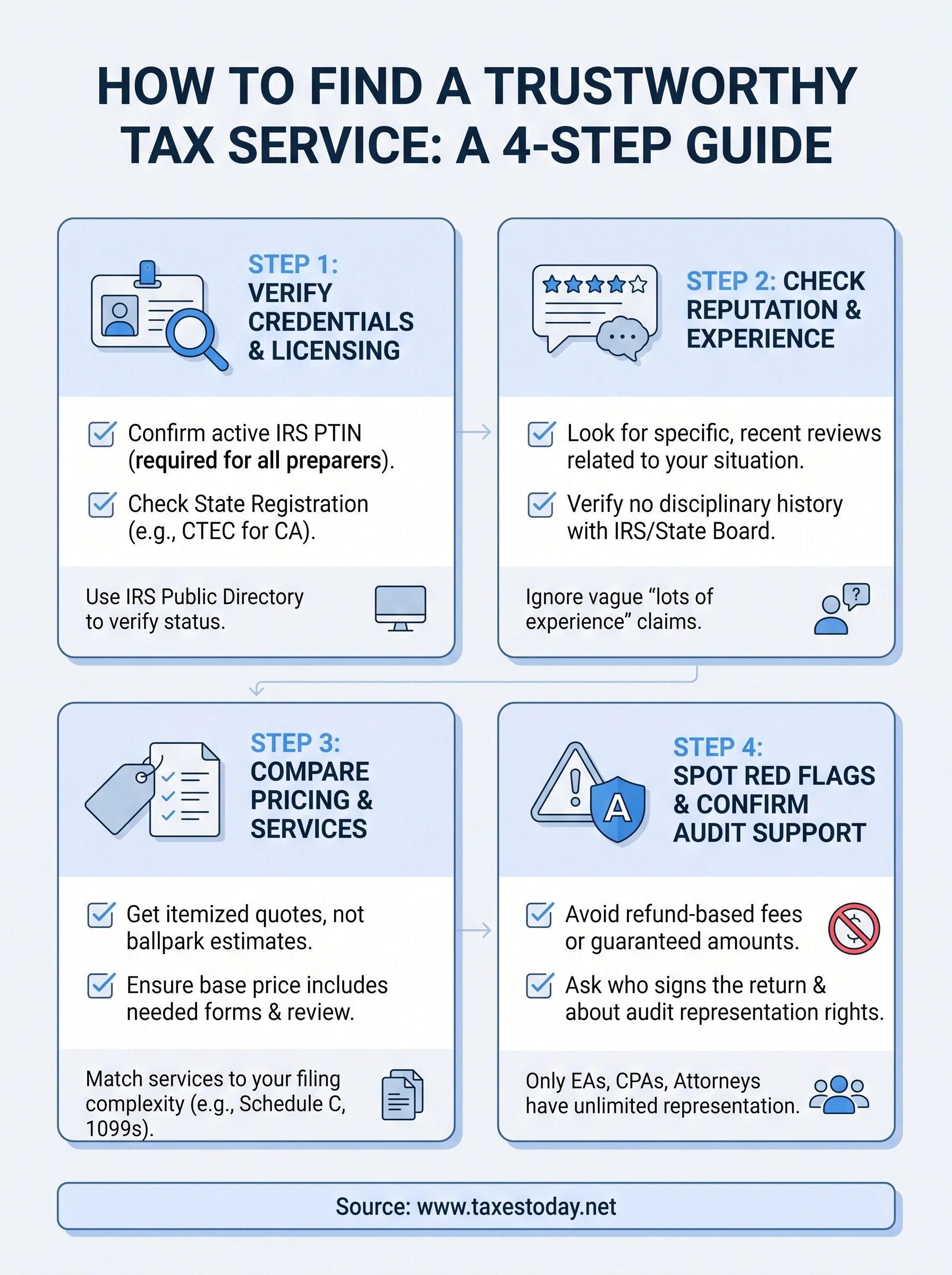
Finding a good tax service isn't about luck. It's about running through the same checklist every time: verify the PTIN and CTEC registration, dig into reviews that mention situations like yours, get an itemized quote instead of a ballpark, and confirm audit support before you sign anything. Skip any one of these steps and you're back to gambling with your financial information.
You don't need to memorize every credential type or fee range from this guide. Just refuse to work with anyone who dodges a direct question about their PTIN, their pricing, or what happens if the IRS sends a notice. That refusal alone filters out most of the preparers who cause problems.
If you'd rather skip the vetting process entirely and work with a CTEC-certified, IRS-registered team that's upfront about pricing and available year-round, get started with TaxesToday and file your return with someone who actually answers the phone in July.