


How Much Does It Cost to Amend a Tax Return?
You caught a mistake on last year's return, or maybe the IRS sent you a notice about it. Now you're wondering how much does it cost to amend a tax return before you commit to fixing it. That's a fair question, because the answer changes depending on whether you go the DIY route or hire someone to handle it for you.
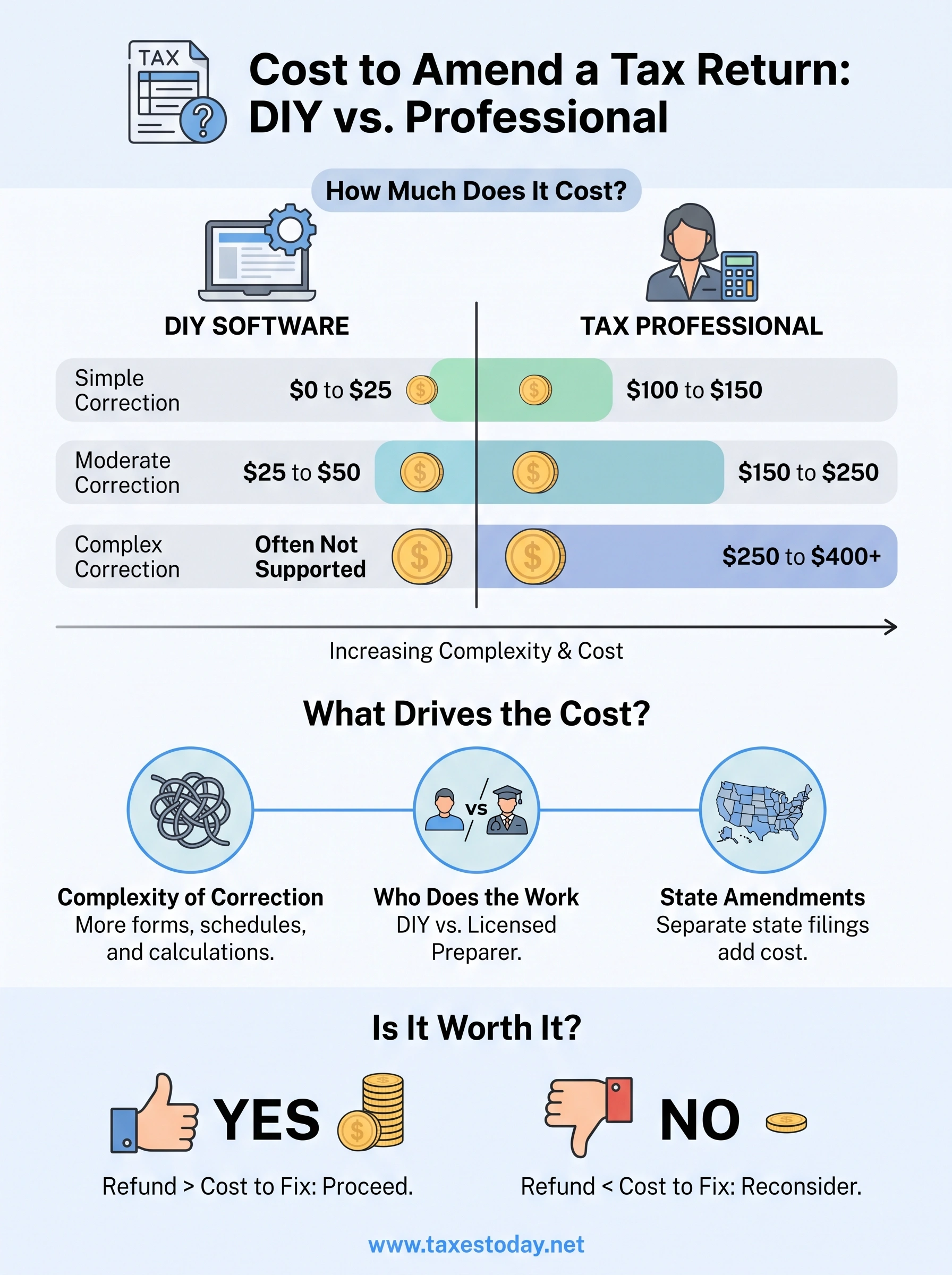
Here's the short version: filing Form 1040-X yourself through tax software usually runs $0 to $50, while a professional preparer typically charges $100 to $400 or more, depending on how complicated your situation is. A simple correction, like fixing a missed W-2, costs a lot less than amending a return with self-employment income or multiple schedules attached.
In this article, we'll break down what drives that price range, when paying for professional help actually saves you money, and what it looks like when we handle an amended return at TaxesToday.net. By the end, you'll know exactly what to budget for and whether your situation calls for a CPA or a software subscription.
Why the cost to amend a tax return varies so much
Ask five tax preparers how much to amend a tax return and you'll get five different quotes. That's because the price hinges on what actually changed, how many forms need updating, and who's doing the work. A missed 1099 that only affects one line item is a quick fix. A correction that touches your Schedule C, adds a dependent, or changes your filing status can mean redoing several supporting schedules, which takes real time.

The cost of amending a return almost always comes down to how many forms it touches, not just the fact that you're filing an amendment.
The complexity of the correction
Simple errors, like a wrong bank account number or a missing W-2 that doesn't change your total income much, are cheap to fix because the preparer isn't recalculating much. But once self-employment income or itemized deductions enter the picture, the preparer has to rebuild those schedules and check how the change ripples through the rest of the return. That extra work shows up directly in the bill.
Who does the work
Doing it yourself through tax software keeps costs near zero, but you're on the hook for spotting every downstream effect of the change. A licensed preparer charges more upfront, but they catch things software won't, like whether your correction also affects a state credit or triggers a new form, so it helps to know how to choose a tax preparer and what they charge.
State amendments add another layer
Most states require their own amended return alongside the federal Form 1040-X, and that's rarely included free in software packages or flat-fee quotes.
| Cost driver | Lower cost | Higher cost |
|---|---|---|
| Type of error | Missing W-2, math mistake | New self-employment income, added dependent |
| Forms affected | Just Form 1040-X | 1040-X plus Schedule C, E, or SE |
| Who prepares it | DIY software | CPA or enrolled agent |
| States involved | Federal only | Federal plus one or more state amendments |
Once you see which of these apply to your situation, the wide $0 to $400+ range starts to make a lot more sense, and you can estimate where you'll actually land before you start the paperwork.
How to amend a tax return step by step
Before you walk through amending a return step by step, gather your original return and any new documents that triggered the correction, like a corrected W-2 or a 1099 that arrived late. Having everything in front of you before you start prevents the back-and-forth that drives up preparer fees or wastes your own time in tax software.
Most of the cost in amending a return comes from tracking down documents, not filling out the form itself.
The core steps
Whether you're doing this yourself or handing it to a preparer, the process follows the same basic path:
- Pull your original tax return and confirm exactly what needs to change.
- Collect supporting documents for the correction, such as a revised 1099 or missed receipts.
- Complete Form 1040-X following the line-by-line 1040-X instructions, explaining the change in Part III.
- Check whether your state requires a separate amended return.
- File electronically if your software supports it, or mail the paper form.
- Track the IRS status by tracking your amendment status online.
Where most people get stuck
Software handles the mechanical parts fine, but it won't always flag that a change to your income affects a credit you claimed elsewhere, like the Earned Income Tax Credit. Preparers catch that because they're trained to trace how one number ripples through the whole return, which is exactly why their fee reflects more than just filling in boxes. According to the IRS, amended returns can take up to 16 weeks to process, so budget your time accordingly no matter who prepares it.
Cost comparison: DIY software vs. a tax professional
Numbers make this decision easier than guessing. Below is what you'll typically pay for each route, based on the complexity tiers we covered above.
| Situation | DIY software | Tax professional |
|---|---|---|
| Simple correction (wrong W-2, math error) | $0 to $25 | $100 to $150 |
| Moderate correction (added dependent, new credit) | $25 to $50 | $150 to $250 |
| Complex correction (Schedule C, multiple states) | Often not supported | $250 to $400+ |
Cheap software works fine until your amendment touches more than one schedule, then a professional almost always pays for itself.
When software is genuinely enough
Quick fixes fit software well. If you're only correcting a stray W-2 or fixing your filing status without any change to income or credits, most software walks you through Form 1040-X without much trouble. You'll spend more time reading instructions than the IRS spends processing the fix.
When paying for a professional makes sense
Often, the software route breaks down the moment your correction touches self-employment income, a dependent, or a credit that phases out based on income. A licensed preparer traces those ripple effects for you instead of leaving you to catch them on your own. That's the gap our amended tax return help is built to close, we price the work based on what actually changed, not a flat fee that ignores your situation.
Budgeting for either path gets easier once you know which tier your correction falls into, so check the table above before you commit to a tool or a preparer.
Is amending your tax return worth the cost?
Sometimes the honest answer is no. If your correction only nets you a $40 refund and the professional fee runs $150, you're paying more to fix the return than you'd get back. Before you spend anything, estimate the dollar impact of the change, not just whether it's technically correct.
Do the math before you file
Weigh the expected refund or amount owed against the preparer's fee or the time you'd sink into software. A missed 1099 that adds $2,000 in refundable credits easily justifies a $150 professional fee. A tiny rounding error that changes your bill by $10 usually doesn't.
If the correction won't move your refund or tax bill by more than the fee to fix it, amending isn't worth pursuing.
Signs it's not worth pursuing
Certain situations rarely justify the cost of an amendment:
- The change affects less than $50 in tax owed or refunded
- The statute of limitations has already passed, so check how long you have to amend a tax return (generally three years from the original filing date)
- The error is cosmetic, like a typo in your address, and doesn't touch any numbers
On the flip side, amending almost always pays off in the situations that justify filing an amendment, like a missed deduction tied to self-employment expenses, a dependent you forgot to claim, or an error the IRS flagged in a notice. Those situations often mean hundreds of dollars in your favor, which makes even a $250 preparer fee an easy trade.
Making the right call on your amendment
Amending a return isn't complicated once you know what drives the cost. A quick fix through software costs almost nothing, while a return touching self-employment income, dependents, or multiple states justifies paying a professional to trace every ripple effect. The real question isn't whether you can technically amend, it's whether the dollar impact clears the cost of fixing it.
Run the math first. Compare what you'd gain or owe against the preparer's fee, and skip the amendment if the numbers don't move enough to matter. But when a missed deduction or an IRS notice points to real money on the table, don't let a $150 or $250 fee talk you out of claiming what's yours.
If your situation involves more than a simple correction, get it done right the first time. Let our CTEC-certified preparers file your amended return starting at $99 and price it based on what actually changed, not a guess.