


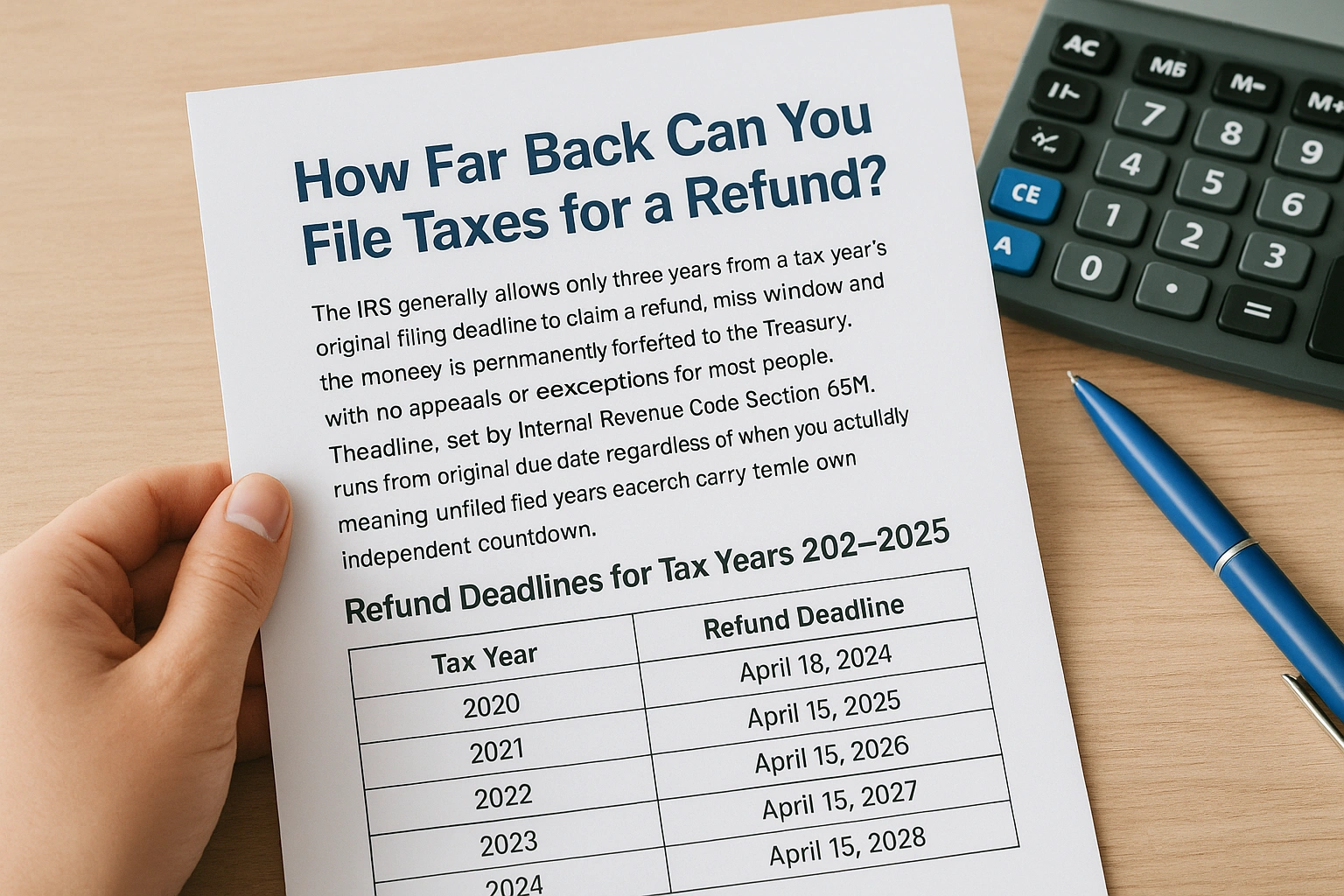
How Far Back Can You File Taxes for a Refund?
You finally sat down to file an old tax return, and now you're wondering if there's even a point. Maybe you skipped a year during a rough patch, or you just found out you were owed money and never claimed it. The question how far back can I file taxes for a refund comes up constantly with clients who assume the IRS locks the door after a year or two and walks away with their money.
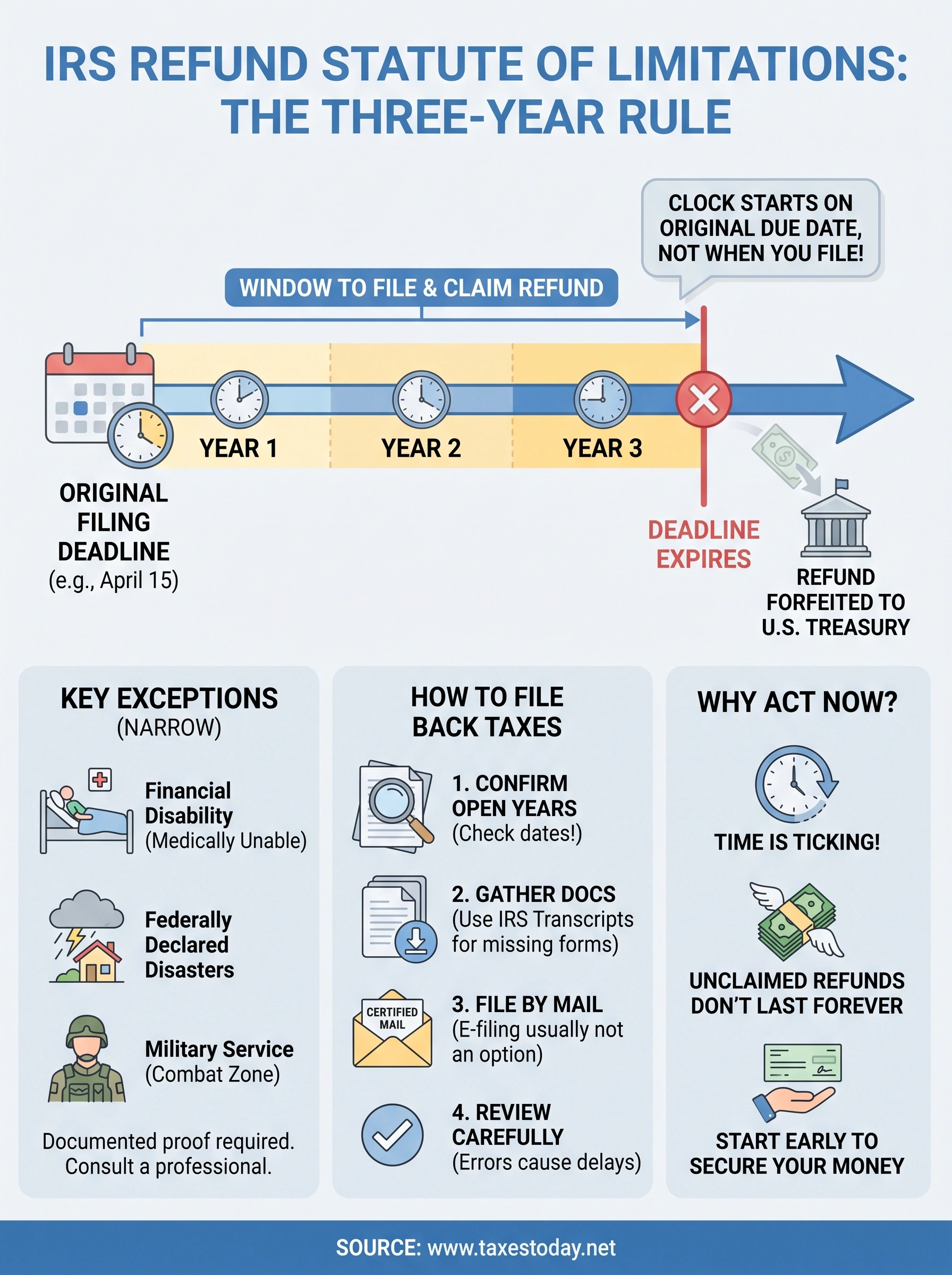
Here's the direct answer: the IRS generally gives you three years from the original filing deadline to file a return and still collect a refund. Miss that window, and the refund is gone for good, forfeited to the U.S. Treasury with no appeal process. There are a few exceptions, like extended deadlines tied to certain disasters or specific circumstances, but the three-year rule is the one that applies to almost everyone.
In this article, we'll walk through exactly how the refund statute of limitations works, what counts as your filing deadline when you never filed at all, and how the deadline for amending a return fits into the timeline. We'll also cover what happens once that window closes and how our team at TaxesToday helps clients file back taxes correctly before it's too late.
Why the three-year refund deadline matters
Money doesn't sit in a government account forever waiting for you to remember it exists. Congress built a hard cutoff into the tax code, and once that cutoff passes, the refund you were owed simply disappears into the general fund. Understanding why this rule exists, and how strictly the IRS applies it, helps you see why filing that old return sooner rather than later actually matters.

The legal basis behind the rule
Section 6511 of the Internal Revenue Code sets the refund statute of limitations at three years from the date you filed the return, or two years from the date you paid the tax, whichever is later. Most people fall under the three-year branch because withholding from a paycheck counts as paid on the original due date of that year's return, even if you file late. So if your 2022 return was due April 15, 2023, and you never filed, your refund deadline is April 15, 2026. File on April 16, and the IRS won't send you a dime, even if the return shows a $4,000 refund sitting right there.
If you don't file within three years of the original due date, the refund is gone for good, no appeal, no exception for most taxpayers.
This isn't a bureaucratic quirk. The IRS treats the deadline as a jurisdictional bar, meaning the agency legally cannot issue the refund even if it wants to. Examiners don't have discretion here the way they sometimes do with penalty abatement requests. A refund claim filed on day 1,096 gets denied automatically by the system, no human review needed.
What counts as your filing date when you never filed
A lot of clients assume the clock only starts once they submit paperwork, so a return that's never filed must mean the clock never starts either. That's backwards. The IRS refund deadline is anchored to the original due date of the tax year in question, not to when you eventually get around to filing. Whether you file zero returns for five years or file everything the day it's due, the three-year window for each specific tax year begins on that year's original deadline (or the extended deadline if you filed for an extension).
This distinction trips people up constantly. Someone might think, "I haven't filed since 2019, so my three years started when I decided to catch up in 2024." It didn't. Each tax year has its own independent deadline, ticking away regardless of whether you've engaged with the IRS at all.
The scale of unclaimed money
This isn't a rare, theoretical problem. The IRS regularly reports that it holds over $1 billion in unclaimed refunds for taxpayers who never filed a given year's return, spread across roughly 1 million people nationwide. The average unclaimed refund typically runs between $700 and $900, though plenty of self-employed filers and families with dependents leave far more on the table once credits like the Earned Income Tax Credit or Child Tax Credit are factored in. You can check the IRS's own reporting on unclaimed refunds at IRS.gov for year-specific figures.
Why withholding and estimated payments behave differently
The rule gets more nuanced once you factor in how your tax was paid. Withheld taxes from a W-2 job are deemed paid on the original due date, which is why the standard three-year window applies cleanly. But if you made estimated payments or had a payment applied from a prior year's overpayment, those follow slightly different timing rules under the two-year-from-payment branch. In practice, this rarely shortens your window, but it's worth knowing if you're trying to calculate an exact deadline down to the day.
The bottom line is simple: every tax year carries its own independent refund clock, and it starts ticking the moment that year's original filing deadline passes, not when you finally sit down to deal with it. If you've got unfiled years sitting in a drawer somewhere, the calendar is already working against you, and it helps to know how many years of returns the IRS expects you to file. Our team handles back tax preparation and filing every week for clients in exactly this position, and the earlier you start, the more likely you are to actually see that money instead of watching it expire.
How to find your exact refund deadline
Pinning down your exact refund deadline takes more than knowing "three years." You need the specific calendar date tied to the specific tax year you're trying to claim, and that date shifts depending on when the original return was due, whether you filed an extension, and whether a weekend or holiday pushed the deadline. Getting this date wrong by even a day can mean the difference between a refund check and a denial letter.
Start with the original due date, not today's date
Every individual tax return has an original due date, usually April 15, though it moves to the next business day when the 15th falls on a weekend or federal holiday. For your 2021 return, for example, the original due date was April 18, 2022, because of a holiday adjustment, which means your refund deadline landed on April 18, 2025, not April 15. Count forward exactly three years from that specific date, not from January 1 of the tax year or from whenever you happen to sit down and file.
Your refund deadline is always tied to the original due date of that specific tax year, never to the date you actually get around to filing.
Factor in extensions you actually filed
If you filed Form 4868 online or by mail for a given year, your refund statute of limitations shifts to three years from the extended due date, typically October 15, rather than the original April deadline. This only applies if you actually filed the extension on time, so it's worth confirming who qualifies for a tax extension in the first place. Skipping the extension paperwork and just filing late later doesn't buy you extra time on the refund clock, it only avoids certain late-filing penalties.
Use IRS tools to confirm your specific dates
Rather than relying on memory or guesswork, pull your own records to confirm the exact dates involved:
- Request an IRS tax transcript through the IRS Get Transcript tool to see what the IRS has on file for each year.
- Check whether you filed an extension for that specific tax year, since this changes your calculation.
- Note whether you made any estimated payments after the original due date, since those follow the two-year-from-payment rule instead.
- Confirm the exact original due date for that tax year, since holidays and weekends shift it by a day or two in some years.
Watch for state-specific deadlines too
California and most other states run parallel refund statutes that mirror the federal three-year rule, but the exact dates and mechanics can differ slightly by state, especially around disaster-related extensions. Filing your federal return doesn't automatically preserve your state refund, so check both deadlines separately if you owe filings in a state beyond California.
Once you've nailed down the precise date for each unfiled year, you'll know immediately which years are still salvageable and which ones have already expired. This is exactly the kind of detail work our preparers at TaxesToday handle daily when clients bring in a stack of unfiled years and need a clear answer on what's still recoverable.
How to file back taxes and claim your refund
Once you know a tax year is still inside the three-year window, the mechanics of filing a late return are more straightforward than mysterious. You're not filing a special "refund claim" form, you're just filing the regular tax return for that year, using that year's specific forms and rules, and mailing it in through the correct channel. The trick is doing it accurately enough that the IRS processes it quickly instead of kicking it back with questions.
Use the correct year's tax forms
Tax forms change every year, sometimes in small ways and sometimes significantly, so you can't file a 2022 return using a 2024 form. The IRS prior-year forms page lets you download the exact version you need, along with that year's instructions, which matter because deduction amounts, credit thresholds, and even line numbers shift from year to year. Grabbing the wrong year's paperwork is one of the most common reasons back-tax returns get rejected or delayed.
Gather the income documents for that specific year
Before you fill anything out, pull together every income document tied to that tax year specifically, not the current year.
- W-2s from every employer you had that year
- 1099s for freelance, contract, or gig income
- Records of any estimated tax payments you made
- Prior-year mortgage interest or student loan interest statements
- Documentation for dependents you're claiming, including their Social Security numbers
If you're missing forms, request an IRS wage and income transcript for that year through the IRS Get Transcript tool. It shows what employers and financial institutions reported to the IRS under your Social Security number, which is often enough to reconstruct a return even when your own paperwork is long gone.
File by mail, since e-filing usually isn't available
Most e-filing software and IRS systems only accept returns for the current year and maybe one year back, so check whether back taxes can be filed electronically before you start. Anything older almost always has to be printed and mailed to the IRS processing center listed in that year's instructions. Mail it via certified mail with a return receipt so you have proof of the date it was sent, since that date matters if you're filing close to the deadline, and then check your refund status once the IRS logs the return.
A back tax return only counts toward your refund deadline once the IRS actually receives it, so don't wait until the last week to mail a claim you've been sitting on.
Double-check the math and claim every credit you qualify for
Errors trigger IRS correspondence, and correspondence eats into the calendar while your refund deadline keeps ticking, which is why a careful review of the numbers before filing pays off. Review every line against that year's instructions, and don't skip credits like the Earned Income Tax Credit or education credits just because you assume you won't qualify, since eligibility rules shifted from year to year and many filers qualify without realizing it.
Handling one prior-year return is manageable on your own if your situation is simple, especially if you already know how to pull up an old return in TurboTax. Once you're juggling multiple unfiled years, mismatched documents, or self-employment income, working with our service for catching up on unfiled years at TaxesToday means someone experienced is checking the year-specific rules for you instead of you guessing at forms that changed three years ago.
Exceptions that can extend your filing deadline
The three-year rule covers most taxpayers, but a handful of situations legally push that deadline further out. These exceptions are narrow and require documentation, so you can't just claim one because you had a hard year. Knowing whether you qualify matters, because it can mean the difference between a denied refund claim and a check that actually clears.
Financial disability due to a medical condition
Under Internal Revenue Code Section 6511(h), the refund clock pauses if you were medically unable to manage your financial affairs during the period in question. This isn't a vague hardship exception. The IRS requires a physician's statement confirming the impairment lasted or was expected to last at least 12 months, plus proof that no one else, like a spouse or guardian, had authority to file on your behalf during that time. Filing this exception means submitting written medical certification alongside your late return, not just checking a box.
A missed deadline only gets restored through documented exceptions like financial disability or a federally declared disaster, never through a general appeal to fairness.
Federally declared disasters
When the President declares a federal disaster area, the IRS routinely issues relief that postpones filing and payment deadlines for affected taxpayers, sometimes by months. These postponements often apply automatically based on your address on record, though taxpayers who moved into an affected area to help with recovery can sometimes qualify too. The IRS disaster relief page lists current declarations and the specific extended deadlines tied to each one, since the length of relief varies by disaster and location.
Military service and combat zones
Service members serving in a designated combat zone, along with those serving in support of contingency operations, get their filing and refund deadlines suspended for the entire time they're in the zone, plus 180 days afterward. This suspension also extends to spouses in many cases. The rule exists because the tax code recognizes it's unreasonable to expect someone deployed overseas to track a three-year filing window on top of everything else they're managing.
Other narrow situations worth knowing
A few less common circumstances can also shift your deadline, though they apply to far fewer taxpayers:
- Written agreements extending the assessment period, which sometimes extend the refund period too, though this usually applies to audit situations rather than simple back filing
- Certain innocent spouse relief cases, where the timeline for claiming a refund tied to a joint return follows separate rules
- Bankruptcy proceedings, which can suspend various IRS deadlines under specific automatic stay provisions
Why you shouldn't assume you qualify
Most people who think they have a special circumstance actually fall under the standard three-year rule once the IRS reviews the facts. Requesting an exception you don't qualify for wastes time you don't have, since the underlying deadline keeps running while your claim gets processed and denied. Verifying eligibility before you file, rather than after a rejection, saves you from watching a legitimate exception period expire while you pursued the wrong one. Our preparers at TaxesToday check these exceptions against your specific documentation before submitting anything, so you're not guessing which rule, if any, actually applies to your situation.
What happens if you miss the refund deadline
Once the three-year window closes, the outcome is blunt: the refund is gone permanently, and there's no appeal, no hardship exception, and no amount of paperwork that brings it back. The IRS isn't being punitive here, it's following a statute that leaves examiners zero discretion. Your return can still be processed, the numbers can still show a refund due, and the system will still reject payment automatically. Plenty of clients come to us confused because they filed correctly and the math checks out, yet the check never arrives. That's the deadline doing exactly what Congress designed it to do.
Once the refund statute expires, filing the return still matters for your record, but the money itself is gone permanently.
The IRS still processes your return, just without a payment
Even past the deadline, you generally still need to file that old return if you had a filing requirement, because unfiled returns can trigger separate IRS enforcement action against non-filers unrelated to the refund itself. The IRS will accept the paperwork, log the income, and close out the year on their end. What it won't do is cut a check or apply an overpayment, since the statute blocks that specific action regardless of how accurate or complete your return is.
You might still owe money even with no refund coming
Here's the part that catches people off guard: the refund deadline only protects your right to receive money back. It does nothing to protect you from owing money. If a late-filed return actually shows a balance due instead of a refund, that balance is fully collectible, with penalties and interest accruing from the original due date regardless of how many years have passed, since the assessment clock never starts on a return you never filed. There's no symmetry here, the IRS keeps every advantage on the collection side while enforcing the strict cutoff on the refund side.
Credits and carryforwards can disappear too
Missing the deadline doesn't just cost you that year's refund. It can also wipe out related benefits tied to that return, including:
- Earned Income Tax Credit or Child Tax Credit amounts specific to that year
- Estimated tax payments or withholding that could have offset a different year's balance
- Certain carryforward items, like capital losses, that depend on a properly filed originating return
Once the statute runs, these amounts aren't just delayed, they're forfeited along with the direct refund.
What you can still do once a year has expired
If you've confirmed a specific year is past saving, don't let that discourage you from tackling the years that are still open, since there's still a clear path for anyone who hasn't filed. A common mistake is assuming that because one year expired, the whole situation is hopeless, so filing stops entirely. That's backwards. Every other tax year runs on its own independent clock, and some of those may still have months or years of runway left. Our preparers at TaxesToday routinely sort through a stack of unfiled years, flag which ones are already gone, and focus the effort on the years that can still produce a real refund, so you're not wasting energy chasing money that's already off the table.
Refund deadlines for recent tax years at a glance
Sometimes you just need the dates laid out without doing the math yourself. Below is a snapshot of the original due date and the corresponding refund statute of limitations for the tax years most people are still asking about, calculated as of today's date. Use this table as a starting point, then verify your own filing status and payment history before assuming a year is open or closed.
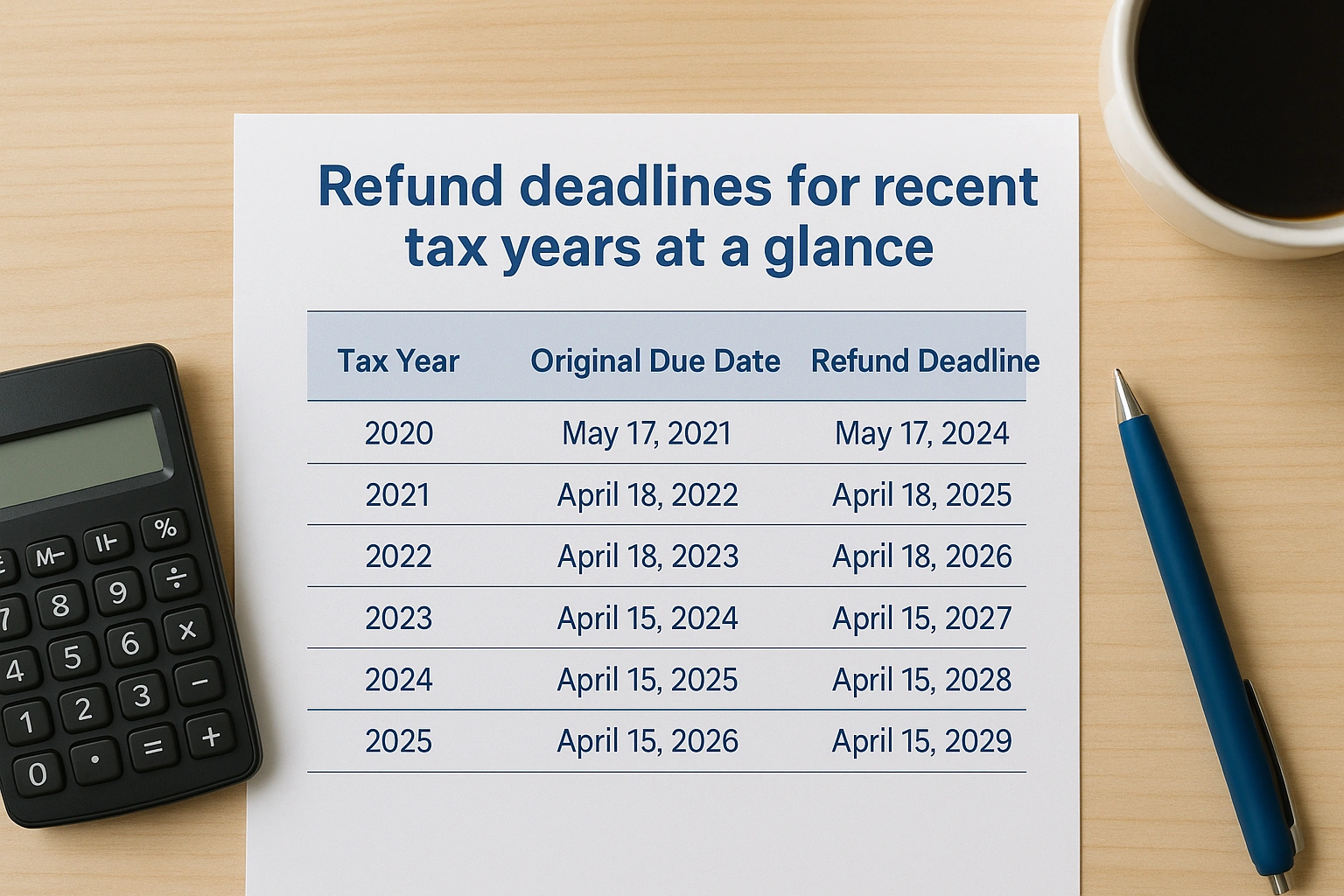
| Tax Year | Original Due Date | Refund Deadline (3 Years Later) | Status as of Sept 2026 |
|---|---|---|---|
| 2020 | May 17, 2021 | May 17, 2024 | Expired |
| 2021 | April 18, 2022 | April 18, 2025 | Expired |
| 2022 | April 18, 2023 | April 18, 2026 | Expired |
| 2023 | April 15, 2024 | April 15, 2027 | Open |
| 2024 | April 15, 2025 | April 15, 2028 | Open |
| 2025 | April 15, 2026 | April 15, 2029 | Open |
If you're only now getting around to filing 2021 or 2022, check the calendar carefully, since those refund windows have already closed for most filers.
Why the deadlines aren't always a clean April 15
Notice that 2021 and 2022 both moved to April 18 instead of the usual April 15. That happened because April 15 landed on a weekend or ran into the Emancipation Day holiday observed in Washington, D.C., which pushes the federal filing deadline to the next business day under IRS rules. The 2020 tax year saw an even bigger shift, with a May 17, 2021 due date tied to pandemic-related relief. These small adjustments matter because they shift your three-year window by the same number of days, and rounding to April 15 out of habit can cause you to miscalculate exactly when a refund claim stops being valid.
What this table means for your situation right now
Given today's date, anyone still holding an unfiled 2022 return has already lost that refund, regardless of how large it might have been. Table aside, this is exactly why we tell clients not to sit on unfiled years once they discover them. Years 2023 through 2025 remain fully open, and 2025 in particular still has roughly three years of runway if you filed an extension or simply haven't gotten to it yet, though extension deadlines and payment rules are worth reviewing first. Reference this table again each time a new filing season closes, since one more year drops off the open list every April.
Confirming your specific dates instead of relying on the table alone
Understand that this table reflects standard due dates for most individual filers, but your personal deadline could differ slightly if you filed an extension, made late estimated payments, or qualify for one of the exceptions covered earlier. Treat the table as a planning tool, not a final legal determination. If you're unsure which column applies to your exact situation, our preparers at TaxesToday can pull your transcripts and confirm the precise deadline before you file, rather than you guessing and finding out too late that a year you thought was open had already closed.
Documents you need to file prior-year returns
Gathering paperwork for a return you're filing years late feels different than pulling together this year's documents, mostly because the records you need are older, harder to find, and sometimes don't exist anymore. Before you sit down to prepare a back tax return, work from a checklist of the records and information you need and take inventory of what you actually have versus what you'll need to request, since missing documents are the single biggest reason prior-year filings drag on for weeks instead of days.
Income documents specific to that tax year
Start with anything that reports income for the exact year you're filing, not the current year. Mixing up years is a common mistake when you're catching up on multiple returns at once.
- W-2s from every employer for that specific tax year
- 1099-NEC or 1099-MISC forms for freelance, gig, or contract income
- 1099-INT or 1099-DIV forms for bank interest and investment income
- Records of any estimated tax payments made during that year
- 1098 forms showing mortgage interest or student loan interest paid
Filing with the wrong year's income documents is one of the fastest ways to trigger an IRS notice on a return you already waited years to submit.
Personal and dependent information
Beyond income, the IRS needs proof of who was in your household that year. Social Security numbers for every dependent you're claiming, along with their birthdates, need to match what's on file, since a mismatch here is another common trigger for correspondence audits. If your filing status changed during that period, such as a marriage, divorce, or a dependent aging out of eligibility, gather documentation supporting whichever status applied specifically to that tax year, not your current one.
What to do when your own records are missing
Here's where most people get stuck: they simply don't have the old paperwork anymore. Request an IRS wage and income transcript for the specific year through the IRS Get Transcript tool, which shows everything employers and financial institutions reported to the IRS under your Social Security number. This transcript won't include every deduction you're entitled to, but it reconstructs the income side of your return reliably, even when your own files are long gone. Reaching out to former employers directly can also work, though many small businesses close or change ownership within a few years, making the IRS record of income reported under your SSN the more dependable option.
Organizing everything before you file
Once you've collected what you can, sort documents by tax year before you start filling out forms. Trying to prepare three back years simultaneously without separating the paperwork first is how income gets misreported on the wrong year's return, creating a second problem on top of the one you're already fixing. If you're missing a document and can't retrieve it through a transcript request, don't guess at the numbers. Our preparers at TaxesToday routinely pull transcripts and cross-reference them against whatever paperwork clients bring in, which catches gaps before a return gets submitted rather than after the IRS sends back a correction notice.
Don't let your refund slip away
Three years sounds generous until you realize how easily a year slips by unnoticed. The refund statute of limitations doesn't send warnings, doesn't pause for confusion, and doesn't care why you fell behind. It just closes, permanently, on a fixed date tied to a return you may not have even started thinking about yet. If you've been asking how far back you can file taxes for a refund, the honest answer is that the clock is already running on every unfiled year sitting in your files right now.
Gathering old W-2s and figuring out which years are still open is exactly the kind of work that stalls people out for months, months you don't actually have. Don't spend that time guessing. Talk to our CTEC-certified tax preparers at TaxesToday, with returns from $99 and get a clear answer on which years are still recoverable before another deadline quietly closes on you.