


Unfiled Tax Returns: What to Do If You Haven't Filed
Maybe it was one bad year that snowballed into three. Maybe you moved, changed jobs, or just froze up after a messy divorce or business shutdown. Whatever the reason, tax returns unfiled for a year or more create a specific kind of stress: you don't know how much you owe, whether the IRS has noticed yet, or where to even start digging up old records.
Here's the direct answer: unfiled income tax returns don't disappear on their own, and waiting rarely makes the situation better. The IRS can file a substitute return for you using only the income data it has, with no deductions or credits applied, which usually means you owe more than you actually should. If you have unfiled federal tax returns, the fix is almost always the same regardless of how many years have piled up: gather your income records, file the oldest year first, and get current before penalties and interest compound further.
This article walks through what counts as an unfiled return, the real consequences of skipping years, and what to do about unfiled tax returns right now, including how far back you actually need to go and when professional help makes the process faster and cheaper.
Why unfiled tax returns are a bigger problem than you think
Most people assume the worst that happens with tax returns unfiled is a fine, but what really happens when you don't file taxes goes well beyond that. In reality, the financial and legal exposure grows every month you wait, and it grows in ways that compound on each other. Understanding exactly what's at stake makes it a lot easier to force yourself to sit down and deal with it.
The penalties stack up fast
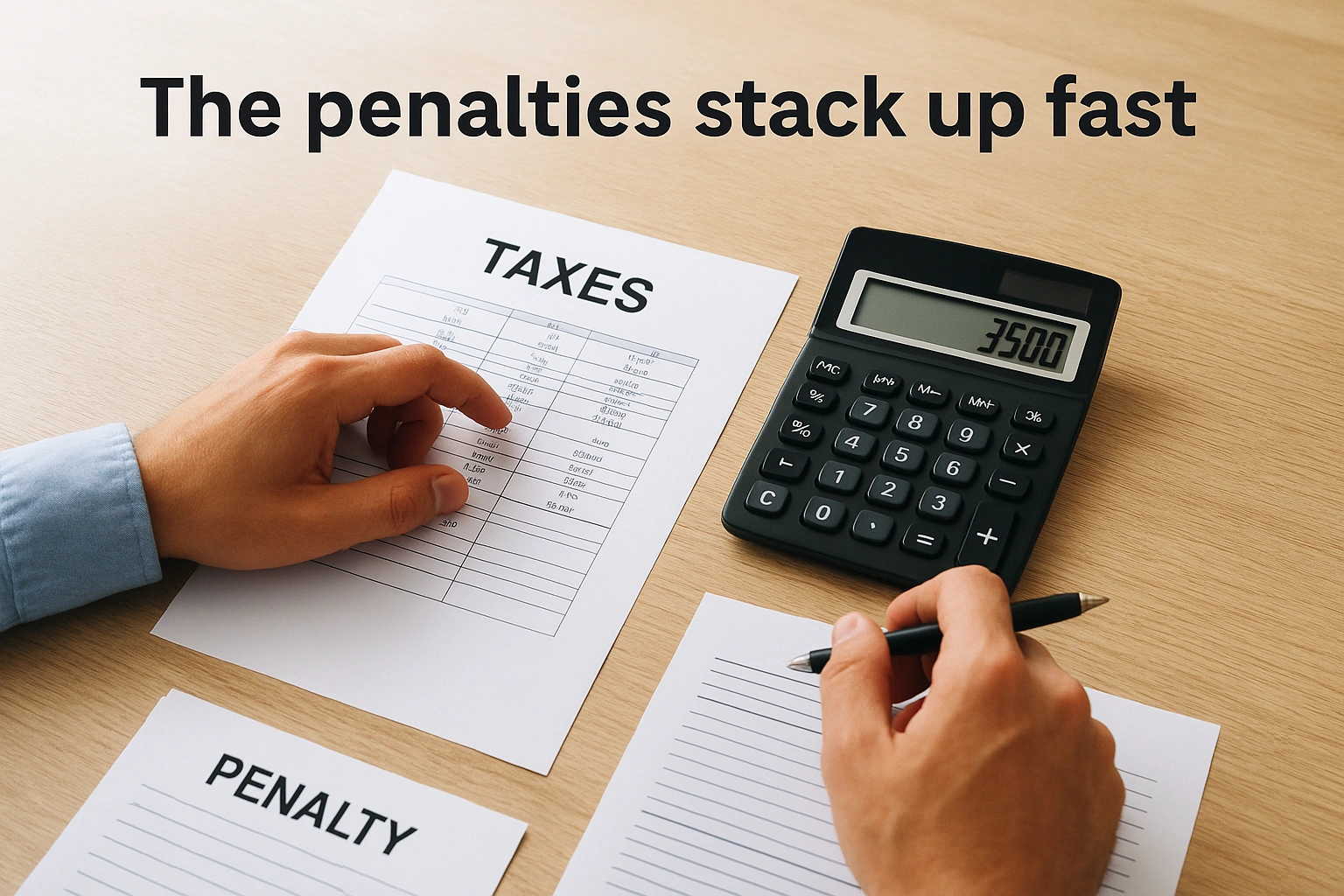
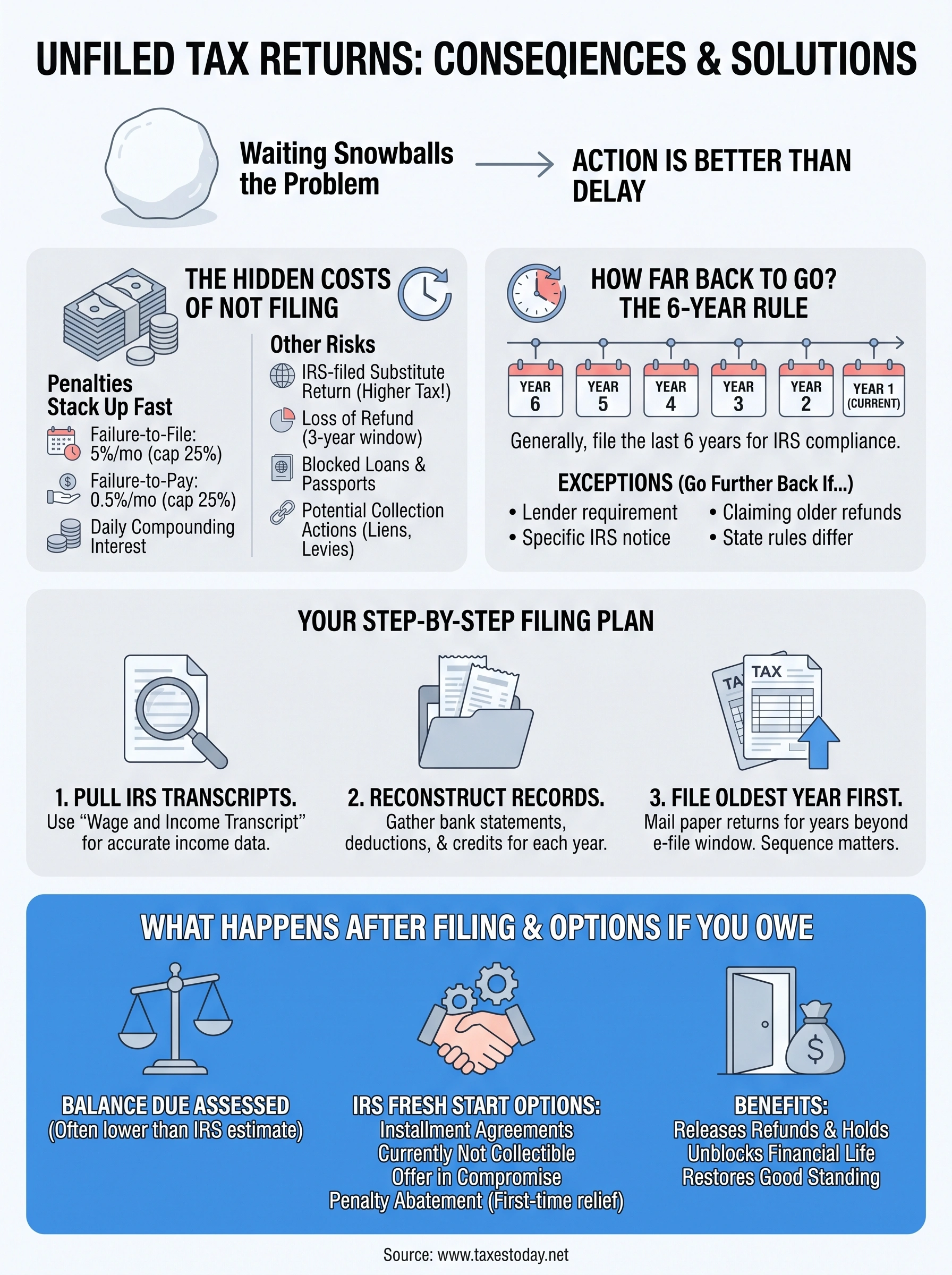
Understand that the IRS charges two separate penalties, and they run at the same time. The failure-to-file penalty is 5% of your unpaid tax for each month your return is late, capped at 25%. The failure-to-pay penalty adds another 0.5% per month on top of that, and interest accrues on the whole balance daily. Run the math on a $10,000 tax bill left unfiled for a year, and you're easily looking at $3,000 or more in penalties and interest before you've paid a dime toward the actual tax owed.
| Penalty type | Rate | Cap |
|---|---|---|
| Failure-to-file | 5% of unpaid tax per month | 25% of unpaid tax |
| Failure-to-pay | 0.5% of unpaid tax per month | 25% of unpaid tax |
| Interest | Federal short-term rate + 3%, compounded daily | No cap |
Every month you delay filing costs real money, not just paperwork stress.
The IRS can (and will) file for you
Visualize this scenario: you ignore the problem long enough, and the IRS eventually steps in with a Substitute for Return (SFR). According to the IRS, this substitute uses whatever income data it has on file, usually from W-2s and 1099s reported by employers and clients, and it applies the single filing status with no dependents, no deductions, and no credits. That almost always produces a tax bill far higher than what you'd actually owe if you filed correctly. Once an SFR is assessed, the IRS can move straight to collection action, including wage garnishment, bank levies, and federal tax liens, without waiting for you to respond.
It's not just about penalties
Consider what else is quietly ticking away in the background. The statute of limitations on IRS audits and collections doesn't even start until you file, so an unfiled return stays open indefinitely, with no expiration date protecting you. If you're due a refund, you only have three years from the original due date to claim it before that money is gone for good, forfeited to the Treasury. Unfiled federal tax returns can also block you from getting a mortgage, a business loan, or renewing a passport if your tax debt crosses a certain threshold, since lenders and even the State Department can require proof of filing compliance. And if the IRS determines your failure to file was willful rather than an oversight, you're looking at potential criminal charges, though that's reserved for the most extreme, deliberate cases of evasion rather than someone who simply fell behind. None of this is meant to scare you into paralysis. It's meant to explain why the smart move is catching up now, before an SFR or a collections notice takes the decision out of your hands entirely.
How many years of back taxes you actually need to file
Good news first: you almost never need to file every single year you missed since childhood. The IRS's own internal policy generally requires enforcement of filing for the last six years of returns to be considered in good standing, unless there's an outstanding balance or specific reason to go further back. If you have unfiled tax returns stretching back a decade or more, how many years of back taxes you can file usually comes down to six, not the full history.
You don't have to file every missing year, just enough to satisfy the IRS's six-year compliance window.
Why six years is the standard
Check this against the IRS's own guidance: the Internal Revenue Manual instructs revenue officers to secure the past six years of returns for full compliance in most collection cases. That said, this is policy, not law, so the IRS retains discretion to ask for more if you have a pattern of business income, prior audits, or a large balance due.
When you might need to go back further
Do you fall into one of these categories? Then plan on filing beyond the standard six years:
- You're applying for a mortgage or business loan and the lender wants a longer filing history
- The IRS has already sent a specific notice requesting a particular year
- You're trying to claim a refund, which only works if you file within three years of the original due date
- Your business has unfiled payroll or sales tax returns tied to state agencies with different lookback rules
Don't leave refunds on the table
Remember that the six-year rule cuts both ways. Filing older returns to claim a refund won't work past that three-year window, so if you suspect a refund is owed for a year outside that range, don't waste time preparing it. Focus your energy instead on the years where filing either satisfies the IRS or actually puts money back in your pocket, since that's where the real return on effort lives.
How to file your unfiled tax returns step by step
Once you know which years to target, filing back taxes step by step is mechanical, not mysterious. You're just working backward through paperwork you probably already have scattered across old emails, drawers, and online accounts. Follow the order below and you'll avoid the two most common mistakes: filing years out of sequence and missing income documents the IRS already has on record.
Pull your wage and income records first
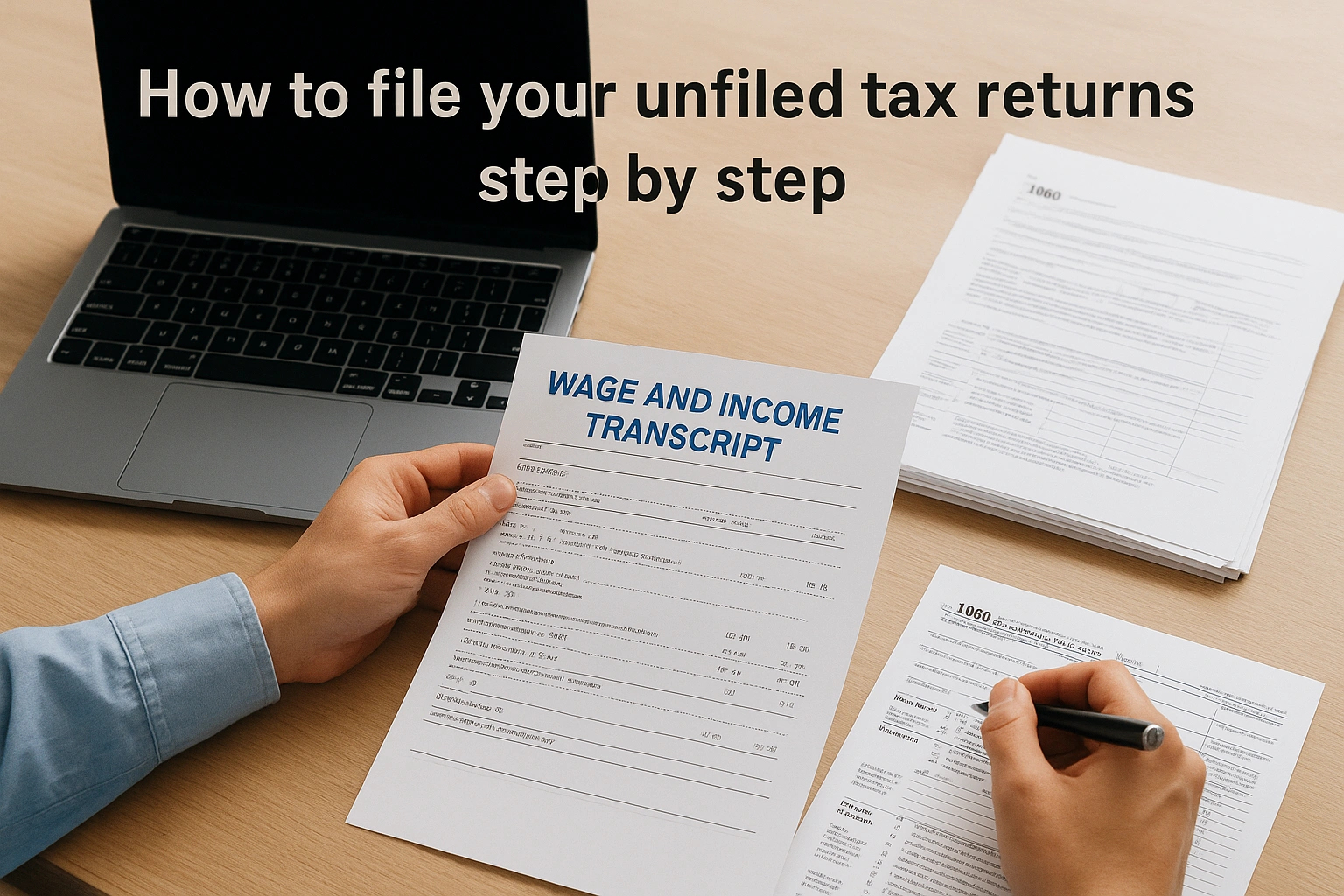
Start by requesting a wage and income transcript from the IRS for each missing year. What a wage and income transcript shows is every W-2, 1099, and other information return filed under your Social Security number, which means you're working from the same numbers the IRS already has instead of guessing. You can order transcripts directly through the IRS Get Transcript tool or by mailing Form 4506-T if you need older years not available online.
Reconstruct deductions and credits
Gather bank statements, mileage logs, receipts, and any business records for the same years, since transcripts only show income, not what you're entitled to deduct. This step matters most for self-employed filers and small business owners, where Schedule C deductions can swing your balance from owing thousands to breaking even.
File in the right order and format
Work through this checklist year by year, oldest first:
- Confirm the correct tax forms and rates for that specific year, since they change annually (where to find prior-year 1040s and schedules)
- Prepare each return using that year's software or a preparer familiar with prior-year rules
- Mail paper returns for older years, since e-filing typically isn't available past the last two tax seasons
- Attach any required schedules, like Schedule C or Schedule SE for self-employment income
- Keep copies and mailing confirmation for every year submitted
Filing oldest to newest keeps your account history clean and avoids processing delays on the current year.
Getting the sequencing wrong is a common reason people stall out here, which is exactly where a back tax filing service earns its fee by catching errors before the IRS does.
What happens after you catch up on your filings
Filing the returns is only half the job. Once the IRS processes each year, you'll typically get a notice confirming the balance due, including all the penalties and interest that built up while the return sat unfiled. Don't panic at the total. Filing back tax preparation correctly, with every deduction and credit you're entitled to, often shrinks that number significantly compared to whatever an IRS-prepared substitute return would have assessed.
You have real options if you owe
Examine the choices available before you assume you have to pay everything at once. The IRS offers several paths for taxpayers who can't clear a balance immediately, many of them grouped under the IRS Fresh Start Program options:
- Installment agreements that spread payments over months or years
- Currently Not Collectible status if you can prove financial hardship
- An Offer in Compromise, settling for less than the full balance in qualifying cases
- Penalty abatement, which can remove failure-to-file or failure-to-pay charges if you have reasonable cause or a clean prior filing history (how to qualify for first-time penalty relief)
Owing money isn't the end of the story. It's the starting point for negotiating a payment plan that actually fits your budget.
Refunds and holds get released
Notice how quickly things move once you're compliant. Any refunds the IRS was holding from prior years typically get released once the missing returns clear processing, assuming you're within the three-year claim window. If a lien or levy was already in place, becoming current is usually the first requirement before the IRS will consider releasing it or approving a formal agreement.
Your financial life opens back up
Think about the doors that reopen once your filing history is clean. Mortgage lenders, business loan officers, and even the State Department for passport renewals all check IRS compliance status, so unfiled income tax returns that get resolved stop blocking approvals that were stuck for years. Catching up doesn't just settle old debt. It restores your standing for everything that depends on it going forward.
Getting back in good standing with the IRS
Getting current on tax returns unfiled for one year or ten comes down to the same playbook: pull your records, work backward through the last six years, and file oldest first. The penalties look intimidating on paper, but they shrink fast once accurate returns replace whatever inflated number an IRS substitute return would have produced. Waiting only adds interest and narrows your options, while acting now keeps installment agreements, penalty relief, and refunds on the table.
You don't have to untangle years of missing paperwork alone, and honestly, you shouldn't try to guess at prior-year rules while a wage garnishment clock is ticking. A preparer who handles back tax preparation every week knows exactly which deductions survive an IRS review and how to sequence your filings correctly. If you're ready to stop guessing and get every missing year filed right, file your unfiled returns with a licensed tax professional and put this behind you for good.