


Rental Property Tax Accountant: What They Do & When To Hire
Owning rental property creates income, and a tax situation that gets complicated fast. Between depreciation schedules, passive activity loss rules, and tracking every deductible expense across one or more properties, filing rental income taxes correctly takes more than a basic understanding of tax law. That's exactly why many landlords and real estate investors turn to a rental property tax accountant for help.
A rental property tax accountant is a tax professional who specializes in the rules and strategies specific to real estate income. They know how to maximize your deductions, handle multi-property portfolios, and keep you compliant with IRS requirements, so you're not leaving money on the table or triggering an audit. But not every property owner needs one right away, and knowing when to hire one can save you both time and money.
In this article, we break down what a rental property tax accountant actually does, the situations that call for one, and how to choose the right professional. At TaxesToday, our licensed and certified tax preparers work with landlords, small business owners, and self-employed individuals across California and nationwide, helping them file accurately and claim every deduction they're entitled to. Whether you're managing your first rental unit or juggling several, this guide will help you decide your next step.
What a rental property tax accountant does
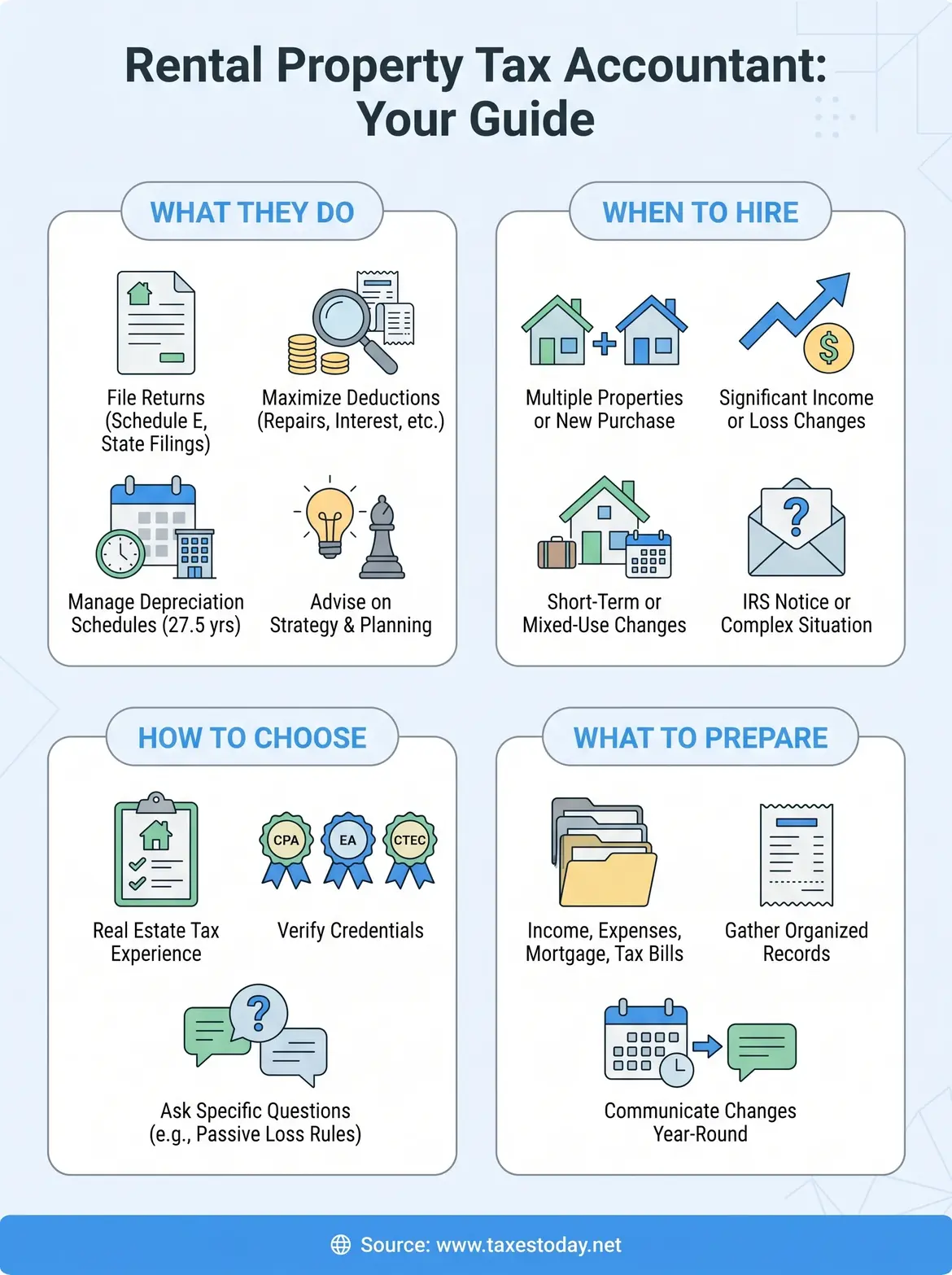
A rental property tax accountant handles far more than entering numbers into a form. They analyze your entire rental operation, from the income you collect each month to the expenses you paid throughout the year, and make sure everything gets reported correctly to the IRS. Their job is to reduce your tax liability legally and keep your filings clean.
Preparing and filing your rental income returns
When you own rental property, you report income and expenses on Schedule E of your federal return. A tax accountant takes care of filling out that schedule accurately, accounting for every source of income and every legitimate expense. They also handle any state-level filings that apply to your situation, which matters especially if you own property in California, where state tax rules add another layer of complexity.
Your accountant also makes sure your filing status and any related schedules align properly, so there are no gaps or conflicts in your return that could flag an issue with the IRS.
Identifying and maximizing your deductions
One of the most valuable things a tax pro does is find deductions you might miss on your own. Common rental property deductions include mortgage interest, property taxes, insurance, repairs, property management fees, advertising costs, and professional services like legal or accounting fees. Many landlords overlook deductions or misclassify expenses, which either increases their tax bill or creates errors.
Missing even one category of deductions across multiple properties can cost you hundreds or thousands of dollars in a single tax year.
Reviewing your full expense history carefully and asking the right questions ensures nothing gets left out before your return is filed.
Managing depreciation schedules
Depreciation is one of the most powerful tax tools available to rental property owners, and also one of the most misunderstood. The IRS allows you to deduct the cost of your residential rental property over 27.5 years, which can significantly reduce your taxable income each year. Your accountant sets up and maintains the correct depreciation schedule from day one and tracks any improvements you make that need to be added separately.
They also handle depreciation recapture calculations if you sell a property, which is an area where errors are both common and costly.
Advising on tax strategy and planning
Beyond filing your return, a good tax accountant helps you think ahead. They advise on the timing of repairs versus capital improvements, how to structure your rental activity, and whether your situation qualifies for special rules like real estate professional status under IRS guidelines. This kind of planning shapes decisions you make during the year, not just at tax time.
Working proactively with a tax professional means you walk into each filing season with fewer surprises and a stronger financial position.
Why rental property taxes get complicated
Rental property taxes aren't complicated because the paperwork is long. They're complicated because multiple sets of rules overlap, and a mistake in one area can affect several others. The IRS treats rental income differently depending on how active you are in managing your properties, what type of property you own, and how your expenses are categorized. That layered structure is exactly why many property owners bring in a rental property tax accountant before problems develop.
Passive activity loss rules restrict your deductions
The IRS classifies most rental activity as passive income, which means you can only use rental losses to offset other passive income, not your regular wages or salary. There are exceptions, such as the $25,000 allowance for active participants with a modified adjusted gross income under $100,000, but that allowance phases out as your income rises. If you misapply these rules, you may either claim deductions you're not entitled to or miss ones you are, both of which create problems with your return.
Getting passive activity loss rules wrong is one of the most common and costly errors rental property owners make when filing on their own.
Repairs versus improvements change how you deduct costs
Repairs are deductible in the year you pay for them, but improvements must be capitalized and depreciated over time. The line between the two isn't always obvious. Replacing a broken window is a repair. Replacing all the windows to upgrade the property is an improvement. If you categorize these incorrectly, your deductions are wrong and your depreciation schedule is off, which creates issues in future years and especially when you sell.
Short-term rentals follow different rules
If you rent a property for fewer than 15 days per year, the income isn't taxable. But if you use it as a vacation rental and also personally stay there, the IRS applies mixed-use rules that split your expenses proportionally. Tracking personal versus rental days accurately is essential, and the calculation is more detailed than most people expect.
When you should hire one
Not every landlord needs to hire a rental property tax accountant from day one, but most benefit from professional help sooner than they expect. The situations below are clear signals that doing it yourself is likely to cost you more than the accountant's fee.
You own more than one property or added one recently
Managing a single straightforward rental might be workable on your own if you have no other income complications. But the moment you add a second property, your depreciation schedules, expense tracking, and passive loss calculations multiply in complexity. A tax professional makes sure every property is handled correctly and that nothing carries over incorrectly from one year to the next.
If you purchased a property this year, a tax accountant also ensures you set up your cost basis and depreciation correctly from the start, which saves you from fixing errors years down the road when the stakes are higher.
Starting depreciation schedules incorrectly can trigger costly corrections when you eventually sell the property.
Your income, losses, or rental use situation has changed
If your adjusted gross income increased significantly, your ability to deduct passive rental losses may be limited or eliminated. Similarly, if you started renting out a property you previously used personally, or if you switched from long-term to short-term rental use, the tax treatment changes in ways that require careful attention. These transitions are exactly where self-prepared returns tend to go wrong.
Consider hiring a professional if you received an IRS notice related to your rental activity, are planning to sell a property, or want to understand whether you qualify for real estate professional status under IRS rules. Each of these situations involves enough complexity that professional guidance pays for itself.
How to choose the right tax pro
Not every tax preparer has experience with rental properties. Finding the right rental property tax accountant means looking beyond a general "tax professional" label and checking whether they actually know real estate-specific tax rules like depreciation, passive activity losses, and Schedule E filing.
Look for real estate tax experience
Start by asking directly how many rental property clients the professional currently works with. A preparer who handles rental property returns regularly will be familiar with the nuances that trip up generalists, like cost segregation, mixed-use property rules, and depreciation recapture. If they struggle to answer questions about Schedule E or passive activity loss limitations, they are not the right fit for your situation.
The right tax professional won't hesitate when you ask about rental-specific topics because they work with them regularly.
Beyond their client base, ask whether they stay current with IRS rule changes that affect rental property owners. Tax law shifts every year, and a preparer who follows those updates will spot new deductions or limitations that someone less engaged would miss entirely.
Verify credentials and ask the right questions
In the United States, only enrolled agents, CPAs, and CTEC-certified preparers (in California) are required to meet continuing education requirements. An IRS-registered and CTEC-certified preparer, like those at TaxesToday, brings both the credentials and the hands-on experience your rental situation needs.

Before you commit, ask these questions:
- Do you handle multi-property portfolios?
- How do you set up depreciation schedules for new purchases?
- How do passive activity loss rules apply at my income level?
- Have you worked with short-term rental or mixed-use property situations?
Clear, confident answers to these questions signal that the preparer understands what your return actually involves. If the answers are vague or they avoid specifics, keep looking. Your tax situation is too detailed to hand off to someone without the right background.
What to prepare and how to work together
Working with a rental property tax accountant goes more smoothly when you come prepared. The more organized your records are before your first meeting, the faster the process moves and the fewer back-and-forth requests you'll deal with during an already busy filing season.
Gather your documents before your first meeting
Your tax preparer needs a clear picture of every transaction connected to your rental activity. Pulling your records together in advance reduces delays and helps your accountant catch every deduction without having to chase down missing details later.
Bring the following when you meet:
- Rental income records: monthly rent collected, security deposits applied, and any late fees
- Expense receipts: repairs, maintenance, insurance premiums, and property management fees
- Mortgage statements: showing interest paid and any escrow activity
- Property tax bills for each rental property you own
- Depreciation records from prior years, or closing documents if you purchased recently
- 1099 forms from property management companies if applicable
Organized records shorten your preparer's work time and lower the risk of missing deductions that could reduce your tax bill.
Communicate changes throughout the year
Don't wait until tax season to tell your accountant about major updates. If you purchased or sold a property, switched from long-term to short-term rental use, made significant improvements, or experienced extended vacancy periods, those details all affect your return and your future depreciation schedules.
Treating your tax preparer like an ongoing resource rather than a once-a-year contact makes a real difference in your results. Sharing updates throughout the year allows your accountant to advise you on the tax impact of decisions before you make them, not after. A quick message when something changes is far easier than untangling the consequences at filing time when you're already under deadline pressure.
A simple next step
Rental property taxes reward landlords who get the details right, and they punish those who guess. If you've been handling your own returns and something in this article made you pause, that instinct is worth following. Working with a rental property tax accountant gives you accurate filings, a cleaner depreciation record, and deductions you can actually defend if the IRS ever asks.
You don't need to sort this out on your own. TaxesToday works with landlords, self-employed individuals, and small business owners across California and nationwide. Our CTEC-certified and IRS-registered preparers handle Schedule E returns, multi-property portfolios, and complex situations like short-term rentals and amended filings. Services start at $99, and you can work with us virtually or in person. If you're ready to file accurately and stop leaving deductions behind, get your rental property taxes prepared by a licensed professional and see the difference firsthand.