


Tax Accountant Near Me: How To Find A Trusted Pro In 2026
Searching for a tax accountant near me pulls up dozens of results, ads, directories, franchise chains, solo practitioners, and most of them tell you nothing about whether the person behind the listing actually knows what they're doing. Picking the wrong preparer doesn't just waste money. It can mean missed deductions, IRS notices, or worse.
The truth is, finding a qualified tax professional takes more than a quick Google search. You need to know what credentials to look for, what questions to ask, and how to tell a skilled accountant from someone who just bought software and hung a shingle. Whether you're filing as an individual, running a small business, or dealing with self-employment income, the stakes are too high to guess.
At TaxesToday, we've spent over 15 years preparing returns for individuals, families, freelancers, and small businesses, so we know exactly what separates a reliable tax pro from a risky one. In this guide, we'll walk you through how to find, vet, and hire a trusted tax accountant in 2026, step by step. We'll cover credentials, red flags, cost expectations, and the specific things most people overlook until it's too late.
What you need before you start searching
Before you type "tax accountant near me" into a search bar, take 20 minutes to get organized. Walking into the search process without a clear picture of your tax situation is how people end up hiring the wrong professional, overpaying, or realizing mid-appointment they're missing key documents. A little preparation upfront saves a lot of frustration later.
Know your filing situation
Your filing situation determines which type of tax professional you actually need. A W-2 employee with one job and no investments has very different needs than a freelancer with multiple 1099s, home office expenses, and quarterly estimated tax payments. Before you search, get honest with yourself about what's on your return.
Here are the most common situations and what they signal about complexity:
| Situation | Complexity Level | What to look for |
|---|---|---|
| Single W-2, no investments | Low | Any licensed preparer or EA |
| Married filing jointly, kids, mortgage | Medium | EA or CPA with family filing experience |
| Self-employed / 1099 income | Medium-High | Preparer experienced with Schedule C |
| Small business (LLC, S-Corp) | High | CPA or EA with business tax experience |
| Non-resident or foreign income | High | Specialist in international tax / 1040NR |
| Back taxes or amended returns | High | EA or tax resolution specialist |
Knowing where you fall on this list narrows your search significantly before you reach out to a single person.
Pull your documents together
A good tax professional will ask for your documents upfront. If you don't know what you have, you can't accurately describe your situation during a consultation, and some preparers charge by the hour or by form count.
Showing up to your first conversation with a clear document list signals that you're an organized client, and it often leads to a faster, cheaper appointment.
At minimum, gather the following before you start reaching out:
- Income documents: W-2s, 1099-NEC, 1099-MISC, 1099-K, SSA-1099
- Deduction records: mortgage interest statements (Form 1098), charitable donation receipts, medical expense records
- Business records (if applicable): profit and loss summary, mileage logs, home office measurements
- Prior year return: your most recent federal and state tax return
- ID information: Social Security numbers or ITINs for yourself and any dependents
Set a realistic cost expectation
Tax preparation fees vary widely based on your location, filing complexity, and the type of professional you hire. A basic individual return might cost $150-$300, while a self-employed return with a Schedule C often runs $300-$600 or more. Business returns can go higher.
Setting a budget range before you search keeps you from being swayed by unusually low prices, which are often a red flag, or dismissing qualified professionals who charge fair market rates. You're paying for accuracy and expertise, not just paperwork.
Step 1. Decide what kind of tax help you need
Not every tax situation calls for the same type of professional. Before you search for a tax accountant near me, you need to understand what the different credentials actually mean and which one fits your specific situation. Choosing the wrong type of preparer is one of the most common mistakes people make early in the process.
Understand the main credential types
Tax professionals fall into several categories, and their qualifications vary significantly. Knowing the difference helps you filter your search from the start rather than wasting time on consultations with the wrong person.
| Credential | Who grants it | Best for |
|---|---|---|
| CPA (Certified Public Accountant) | State board of accountancy | Complex returns, business financials, audits |
| EA (Enrolled Agent) | IRS | All tax types, IRS representation, back taxes |
| CTEC (CA Tax Education Council) | California state | California residents with standard to mid-complexity returns |
| Non-credentialed preparer | N/A | Simple W-2 returns only, with close oversight |
If your return involves business income, foreign assets, or prior-year issues, stick to a CPA or EA. The stakes are too high for an uncredentialed preparer.
Match your needs to the right fit
Self-employed individuals and small business owners need someone with hands-on experience filing Schedule C, handling estimated tax payments, and understanding deductible business expenses. A general preparer who mostly handles W-2 returns may miss deductions that a specialist would catch automatically.
Similarly, non-residents, foreign students, and anyone with international income need a preparer who understands Form 1040NR and the relevant tax treaties. This is a narrow specialty, and not every EA or CPA handles it. When you reach out to candidates, ask directly whether they have experience with your specific situation. A confident, specific answer tells you a lot more than a generic "yes we handle all returns."
Step 2. Build a shortlist using trusted sources
Once you know what kind of help you need, it's time to find real candidates. When you search for a tax accountant near me, the results you get aren't ranked by quality. They're ranked by advertising spend and SEO. That means you need to look beyond the first page and use sources that actually screen for credentials.
Where to look first
Start with official directories before you go anywhere else. These sources verify credentials directly, which means you skip a layer of guesswork.
- IRS Directory of Federal Tax Return Preparers: Search by zip code and filter by credential type (EA, CPA, CTEC). Find it at irs.gov/tax-professionals.
- NAEA Member Search: The National Association of Enrolled Agents lists verified EAs by location.
- Your state's CPA society: In California, the California Society of CPAs maintains a public member directory.
- Personal referrals: Ask a trusted friend, colleague, or small business owner who handles a similar financial situation. A direct referral from someone with your filing complexity is often the most reliable lead you'll find.
A name that appears in an official directory and comes with a personal referral is worth prioritizing over any paid ad or sponsored listing.
How to narrow your list down
After you have five to eight names, cut the list to three before you spend time on calls. Look at each candidate's website or listing and check for three things: clear credential information, a stated specialty that matches your situation, and contact details that make it easy to reach a real person. If a preparer's website lists no credentials, no specialties, and no bio, move on. You're looking for someone who presents themselves professionally before you've even spoken, because that signals how they'll handle your return.
Step 3. Verify credentials and watch for red flags
Having a shortlist is a solid start, but a name in a directory does not confirm competence or honesty. Before you book an appointment with any tax accountant near me result, take 10 minutes to verify credentials independently. This step alone removes most of the risky options from your list.
How to confirm a preparer is legitimate
Every paid tax preparer in the United States is required to have a Preparer Tax Identification Number (PTIN), issued by the IRS. You can verify this through the IRS Return Preparer Office, which also shows credential type and disciplinary history. For CPAs, check your state board of accountancy's public license lookup tool. In California, the California Board of Accountancy provides a free online license search. For Enrolled Agents, the IRS Office of Enrollment holds the official record.
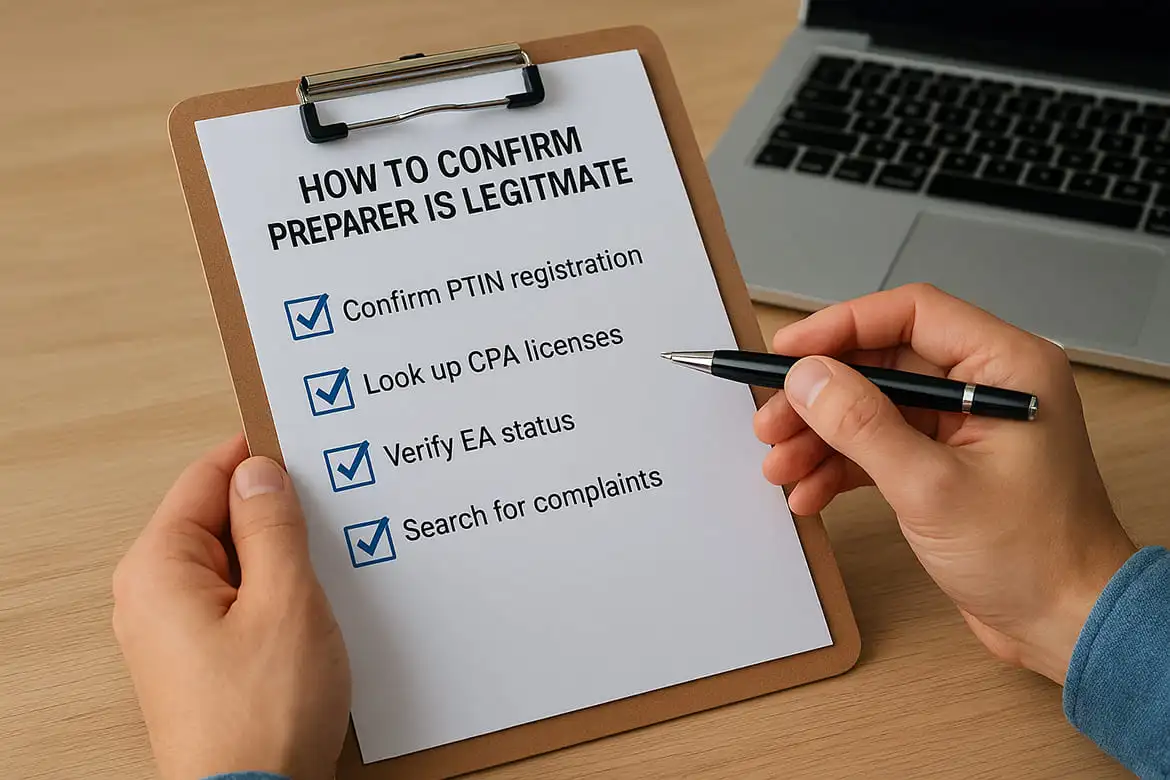
Use this checklist before you commit to anyone:
- Confirm PTIN registration at irs.gov
- Look up CPA licenses through your state board of accountancy
- Verify EA status through the IRS Office of Enrollment
- Search for complaints through the Better Business Bureau at bbb.org
If a preparer cannot give you their PTIN immediately when asked, walk away.
Red flags that should stop you cold
Certain behaviors signal a preparer you should avoid, regardless of how polished their website looks. Watch for anyone who promises a large refund before reviewing your documents, charges fees as a percentage of your refund, or refuses to sign your return. A legitimate professional always signs as the paid preparer and includes their PTIN on every filed return.
Also avoid preparers who encourage inflating deductions, omitting income, or claiming a filing status that does not match your situation. You remain legally responsible for what appears on your return, even when someone else prepared it. A trustworthy preparer protects your compliance, not their own bottom line.
Step 4. Interview and compare fees the right way
Once you have a verified shortlist of two or three candidates, schedule brief consultations before you commit. Most tax preparers offer a free 15-to-30-minute introductory call, and this conversation tells you more than any online profile. Use it deliberately. You are not just explaining your situation; you are evaluating whether this person is the right fit for your specific return.
Questions to ask on the first call
A structured conversation gives you consistent data across all your candidates, which makes comparing them much easier afterward. Ask each preparer the same questions so you are not trying to reconcile mismatched answers when you review your notes later.
Use this question list on every call:
- How many returns like mine do you prepare each year? (Confirms relevant volume and experience)
- Who actually prepares my return? (At larger firms, it may be a junior staff member)
- What documents do you need, and in what format do you accept them?
- What is your typical turnaround time during tax season?
- Will you be available if I receive an IRS notice after filing?
- Do you offer representation if my return is audited?
The last two questions matter more than most people realize. A preparer who disappears after filing is not the same as one who stands behind their work throughout the year.
How to compare fee quotes fairly
When you search for a tax accountant near me and gather quotes, do not compare raw numbers without context. A $200 quote for a self-employed return may exclude the Schedule C entirely, while a $450 quote may cover everything. Ask each preparer for an itemized breakdown of exactly what their fee includes.
Get every fee quote in writing before you agree to anything, even if it is just a simple email confirmation.
Use this comparison template when you collect your quotes:
| Preparer | Base fee | Schedule C included? | State return included? | Audit support? |
|---|---|---|---|---|
| Candidate A | $__ | Yes / No | Yes / No | Yes / No |
| Candidate B | $__ | Yes / No | Yes / No | Yes / No |
| Candidate C | $__ | Yes / No | Yes / No | Yes / No |
Filling in this table removes the ambiguity that leads to surprise charges and turns an emotional decision into a straightforward comparison.
Next steps
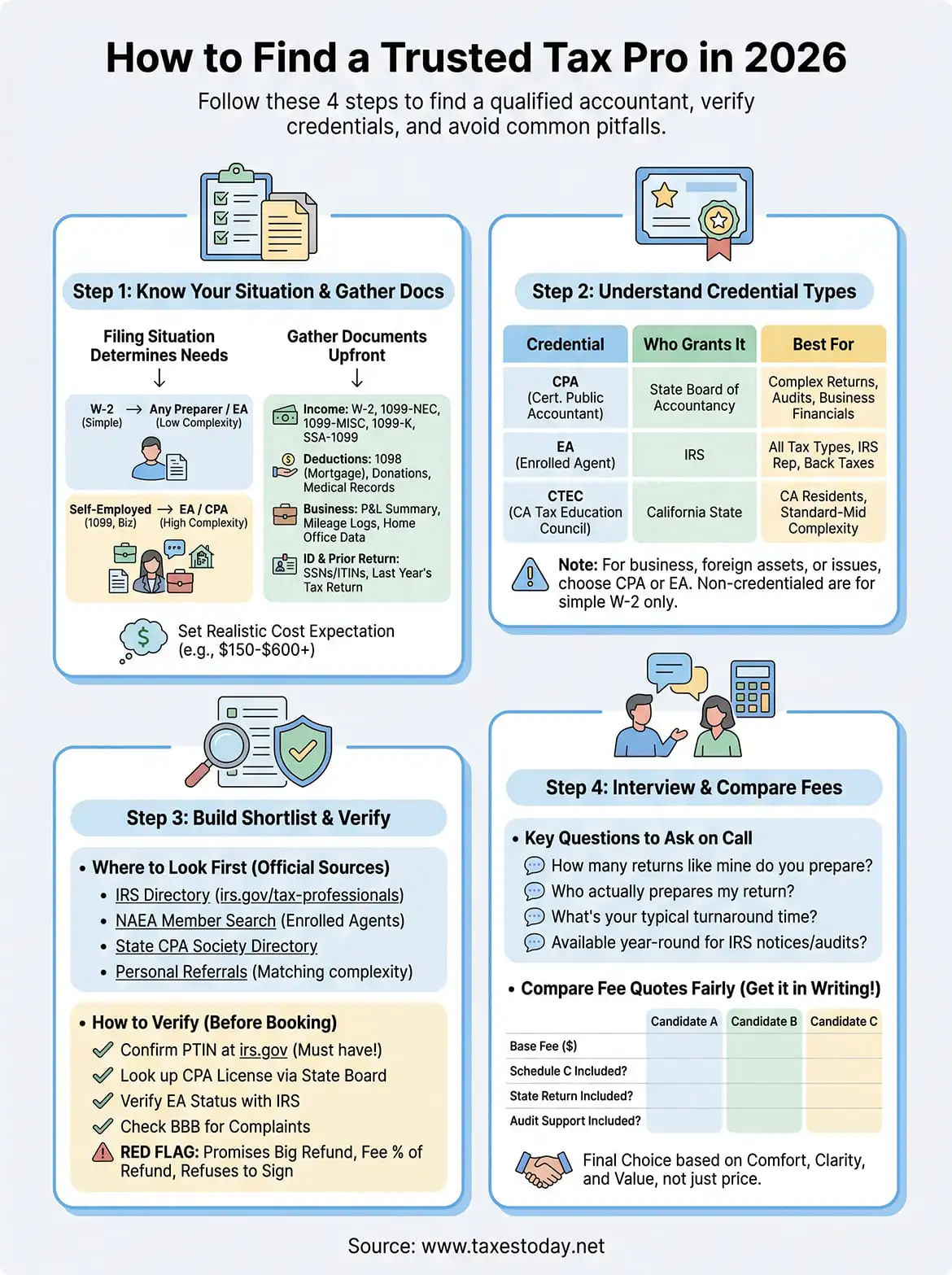
You now have a complete process for finding a qualified tax professional in 2026. Start with your filing situation, gather your documents, and use official directories to build your shortlist. From there, verify credentials independently, run every candidate through the same interview questions, and compare fee quotes with a clear breakdown before you commit. Following these steps turns a stressful tax accountant near me search into a straightforward hiring decision.
Most people skip at least one of these steps and pay for it later, whether through surprise charges, missed deductions, or an IRS notice that a more careful preparer would have avoided. You do not have to figure this out alone. If you want experienced, licensed tax professionals who handle everything from W-2 returns to self-employed filings and non-resident tax situations, get your taxes prepared by TaxesToday and file with confidence this season.