


Multi State Tax Returns: When to File and How to Avoid Double Tax
Moved to a new state last year? Worked remotely for a California company while living in Texas? Freelanced for clients in three different states? If any of that sounds familiar, you probably need to deal with multi state tax returns, and getting it wrong can mean paying tax twice on the same dollar of income or missing a filing requirement entirely. That's not a small mistake. It's the kind of thing that triggers IRS and state notices months down the road.
Here's the short answer: you generally file a resident return in your home state and a nonresident or part-year return in any state where you earned income, whether from a job, rental property, or freelance work. Most states then offer a credit for taxes paid to another state, which is what actually prevents you from being taxed twice on the same earnings.
In this article, we'll walk through exactly when multi state filing applies, which states have reciprocity agreements that simplify things, how the tax credit process works in practice, and the common mistakes that cost people money or invite IRS scrutiny.
Why you might need to file taxes in multiple states
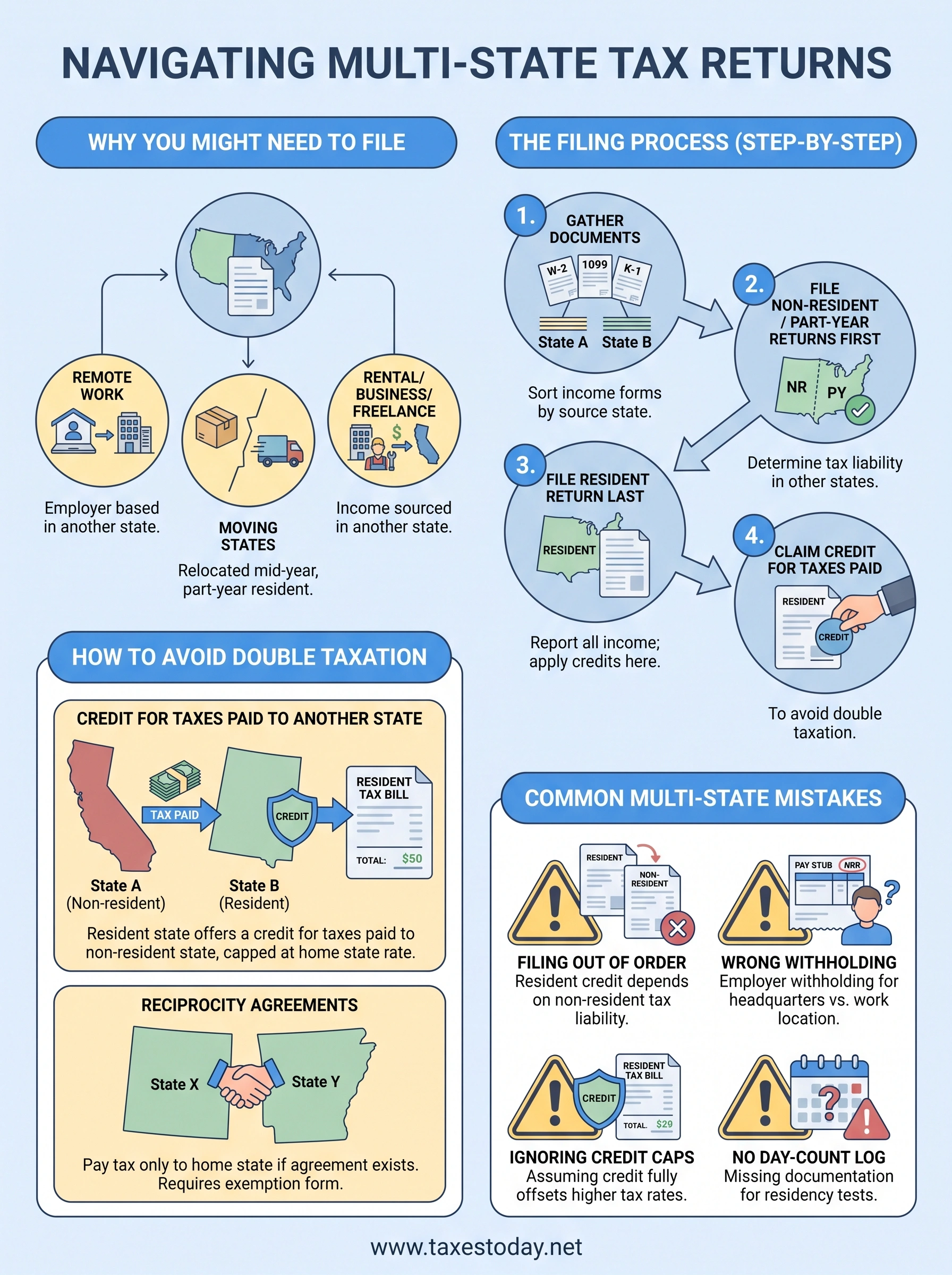
Multi state tax obligations show up in more situations than most people expect. You don't have to own property in two states or run a business across state lines to trigger a filing requirement. Something as simple as a job change, a remote work arrangement, or a rental property you inherited can put you in the position of owing returns to more than one state department of revenue. Understanding which scenario applies to you is the first step toward filing correctly and avoiding double taxation on income you only earned once.

Remote work for an out-of-state employer
Remote work has made this the most common trigger by far. If you live in one state but your employer is based in another, the state where you physically do the work usually has the right to tax that income, not just the state where the company is headquartered. So if you live in Arizona and work remotely for a company in California, you may owe nonresident state taxes to California on wages earned while performing work there, plus a resident return in Arizona reporting all your income, and the same tax rules for working remotely from a different state apply to visa holders too. A handful of states use a "convenience of the employer" rule that complicates this further: New York, for example, taxes remote workers as if they worked in-state unless the remote arrangement is for the employer's necessity, not the employee's convenience.
If you live in one state and work for a company based in another, don't assume only one state gets a piece of your paycheck.
Moving to a different state during the year
Anyone who relocated mid-year almost always needs to file part-year resident returns in both the old and new state. Each state taxes the income you earned while you were a resident there, which means splitting your W-2 wages, interest, dividends, and any other income by the date you established residency in the new location. This gets messier when your final paycheck from the old job arrives after you've already moved, or when you're still receiving income like unemployment benefits sourced to the state you left. Keep a clear record of your move date and any paystubs that straddle the transition, because that date is the dividing line the state uses to allocate your income.
Owning rental property or a business in another state
Rental income, royalties, and business profits are sourced to the state where the property or business activity is located, regardless of where you personally live. If you live in Nevada but rent out a condo in Colorado, Colorado will want a nonresident return reporting that rental income even though you never set foot there during the tax year, which is one reason out-of-state landlords often bring in an accountant who specializes in rental property returns. The same logic applies to a small business with a physical location, employees, or significant sales in a state other than your home state. Freelancers and independent contractors run into this too: if you do work on-site for a client in another state, or your LLC has a registered presence there, you may owe that state a return even though your business is headquartered elsewhere.
Working across state lines for part of the year
Some people don't move at all but still end up owing multiple states because they physically worked in more than one location. Traveling nurses, construction workers on out-of-state projects, athletes, and consultants who spend weeks at a client site in another state are classic examples. Several states track this closely and expect a nonresident return once you cross a certain number of days worked or income earned within their borders. The threshold varies by state, so it's worth checking the specific rule rather than assuming a short assignment is automatically exempt.
| Situation | State returns typically needed |
|---|---|
| Remote employee, employer in another state | Resident return (home state) + possible nonresident return (employer state, depending on rules) |
| Moved states mid-year | Part-year resident returns in both states |
| Rental property in another state | Resident return + nonresident return (property state) |
| Freelance/contract work performed on-site elsewhere | Resident return + nonresident return (work-location state) |
| Business with nexus in another state | Resident return + nonresident/business return (nexus state) |
Reciprocity agreements that simplify the picture
A smaller group of taxpayers gets a break here. Several neighboring states have signed reciprocity agreements, which let residents who work across the border pay income tax only to their home state instead of filing in both. Pennsylvania and New Jersey, Illinois and Wisconsin, and Virginia and Maryland are examples of reciprocal pairs. If your home state and work state have this kind of agreement, you generally just submit an exemption form to your employer so they withhold correctly, then file a single resident return. It's worth checking your state's official tax agency website, since reciprocity rules and the states involved can change.
Each of these situations shares one theme: the state where income is physically earned or sourced usually gets the first claim on taxing it, and your home state taxes it too unless a credit or reciprocity agreement steps in. Sorting out which category, or categories, apply to your year is what determines how many returns land on your desk come filing season.
How to determine where you owe state taxes
Before you can file anything, you need to figure out which states actually have a claim on your income. This isn't always obvious, since states use different tests for residency and different rules for what counts as taxable income within their borders, so it helps to review how state income tax filing works before you start. Getting this step right saves you from either overpaying or missing a required filing.
Start with your domicile
Your domicile is the state you consider your permanent home, the place you intend to return to even if you're temporarily living elsewhere. It's determined by facts like where you're registered to vote, where your driver's license is issued, where you own or rent your primary residence, and where your kids go to school. Most states will treat you as a full-year resident of your domicile state no matter how much time you spend elsewhere, unless you've formally established a new domicile. Changing your domicile takes more than renting an apartment in a new state; you generally need to sever ties with the old one, too.
Check for statutory residency rules
Even if your domicile is clearly elsewhere, some states will still tax you as a resident if you meet a statutory residency test. New York is the classic example: if you maintain a place to live there and spend more than 183 days in the state during the year, you can be taxed as a statutory resident even though your legal domicile is somewhere else. This creates the uncomfortable possibility of being taxed as a full resident by two different states at once, which is exactly the scenario a credit for taxes paid to another state is designed to fix. Keep a simple day-count log if you split significant time between two states; it's the single best piece of evidence if a state ever questions your residency status.
Two states can both call you a resident in the same year, so don't assume domicile alone settles the question.
Source your income correctly
Once you know your residency status, look at where each dollar of income was actually earned or sourced. Wages are generally sourced to the state where the work was physically performed, not where your employer is headquartered or where your paycheck was deposited. Rental income and business profits are sourced to the location of the property or the business activity. Investment income like interest and dividends is usually taxed only by your resident state, with some exceptions for state-specific municipal bonds. Freelancers should track this by client and by location, since a single 1099 can sometimes need to be split across two states if the work itself happened in more than one place.
Apply state-specific filing thresholds
Even after you've sourced your income, you still need to check whether the amount involved actually triggers a filing obligation. States set their own minimum income thresholds for nonresidents, and these vary widely:
- Some states require a nonresident return if you earned even a few hundred dollars there.
- Others set the threshold in the low thousands, tied to the state's standard deduction amount.
- A handful of states, like Florida, Texas, and Nevada, have no state income tax at all, so no filing is required regardless of income earned there.
- States with reciprocity agreements may not require a nonresident filing at all if the correct exemption form was submitted to your employer.
The IRS website offers general guidance on federal filing status, but your state filing requirement comes entirely from that state's own department of revenue, so it's worth confirming directly on their official site rather than assuming your home state's rules apply everywhere. Working through this exercise state by state, rather than guessing, is what determines exactly which returns you'll need to prepare next.
How to file a multi-state tax return step by step
Once you know which states have a claim on your income, the actual filing process follows a specific order. Skip the order and you'll end up calculating credits on numbers that haven't been finalized yet, which means amending returns later. Here's how to work through it without that headache.
Gather every document before you start
Before you open any tax software, work through a list of the documents and information you need to file and pull together every W-2, 1099, and K-1 you received, sorting them by the state where the income was earned rather than the state where the form was mailed from. A single employer can issue one W-2 with wages split across two state boxes if you moved or worked remotely part of the year, so check those boxes carefully. If you're self-employed, break out your income and expenses by client location too, since that's what lets you allocate a Schedule C properly across states later when you sit down to handle your 1099 income filing.
File nonresident and part-year returns first
Here's the sequencing that trips people up: you generally need to complete your nonresident or part-year return for the non-home state before you finish your resident return. That's because your resident state credit is based on the actual tax liability calculated on the other state's return, not an estimate. Working through them in this order looks like:
- Prepare the nonresident or part-year return for the state where you earned income but don't live (or lived only part of the year).
- Calculate the actual tax owed to that state after applying its deductions and credits.
- Note the final tax liability figure, since this is the number your resident state will use.
- Move to your resident state return and claim the credit for taxes paid to the other state.
- Attach a copy of the nonresident return to your resident filing if your state requires it.
Prepare the other state's return before your home state's return, because your home state credit depends on that finished number.
Most major tax software walks you through multi state tax returns in this order automatically once you tell it you lived or worked in more than one state, but it's worth double checking the sequence manually if you're filing taxes online with a program for the first time.
File your resident return last
Your resident return comes last because it's the one that pulls everything together. Report all your income here, including what you earned in other states, then apply the credit for taxes paid to those states on the appropriate line or schedule. Most states cap this credit at the amount you'd have owed your home state on that same income, so you generally won't get a bigger break than that. If you have part-year returns in two states instead of one full resident return, you'll do this allocation twice, once for each portion of the year.
Decide between software and a professional
Simple two-state situations, like a single mid-year move with no rental income or freelance work, are usually manageable with consumer tax software. Once you're juggling a rental property, self-employment income sourced to multiple clients, or a state with unusual rules like New York's convenience test, the math gets complicated fast and a small error compounds across two or three returns. That's the point where working with a preparer who handles multi-state filings regularly pays for itself, both in the deductions you don't miss and the notices you avoid. If your situation involves more than one state this year, TaxesToday's tax preparation services can sort out the filing order and credits for you rather than leaving it to trial and error.
How to avoid double taxation between states
Double taxation happens when two states both tax the same dollar of income with no mechanism to offset it. The good news is that nearly every state with an income tax builds in a fix for this, called the credit for taxes paid to another state. Understanding exactly how that credit works, and where its limits are, is what keeps you from either overpaying or assuming you're covered when you're not.
The resident credit is your main defense
Your home state generally taxes all your income no matter where you earned it, since residents are taxed on worldwide income by definition. To prevent that from stacking on top of what a nonresident state already collected, your resident state lets you claim a credit equal to the tax you paid elsewhere on that same income. So if you live in Georgia and paid $1,200 in nonresident tax to South Carolina on rental income, Georgia lets you subtract that $1,200 (up to a cap) from what you'd otherwise owe on the same rental income. This is the mechanism that does the actual work of preventing double taxation, not the filing order itself.
The credit for taxes paid to another state is the actual mechanism that prevents double taxation, not just filing two returns.
Where the credit falls short
The cap is where people get caught off guard. Most states limit the credit to whatever you would have owed your home state on that same income, which means if the other state's tax rate is higher, you eat the difference. California and New York both have relatively high rates, so a resident of a low-tax state working there can end up with a real, uncredited gap. This is exactly why New York's convenience of the employer rule causes so much frustration: a remote worker living in New Jersey but paid by a New York company can owe New York tax on the full salary, and while New Jersey grants a credit, it's capped at New Jersey's own rate, leaving a partial double-tax bill that no amount of paperwork fixes.
Reciprocity avoids the problem entirely
For the handful of state pairs with a reciprocity agreement, you sidestep the credit calculation altogether. Submitting the right exemption form to your employer means only one state withholds tax in the first place, so there's nothing to reconcile later. It's the cleanest outcome available, but it only applies to wage income between specific neighboring states, not to rental income, business profits, or freelance work.
Quick reference for prevention methods
| Scenario | How double taxation is prevented |
|---|---|
| Nonresident wages, no reciprocity | Resident state credit, capped at home-state tax rate |
| Reciprocity agreement states | Single state withholding, no credit needed |
| Convenience of employer rule (e.g., NY) | Credit allowed but may not fully offset a higher nonresident rate |
| Rental or business income sourced elsewhere | Credit on resident return for nonresident tax paid |
| Investment income (interest, dividends) | Taxed only by resident state in most cases |
Adjust withholding and estimates proactively
Don't wait until filing season to discover a gap. If you know you're working across state lines, adjust your withholding or pay quarterly estimated taxes online during the year so you're not stuck writing a large check to one state while waiting on a refund from another. Freelancers especially should set aside a percentage for each state where they have nonresident liability, since underpayment penalties apply state by state, separate from any federal shortfall. Getting the credit right on paper doesn't help your cash flow if you didn't plan for the timing mismatch between when you paid one state and when the other one wants its share.
Common multi-state tax situations explained
Some multi-state scenarios come up so often that it's worth walking through exactly how they play out, since the general rules can look different once you apply them to a specific life situation. Each of the examples below follows the same underlying framework covered above, resident return plus nonresident or part-year return, credit for taxes paid, but the details shift enough that people miss requirements or overpay without realizing it.
Military spouses working across state lines
Military families get a specific carve-out that most other taxpayers don't have access to. Under the Military Spouses Residency Relief Act, a spouse can often keep the same state of residency as the service member, even while living and working in a different state due to military orders. That means a spouse stationed with their partner in Virginia but domiciled in Texas can potentially avoid filing a Virginia resident return altogether, paying tax only to Texas (which, as a no-income-tax state, may mean no state tax at all). Missing this election is a common mistake among military families who assume they automatically owe tax wherever they're currently stationed; couples in this position should also review how to file when a spouse works in a different state.
A military spouse can often keep their home-state residency for tax purposes no matter where orders send the family.
College students earning income out of state
Students attending school in one state while claimed as a dependent in another run into a smaller-scale version of the same problem. A student from Ohio attending college in Massachusetts who takes a part-time campus job typically owes a nonresident return to Massachusetts on those wages, while Ohio, as the domicile state, still taxes all the student's income and grants a credit. Parents sometimes assume a student's part-time earnings are too small to matter, but even modest wages can trigger a nonresident filing requirement if they cross that state's threshold, so it's worth checking the actual dollar figure rather than guessing.
Digital nomads working from multiple states
Workers who move between states throughout the year, rather than settling into one new location, face a more fragmented version of the part-year resident scenario. Instead of two states, someone who works remotely from three or four different locations over twelve months may owe part-year or nonresident filings in each place they spent meaningful time or earned income, depending on each state's day-count and income thresholds. Tracking dates and income by location becomes essential here, since untangling it after the fact from bank statements and calendar apps is far harder than logging it as you go.
Retirees splitting time between two states
Retirees who spend part of the year in a warm-weather state and part in their longtime home state, often called snowbirds, face residency questions that hinge on intent and factual ties rather than income sourcing. Pension income, Social Security, and retirement account withdrawals are generally taxed only by the state of legal residence, not by every state where a retiree happens to spend time, which is different from the wage and business income rules covered earlier. The complication shows up when a retiree hasn't clearly established which state is the true domicile, since two states can each claim full residency status and tax all of that retirement income, leaving the retiree to fight for a credit or a residency determination after the fact.
| Situation | Key rule that applies |
|---|---|
| Military spouse on orders | MSRRA may allow keeping service member's home-state residency |
| Student working out of state | Nonresident return in school state if income exceeds threshold |
| Digital nomad, multiple states | Part-year or nonresident filings possible in each state with meaningful presence |
| Retiree splitting time (snowbird) | Domicile state generally taxes retirement income exclusively |
Each of these situations rewards the same habit: documenting dates, income sources, and residency ties as they happen, rather than reconstructing them under deadline pressure the following spring.
Mistakes that create multi-state tax problems
Most multi-state tax problems aren't caused by exotic situations. They come from a handful of predictable errors that repeat year after year, and nearly all of them are avoidable if you know to look for them. Reviewing these before you file multi state tax returns can save you an amended return, or worse, a notice from a state you didn't even realize was watching.
Assuming your employer's withholding is correct
Payroll departments often default to withholding for the state where the company is headquartered, not necessarily the state where you actually live or work. That mismatch means you could go a full year without any withholding sent to your resident state, or with the wrong state's tax withheld entirely, leaving you with a surprise bill in April. Check your pay stub the first month after any move or remote-work change, and don't assume HR caught the update automatically. Fixing a withholding form takes five minutes; unwinding a year of misdirected withholding takes considerably longer.
Don't assume your paycheck's withholding matches where you actually live and work; check it yourself after any move.
Filing the resident return before the nonresident return
As covered earlier, the credit on your resident return depends on the finished tax liability from your nonresident or part-year return. Filing out of order, or estimating the other state's tax instead of finishing that return first, means your credit calculation is built on a guess. When the actual number comes in different, you're stuck correcting a state tax return twice instead of once. This is one of the most common multi-state filing errors preparers see, and it's entirely a sequencing problem, not a math problem.
Ignoring day-count and residency documentation
States that use statutory residency tests, or that scrutinize domicile changes, expect you to have evidence, not just an assertion. Skipping a simple day-count log is a mistake that only shows up when a state audits your return, at which point reconstructing a year of travel from memory is nearly impossible. Keep a basic spreadsheet noting where you were on any day that matters, especially around a move date or a state border you crossed for work.
Missing state-specific credit limitations
Taxpayers frequently assume the credit for taxes paid to another state erases the entire tax bill from that state, when in reality most states cap the credit at their own tax rate on that income. Working in a higher-tax state while living in a lower-tax one, without planning for the gap, leaves people underpaying and then facing a balance due plus interest. Reviewing your state's specific credit form, rather than assuming it works like a full offset, catches this before it becomes a bill.
Overlooking small-dollar nonresident thresholds
A lot of people skip filing in a state because the income earned there seems too small to matter. But some states set nonresident filing thresholds in the low hundreds of dollars, and skipping the return doesn't erase the requirement, it just delays a notice. Freelancers with several small out-of-state clients are especially prone to this, since no single 1099 looks large enough to worry about on its own.
Common errors at a glance
- Wrong withholding state: employer withholds for headquarters state instead of your actual work or resident state.
- Filing order reversed: resident return completed before the nonresident return that determines the credit.
- No residency documentation: no day-count log or paper trail to support a domicile claim.
- Credit cap ignored: assuming the credit fully offsets tax paid to a higher-tax state.
- Small income skipped: assuming modest out-of-state earnings fall below a filing threshold without checking.
Each of these mistakes shares a common thread: they're procedural, not tied to complicated tax law, which means a careful review before you submit anything catches nearly all of them.
Staying compliant across state lines
Multi state tax returns come down to three habits: figuring out which states actually have a claim on your income, filing the nonresident or part-year returns before your resident return, and claiming the credit for taxes paid so you're not covering the same income twice. Skip any one of those steps and you either overpay or end up amending returns after a notice arrives. Most of the mistakes covered above aren't complicated tax law problems, they're sequencing and documentation problems, which means they're fixable with a little planning before filing season hits.
If you moved states, worked remotely for an out-of-state employer, or picked up freelance clients across state lines this year, don't try to untangle the credit calculations and filing order on your own the first time. Get your multi-state return prepared by a CTEC-certified, IRS-registered preparer starting at $99: we sort out which returns you actually owe and make sure the credit gets applied correctly so you're not paying any state twice.