


H1B Working Remotely From a Different State: Tax Rules Explained
If you're on an H1B working remotely from a different state than your employer's office, tax season probably feels more confusing than it should. You're already juggling visa compliance, and now you're wondering whether you owe taxes to your employer's state, your home state, or both. That confusion is normal, and it catches a lot of H1B holders off guard when they file.
Here's the short answer: your state tax obligations follow where you physically live and work, not where your employer is headquartered. If you moved from California to Texas but your paycheck still comes from a California company, you may still owe California tax on income earned while you lived there, plus tax in your new state going forward. Add nonresident alien filing rules into the mix, and the situation gets more complicated fast.
This article walks through how state residency, withholding, and reciprocity rules apply to H1B visa holders working remotely across state lines. You'll also see how these rules interact with your federal nonresident or resident alien status, so you can file correctly and avoid surprises from either the IRS or your state's tax agency.
Why your work state matters for H1B taxes
Most H1B holders assume their tax home follows their employer's address. It doesn't. State tax authorities care about where you actually sit at your desk, not where the company that signs your paycheck is based. This single fact trips up more remote workers on H1B status than almost anything else in the filing process, because it means your physical location can create a tax obligation your employer never accounted for in payroll.

Physical presence creates tax liability
States generally tax income earned by anyone who lives or works within their borders, regardless of visa type or citizenship status. If you're on H1B and working from an apartment in Colorado while your employer operates out of New York, Colorado has a claim on that income because that's where the work physically happened. New York may also have a claim if your employer never updated your work location in its systems, which is common when remote arrangements happen quickly.
Your physical location, not your employer's address, decides which state taxes your paycheck.
Not every state taxes income the same way
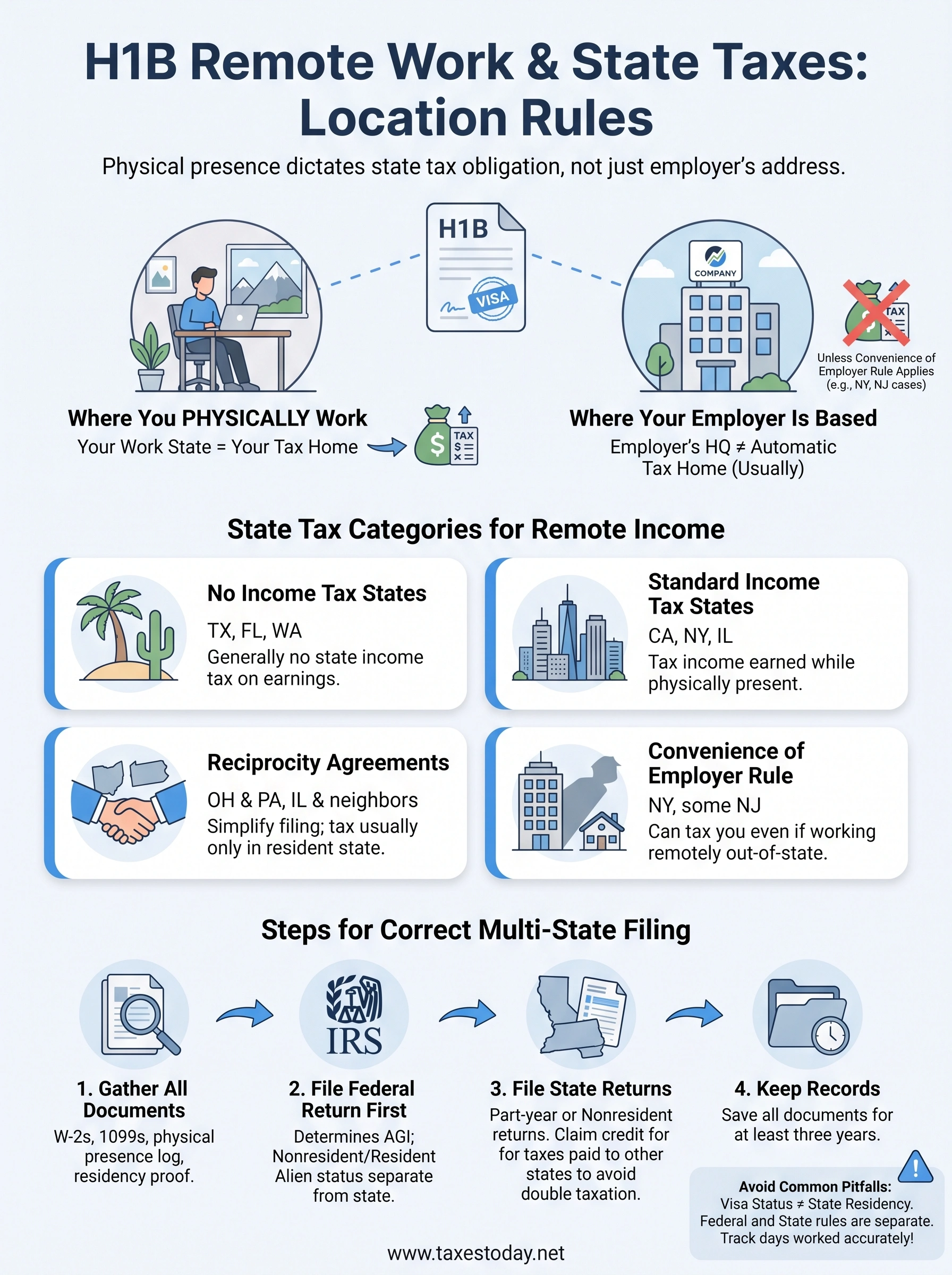
The rules shift dramatically depending on which states are involved. Some states have no income tax at all, others tax aggressively, and a handful have reciprocity agreements that simplify things for cross-border commuters. Here's how the major categories break down:
| State Type | Tax Treatment | Example States |
|---|---|---|
| No income tax | You owe nothing to that state | Texas, Florida, Washington |
| Standard income tax | Taxes income earned while physically present | California, New York, Illinois |
| Reciprocity agreements | Taxes only your resident state, not where you work | Ohio, Pennsylvania, Illinois (with neighbors) |
| Convenience of employer rule | Taxes you even if you never set foot there | New York, some New Jersey cases |
Understanding which category your work state and your employer's state fall into tells you almost everything about your filing burden before you even open a tax form.
Withholding rarely matches your real obligation
Payroll departments often keep withholding taxes for the state listed on your original job offer, even after you've relocated. That mismatch doesn't erase your tax bill in your new state, it just means you'll likely owe money there at filing time while possibly overpaying, or needing a refund, from the state your employer withheld for. This is one of the most common multi-state tax filing headaches for H1B professionals who relocated mid-year without updating HR paperwork. Fixing your W-4 state elections as soon as you move can prevent a chunk of this mess before it starts.
Visa status doesn't override state rules
Some H1B holders assume their visa category or nonresident alien status for federal purposes somehow shields them from state-level complexity. It doesn't. States don't ask about your immigration status when deciding tax residency, they ask where you lived and worked during the tax year. Your federal filing status under IRS rules (resident alien or nonresident alien) runs on a completely separate track from your state tax residency status, and you need to satisfy both correctly. Treating them as one and the same is how H1B filers end up with mismatched returns, missed state filings, or penalty notices months later.
How to determine which states you owe taxes to
Figuring out your actual tax obligation takes more than guessing based on your paycheck stub. You need to work through a short sequence of questions about where you lived, where you worked, and how each state defines residency. Skipping this step is how H1B holders end up filing in the wrong state entirely, or missing a state filing altogether.
Start with days physically present
Every state that levies income tax uses some version of a physical presence test to decide who owes them money. Count the actual days you spent living and working in each state during the tax year, not the days your employer assumed you were there. If you split time between two states, say six months in California and six months in Arizona, both states likely want a partial-year return covering the income earned while you were a resident.
The number of days you physically worked in a state, not your job title or visa type, determines your filing duty there.
Check your employer's state registration
Your employer's payroll state matters too, though in a different way. If your company hasn't registered to do business or withhold taxes in your new state, that's a payroll problem for them, but it doesn't remove your personal filing obligation in the state where you actually live. You may need to file a return there yourself and pay estimated taxes if withholding never caught up.
Confirm your state residency status
Each state defines residency slightly differently, but most use a combination of domicile (where you intend to permanently live) and a day-count threshold, often 183 days. Run through this checklist for every state involved:
- Where is your primary home, the one you'd list on a lease or mortgage?
- Where are your car registration, driver's license, and voter registration?
- How many days did you physically work from each state this year?
- Did you sever ties (bank accounts, memberships, mailing address) with your old state?
- Does the state use a "convenience of employer" rule that could tax you anyway?
Separate this from your federal nonresident alien status
Don't let your federal classification distract from the state-level analysis. Whether the IRS treats you as a resident or nonresident alien under the substantial presence test has no bearing on how a state defines residency for its own income tax purposes. Treat these as two separate worksheets, because conflating them is one of the fastest ways to file an incorrect return.
Common state tax scenarios for H1B remote workers
Every H1B remote work situation looks a little different, but most fall into a handful of recurring patterns. Recognizing which scenario matches your situation helps you skip straight to the right filing approach instead of guessing your way through multi-state tax filing for the first time. Below are the four setups that show up most often among H1B holders working outside their employer's home state.
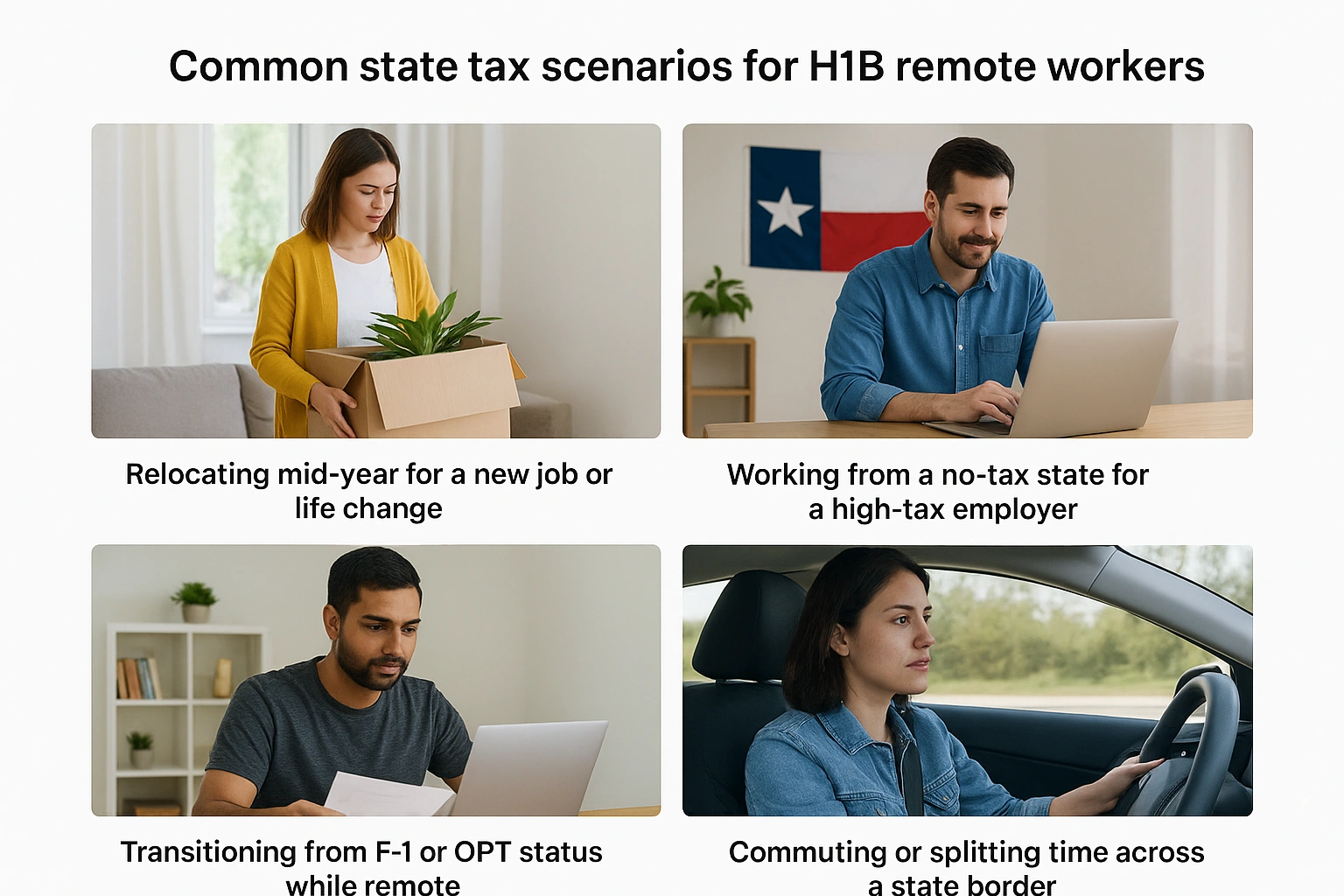
Relocating mid-year for a new job or life change
If you moved states partway through the year, say from New Jersey to Nevada, you'll typically file a part-year resident return in New Jersey covering income earned before the move, and nothing at all in Nevada since it has no income tax. Your employer's withholding often lags behind the move by weeks or months, which means you could see a shortfall in one state and a refund owed from the other when you reconcile everything at filing time.
Working from a no-tax state for a high-tax employer
This is one of the more favorable setups for H1B remote workers. If you live and work entirely from Texas or Florida while your employer is based in California, you generally don't owe California personal income tax just because the company is headquartered there, as long as you never physically worked from California during the year. The exception comes from states with a convenience of employer rule, discussed below, which can pull you back into tax liability even without setting foot there.
Living in a no-tax state doesn't automatically protect you if your employer's state applies a convenience of employer rule.
Transitioning from F-1 or OPT status while remote
H1B holders who converted from F-1 OPT mid-year face a layered problem: their federal filing status may shift from nonresident to resident alien partway through the year under the substantial presence test, while their state residency shifts on a completely separate timeline based on physical presence and domicile. Filing both correctly usually means treating the federal return and each state return as independent calculations rather than assuming one determines the other.
Commuting or splitting time across a state border
Some H1B workers live in one state but drive into an office in a neighboring state a few days a week. If both states participate in a reciprocity agreement, you'll usually file only in your resident state. Without reciprocity, you may owe a nonresident return in the work state and a resident return at home, with a credit for taxes paid to the other to avoid double taxation.
Steps to file your multi-state tax return correctly
Once you know which states you owe, the actual filing process follows a predictable order. Rushing this sequence, or filing state returns before your federal return is finalized, is how H1B holders end up amending everything a few months later.
Gather every income and residency document first
Before you open any tax software, pull together every document that shows where and when you earned money. Missing even one W-2 or 1099 from a short-term arrangement can throw off your multi-state tax filing entirely. Collect:
- W-2s and 1099s from every employer or client during the tax year
- A day-by-day log of which state you physically worked from, especially around your move date
- Lease agreements, mortgage statements, or utility bills proving your residency dates
- Records of any state estimated tax payments you made
File your federal return before touching state forms
Your federal return, filed as either a resident or nonresident alien depending on your substantial presence test results, forms the foundation every state return pulls numbers from. Software and paper forms alike expect your federal adjusted gross income as a starting point, so finishing this first prevents rework later.
Get your federal filing status settled before you touch a single state form, everything downstream depends on it.
Prepare part-year or nonresident state returns next
For each state where you lived or worked, you'll typically file one of two forms: a part-year resident return if you moved during the year, or a nonresident return if you worked there temporarily without establishing residency. Most state tax agencies, including California's Franchise Tax Board, publish worksheets that allocate income based on the days you actually spent there rather than your full annual salary.
Claim credits to avoid paying twice
Going through your resident state's return last lets you claim a credit for taxes paid to any nonresident state, which is the standard mechanism states use to prevent double taxation on the same income. Skipping this credit is a common, expensive mistake among H1B filers juggling two or three state returns in the same year.
Keep a paper trail for at least three years
Finally, save copies of every return, W-2, and residency document for at least three years. If a state questions your physical presence test calculations or your employer's withholding records don't match your claimed residency dates, you'll need that evidence ready rather than reconstructed under deadline pressure.
Getting your H1B remote work taxes right
Working on H1B while living in a different state than your employer doesn't have to end in a mess of amended returns and penalty notices. Once you understand that physical presence, not your paycheck's origin, drives your state tax obligation, the rest of the process becomes a matter of paperwork rather than guesswork. Track your days, separate your federal and state filings, and claim every credit you're owed before you sign anything.
Specific situations, like converting from F-1 status mid-year or splitting time across three states, still trip up even careful filers. Rather than risk an incorrect multi-state tax filing that draws IRS or state attention, get a professional set of eyes on your return. Get your H1B tax return prepared accurately today by CTEC-certified preparers who handle nonresident and multi-state filings every day.