


International Tax Accountant: What They Do and When You Need One
If you have income crossing borders, whether from a foreign job, an overseas rental property, or a visa that puts you in tax limbo between two countries, a regular tax preparer often isn't enough. That's where an international tax accountant comes in. These specialists understand how the IRS treats foreign income, foreign accounts, and treaty benefits, and they know the forms that trip up general preparers, like FBAR, Form 8938, and Form 8843 for students on F-1 or J-1 visas.
This article breaks down exactly what an international tax accountant does day to day and, more importantly, when you actually need one instead of a standard CPA. You'll see the specific situations, like foreign earned income exclusions, non-resident filings, or dual-country tax obligations, where cross-border expertise saves you money and keeps you out of IRS trouble.
We'll also cover what qualifications matter when you're vetting someone for the job, from CTEC certification to years of hands-on experience with 1040NR and expatriate returns. By the end, you'll know whether your tax situation calls for specialized international help or if a general preparer can still handle it, and what questions to ask before you hire anyone.
Why you need an international tax accountant
Most general tax preparers handle W-2s, standard deductions, and maybe a Schedule C without blinking. But the moment foreign income, foreign bank accounts, or dual tax residency enters the picture, the rules change fast. An international tax accountant trains specifically in the treaties, exclusions, and reporting forms that a general preparer rarely touches, which means fewer mistakes and fewer surprises when the IRS reviews your return.
The rules multiply once borders get involved
Domestic tax law is complicated enough. Add a second country, and you're now dealing with foreign tax credits, currency conversion timing, and the question of which country actually gets to tax a given dollar first. A cross-border tax accountant knows how to apply the foreign earned income exclusion under IRC Section 911, how to claim credits under Form 1116 instead of double paying, and how tax treaties between the US and specific countries change the math entirely. General preparers often default to the safest, most conservative reading of the rules, which usually means you overpay.
Cross-border tax mistakes rarely show up as a small correction. They show up as thousands of dollars in penalties years later.
The penalties for getting it wrong are steep
Foreign account reporting isn't optional, and the IRS treats it seriously. Missing an FBAR (FinCEN Form 114) or Form 8938 filing isn't like forgetting a minor deduction. Here's what's actually at stake:

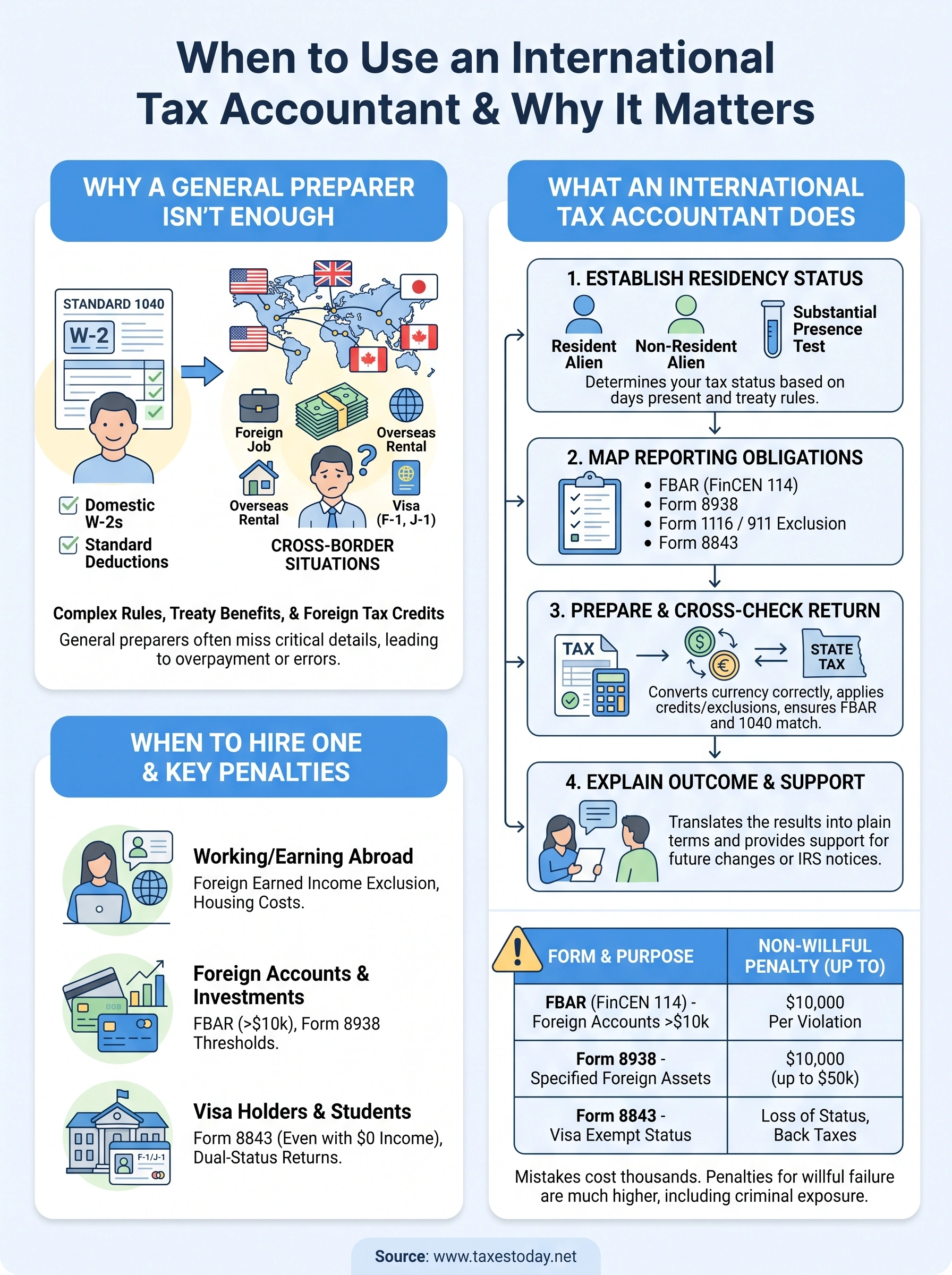
| Form | Purpose | Penalty for Non-Willful Failure |
|---|---|---|
| FBAR (FinCEN 114) | Reports foreign bank/financial accounts over $10,000 | Up to $10,000 per violation |
| Form 8938 | Reports specified foreign financial assets | $10,000, up to $50,000 for continued failure |
| Form 8843 | Required for F-1/J-1 visa holders claiming exempt status | Loss of exempt status, back taxes owed |
These numbers assume the failure is non-willful. If the IRS decides you knew about the requirement and skipped it anyway, penalties climb into the tens of thousands and can include criminal exposure in extreme cases. An expatriate tax accountant who files these forms routinely catches the reporting requirement before it becomes a five-figure problem.
General CPAs often miss the details that matter
Even a competent, licensed CPA without international experience can misstep here. They might not know that a foreign pension counts as a reportable asset, or that a non-resident alien files a 1040NR instead of a standard 1040, or that a student on OPT still needs to file Form 8843 even with zero income. None of this reflects poorly on general preparers, it's just not their specialty. Tax law covering cross-border situations changes with treaty updates and IRS guidance, and staying current on it requires ongoing, focused attention.
Peace of mind matters as much as the paperwork
Questions about residency status, treaty tie-breaker rules, or whether you're a resident or non-resident alien for tax purposes create real anxiety, especially for visa holders and new immigrants. Someone who works these cases regularly can look at your visa type, your days present in the US under the substantial presence test, and your income sources, then tell you definitively where you stand. That clarity alone is worth the cost of hiring a specialist rather than guessing with a general preparer and hoping the IRS agrees with your interpretation later. You can review the IRS's own guidance on foreign account reporting requirements directly through the IRS Report of Foreign Bank and Financial Accounts page to see how detailed these rules get.
How an international tax accountant handles your case
Working with an international tax accountant looks different from dropping your W-2 off at a strip-mall tax office. The process starts before any forms get filled out, because your specific facts (visa type, residency history, income sources, foreign accounts) determine which forms even apply to you. A good preparer treats that discovery phase as the most important part of the engagement, not a formality to rush through.
Step one: figuring out your residency status
Before anything else, your accountant needs to establish whether you're a resident alien, non-resident alien, or dual-status filer for the tax year. This isn't guesswork. They'll walk through the substantial presence test, count your qualifying days in the US, and check whether a tax treaty tie-breaker rule overrides the default residency determination. Get this step wrong and every form that follows is built on a bad foundation.
Step two: mapping out your reporting obligations
Once residency is settled, the accountant builds a checklist specific to your situation. This typically covers:
- Whether FBAR (FinCEN 114) applies based on foreign account balances
- Whether Form 8938 is required for specified foreign assets
- Whether Form 1116 or the Section 911 exclusion better reduces your foreign income tax burden
- Whether Form 8843 is needed for visa status, even with no income
- Whether a treaty benefit reduces or eliminates tax on specific income types
Step three: preparing and cross-checking the return
Here's where the technical work happens. Your cross-border tax accountant converts foreign currency amounts using the correct exchange rate method, applies the right exclusion or credit, and makes sure state tax obligations (if you have California ties, for example) line up with your federal filing. They'll also cross-check that no form contradicts another, since inconsistencies between your FBAR and your 1040 are a common trigger for IRS scrutiny.
The real value of a specialist isn't filling out forms faster, it's catching the mismatches a general preparer wouldn't know to look for.
Step four: explaining the outcome in plain terms
After filing, a good accountant doesn't just hand you a confirmation number. They explain what was claimed, why, and what to expect if the IRS sends a notice. For students and new visa holders especially, this final conversation often matters more than the return itself, because it sets expectations for next year and flags any changes in circumstances that might shift your filing requirements going forward.
Common situations that call for international tax help
Some tax situations practically announce themselves as candidates for specialized help. If you recognize your own circumstances in the list below, it's a strong sign a general preparer won't cut it this filing season.

Working abroad or earning foreign income
Americans working overseas, whether on a corporate assignment or as remote freelancers billing foreign clients, run into the foreign earned income exclusion and foreign tax credit rules immediately. Getting the timing right on which credit or exclusion to claim, and in what order, changes your tax bill significantly. An international tax accountant also knows when housing costs qualify for an additional exclusion under Section 911, something general preparers frequently overlook entirely.
Holding foreign bank accounts or investments
Anyone with a foreign bank account, foreign brokerage account, or even a foreign pension needs to check FBAR and Form 8938 thresholds every single year. Account balances fluctuate, and crossing the reporting threshold even briefly during the year can trigger a filing requirement you didn't have last year. This is one of the most common blind spots for taxpayers who assume nothing changed since their last return.
Studying or working on a visa
Students on F-1, J-1, OPT, or CPT status face a different problem: figuring out whether they're a resident or non-resident alien, and whether Form 8843 applies even without income. Visa holders transitioning from non-resident to resident status mid-year often need a dual-status return, which most general preparers have never actually filed.
Owning rental property or a business overseas
Owning a rental property abroad means reporting that income on your US return regardless of whether you also pay tax on it overseas. Small business owners with a foreign LLC or foreign subsidiary face additional reporting like Form 5471, with penalties that start at $10,000 for a missed filing.
Filing back taxes with foreign income involved
Taxpayers who discover they should have been filing FBAR or reporting foreign income years ago need someone familiar with the IRS's Streamlined Filing Compliance Procedures, which offer reduced penalties for non-willful violations. You can read the IRS's own overview of these procedures on the Streamlined Filing Compliance Procedures page.
The common thread across every scenario here is the same: a missed form costs far more than the accountant's fee ever would.
How to choose the right international tax accountant
Picking the right specialist matters as much as recognizing you need one. Not every preparer who lists "international" on their website has actually filed a 1040NR or handled a Streamlined Filing case, so you need to verify credentials before handing over sensitive financial details.
Credentials matter more than you think
Look for CTEC certification, an IRS Enrolled Agent designation, or CPA licensure combined with documented experience in cross-border returns. A CTEC-certified preparer with 15+ years of experience handling expatriate and non-resident filings brings a different level of confidence than someone who occasionally files a 1040NR between standard returns. Ask directly how many international returns they prepare per year, not just whether they "can" handle one.
The right question isn't whether they can file your return, it's how many times they've filed one exactly like yours.
Match experience to your specific situation
Ask specific questions tied to your circumstances rather than accepting a general "yes, we do that." A qualified international tax accountant should answer these without hesitation:
- Have you filed Form 8843 for F-1 or J-1 visa holders before?
- How do you determine residency under the substantial presence test?
- Do you have experience with the Streamlined Filing Compliance Procedures?
- Can you handle both federal and state filings if I have California ties?
- What's your process for cross-checking FBAR against my 1040?
Vague or rehearsed answers to these questions signal you're talking to someone unfamiliar with the actual mechanics of cross-border filing.
Weigh pricing against complexity
Pricing for international work runs higher than a standard W-2 return, and that's reasonable given the added forms and research involved. Still, transparency matters. A firm quoting a flat starting rate, say $99 to $125 for straightforward filings, with clear add-on pricing for FBAR, Form 8938, or 1040NR complexity, gives you a better basis for comparison than a vague "it depends" answer. You want someone who explains costs upfront and doesn't pad the bill once your return turns out more complicated than expected.
Confirm availability for follow-up
Finally, confirm whether your accountant offers support after filing. IRS notices related to foreign accounts can arrive months later, and you want the same preparer available to explain what's happening rather than starting over with someone new. Virtual and in-person options both work, but responsiveness after the return is filed separates a good expatriate tax accountant from one who disappears once the invoice is paid.
Getting your cross-border taxes right
Cross-border tax situations don't forgive guesswork. Whether you're claiming the foreign earned income exclusion, filing Form 8843 as a visa holder, or catching up on years of unfiled FBARs, the difference between a general preparer and an international tax accountant shows up in your refund, your compliance, and your peace of mind. Waiting until the IRS sends a notice costs far more than hiring the right person upfront.
Deciding you need specialized help is the easy part. Finding a CTEC-certified preparer who actually files 1040NR and expatriate returns regularly, asks the right residency questions, and stays available after filing takes more effort, but it's worth it. Your specific facts, visa status, foreign accounts, income sources, determine everything that follows, so start there before you file anything.
If you're ready to get your cross-border return handled by professionals who work these cases every day, schedule your tax preparation with TaxesToday and file with confidence this year.