


7 Ways To Find Trusted Tax Preparers In My Area (2026)
Searching for tax preparers in my area sounds simple enough, until you realize how many options show up and how hard it is to tell who's actually qualified. Between unlicensed preparers, seasonal pop-up shops, and outdated directory listings, picking the wrong person can cost you money, time, and peace of mind.
The good news? Finding a reliable tax professional doesn't require guesswork. You just need to know where to look and what credentials to verify before handing over your W-2s, 1099s, or business records. At TaxesToday, we've spent over 15 years preparing returns for individuals, freelancers, and small businesses, so we know exactly what separates a trustworthy preparer from a risky one.
This guide breaks down seven practical ways to find, vet, and hire a qualified tax preparer near you, whether you prefer in-person meetings or want the flexibility of virtual tax preparation from anywhere in the country.
1. TaxesToday tax prep, virtual or in-person
When you search for tax preparers in my area, one of the first things you want to know is whether a service can handle your specific situation. TaxesToday prepares returns for W-2 employees, 1099 contractors, small business owners, and non-residents, so there's a strong chance your filing type falls within what the team works on every day.
What you get when you work with TaxesToday
TaxesToday is staffed by IRS-registered and CTEC-certified preparers with more than 15 years of hands-on experience. You can meet in person if you're in California or work completely virtually from anywhere in the country. Both options deliver the same level of care, so your location doesn't restrict your access to a qualified professional.
How to confirm a good fit for your tax situation
Before you commit, check that your return type is covered. TaxesToday handles individual, married, head of household, self-employed, LLC, S-Corp, amended, back taxes, and non-resident filings. Foreign income situations, 1040NR returns, and F-1 or J-1 student filings are specifically supported as well.
If your tax situation involves multiple income sources, international income, or prior unfiled returns, confirm upfront that the preparer has direct experience with those exact forms.
What to ask before you share documents
Ask the preparer which forms they will file on your behalf and whether both federal and state returns are included in the quote. You should also confirm turnaround time, how they communicate updates, and what support you receive if an IRS notice arrives after filing. Getting clear answers to these questions before sending any documents protects you regardless of which service you use.
Pricing and what it includes
TaxesToday's services start at $99, which is competitive when you compare it to firms that layer on fees at every step of the process. Your quoted price covers preparation and e-filing. Requesting a written estimate before you share any documents is a smart habit, and TaxesToday keeps pricing transparent so you know what you're paying from the start.
2. IRS tax preparer directory
The IRS maintains a free public directory at irs.gov that lists credentialed tax professionals across the country. When you're comparing tax preparers in my area, this is one of the most reliable starting points because every person listed holds an active credential directly recognized by the IRS.
What the IRS directory shows and what it does not
The directory includes CPAs, enrolled agents, attorneys, and Annual Filing Season Program participants. It does not include every paid preparer in your city, only those with specific credentials. This means a qualified local preparer who lacks those exact credentials won't appear, so use the directory as a filter, not a complete list.
The IRS directory confirms credentials but does not verify a preparer's experience with your specific tax forms, so always ask directly about your situation.
How to filter for the right credential and location
You can search by ZIP code, credential type, and name. Narrow your results by selecting the credential that matches your complexity level, enrolled agent for IRS matters, CPA for business filings.
How to verify PTIN and avoid ghost preparers
Every paid preparer must have a valid Preparer Tax Identification Number (PTIN). You can verify PTIN status through the IRS directory. Avoid anyone who refuses to sign your return or won't provide their PTIN, these are known as ghost preparers and pose serious legal risks.
Cost expectations when you hire from a directory
Fees vary widely based on credential level and return complexity. A basic individual return typically runs $150 to $300, while business or multi-state returns can cost significantly more.
3. State CPA society and CPA Verify
State CPA societies maintain searchable member directories that connect you with licensed accountants in your area. If you're looking for tax preparers in my area with a [formal accounting credential](https://www.taxestoday.net/best-tax-experts-near-me.html), these directories give you a verified starting point without sorting through unverified online listings.
When a CPA makes the most sense
A CPA is the strongest fit when your return involves business income or multi-state filings that require deep accounting knowledge. For straightforward W-2 returns, a CPA may be more than you need, but for small business owners or anyone with significant assets, the credential carries real weight.
How to find CPAs through state societies
Each state has its own CPA society, and most offer free public directories on their websites. You can search by location and specialization to narrow results. The AICPA's CPA Verify tool also lets you confirm a CPA's license status across multiple states in one place.
Use CPA Verify before your first meeting to confirm active licensure and check for any disciplinary actions on record.
How to check licensing and disciplinary history
Your state board of accountancy is the official source for license status and any complaints filed against a CPA. A search takes under two minutes and tells you whether the license is current.
Typical CPA fee structures and price ranges
CPAs generally charge $200 to $500 for an individual return and more for business filings. Most bill by the form or hour, so ask for a written estimate before you commit.
4. Enrolled agent directories like NAEA and NATP
When you look for tax preparers in my area, enrolled agents are often overlooked, but they hold the highest credential the IRS issues directly and can represent you in any federal tax matter nationwide.
What an enrolled agent can do for you
An enrolled agent passes a rigorous three-part IRS Special Enrollment Exam covering individual and business tax law. Unlike state-licensed CPAs, their credential is federally issued, meaning they practice in all 50 states with no geographic restrictions. That matters if you move, have income in multiple states, or face an IRS audit.
How to use association directories to find specialists
The National Association of Enrolled Agents (NAEA) and the National Association of Tax Professionals (NATP) both maintain public member directories. Search by ZIP code or specialty to find agents who focus on self-employment, business returns, or international income.
Filter by specialty in the directory before reaching out, so you only contact EAs who regularly handle your specific forms.
Questions that reveal experience with your forms
Ask targeted questions before you share any documents:
- How many returns similar to mine did you file last year?
- Do you cover both federal and state filings in one quote?
- What happens if I receive an IRS notice after filing?
Direct, specific answers signal hands-on experience rather than surface-level familiarity.
Pricing expectations for EAs and credentialed preparers
EAs typically charge $150 to $400 for individual returns and more for complex business filings. Most offer a flat fee per return, so always request a written estimate before committing.
5. Referrals from friends, business owners, and banks
Personal referrals remain one of the most reliable ways to find tax preparers in my area because someone in your network has already tested the preparer's accuracy, communication, and turnaround time. A single warm recommendation from a person whose financial situation resembles yours carries more weight than a five-star rating from a stranger.
How to ask for referrals that match your situation
When you reach out to a contact, be specific about your filing type. Ask whether they file as self-employed, run a small business, or deal with 1099 income, and only follow up on referrals from people whose situation closely mirrors yours. A preparer who excels at simple W-2 returns may not have deep experience with Schedule C or multi-state filings.
How to sanity-check a referral fast
Before booking, confirm the preparer holds an active PTIN and look up any state license or credential they claim. A quick search on the IRS directory takes under two minutes.
A referral removes some guesswork, but it does not replace credential verification.
What to confirm about availability and turnaround time
Ask the referred preparer how many clients they take on each season and what their typical completion window looks like. Smaller firms sometimes close their books weeks before the deadline, so confirm open availability before sharing any documents.
How pricing usually works with small local firms
Most small local preparers charge a flat fee per return or per form. Ask for a written quote upfront and confirm whether the price includes both federal and state filings to avoid surprises at pickup.
6. Google Maps and local listings
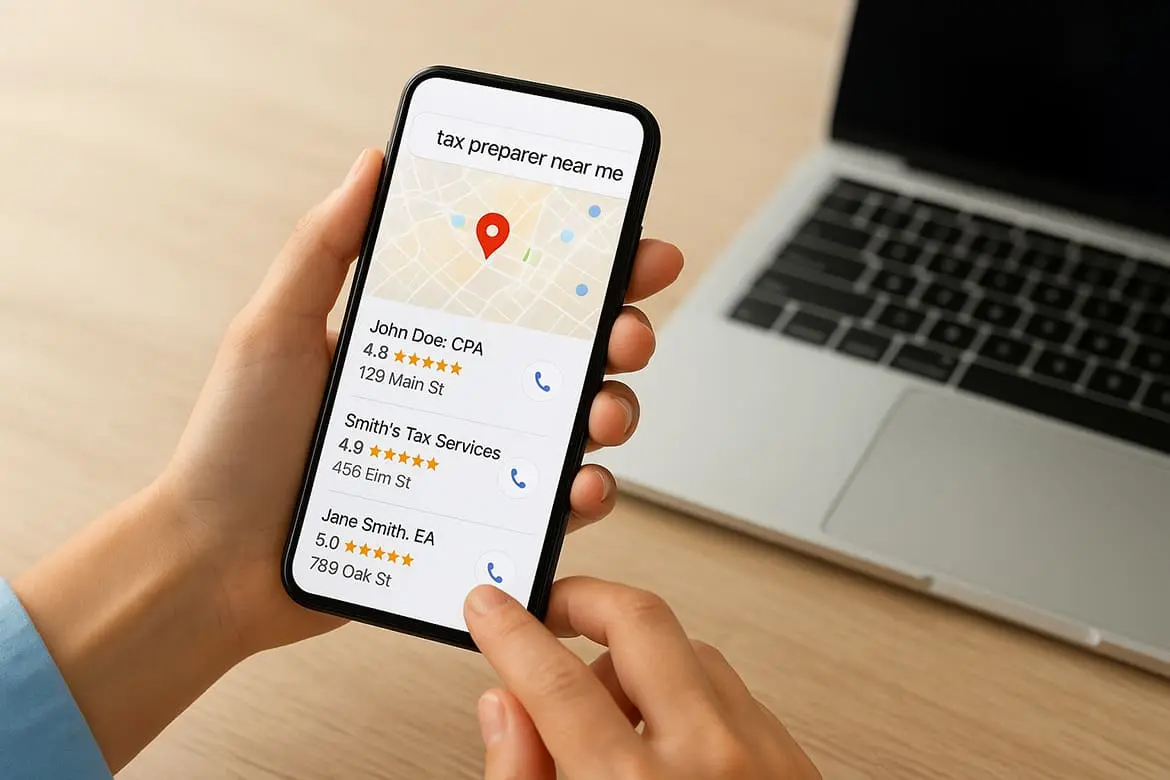
Google Maps is one of the fastest tools you have for finding tax preparers in my area, but the results you see depend entirely on how you search. A vague search returns a mixed list of qualified professionals alongside seasonal pop-ups and uncredentialed preparers, so the way you frame your query matters from the start.
How to search in a way that surfaces real specialists
Instead of searching "tax preparer near me," add your specific filing type to the query. Terms like "self-employed tax preparer," "1099 tax help near me," or "small business tax preparation" push specialists to the top and filter out generalists who may not handle your forms regularly.
What to look for on profiles, websites, and policies
Once you find a profile, check for a physical address, a listed credential (CPA, EA, or CTEC), and a website that describes the specific return types they handle. A thin profile with no credential listed and no website is a warning sign worth taking seriously.
A strong Google profile does not confirm credential status; always verify the preparer's PTIN or state license through an official source before sharing any documents.
Red flags that signal a risky preparer
Avoid any preparer who promises a large refund before reviewing your documents or charges fees based on a percentage of your refund. Both are red flags the IRS specifically warns against.
How to compare quotes without getting baited
Request a flat-fee written estimate from at least two or three preparers before you commit. Confirm whether the quote covers both federal and state returns, and ask what happens if your return requires an additional form mid-process.
7. Online marketplaces and retail tax offices
Online platforms and retail chains offer another route to finding tax preparers in my area, but both come with trade-offs worth understanding before you hand over your documents.
When marketplaces can help and when they hurt
Platforms like Thumbtack connect you with local preparers quickly, which helps when you're short on time. The problem is that credential verification is minimal on most platforms, and user reviews rarely tell you whether a preparer accurately handled complex returns or just simple W-2 filings.
How to screen pros on platforms before you book
Before you book anyone through a marketplace, ask for their PTIN number and verify it through the IRS directory. Check whether their listed specialties match your specific filing type, and request a written quote before sharing any financial documents.
Screening a marketplace preparer takes the same steps as vetting any other professional; the platform itself does not do that work for you.
What to know about retail tax offices and add-on fees
Retail chains are accessible and widely available, but pricing can climb quickly once add-on fees for additional forms, state returns, or audit protection get layered in. Request a complete itemized quote before your appointment starts, not after the preparer has already reviewed your documents.
How to protect your data when you work online
Whether you use a marketplace or a retail office, confirm the platform uses encrypted file transfer for document uploads. Never send sensitive financial information through regular email without a secure portal or password-protected file.
Next steps
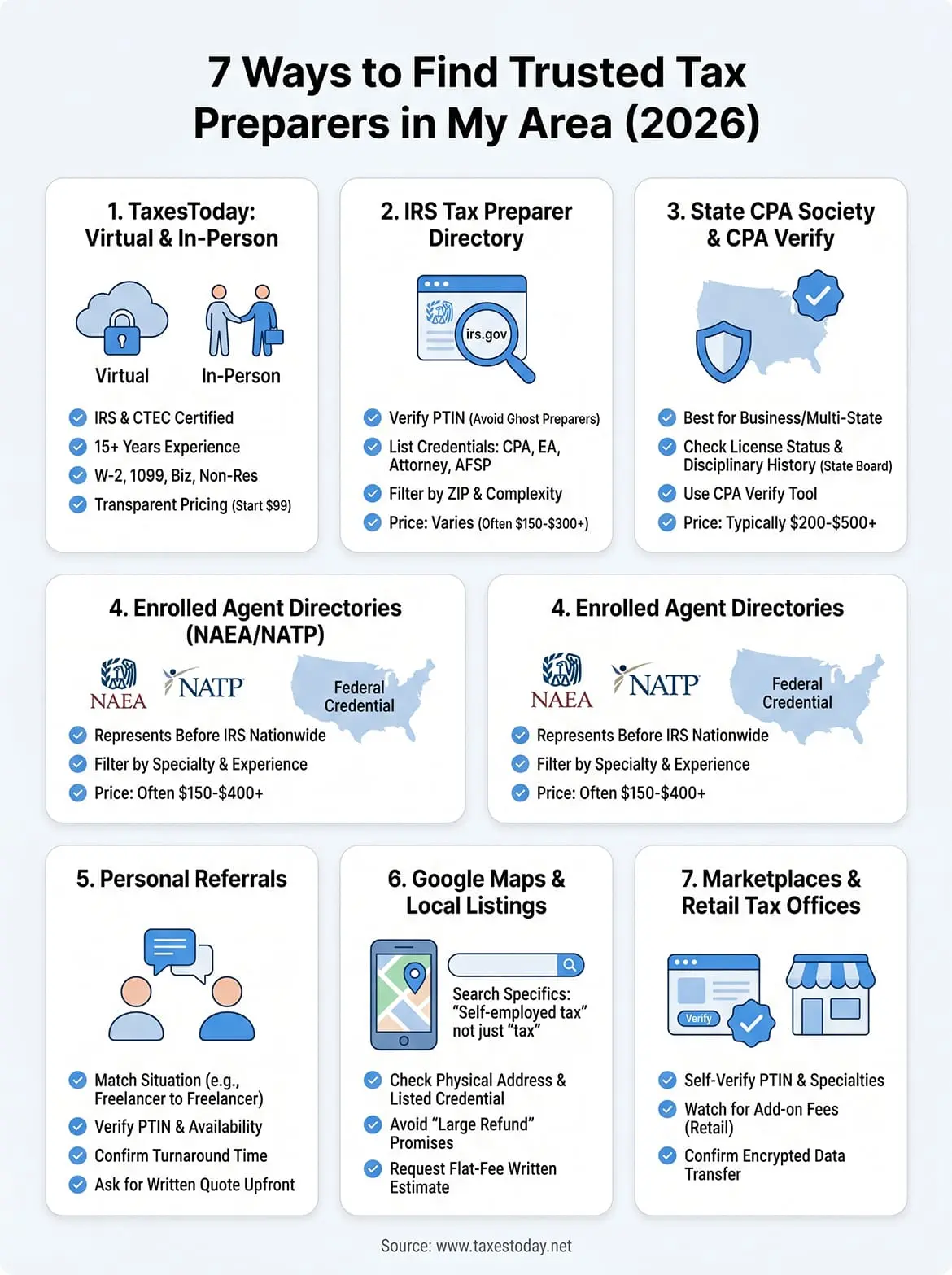
You now have seven concrete ways to find and vet tax preparers in my area, from the IRS directory and state CPA societies to referrals, Google Maps, and credentialed specialists. Each method works best when you pair it with credential verification before sharing any financial documents, so keep that step non-negotiable regardless of which route you take.
Picking the right preparer comes down to matching their specific experience to your exact filing type. A preparer who handles dozens of self-employed returns each season will serve a freelancer far better than a generalist who mostly processes simple W-2 returns.
If you want a straightforward starting point without the research, get your taxes prepared by a certified professional at TaxesToday. CTEC-certified and IRS-registered preparers handle everything from individual W-2 returns to self-employed, business, and non-resident filings, with transparent pricing starting at $99 and virtual options available nationwide.