



How To Claim The Tip Tax Credit (FICA And Tip Deduction)
If you earn tips or run a business where employees receive them, you're likely paying more in taxes than you need to. Tips are taxable income, that part isn't news. But what catches many people off guard is that the IRS offers specific credits and deductions designed to offset that tax burden. Knowing how to claim the tip tax credit can put real money back in your pocket, whether you're a restaurant owner filing for your business or a server reporting your earnings.
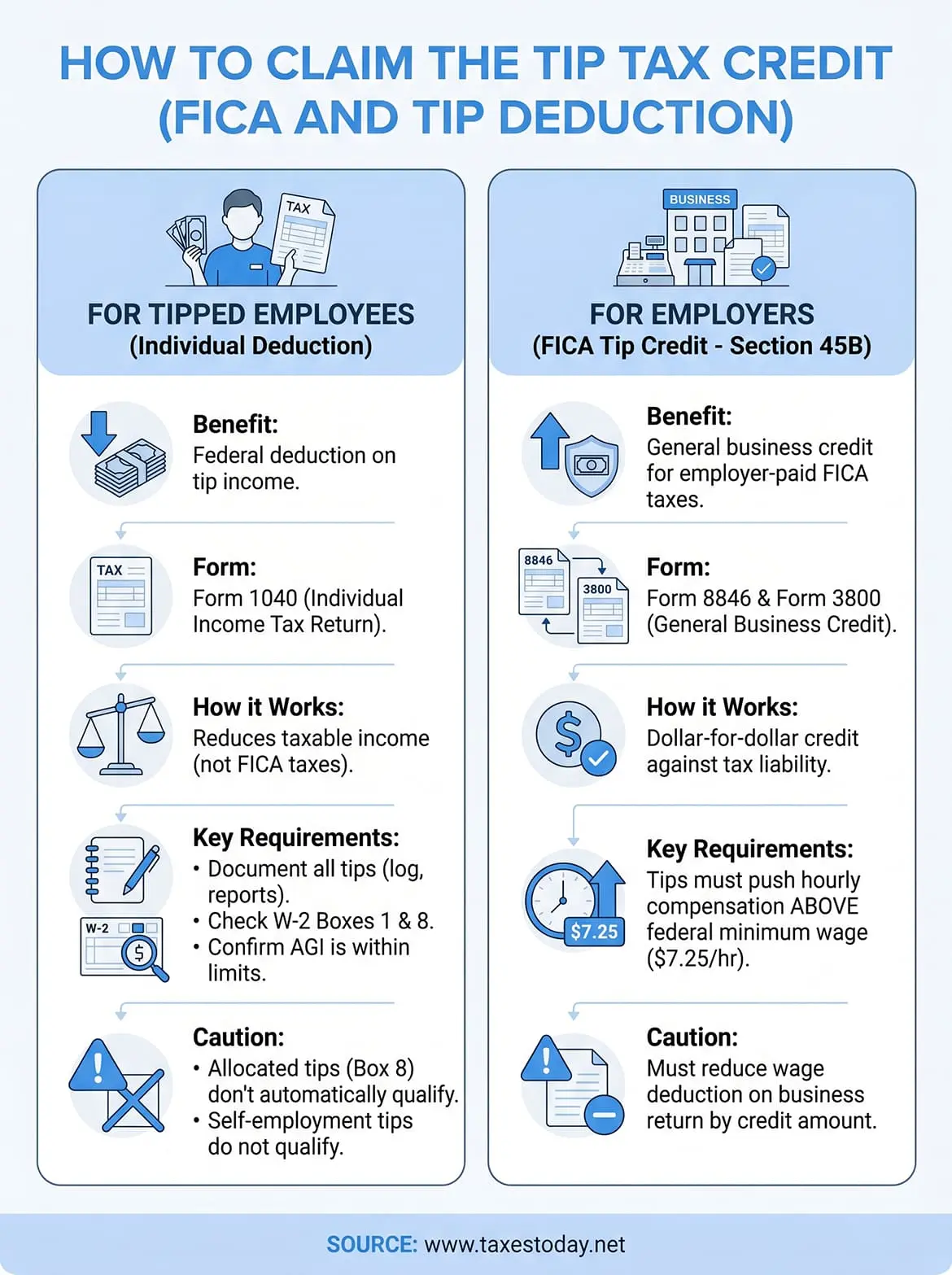
There are two distinct tax benefits at play here, and they apply to very different groups of taxpayers. Employers can claim the FICA tip credit (Form 8846) to recover a portion of the Social Security and Medicare taxes they pay on employee tips. On the individual side, tipped workers may qualify for a federal deduction on tip income, depending on current legislation and filing requirements. Mixing these up, or missing them entirely, is one of the most common mistakes we see during tax season.
This guide breaks down both paths step by step: who qualifies, which forms to file, how to calculate the credit or deduction, and where people typically go wrong. At TaxesToday, we prepare taxes for individuals, freelancers, and small business owners across California and nationwide, and tip-related filings are something our CTEC-certified preparers handle regularly. If you'd rather have a professional manage the process, we're here for that too, but first, let's walk through exactly how this works.
What "tip tax credit" means for workers and employers
The phrase "tip tax credit" gets used loosely, and that looseness causes real confusion at filing time. Two entirely separate tax benefits carry this informal label: one applies to employers paying FICA taxes on employee tips, and the other relates to a potential deduction for individual tipped workers on their personal returns. If you walk into the situation without knowing which one applies to you, you'll either file the wrong form or miss the benefit entirely. Knowing how to claim the tip tax credit starts with knowing which version of that credit or deduction actually belongs to you.
For tipped employees: how tips are taxed
When a customer leaves you a tip, that money counts as taxable income under federal law. You're required to report all cash tips to your employer if they total $20 or more in a calendar month, and your employer then withholds Social Security, Medicare, and income taxes on that reported amount. This requirement covers cash tips, credit card tips, and amounts received through tip pools.
For a long time, individual tipped workers had no special deduction or credit to offset this tax burden on their personal returns. That changed with the legislative push around a "no tax on tips" framework gaining traction at the federal level in 2025 and 2026. Under proposals moving through Congress, eligible workers in traditionally tipped industries may be able to deduct a portion of their reported tip income directly on Form 1040, subject to income limits and industry qualifications. Because the rules are still being finalized, checking the IRS website for current guidance before you file is essential.
If you hear that there's "no tax on tips," it does not mean tips are entirely tax-free. It means a deduction may reduce your taxable tip income, subject to specific eligibility rules that are actively being written into law.
For employers: the Section 45B FICA tip credit
If you own a food or beverage business where employees receive tips, your FICA obligations don't stop at the wages you directly pay. You cover the employer's share of Social Security (6.2%) and Medicare (1.45%) taxes on every dollar of tip income your employees report, even when those tips push wages well above the federal minimum wage. That tax cost adds up fast across a full staff.
Section 45B of the Internal Revenue Code addresses this directly. It lets qualifying employers claim a general business credit equal to the employer's share of FICA taxes paid on tips that exceed the federal minimum wage rate of $7.25 per hour. You calculate and claim this using Form 8846, and the credit flows through to your business tax return.
Why the terminology causes confusion
Most people searching for information about tip-related tax benefits are actually looking for two different answers depending on their role in the transaction. A restaurant server wants to know if they can reduce their taxable income on their personal Form 1040. A restaurant owner wants to recover a portion of the FICA taxes they've been paying all year on reported employee tips. Both situations involve tips and taxes, but the forms, calculations, and eligibility rules are entirely different.
The overlap in language also leads people to assume that claiming one benefit somehow cancels the other. It does not work that way. An employer can claim the Section 45B credit on the business return while employees independently take any applicable tip deduction on their personal returns. Understanding which role you're in when you sit down to file is the single most important first step before you look at any form, instruction set, or calculation worksheet.
Pick the right benefit: tip deduction vs FICA tip credit
Before you figure out how to claim the tip tax credit or deduction, you need to confirm which benefit actually applies to your situation. Choosing the wrong path wastes time, and in some cases, filing the wrong form creates IRS correspondence you don't want. The decision comes down to one core question: are you the person who received tips, or are you the employer who paid FICA taxes on those reported tips?

Who should take the tip deduction
If you work in a tipped occupation and report your tips to your employer, the individual tip deduction is the benefit you're looking at. This applies to workers in industries where tipping is customary, including food service, beverage service, cosmetology, and similar fields. Under the federal framework being finalized for 2025 and 2026 tax years, eligible workers can deduct qualifying tip income directly on their Form 1040, subject to income thresholds and industry restrictions.
Use this quick checklist to confirm you're in the right category:
- You are an individual filing a personal return (Form 1040)
- You work in a traditionally tipped occupation recognized by current IRS guidance
- Your employer withheld Social Security and Medicare taxes on your reported tips
- Your adjusted gross income falls within the qualifying limits once final rules publish
The individual tip deduction does not reduce your Social Security or Medicare tax owed on those tips. It reduces your federal income tax base, which is a meaningful but different benefit.
Who should claim the FICA tip credit
If you own or operate a food or beverage business and your employees receive tips, the Section 45B credit is the benefit you should be pursuing. You are not claiming a deduction on income. Instead, you are recovering part of the employer-side FICA taxes you already paid on your employees' tip income throughout the year. This is a dollar-for-dollar credit against your tax liability, not just a reduction in taxable income, which makes it more valuable per dollar than a standard deduction.
Two conditions must be true for you to qualify:
- Your business is in the food or beverage industry and customers regularly tip employees
- The tips you paid FICA taxes on pushed employee compensation above the federal minimum wage of $7.25 per hour
Tips that merely bring employee wages up to minimum wage level do not qualify for the credit. Only the FICA taxes paid on tips above that threshold are eligible, so the calculation matters significantly when you sit down to complete Form 8846.
Checklist: documents and numbers you need before you start
Gathering the right documents before you start is how you avoid mid-filing problems. Whether you are figuring out how to claim the tip tax credit as an employee or calculating the Section 45B credit as an employer, walking into the process with incomplete numbers means you will either understate your benefit or need to file an amendment later. Pull everything together first, and the actual filing steps in the next sections go considerably faster.
Reconstructing payroll figures or tip records after the fact is time-consuming and increases the risk of errors that invite IRS scrutiny.
What tipped employees need
If you are filing a personal return and planning to take the individual tip deduction, your goal is to document every dollar of tip income you received and verify exactly what taxes were withheld on those amounts. Your W-2 form is the starting point, since it shows your total wages including reported tips in Box 1, and the Social Security and Medicare taxes withheld on those tips in Boxes 4 and 6. You also want to confirm that the figures on your W-2 match your own records before you enter anything on your return.
Here is what to collect before you open Form 1040:
- W-2 form(s) from all employers showing total wages and reported tip income
- Your personal tip log or employer-provided tip reports showing cash and credit card tips by month
- Prior year return to confirm your filing status and any carryforward items
- Your Social Security number and current mailing address
- Documentation of any other income sources to determine whether your adjusted gross income falls within qualifying thresholds once final IRS guidance publishes
What employers need for Form 8846
Before you complete Form 8846, you need payroll data organized by employee and pay period. The credit calculation depends on knowing exactly how much of each employee's tip income pushed their total hourly compensation above $7.25, so your payroll records must separate regular wages from reported tips. If your payroll software does not produce that breakdown automatically, run a custom report before you start, since manually reconstructing the numbers mid-calculation leads to errors.
Collect the following before you begin:
- Total tip income reported by each employee across the full tax year
- Total hours worked per employee for each pay period during that year
- Employer FICA taxes paid on tip income (6.2% Social Security plus 1.45% Medicare)
- Your business EIN and entity type (sole proprietor, partnership, S-Corp, or C-Corp)
- The business tax return you plan to attach Form 8846 to, whether that is Schedule C, Form 1065, Form 1120-S, or Form 1120
Claim the tip deduction on your Form 1040
Once you have confirmed your eligibility and gathered your documents, the actual filing process is straightforward. Knowing how to claim the tip tax credit or deduction on your personal return means locating the correct line on Form 1040, entering the right amount, and making sure your supporting records match what you report. The steps below walk you through exactly that.
Determine your deduction amount
Your deduction is based on qualifying tip income you received and reported during the tax year. For the 2025 and 2026 tax years, the deduction applies to tips received in the course of employment in a traditionally tipped occupation, such as food service, beverage service, or cosmetology. It does not apply to tips you earned from self-employment, since those fall under a different part of the return. Pull your W-2 and cross-reference the tip amounts shown in Box 8 (allocated tips) and the total wages in Box 1 against your own tip log to confirm the qualifying figure before you enter anything.
The deduction reduces your federal taxable income, not your Social Security or Medicare tax base, so your payroll taxes on those tips remain the same regardless of what you claim here.
Keep in mind that income limits apply once final IRS guidance publishes for 2025 returns. If your adjusted gross income exceeds the qualifying threshold, the deduction phases out or disappears entirely. Check the IRS instructions for the relevant tax year at irs.gov to confirm the current limit before you calculate your deduction.
Enter the deduction on Form 1040
The tip deduction appears as an above-the-line deduction, meaning you subtract it before calculating your adjusted gross income rather than itemizing it on Schedule A. Follow these steps when you sit down to complete your return:
- Add up all qualifying tip income from your W-2(s) and personal tip records for the year.
- Confirm that the tips came from a qualifying occupation under current IRS guidance.
- Verify your adjusted gross income falls within the allowable threshold for the deduction.
- Enter the qualifying tip amount on the designated line in the "Adjustments to Income" section of Form 1040, which the IRS will specify in the final instructions for your tax year.
- Carry the reduced amount forward to calculate your taxable income on the same form.
Double-check that the number you enter matches your W-2 and tip log records exactly. A discrepancy between what your employer reported and what you claim is one of the fastest ways to generate an IRS notice.
Solve common tip deduction issues and edge cases
Even after you understand how to claim the tip tax credit deduction on your Form 1040, a few specific situations can create real complications at filing time. Knowing where the problems typically appear keeps you from either underclaiming your benefit or triggering an IRS notice because your numbers do not line up with what your employer reported.
Allocated tips show up in Box 8 of your W-2
If you work in a food or beverage establishment and your reported tips fell below a certain percentage of gross sales, your employer may have allocated additional tip income to you. This amount appears in Box 8 of your W-2 and represents the difference between what you reported and what the IRS estimates you should have earned. Allocated tips are not the same as tips you actually received and reported, and the IRS treats them differently on your return.
Allocated tips in Box 8 do not automatically qualify for the tip deduction. You should report them as income and consult IRS Publication 531 to determine how they affect your specific filing situation.
If you believe the allocated amount is incorrect because you kept a daily tip log that shows lower actual tips, you can use Form 4137 to recalculate your Social Security and Medicare taxes based on your actual records rather than the employer's estimate.
Tips from multiple employers in the same year
If you worked at more than one tipped job during the tax year, each employer issues a separate W-2, and your qualifying tip income for the deduction calculation spans all of them. Add the tip figures from every W-2 before you enter a total on your return. Do not apply the income threshold test to each employer separately.
Your combined adjusted gross income determines whether you stay under the deduction limit, so pulling all W-2s together before you calculate is a required step, not optional. Missing one employer's tip income when you calculate your qualifying amount creates a mismatch between your return and IRS records.
Self-employment tips do not qualify
Tips you receive as a self-employed individual, such as gratuities collected through your own business account rather than through an employer's payroll, fall outside the scope of the individual tip deduction. Those tips report on Schedule C as gross receipts, and self-employment tax applies through Schedule SE separately. The deduction framework targets W-2 employees working in traditionally tipped occupations, so if you operate independently and receive tips directly from clients, a different set of rules governs how you handle that income on your return.
Calculate the employer FICA tip credit under Section 45B
Before you can file anything, you need the actual credit figure, and getting that number right is the most critical step in understanding how to claim the tip tax credit as an employer. The Section 45B calculation follows a specific formula: you multiply the employer FICA tax rate of 7.65% (6.2% Social Security plus 1.45% Medicare) by the portion of each employee's reported tip income that pushed their total compensation above the federal minimum wage of $7.25 per hour. Tips that only brought wages up to that minimum do not count toward the credit, which is why you need payroll data broken down by employee and pay period before you start.
Identify the tip wages that qualify for the credit
Your first task is separating qualifying tips from non-qualifying tips for each employee across the full tax year. An employee's hourly rate plus their tips represents their effective compensation per hour worked. Only the tips that lift total hourly compensation above $7.25 factor into your credit calculation. If an employee earned $5.00 per hour in base wages and reported $4.00 per hour in tips on average, only $2.25 of that $4.00 tip figure qualifies, since the first $2.25 in tips was needed just to reach minimum wage.
Work through this calculation for every tipped employee separately, since mixing employees together produces an inaccurate credit amount that does not match the Form 8846 instructions.
Multiply each employee's qualifying tip hours by their qualifying tip rate to get their annual qualifying tip income, then add all employees together to reach your total qualifying tip pool for the business.
Run the Section 45B calculation
Once you have the total qualifying tip pool, the credit formula is straightforward. Apply the 7.65% combined FICA rate to that pool, and the result is your Section 45B credit amount.
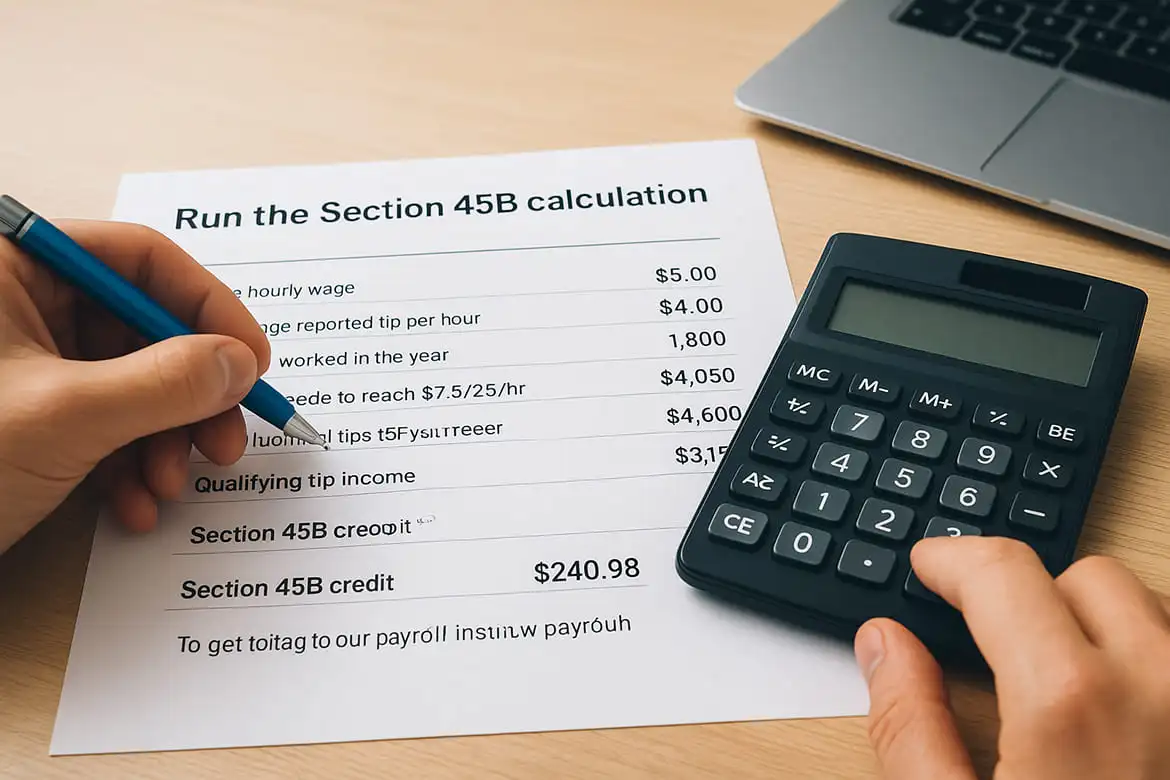
Here is a concrete example using a single employee:
| Detail | Amount |
|---|---|
| Base hourly wage | $5.00 |
| Average reported tip per hour | $4.00 |
| Hours worked in the year | 1,800 |
| Tip dollars needed to reach $7.25/hr | $2.25 × 1,800 = $4,050 |
| Total reported tips for the year | $4.00 × 1,800 = $7,200 |
| Qualifying tip income | $7,200 - $4,050 = $3,150 |
| Section 45B credit (7.65%) | $3,150 × 0.0765 = $240.98 |
Repeat this for every tipped employee on your payroll, then sum the individual credit amounts to get the total figure you will carry onto Form 8846.
File Form 8846 and claim the credit on your business return
Once you have your Section 45B credit amount calculated, the next step in understanding how to claim the tip tax credit is completing Form 8846 and attaching it correctly to your business return. The IRS uses this form to verify your qualifying tip wages, confirm your FICA tax calculation, and determine the final credit amount flowing to your return. Filling it out incorrectly or skipping the attachment step are the two most common reasons employers lose the credit entirely.
Complete Form 8846 line by line
Form 8846 is short, but each line depends on accurate payroll data, so work through it in order rather than jumping to the total.
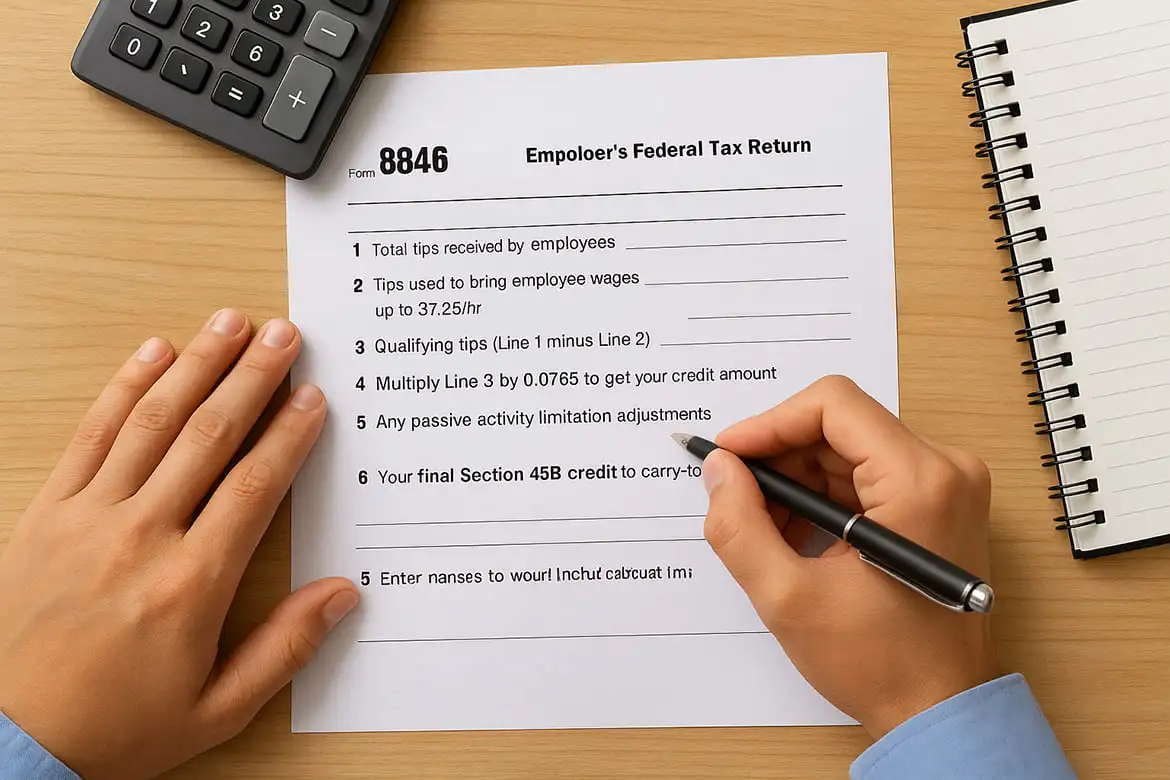
| Line | What you enter |
|---|---|
| Line 1 | Total tips received by employees during the tax year |
| Line 2 | Tips used to bring employee wages up to $7.25/hr (not eligible) |
| Line 3 | Qualifying tips (Line 1 minus Line 2) |
| Line 4 | Multiply Line 3 by 0.0765 to get your credit amount |
| Line 5 | Any passive activity limitation adjustments (most small businesses enter zero) |
| Line 6 | Your final Section 45B credit to carry to Form 3800 or your return |
Enter the total tip income from Line 1 using your payroll records, not estimates. Line 2 requires the same employee-by-employee calculation you completed in the previous section, so keep that worksheet available while you fill out the form. The number on Line 4 should match your pre-calculated figure exactly before you move forward.
If Line 4 does not match your manual calculation, recheck your qualifying tip pool for any employees whose base wages already exceeded $7.25 per hour before tips, since those employees contribute no qualifying tip dollars to the credit.
Attach the credit to your business return
Where the credit lands on your final return depends on your business entity type. For most food and beverage businesses, the Section 45B credit flows through Form 3800 (General Business Credit) before reaching your main return. Use the following guide to locate the right attachment point:
- Sole proprietors (Schedule C): Carry Form 8846 to Form 3800, then report the credit on Schedule 3, Part I, of your Form 1040
- Partnerships (Form 1065): Report on Schedule K and pass through to partners via Schedule K-1
- S-Corporations (Form 1120-S): Report on Schedule K and distribute to shareholders via Schedule K-1
- C-Corporations (Form 1120): Carry through Form 3800 directly to the tax liability section of Form 1120
File all supporting forms together as a single package. A credit claimed on Form 3800 without the corresponding Form 8846 attached gives the IRS no way to verify your calculation, which typically results in the credit being disallowed pending additional documentation.
Avoid mistakes that trigger notices or reduce your benefit
Understanding how to claim the tip tax credit is only half the work. The other half is filing it in a way that holds up under IRS review. Several specific errors show up repeatedly in tip-related filings, and each one either reduces your benefit or generates correspondence you will need to respond to. Fixing these problems after the fact costs more time than preventing them in the first place, so review each of the areas below before you submit.
Reporting tip income that does not match your W-2
The most common reason tipped employees receive IRS notices is a discrepancy between the tip income they report on their return and the figure their employer already submitted. Your employer files payroll forms with the IRS throughout the year, so the IRS already has a number in their system before your return arrives. If your Form 1040 shows a different tip figure, the system flags it automatically.
Cross-reference your W-2, your employer's tip reports, and your own tip log before you enter anything on your return, and reconcile any differences before filing.
If your log shows lower tips than your W-2 because your employer allocated tips to you in Box 8, use Form 4137 to recalculate your Social Security and Medicare tax liability using your actual documented records rather than the allocated figure.
Claiming the employer credit without reducing your wage deduction
Employers who claim the Section 45B credit on Form 8846 must reduce their wage deduction on their business return by the exact credit amount. If your credit totals $1,800, your deductible wages drop by $1,800 on Schedule C, Form 1120-S, or whichever return applies to your entity. Skipping this adjustment is one of the fastest ways to trigger a recalculation notice from the IRS, because the agency cross-checks the two figures when it processes your return.
Filing Form 8846 without attaching Form 3800
Form 8846 calculates your credit, but it does not stand alone on your return. You must carry the Line 6 amount to Form 3800 (General Business Credit) and attach both forms when you file. If you submit Form 8846 without completing the corresponding lines on Form 3800, the IRS has no mechanism to apply the credit to your tax liability, and it will typically disallow the benefit pending your response.
Run this final check before you submit:
- Form 8846 Line 6 matches your manual calculation worksheet
- Form 3800 reflects the same credit amount from Form 8846
- Your wage deduction on your business return is reduced by the credit amount
- All three forms are included in your filing package as a single submission
Next steps
You now have a complete picture of how to claim the tip tax credit, whether you are a tipped employee taking the individual deduction on Form 1040 or a food and beverage employer calculating the Section 45B credit on Form 8846. The key is starting with the right benefit for your role, gathering accurate payroll and tip records before you begin, and double-checking that every form in your filing package connects correctly before you submit.
Tip-related filings are detailed, and small errors in your qualifying tip calculation or your wage deduction adjustment can reduce your benefit significantly. If you want a CTEC-certified preparer to handle the numbers and make sure you claim every dollar you qualify for, the team at TaxesToday is ready to help. Get your taxes prepared by a licensed professional and avoid the back-and-forth that comes from filing errors on your own.