


Dentist CPA: What They Do and How to Find the Right One
Running a dental practice means juggling patient care, staff payroll, equipment loans, and a tax code that treats your S-Corp or LLC very differently than a typical W-2 job. A dentist cpa understands that mix. They know how to separate personal and practice expenses, track depreciation on chairs and imaging equipment, and plan quarterly payments so April doesn't bring a surprise bill.
If you're searching for this term, you likely want someone who does more than data entry at tax time. You need specialized bookkeeping for a dental practice's cash flow, guidance on entity structure (S-Corp versus LLC), and a preparer who catches deductions generic accountants miss, like continuing education, dental supplies, or office renovations.
This article breaks down exactly what a dentist CPA handles day to day, how their work differs from a general accountant's, and the specific questions to ask before hiring one. Whether you're a solo practitioner in Orange County or running a multi-location practice, you'll walk away knowing how to vet a qualified professional and what fair pricing looks like for the specialized help your practice actually needs.
Why your dental practice needs a specialized CPA
Dental practices don't run like a typical small business, and a general accountant often misses the details that matter most. Your practice carries high equipment costs (a single CBCT scanner can run $150,000), a mix of insurance reimbursements and cash-pay patients, and payroll for hygienists and front-office staff that fluctuates with hours worked. A dental accountant who specializes in this field, much like a medical practice accountant, builds your books around these realities instead of forcing them into a generic template meant for a retail shop or a freelancer.

The tax code treats you differently
Owning a dental practice usually means operating as an S-Corp, a single-member LLC, or a partnership, and each structure changes how you pay yourself, how much self-employment tax you owe, and what you can deduct. A specialized CPA knows what counts as a reasonable S-Corp salary and what triggers an IRS red flag. They also track depreciation schedules on dental chairs, imaging equipment, and office buildouts, spreading those deductions over the right number of years instead of guessing.
A generalist accountant files your return. A dentist CPA builds a tax strategy around how dental practices actually make and spend money.
Where generic accounting falls short
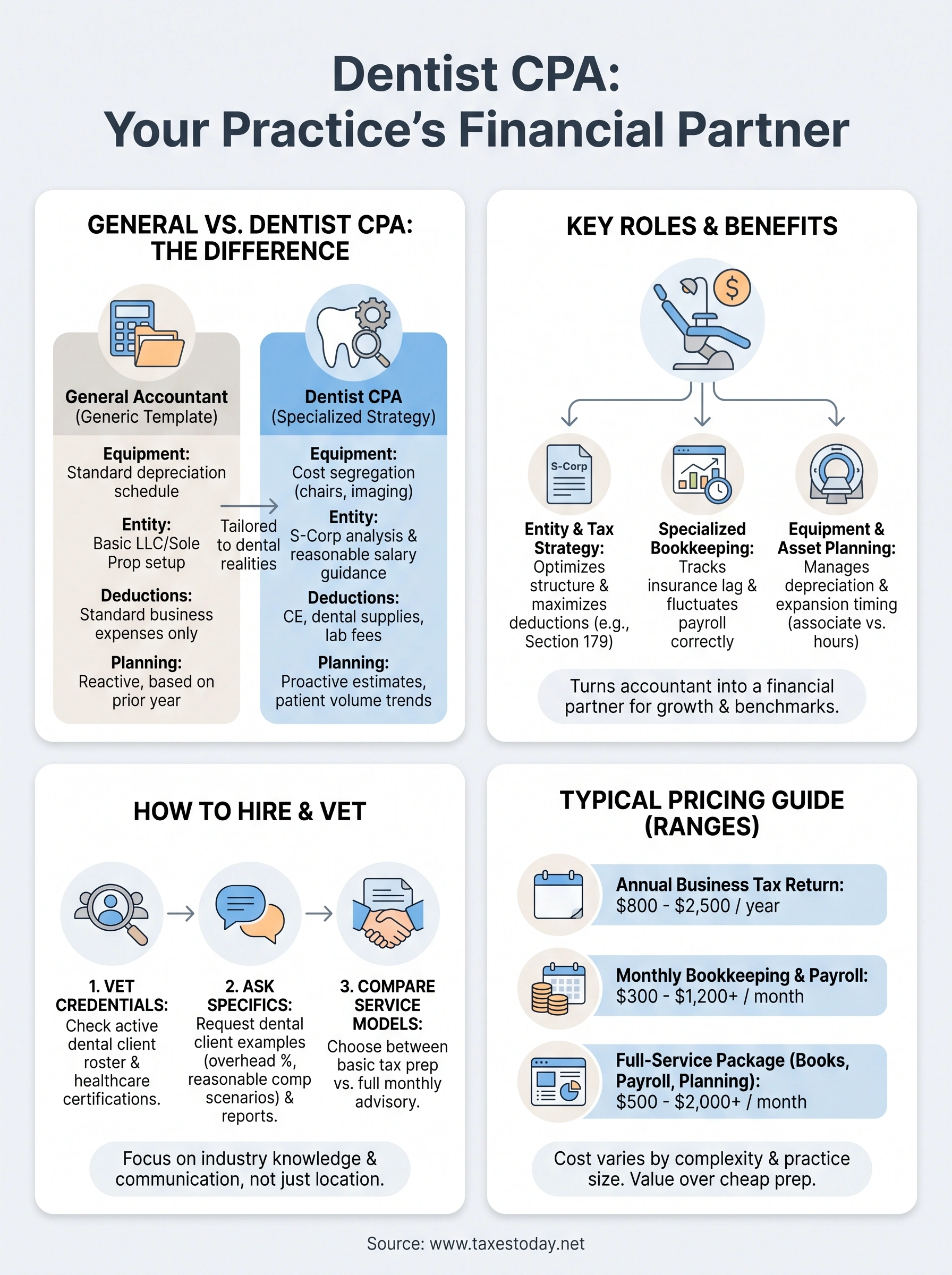
Here's a quick look at what separates the two approaches:
| Situation | General accountant | Dentist CPA |
|---|---|---|
| Equipment purchases | Standard depreciation schedule | Cost segregation for chairs, imaging tech, buildouts |
| Entity structure | Basic LLC or sole prop setup | S-Corp election analysis, reasonable salary guidance |
| Deductions | Standard business expenses only | CE courses, dental supplies, lab fees, licensing dues |
| Cash flow | Monthly reconciliation | Insurance reimbursement lag tracking, production reports |
| Quarterly planning | Reactive, based on prior year | Proactive estimates tied to patient volume trends |
Without this level of attention, practices routinely overpay in taxes or misclassify expenses that later draw IRS scrutiny. Missing a Section 179 deduction on new equipment, for instance, can cost thousands in a single filing year. Overlooking continuing education or dental society dues as deductible expenses adds up fast when you multiply it across associates and hygienists on staff.
Beyond compliance, a dentist-focused CPA gives you benchmarks. They can tell you how your overhead ratio compares to similar practices, whether your staffing costs are running high, and when it makes sense to bring on an associate versus expand your hours. That kind of insight turns your accountant into a financial partner rather than a once-a-year tax filer, which matters when you're trying to grow the practice, not just survive the season.
How to find the right dentist CPA for your practice
Finding a dentist cpa takes more digging than a quick search for accountants near me. Start by asking your dental society, study club, or even your equipment rep for referrals. Dentists talk to each other about money more than you'd think, and a name that comes up twice from trusted colleagues is worth a call.
Look past the zip code
Geography matters less than it used to. Plenty of firms serve dental clients nationwide through secure portals, video calls, and cloud accounting software like QuickBooks Online. If you're in Orange County, a local dental accountant who understands California's franchise tax and payroll rules still has an edge, the same reason many owners start by comparing an Orange County tax accountant, but don't rule out a remote specialist with deep dental experience over a generalist down the street.
The right dentist CPA is the one who already knows your industry, not just the one closest to your office.
Check their client roster and credentials
Before you commit, confirm a few basics:
- Active client base: Do they currently work with multiple dental or medical practices, not just one from years ago?
- Credentials: Are they a licensed CPA, and do they carry any additional certifications in healthcare or dental accounting?
- Software fit: Do they work inside the practice management and accounting tools you already use, like Dentrix or Eaglesoft integrations?
- Availability: Will you get a dedicated contact, or get routed through a call center during busy season?
Running through this list before you sign anything saves you from discovering mismatches six months in, when switching accountants mid-year creates its own headaches.
Questions to ask before hiring a dentist CPA
Once you've narrowed your list, the interview itself tells you more than any website bio. Treat it like a working session, not a sales pitch, and pay attention to whether the person answers with specifics or vague reassurances. A qualified dentist CPA should be able to walk you through real numbers from other dental clients, not just industry generalities.
Ask about their dental-specific experience
Go beyond "have you worked with dentists before" and push for detail:
- How many active dental or medical practice clients do you currently manage?
- What's a typical overhead percentage you see in practices my size?
- How do you handle S-Corp reasonable compensation for dentists specifically?
- Can you walk me through a Section 179 deduction you've applied for equipment like mine?
Specific, confident answers here separate a true specialized accounting firm from someone who added "dental" to their marketing after landing one client, the same test worth applying when vetting any tax expert near you.
If a CPA can't cite a real dental client scenario, they're learning on your dime.
Ask about communication and turnaround
Beyond the numbers, find out how the relationship actually works day to day. Request a sample of the monthly or quarterly reports you'll receive, and ask who prepares them, an associate or the CPA themselves. Confirm response times for questions during tax season versus the rest of the year, since a two-week delay in March can mean a missed estimated payment deadline.
Finally, ask what happens if the IRS sends a notice. A dental practice CPA worth hiring should include audit support or representation guidance as part of the relationship, not as a costly add-on you discover after the fact.
What dentist CPA services typically cost
Pricing for a dentist cpa varies more than most practice owners expect, and it depends heavily on whether you need basic tax prep or ongoing monthly bookkeeping with payroll and advisory work baked in. A solo practitioner filing a straightforward S-Corp return might pay a flat annual fee, while a multi-location practice with associates and multiple payroll runs will pay for monthly reconciliation, quarterly estimates, and year-end planning on top of the return itself.

Typical fee ranges
Here's a general breakdown of what practices report paying, though your actual quote depends on practice size, entity type, and how clean your books already are:
| Service | Typical cost range |
|---|---|
| Annual business tax return (S-Corp/LLC) | $800 to $2,500 |
| Monthly bookkeeping and reconciliation | $300 to $1,200/month |
| Payroll processing | $75 to $200/month plus per-employee fees |
| Quarterly tax planning | $150 to $500 per quarter |
| Full-service package (books, payroll, taxes) | $500 to $2,000+/month |
Cheap tax prep that misses a Section 179 deduction or a reasonable-salary mistake costs far more than a specialist's monthly fee.
What drives the price up or down
Several factors push these numbers higher or lower. A practice with clean, current books pays less than one that needs a year of catch-up entries. Multiple entities, associate buy-ins, or a recent equipment purchase all add complexity that shows up in the invoice. If you're comparing quotes, ask exactly what's included, since some firms bundle bookkeeping and tax prep while others bill them separately. TaxesToday.net structures its small business tax preparation services this way, with transparent pricing so you know upfront what you're paying for before any work begins.
Choosing the right financial partner
A dentist cpa does more than file your return once a year. They build your books around how dental practices actually earn and spend money, guide your entity structure, and catch deductions that keep more cash in your practice instead of going to the IRS. Getting this right means fewer surprises in April and a clearer picture of where your practice stands financially year-round.
Before you sign with anyone, run through the questions in this guide, compare pricing against the ranges above, and confirm they already work with dental clients like you. Your practice's finances deserve someone who treats them as a specialty, not an afterthought squeezed in during tax season.
If you're ready to get your return handled by preparers who understand self-employed and small business filings, start your tax preparation with TaxesToday.net and see what accurate, affordable filing actually looks like.