



Construction Tax Preparation: Key Rules, Deductions & Tips
Construction businesses deal with tax rules that most other industries never touch. Between long-term contract accounting methods, job costing across multiple projects, and fluctuating material costs, construction tax preparation requires a level of detail that generic tax software simply can't handle. One misclassified expense or incorrect method of revenue recognition can trigger IRS scrutiny, or leave thousands of dollars in deductions unclaimed.
Whether you're an independent contractor framing houses, a subcontractor running a small crew, or an LLC managing commercial builds, your tax situation has layers that demand specialized attention. Worker classification rules alone, distinguishing W-2 employees from 1099 subcontractors, create compliance risks that catch construction business owners off guard every filing season. Add in equipment depreciation, the home office deduction, and retainage accounting, and you're looking at a return that needs real expertise behind it.
At TaxesToday, we prepare taxes for self-employed individuals, independent contractors, and small business owners across California and nationwide, including those in the construction trades. This guide breaks down the key tax rules, deductions, and strategies specific to the construction industry so you know exactly what applies to your situation. We'll cover everything from choosing the right accounting method to maximizing write-offs on tools, vehicles, and job-site expenses, giving you a clear path toward a more accurate and beneficial return.
Why construction tax prep is different
Construction businesses don't fit neatly into a standard tax return. Revenue patterns, expense timing, and workforce structures in the construction industry create tax situations that most general-purpose approaches miss entirely. When you're managing multiple active projects at different stages of completion, you can't apply the same simple income-and-expense tracking that a retailer or consultant uses. Proper construction tax preparation requires understanding how the IRS expects you to report income and expenses based on how your contracts are structured.
Revenue timing and contract accounting
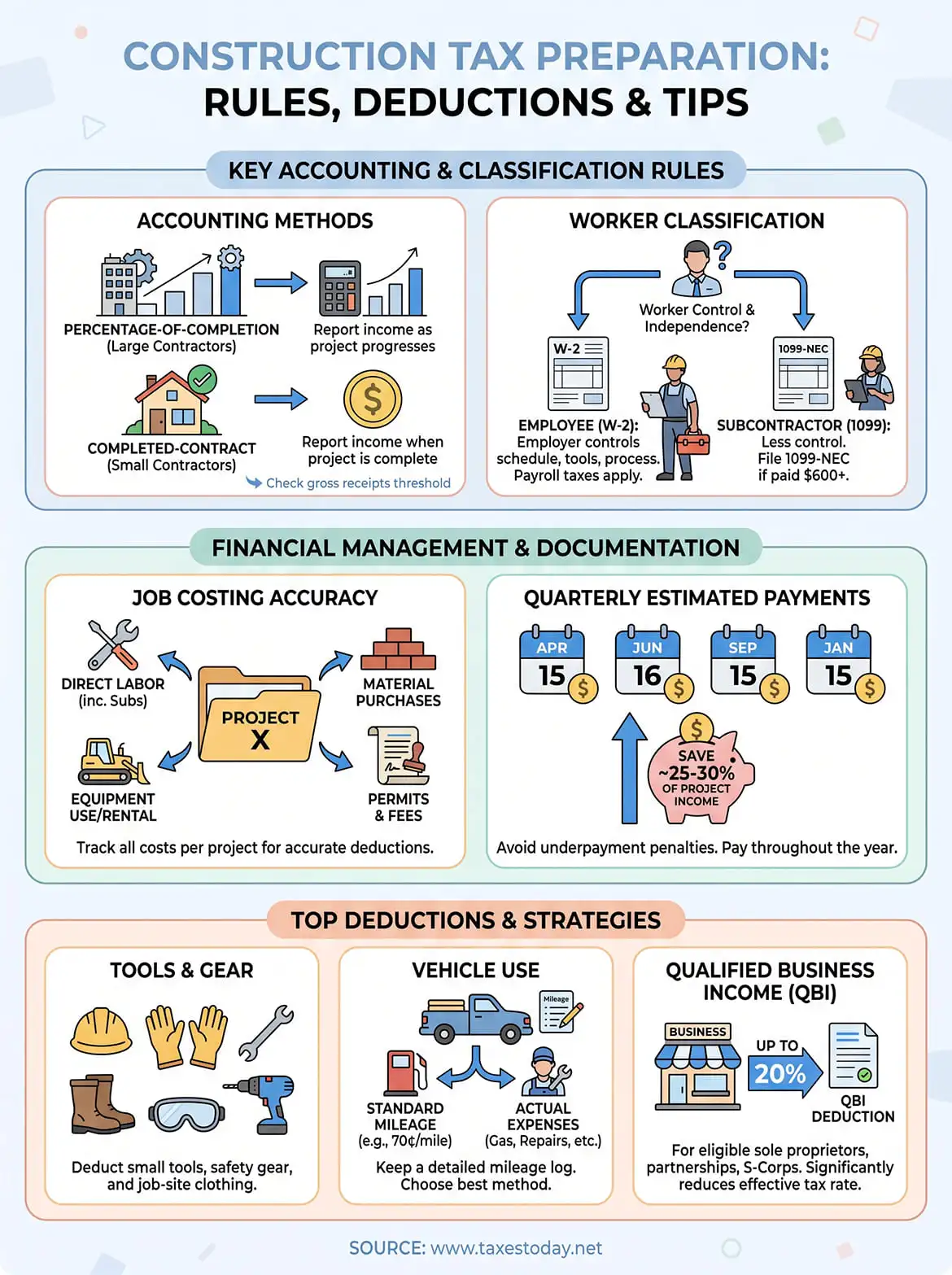
Most businesses recognize income when they receive payment. Construction contractors often can't do that, because projects span months or years, and payments arrive in installments tied to milestones rather than delivery. The IRS recognizes this and allows certain contractors to choose between accounting methods, including the percentage-of-completion method and the completed-contract method. The method you use determines when you report income and when you deduct costs, which directly affects your tax bill in any given year.

Choosing the wrong accounting method for your contract size and business type can shift significant tax liability to the wrong year, triggering underpayment penalties.
These rules also differ based on your gross receipts. Small contractors with average annual gross receipts under $30 million (adjusted for inflation) may qualify to use the completed-contract method or the cash method, which offers more flexibility. Larger contractors generally must use the percentage-of-completion method. Getting this wrong isn't a minor clerical error; it can mean restating income across multiple prior-year returns.
Worker classification and subcontractor rules
Construction businesses routinely use a mix of employees and subcontractors, and the IRS pays close attention to how you classify each worker. If you pay someone as a 1099 subcontractor but control their schedule, tools, and work process the way you would an employee, the IRS can reclassify that worker and bill you for back payroll taxes plus penalties. The degree of behavioral and financial control you exercise over a worker drives the classification decision, not what a written agreement says.
Your paperwork obligations also increase when you use subcontractors. You must file Form 1099-NEC for any subcontractor you pay $600 or more in a calendar year, and missing those filings is one of the most consistent audit triggers for construction businesses.
Job costing and why it matters for taxes
Every project you run generates its own set of costs, from materials and labor to permits and equipment rental. Job costing is the process of tracking those costs against a specific project, and it matters for taxes because it determines when and how much you can deduct. Without accurate job costing records, you risk missing deductions entirely because costs weren't documented at the time they occurred. At a minimum, your job cost records should capture:
- Direct labor costs per project, including subcontractor payments
- Material purchases tied to specific jobs
- Equipment use or rental allocated by project
- Permits, inspections, and fees specific to each site
Key tax rules for construction businesses
Construction businesses operate under specific federal tax rules that differ from standard small business obligations. Understanding these rules before you file keeps you compliant and helps you plan strategically throughout the year, not just at tax time. Solid construction tax preparation starts with knowing which rules apply to your business structure and contract size.
Self-employment tax and quarterly estimated payments
If you operate as a sole proprietor or single-member LLC, you owe self-employment tax on your net profit, currently 15.3% on the first $176,100 of net earnings for 2025 and 2.9% above that threshold. The IRS expects you to cover this through four estimated quarterly payments rather than waiting until April. Missing those payments results in underpayment penalties that stack on top of your actual tax liability.
Set aside roughly 25 to 30 percent of each project payment you receive to cover both income tax and self-employment tax throughout the year.
Your quarterly payment due dates are April 15, June 16, September 15, and January 15. If a job runs long and your income spikes in the second half of the year, you may need to adjust your estimates upward to avoid a shortfall at filing.
Equipment deductions and material cost rules
Construction businesses spend heavily on equipment, and the IRS provides two main tools to recover those costs faster than standard depreciation allows. Section 179 lets you deduct the full cost of qualifying equipment in the year you place it in service, up to $1,220,000 for 2025. Bonus depreciation gives you additional first-year deductions on new and used equipment, though the percentage has been phasing down in recent years.
Beyond equipment, you also need to track how you handle sales tax on materials. Many contractors purchase supplies tax-free with a resale certificate, then collect sales tax from the project owner at billing. If you skip that step or purchase materials for your own use without paying use tax, the state can assess that liability during an audit, which applies whether you work in California or anywhere else nationwide.
Deductions and credits contractors miss
Even experienced contractors leave money on the table at filing time. Thorough construction tax preparation catches write-offs that generic software overlooks, and the difference between a complete return and a sloppy one often comes down to knowing which deductions apply specifically to the trades.
Tools, materials, and protective gear
Small tools you buy throughout the year, like saws, levels, drill bits, and hand tools under a certain dollar threshold, are fully deductible as business expenses in the year you purchase them. You can also deduct work boots, hard hats, gloves, and safety gear required on job sites, though general-purpose clothing that could be worn outside of work does not qualify. Keep your receipts organized by job throughout the year rather than scrambling at filing time.
- Safety glasses, respirators, and hearing protection
- Job-site clothing with company branding
- Consumable materials used in the course of work
Vehicle use for job sites and supply runs
Driving to job sites, picking up materials, and hauling equipment all count as deductible business mileage. Claiming either the standard mileage rate or your actual vehicle expenses is an option, and the right choice depends on your specific usage patterns. For 2025, the IRS standard mileage rate for business use is 70 cents per mile. Track every trip with a mileage log that records the date, destination, purpose, and miles driven.

A mileage log kept throughout the year is far easier to defend during an audit than a reconstructed estimate made at filing time.
The qualified business income deduction
If you operate as a sole proprietor, partnership, or S-Corp, you may qualify for the Section 199A deduction, which lets eligible business owners deduct up to 20% of qualified business income from their federal taxable income. Construction businesses generally qualify because the industry is not listed among the excluded service trades. This deduction can significantly reduce your effective tax rate, making it one of the most valuable write-offs available to contractors.
How to prepare construction business taxes
Preparing your taxes as a construction business owner works best when you treat it as a year-round process, not a once-a-year scramble. Solid construction tax preparation depends on keeping clean records at the project level, staying current on estimated payments, and organizing your documentation before a tax professional ever sees your return. Getting this process right reduces your tax bill, speeds up your filing, and gives you a clear defense if the IRS ever asks questions.
Organize your records by project and category
Strong records are the foundation of an accurate filing. Separate your income and expenses by project throughout the year, not just at year-end. Use accounting software or a dedicated spreadsheet to log every material purchase, subcontractor payment, permit fee, and equipment cost tied to each job. When filing time comes, you'll want bank statements, receipts, 1099s received, and mileage logs all in one place so nothing gets missed and no deduction goes unclaimed.
The cleaner your records are before you hand them to a tax preparer, the lower your preparation cost and the lower your audit risk.
Keep these documents organized and accessible throughout the year:
- Invoices issued and payments received per project
- Subcontractor agreements and 1099-NEC copies filed
- Equipment purchase receipts and any related loan statements
- Mileage logs covering job-site travel and supply runs
Choose the right filing approach for your structure
Your business structure determines which tax forms you file. A sole proprietor or single-member LLC files a Schedule C attached to Form 1040. An S-Corp files Form 1120-S and issues you both a W-2 and a Schedule K-1. Knowing which forms apply prevents late filings and missed elections that cost you money. If your situation involves subcontractors, equipment purchases, or contracts that span multiple tax years, working with a tax professional who knows the construction industry delivers real returns in accuracy and reduced liability.
Common mistakes and audit red flags
Even contractors with clean intentions file returns that draw IRS attention. Construction tax preparation involves enough moving parts that small errors compound, and certain patterns consistently raise flags during audits. Knowing where mistakes typically happen gives you a real opportunity to correct them before they cause problems.
Misclassifying workers and skipping 1099 filings
Worker misclassification is the most common audit trigger for construction businesses. If you treat someone like an employee but pay them as a 1099 subcontractor, the IRS can assess back payroll taxes, interest, and penalties that stretch back years. The determination hinges on behavioral control, financial control, and the nature of the working relationship, not on what your contract calls the worker.
Failing to file Form 1099-NEC for subcontractors paid $600 or more is one of the fastest ways to attract IRS scrutiny during an audit.
Skipping the 1099 filing is a separate but related problem. If you paid five subcontractors last year and filed zero 1099-NECs, the IRS can flag that discrepancy when your subcontractors report their own income. The cost of correcting that after an audit far exceeds the time it takes to file the forms correctly from the start.
Mixing personal and business expenses
Running personal expenses through your business account creates a messy paper trail that auditors notice immediately. Vehicle costs are the most frequent source of this problem. Claiming 100% business use on a vehicle you also use for personal driving is a red flag, and the IRS expects a mileage log to support whatever percentage you claim.
The same issue surfaces with home office deductions that don't meet the exclusive-use requirement. If you deduct a room as a home office but use it for other purposes, that deduction becomes indefensible under audit. Keep your business finances in a dedicated business account, track personal versus business vehicle use separately, and document any home office space clearly before claiming it on your return.
Next steps for a clean filing
Construction tax preparation comes down to one thing: being prepared before tax season arrives, not during it. Start now by separating your project income and expenses in dedicated accounting software, logging every mile you drive for business, and filing 1099-NECs for any subcontractor you paid $600 or more this year. These three habits alone eliminate the most common mistakes that cost contractors money and trigger audits.
Working with a tax professional who understands construction accounting methods, worker classification rules, and industry-specific deductions turns a stressful filing into a predictable process. You stop guessing which method applies to your contracts, and you stop leaving deductions on the table. If you're a contractor, independent tradesperson, or small construction business owner looking for accurate, affordable filing from certified professionals, get your construction taxes prepared by TaxesToday and file with confidence this year.