


Cheap Tax Filing Near Me: How To Get Free Or Low-Cost Help
If you've searched for cheap tax filing near me, you're not alone, and you're not wrong for wanting to keep costs down. Tax preparation fees have climbed steadily over the past several years, and paying hundreds of dollars just to file a straightforward return doesn't sit right with most people. The good news is that free and low-cost tax filing options actually exist, and many of them are closer than you think.
From IRS-sponsored programs like VITA and TCE to discounted software and local tax offices with transparent pricing, there are real ways to get your taxes done accurately without draining your bank account. The trick is knowing where to look, what qualifies you for free services, and when it makes sense to pay a professional instead of going the DIY route.
At TaxesToday, we've helped thousands of individuals, freelancers, and small business owners file their taxes, with services starting at $99 and options for both virtual and in-person appointments. We built this guide because we believe everyone deserves to understand their choices before committing to a tax prep method. In this article, we'll walk you through every major option for affordable tax filing in 2026, explain who qualifies for free programs, and help you figure out which path actually makes sense for your situation.
What cheap tax filing really means
When most people search for cheap tax filing near me, they're thinking about the upfront dollar amount. But the actual cost of filing your taxes runs deeper than the fee you pay at a desk or online checkout. Cheap filing means different things depending on your situation: a free option that misses deductions can cost you more in the long run than a paid preparer who finds credits you didn't know existed.
The real cost breakdown of tax preparation
Tax preparation fees vary widely based on the complexity of your return. A basic W-2 return with one income source looks very different from a return with self-employment income, rental property, multiple states, or deductions like a home office. Understanding what drives the price helps you comparison-shop without getting blindsided at the end.
Here's a general breakdown of what different filing situations typically cost in 2026:
| Filing Situation | Typical Price Range |
|---|---|
| Simple W-2 only (1 employer) | Free to $80 |
| W-2 with itemized deductions or credits | $80 to $150 |
| Self-employed / 1099 income | $150 to $350 |
| Small business (Schedule C or S-Corp) | $300 to $600+ |
| Amended return (Form 1040-X) | $100 to $250 |
| Non-resident or international filer | $150 to $300 |
These ranges are general estimates. Your actual cost will depend on your location, the provider you choose, and the specific details of your return.
When "free" isn't actually free
Some services advertise free filing but charge fees for state returns, additional forms, or any income beyond basic W-2 wages. You might start the process expecting to pay nothing, then see a $40 to $60 charge appear at checkout because you received a 1099 or claimed a specific deduction. This is a common practice with large online software platforms, and it trips up a lot of filers every year.
Free filing programs backed by the IRS, such as VITA and IRS Free File, do not tack on surprise fees at checkout, which is exactly what makes them worth checking before anything else.
Reading the fine print before you start any online return saves you real time and real frustration. Look specifically for language around state return fees and income-type restrictions before you enter a single number into any form.
What cheap actually costs you if you make mistakes
Filing errors are expensive in ways that are easy to underestimate. The IRS charges a failure-to-pay penalty of 0.5% per month on any unpaid tax balance, and if you miss a credit or deduction you were entitled to, that's money you simply don't get back. A return that costs you nothing to file but results in a $400 smaller refund is not actually cheap by any reasonable measure.
Accuracy matters more than the line-item filing fee. Missed credits like the Earned Income Tax Credit, Child and Dependent Care Credit, or deductions for student loan interest add up fast, and they're the exact type of items a qualified preparer catches that tax software sometimes doesn't prompt you about.
The right approach is to match your filing method to your actual tax situation. If you have a straightforward return with no complications, a free option handles it well. If your return involves business income, multiple income sources, or prior-year issues, spending a modest amount on a professional typically returns more than it costs.
Step 1. Check if you qualify for free filing
Before spending a dollar on tax prep, find out whether you qualify for a completely free filing option backed by the IRS. Millions of Americans skip this step entirely and end up paying for something they could have gotten at no cost. Checking your eligibility takes about two minutes and can save you anywhere from $50 to $300 depending on the service you would have paid for otherwise.
IRS Free File income threshold
The IRS partners with tax software companies through its Free File program, which lets eligible filers complete and submit their federal return at zero cost. For the 2025 tax year (returns filed in 2026), you qualify if your adjusted gross income (AGI) is $84,000 or below. That threshold covers a large portion of individual filers in the United States.
If your income falls under $84,000, you should check the IRS Free File program at irs.gov/freefile before looking at any paid option.
You can find your AGI on line 11 of your prior-year Form 1040. If you don't have that form, your most recent W-2 or 1099 total income gives you a working estimate to check eligibility quickly. Each participating software company within Free File sets its own age and income rules, so browse the full list on the IRS website to find the one that matches your situation.
VITA and TCE qualification criteria
Volunteer Income Tax Assistance (VITA) and the Tax Counseling for the Elderly (TCE) program offer free in-person tax prep at thousands of community sites. These are IRS-certified volunteers who prepare your return at no charge, and they're a strong answer to the common search for cheap tax filing near me that actually means free filing with a real person.
VITA generally serves filers who meet one or more of the following criteria:
- Income of $67,000 or less per year
- A disability that makes self-filing difficult
- Limited English-speaking ability
TCE focuses specifically on taxpayers age 60 and older, with particular expertise in pension and retirement-related tax questions. Both programs prepare federal and most state returns, and neither program charges you anything at the point of service. You bring your documents, a certified volunteer handles the preparation, and you leave with a completed, e-filed return.
Step 2. Find free tax prep sites near you
Knowing that free filing programs exist is only half the job. The other half is actually locating a nearby VITA or TCE site that's open, staffed, and accepting new filers. This step is more straightforward than most people expect, and it takes less than five minutes to find a location you can walk into this week.
Use the IRS VITA locator tool
The IRS maintains a free, searchable VITA site locator at irs.gov that lets you search by zip code. You enter your zip code, set a search radius, and the tool returns a list of nearby sites with addresses, hours, phone numbers, and language services available. This is the most reliable way to find cheap tax filing near me options that are actually free with no hidden fees.
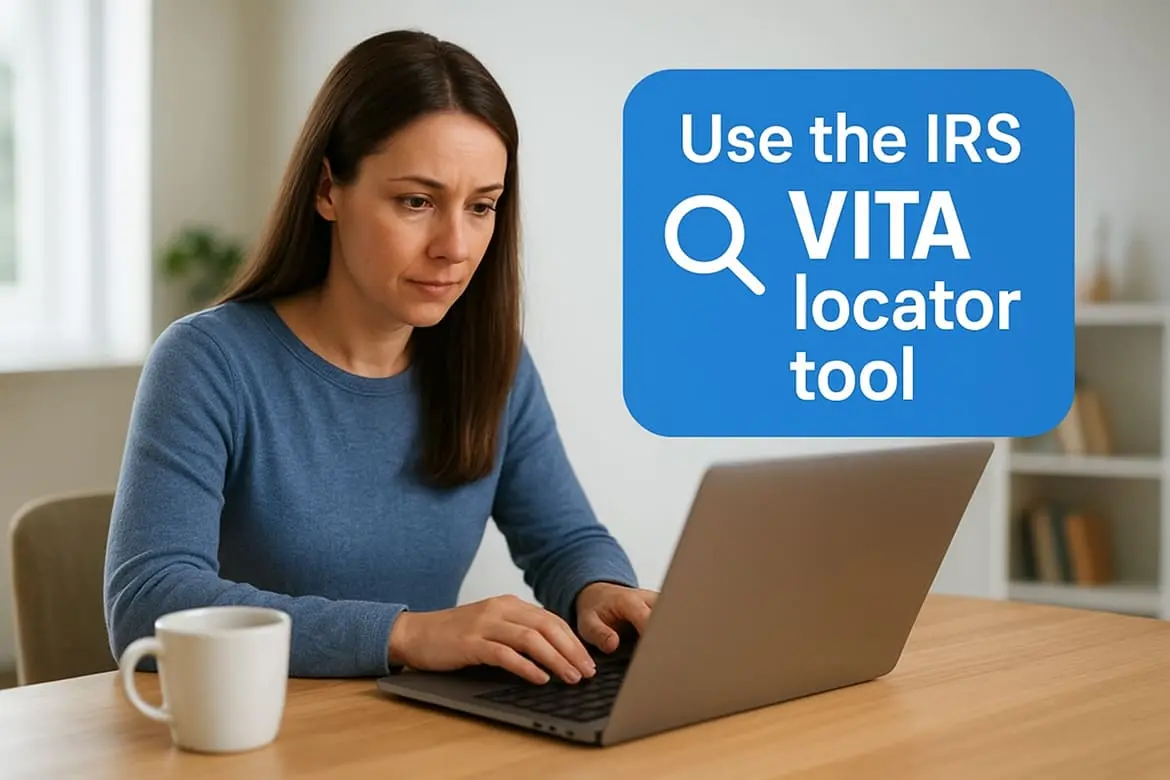
Always call ahead before visiting a VITA site, since hours and appointment availability change throughout filing season and some sites close once volunteer capacity fills up.
Follow these steps to find a site near you:
- Go to the IRS free tax prep locator page
- Enter your zip code and select a search radius (5 to 25 miles is a practical starting point)
- Review the results list, noting which sites require appointments versus accepting walk-ins
- Call the site directly to confirm they handle your specific filing situation (some sites do not prepare returns with self-employment income or rental income)
- Write down the documents they ask you to bring before your appointment
What to expect at a free prep site
When you arrive at a VITA or TCE site, an IRS-certified volunteer will review your documents, ask you questions about your income and filing status, and prepare your federal and state returns. The volunteer typically e-files your return on the spot or gives you a copy to review before submission. You do not pay anything, and you do not sign a blank return.
Most sites handle standard filing situations efficiently, including W-2 income, basic credits like the Earned Income Tax Credit, and straightforward deductions. If your return involves rental property, a business with employees, or international income, the volunteer may refer you to a paid preparer with the experience to handle those specifics accurately.
Step 3. Compare low-cost paid options nearby
Free programs are the right starting point, but they don't fit every filing situation. If you have self-employment income, rental property, or a more complex return, a low-cost paid preparer is often worth the fee. The key is knowing what's actually available nearby and how to compare prices before you sit down and hand over your documents.
National retail tax chains
National chains like H&R Block and Jackson Hewitt operate walk-in locations across most cities and suburbs, which makes them a practical answer when you're searching for cheap tax filing near me and need a physical office fast. These chains typically publish starting prices for basic returns, though your final fee rises with every form they add to your return. A simple W-2 return might run $100 to $180, while adding a Schedule C for freelance income can push the total past $300 at some locations.
Before you sit down at a retail chain, ask directly for a written estimate based on your specific forms, since the starting price on the sign rarely reflects what a self-employed filer actually pays.
Walk-in availability and extended hours during filing season are genuine advantages these offices offer, especially if you need to get something filed quickly or prefer to speak with someone face-to-face.
Local independent preparers
Independent tax preparers and smaller local firms often charge meaningfully less than national chains for identical work. An enrolled agent or CTEC-certified preparer in your area may handle a 1099 return for $150 to $200 less than a retail chain charges for the same forms. You get a licensed professional and a more predictable fee structure, without the markup built into large franchise operations.
Use the IRS Directory of Federal Tax Return Preparers at irs.gov to find credentialed preparers near you who hold an active Preparer Tax Identification Number (PTIN). Every paid preparer is legally required to have one, and the directory lets you filter by credential type and location.
What to compare before you choose
When you contact any paid preparer, ask these specific questions to get a fair comparison:
- What is your base fee for my filing status and primary income type?
- Do you charge extra for each additional form or schedule added to the return?
- Is the state return included in the quoted price or billed separately?
- How do you handle errors or audit notices after filing?
Getting clear answers to all four questions from at least two providers gives you a real side-by-side comparison and protects you from surprise charges at the end.
Step 4. Gather the right documents before you go
Walking into any tax appointment, whether at a free VITA site or a low-cost paid preparer, without your documents is the fastest way to waste an afternoon and delay your refund. Preparers cannot complete your return without your information in hand, and missing even one form means a second trip or a delayed filing. Taking 20 minutes to gather everything before you go removes that friction entirely.
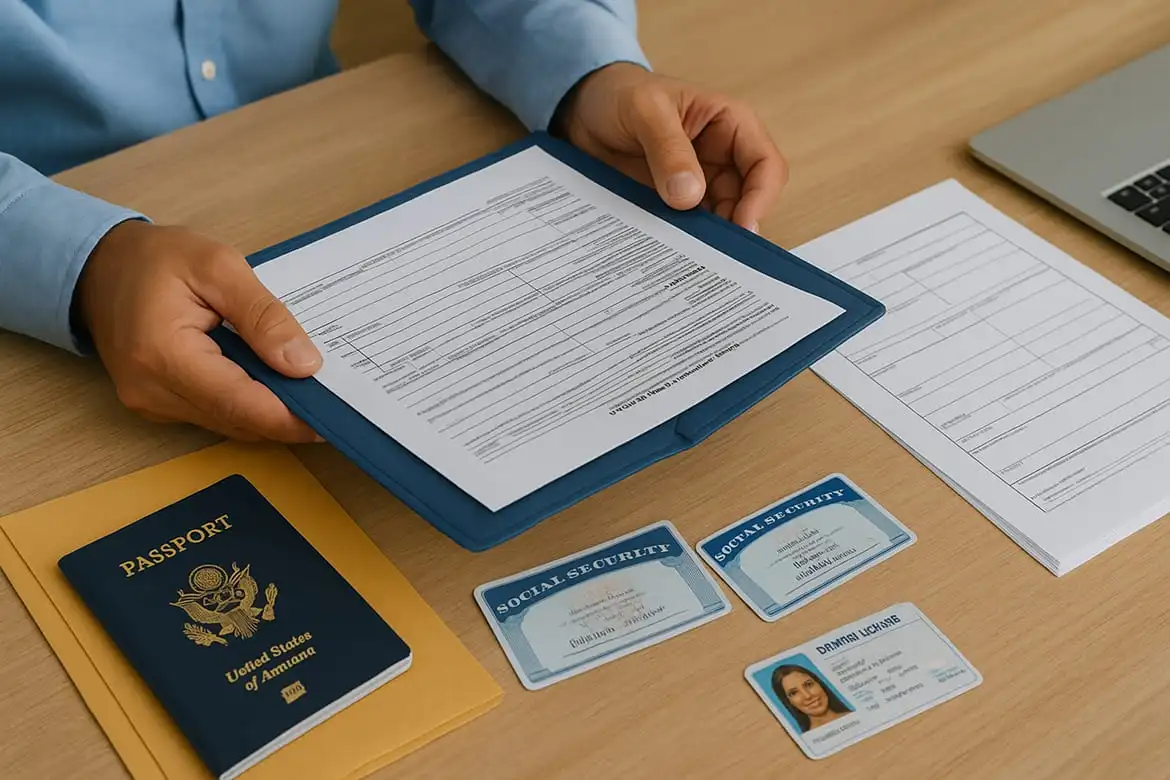
Showing up prepared is one of the simplest things you can do to keep your appointment short, your preparer's time focused, and your total cost as low as possible, especially if you found a cheap tax filing near me option that bills by the hour.
Identity and filing status documents
Your preparer needs to verify who you are and who you're filing for before touching any numbers. Bring a government-issued photo ID such as a driver's license or passport for yourself and your spouse if filing jointly. If you're claiming dependents, bring their Social Security cards or Individual Taxpayer Identification Number (ITIN) letters, along with their dates of birth. Missing dependent information is one of the most common reasons a preparer has to pause or reschedule a session.
- Government-issued photo ID (yours and your spouse's if applicable)
- Social Security cards for all dependents
- ITIN letters for any non-resident or foreign filer on the return
- Prior-year tax return (Form 1040) for reference
Income documents
Every source of income needs a matching form, and forgetting one can result in an amended return later, which costs additional time and sometimes additional fees. Collect all income documents before your appointment and check each one against the list below.
- W-2 for each employer you worked for during the year
- 1099-NEC or 1099-MISC for freelance or contract income
- 1099-INT and 1099-DIV for interest and dividend income
- 1099-G if you received unemployment compensation
- SSA-1099 for Social Security benefits
- Records of any other income, including cash payments or side work
Deduction and credit records
Deductions and credits are where many filers leave money behind because they arrive without documentation to support them. Bring receipts, statements, or letters for anything you plan to claim. Common items include mortgage interest statements (Form 1098), student loan interest statements, childcare provider receipts with the provider's tax ID, charitable donation acknowledgment letters, and records of any estimated tax payments you made during the year.
Step 5. Pick a preparer you can trust
Finding a cheap tax filing near me option matters, but the preparer you hand your documents to matters just as much as the price. A low fee means nothing if the person making errors on your return disappears after filing season ends or refuses to stand behind their work. Taking a few extra minutes to verify credentials before you commit protects you from problems that cost far more than the filing fee you saved.
Check credentials and registration
Every paid tax preparer in the United States is required by law to hold a valid Preparer Tax Identification Number (PTIN), issued and renewed annually by the IRS. You can verify that a preparer has an active PTIN through the IRS Directory of Federal Tax Return Preparers, which is searchable by name, zip code, and credential type. Beyond the minimum PTIN requirement, look for preparers who hold one of the following recognized credentials:
- Enrolled Agent (EA): Licensed directly by the IRS with unlimited practice rights and the ability to represent you in an audit
- Certified Public Accountant (CPA): State-licensed with broad tax and accounting authority
- CTEC-Registered Tax Preparer (CRTP): Required for paid preparers in California, meaning they've completed state-mandated education and carry a surety bond
- Annual Filing Season Program (AFSP) participant: Has completed continuing education and holds limited representation rights before the IRS
Choosing a credentialed preparer means you have a real point of accountability if something goes wrong on your return after filing.
In California specifically, any paid preparer who is not a CPA, EA, or attorney must be registered with CTEC to legally prepare returns for compensation. Verifying this takes less than two minutes on the CTEC website and protects you from paying someone who is operating without the required license.
Red flags to watch before you sign anything
A trustworthy preparer will always ask you detailed questions about your income, deductions, and life changes before preparing anything. If someone quotes you a firm price without reviewing your documents first, or promises a large refund before seeing a single form, treat both as warning signs.
Never sign a blank or incomplete return, and avoid any preparer who asks you to sign before the return is fully filled in. Your preparer is also required to give you a copy of your completed return at no extra charge, and they must sign it themselves with their PTIN included.
Step 6. File smart and avoid expensive mistakes
Getting your taxes prepared, whether through a free program or a cheap tax filing near me option, is only the second-to-last step. The final one is making sure what gets submitted is accurate and on time. Filing errors and missed deadlines create penalties and interest that erase any savings you built up by finding an affordable preparer in the first place.
Review your return before it goes out
Your preparer should hand you a completed copy of your return to review before you sign anything. Do not skip this step. Look at each number and confirm it matches the documents you brought. Check that your name, Social Security number, bank account details for direct deposit, and filing status are all correct. A typo in your bank routing number delays your refund by weeks.
Run through this checklist before signing:
- Name and SSN match exactly what appears on your Social Security card
- All income sources are listed (check each W-2 and 1099 against the return)
- Direct deposit information is correct if you expect a refund
- Your filing status matches your actual household situation
- Any credits you discussed with your preparer (Earned Income Credit, Child Tax Credit) appear on the return
If you spot a discrepancy, point it out before you sign. Correcting an error before filing costs nothing. Fixing it after filing with an amended return costs time and sometimes money.
Know your deadline and what to do if you need more time
The standard federal filing deadline for most individual filers is April 15. Missing that date without filing an extension triggers a failure-to-file penalty of 5% of any unpaid tax per month, up to 25%. If you cannot complete your return in time, your preparer can file Form 4868 to extend your deadline to October 15, giving you six more months to file. The extension does not push back the deadline to pay, so if you owe taxes, estimate and pay by April 15 to avoid interest charges.
Track your refund after you file
Once your return is e-filed, the IRS typically processes it within 21 days. You can monitor your refund status using the IRS "Where's My Refund" tool at irs.gov. Keep a printed or digital copy of your completed return and all supporting documents for at least three years from the filing date in case the IRS has questions.
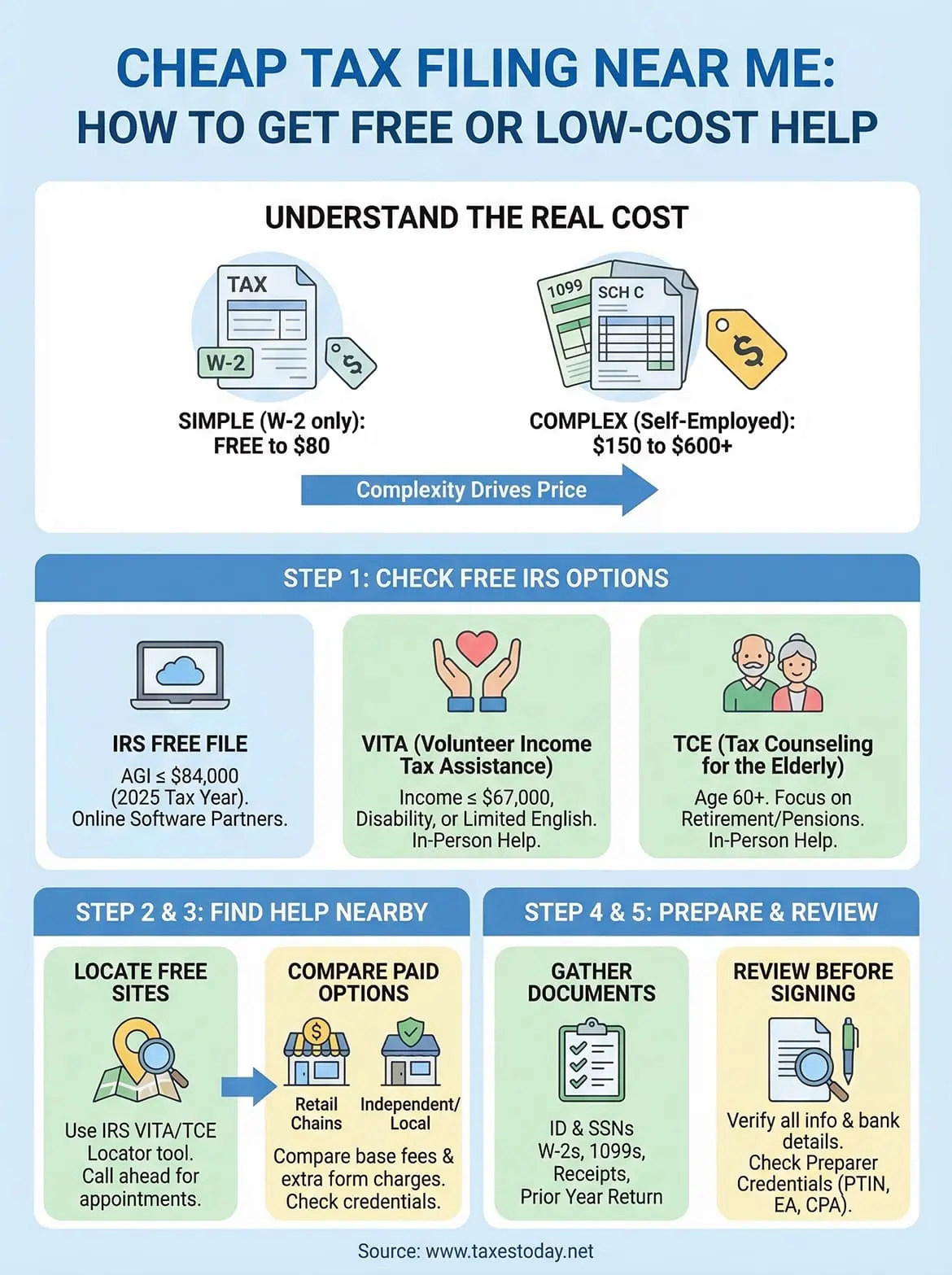
Quick recap and where to get help
Finding cheap tax filing near me options comes down to matching your situation to the right resource. If your income is $84,000 or below, check IRS Free File first. If you want in-person help at no cost, search for a VITA or TCE site near you using the IRS locator. For more complex returns involving freelance income, a small business, or a prior-year issue, a credentialed low-cost preparer gives you accuracy that free software sometimes misses.
No matter which path you choose, the steps stay the same: verify your eligibility, gather your documents before you go, check your preparer's credentials, and review your return before you sign. Those habits protect your money and your refund.
Ready to file with a licensed professional at a price that makes sense? Get affordable tax preparation starting at $99 with IRS-registered, CTEC-certified preparers who handle everything from W-2 returns to self-employment and small business filings.