



Trucking Tax Preparation: How To File & Cut Your Tax Bill
Owner-operators and small trucking businesses deal with a tax situation most filers never face. Between per diem deductions, heavy vehicle use tax, fuel credits, and depreciation on rigs worth six figures, trucking tax preparation demands more than a basic 1040. Miss the right deductions and you overpay. Claim them incorrectly and you're looking at an IRS notice, or worse.
The good news: truckers have access to some of the most generous write-offs in the tax code. The challenge is knowing exactly which ones apply to your operation and how to document them properly. That's where most owner-operators either leave money on the table or run into trouble. At TaxesToday, our licensed, CTEC-certified preparers work with self-employed filers and small business owners every day, and we understand the specific deductions and compliance rules that apply to the trucking industry.
This guide breaks down how to file your taxes as a truck driver or trucking business owner, which deductions can cut your tax bill significantly, and when it makes sense to hand things off to a professional. Whether you're an independent contractor hauling freight with a single rig or running a small fleet, you'll walk away with a clear plan for tax season, and beyond.
What makes trucking taxes different
If you're an owner-operator or run a small trucking company, you're not filing the same return as a typical self-employed person. Trucking businesses carry unique federal and state obligations that most other industries never touch, including the Heavy Highway Vehicle Use Tax (Form 2290), International Fuel Tax Agreement (IFTA) reporting, and special depreciation rules for vehicles over 6,000 pounds.
Self-employment tax and business structure
When you operate as a sole proprietor or single-member LLC, every dollar of net profit gets hit with self-employment tax: 15.3% on top of your regular income tax. That's the part that catches many new owner-operators off guard. How you structure your business, whether as a sole prop, LLC, or S-Corp, directly affects how much of that 15.3% you actually pay. Some truckers save thousands annually by electing S-Corp status once their net profit clears a certain threshold.
The IRS treats owner-operators as self-employed business owners, which means you're responsible for both the employer and employee portions of Social Security and Medicare taxes.
Industry-specific rules that change the math
Trucking tax preparation involves deduction categories you simply won't find in a standard freelancer return. The IRS allows long-haul truckers a per diem rate for meals and incidental expenses when they're away from home overnight on a run. That rate is 80% deductible for transportation workers, compared to 50% for most other businesses. On top of that, Section 179 and bonus depreciation let you write off a significant portion of your rig in the year you place it in service, rather than spreading the cost across five to seven years. Fuel tax credits, logbook requirements, and state-level IFTA filings add another layer that demands careful recordkeeping from day one.
Step 1. Get your paperwork and numbers ready
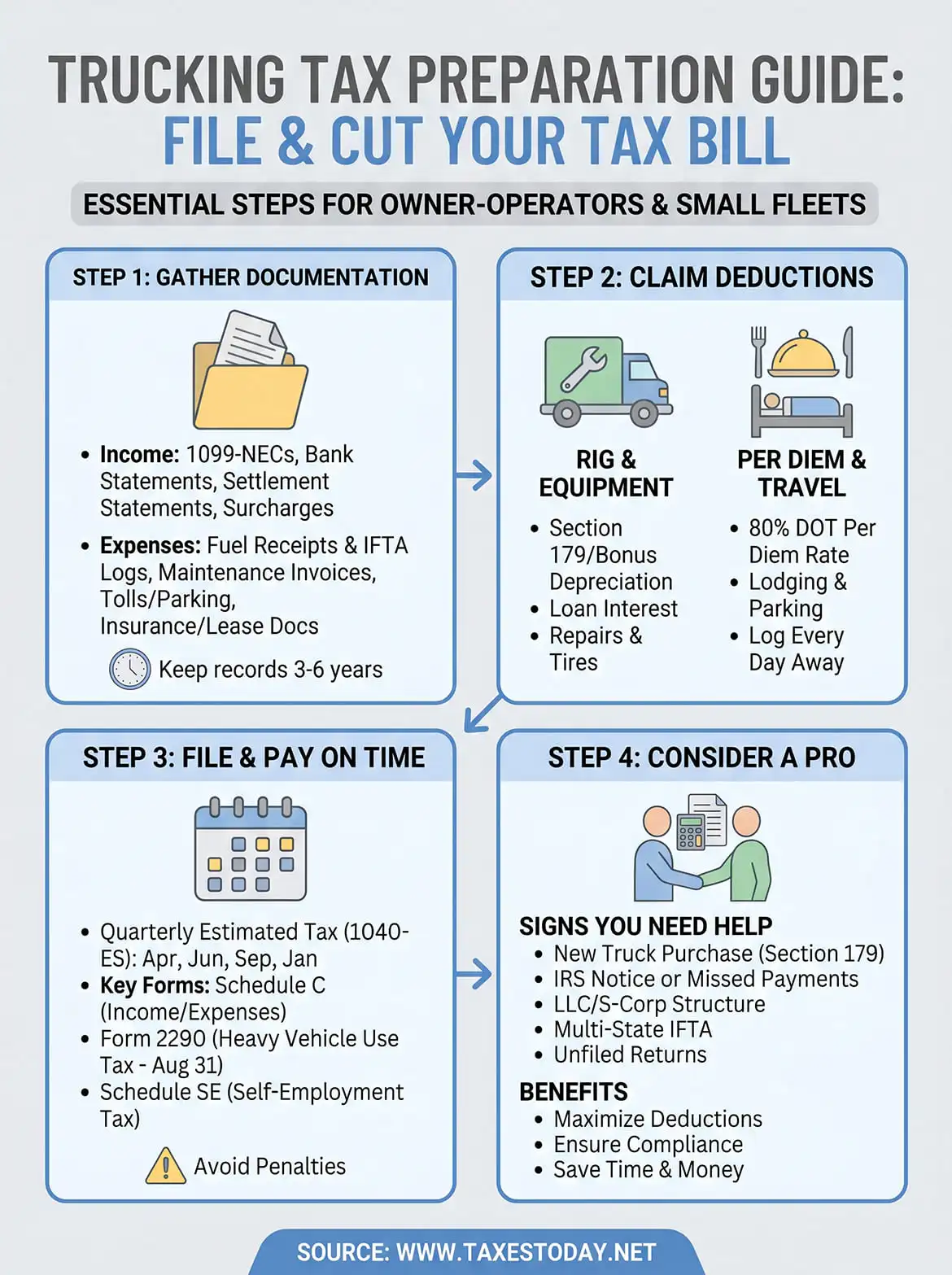
Before you touch a tax form, pull together every document that shows what you earned and what you spent over the year. Disorganized records are the number one reason truckers either miss deductions or get flagged during an audit. Starting your trucking tax preparation with complete documentation saves time and protects you if the IRS ever asks questions.
The IRS can audit returns up to three years back, and in cases of substantial underreporting, up to six years, so keep your records organized for at least that long.
Income records to collect
You need a clear picture of every dollar that came in. Gather the following before you file:
- 1099-NEC forms from every broker or company that paid you $600 or more
- Bank statements showing all deposits into your business account
- Settlement statements from any load boards or freight brokers you worked with
- Records of fuel surcharges or accessorial fees paid to you
Expense records to collect
Your deductions are only as strong as your documentation. Collect receipts, invoices, and logs for the following:
- Fuel receipts and IFTA mileage logs broken down by state
- Maintenance and repair invoices for your truck and trailer
- Toll records, parking fees, and lumper service receipts
- Insurance premium statements and any lease or loan documents on your equipment
Step 2. Claim trucking deductions the right way
Knowing which deductions apply to your operation is only half the job. Accurate trucking tax preparation requires you to claim each write-off in the correct category using the correct Schedule C line item. Putting a deduction in the wrong place can trigger scrutiny even when the expense is fully legitimate.
Deductions on your rig and equipment
Your truck is your biggest asset, and it generates some of your largest deductions. Under Section 179, you can deduct the full purchase price of qualifying equipment placed in service during the year, up to the annual limit. Bonus depreciation may let you write off an additional percentage in year one. Here are the main equipment-related deductions to claim:

- Section 179 or bonus depreciation on your truck, trailer, and major equipment
- Loan interest on financed vehicles (deductible as a business expense)
- Repairs, maintenance, and tires that keep your rig road-ready
Per diem and travel costs
Long-haul drivers qualify for the DOT meal per diem rate, currently $80 per day away from home. You claim 80% of that amount, not 50% like most self-employed filers, which adds up fast on a full year of long runs.
Keep a log showing departure dates, destinations, and overnight stays to back up every per diem day you claim.
Parking fees, tolls, and lodging costs on runs where you leave your sleeper cab are also deductible. Document each expense separately rather than grouping them together so your records hold up if the IRS asks for detail.
Step 3. File the right forms and pay on time
Filing the wrong form or missing a deadline costs you money in penalties and interest. Trucking tax preparation involves more filing obligations than a standard self-employment return, so knowing exactly which forms apply to your situation keeps you compliant and avoids surprises.
Key forms you need to file
Your filing checklist depends on your business structure and the freight you haul. Most owner-operators need to file Schedule C (Profit or Loss from Business) attached to their Form 1040. If your truck has a taxable gross weight of 55,000 pounds or more, you also owe Form 2290 (Heavy Highway Vehicle Use Tax), due by August 31 for vehicles first used in July.

| Form | Purpose | Deadline |
|---|---|---|
| Schedule C | Report business income and expenses | April 15 |
| Form 2290 | Heavy vehicle use tax | August 31 |
| Schedule SE | Calculate self-employment tax | April 15 |
Quarterly estimated tax payments
No employer withholds taxes from your pay, so you must send quarterly estimated payments to the IRS using Form 1040-ES. Payments are due in April, June, September, and January each year.
Missing a quarterly payment triggers an underpayment penalty from the IRS, even if you pay in full by April 15.
Step 4. Decide if you need a tax pro
Some truckers handle their own returns without problems. Others lose hundreds or thousands of dollars by missing deductions or filing the wrong forms. If your situation involves multiple income sources, an S-Corp election, IFTA filings, or a new truck purchase with Section 179 depreciation, trucking tax preparation gets complex fast, and the cost of a mistake usually exceeds what a professional charges.
Signs you should hire a professional
If any of the following apply to you, working with a licensed tax preparer who knows the trucking industry will likely pay for itself:
- You bought or financed a truck this year and need to maximize Section 179 or bonus depreciation
- You received an IRS notice or missed quarterly estimated payments
- You operate as an LLC or S-Corp and need to separate owner salary from distributions
- You haul in multiple states and owe IFTA filings
- You have unfiled returns from prior years
A qualified preparer does more than fill out forms. They identify deductions you'd miss and keep you IRS-compliant year after year.
What a good tax pro brings to the table
Look for a preparer with verifiable credentials, such as a CTEC-certified preparer or IRS-registered agent, who has direct experience with self-employed truckers. Ask specifically whether they handle Schedule C, Form 2290, and quarterly estimated taxes before you commit to working with them.
Next steps
Trucking tax preparation is not a once-a-year scramble. The truckers who keep the most money are the ones who track expenses weekly, log every mile and per diem day in real time, and know their quarterly deadlines before they arrive. Start by setting up a dedicated business bank account if you don't have one yet, then build a simple folder system for receipts, settlement statements, and mileage logs. Those two habits alone will make every future filing faster and cleaner.
From there, review the deductions covered in this guide against your own operation. If you bought equipment this year, have unfiled returns, or run across state lines, your situation calls for a licensed professional who knows the trucking industry. At TaxesToday, our CTEC-certified preparers handle exactly these cases. Get started today with affordable tax preparation for self-employed truckers and stop leaving money on the table.