



Real Estate CPA: What It Is and When Investors Need One
Owning rental properties, flipping houses, or investing in commercial real estate can generate serious wealth, but it also creates tax situations that most general accountants aren't equipped to handle. That's where a real estate CPA comes in: a certified public accountant who specializes in the tax rules, deductions, and strategies specific to property investors.
The difference between working with a generalist and working with someone who actually understands depreciation schedules, 1031 exchanges, and passive activity rules can be thousands of dollars in tax savings each year. Yet many investors, especially those just starting out, don't realize they need this kind of specialized help until they've already left money on the table or triggered an IRS notice.
This article breaks down exactly what a real estate CPA does, how they differ from a standard accountant, and at what point in your investment journey it makes sense to hire one. Whether you own a single rental unit or manage a growing portfolio, you'll walk away knowing what to look for and what questions to ask. At TaxesToday, we work with real estate investors, self-employed professionals, and small business owners across California and nationwide, handling everything from Schedule C and LLC filings to complex tax situations that demand specialized attention. If real estate is part of your financial picture, this guide is for you.
What a real estate CPA does
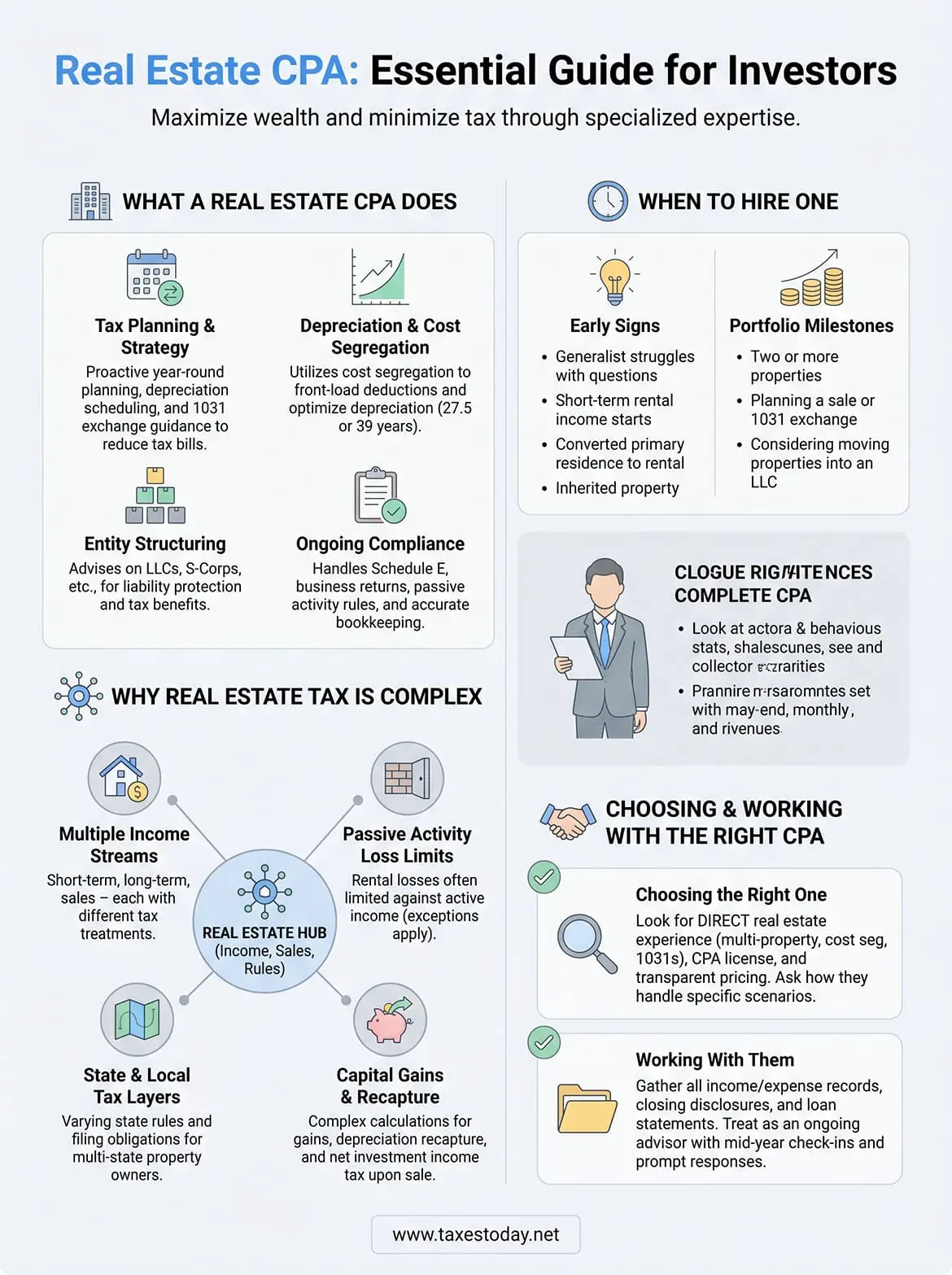
A real estate CPA does more than file your annual tax return. They actively manage your tax position throughout the year, looking for ways to reduce what you owe while keeping you fully compliant with IRS rules. They understand how property income, expenses, financing costs, and depreciation interact with the tax code, and they apply that knowledge to your specific situation rather than running you through a one-size-fits-all process.
Tax planning and strategy
The core of what a real estate CPA provides is proactive tax planning. That means they review your portfolio before the year ends, not after, and make recommendations that actually affect your tax bill. If you hold rental properties, they'll map out depreciation schedules, expense timing, and income deferral strategies based on what you own and how you own it. They're thinking about this year's return and the next several years at the same time.
A good real estate CPA doesn't just tell you what you owe after the fact. They help you make decisions throughout the year that directly change what you'll owe.
They also advise on strategies like 1031 exchanges, which let you defer capital gains taxes when you sell one investment property and roll the proceeds into another qualifying property. Executing a 1031 exchange correctly requires strict timing and documentation, and a CPA who knows real estate will walk you through the process so you don't accidentally trigger a fully taxable sale.
Depreciation and cost segregation
One of the most valuable things a real estate CPA brings to the table is their command of depreciation rules. Residential rental properties depreciate over 27.5 years under standard IRS guidelines, while commercial properties depreciate over 39 years. Many investors stop there, not realizing they may qualify for accelerated depreciation through cost segregation studies, which break a property down into components that can depreciate on a much shorter timeline.

A cost segregation study can front-load significant deductions into the early years of ownership, reducing your taxable income when you need it most. Your CPA will assess whether the cost of the study makes sense given your property's value and your overall tax picture, so you're not spending money on a strategy that won't generate a meaningful return.
Entity structuring and compliance
How you hold your properties matters as much as the properties themselves. A real estate CPA helps you evaluate whether you should own rentals in your personal name, inside an LLC, an S-Corp, or another structure. Each option carries different liability exposure, self-employment tax implications, and reporting requirements, and the right answer depends on your income level, the number of properties you own, and your goals for the portfolio.
Beyond the initial structure, they handle ongoing compliance: preparing Schedule E for rental income and losses, filing business returns for LLCs or S-Corps, reconciling depreciation records, and keeping your books organized in a way that holds up under IRS scrutiny. Your CPA also tracks passive activity loss rules, which limit how much rental loss you can deduct in a given year depending on your level of participation in the activity and your adjusted gross income.
Why real estate taxes get complicated
Real estate sits at the intersection of several tax rules that don't apply to ordinary W-2 income. When you earn wages, your employer withholds taxes and you receive a W-2 at year's end. When you own rental properties, you're managing rental income, depreciation recapture, capital gains, and passive activity rules all at once, and each one carries its own IRS requirements and potential traps. Stack a sale or a new acquisition on top of your existing portfolio, and the complexity compounds quickly.
Multiple income streams and overlapping rules
If you generate income from a combination of short-term rentals, long-term leases, and property sales, the IRS treats each stream differently. Short-term rentals, for example, may be classified as active business income rather than passive rental income depending on how many hours you spend managing the property. That classification changes which deductions you can claim and how any losses interact with your other income sources.
Selling a property brings its own set of calculations. Capital gains tax rates, depreciation recapture taxed at 25%, and the net investment income tax can all apply to the same transaction simultaneously. Getting the numbers right requires a complete history of every improvement, depreciation deduction, and cost adjustment made during your entire holding period.
Missing even one piece of your property's cost basis history can cause you to overpay capital gains taxes by a meaningful amount.
Passive activity loss limitations
The IRS treats most rental income as passive activity, which means rental losses can only offset other passive income, not your wages or active business income. There is a limited exception: an allowance of up to $25,000 for active participants with a modified adjusted gross income below $100,000. That allowance phases out entirely as your income climbs toward $150,000. Real estate professionals who meet specific hour requirements can unlock the ability to deduct losses against all income types, but qualifying requires thorough documentation of your time and involvement across every property.
State and local tax layers
Federal tax is only part of what you owe. California, for instance, taxes capital gains as ordinary income, which means the same sale can be taxed very differently depending on where your property sits. If you own properties in multiple states, you may have filing obligations in each one. A real estate CPA who understands both federal rules and the specific states where you invest protects you from missing requirements that could lead to penalties, back taxes, or unwanted IRS attention.
When investors should hire one
Many investors put off hiring a real estate CPA because they assume it's only necessary once the portfolio gets large. That thinking costs money. The right time to bring in a specialist is earlier than most people expect, and the signals are less about portfolio size and more about the complexity of your tax situation. If your tax return involves anything beyond a simple W-2 and a basic Schedule E, you're likely leaving savings behind without one.
Early signs you've outgrown a generalist
The clearest sign that you need a real estate CPA is when a general tax preparer starts struggling with your questions. If your accountant can't explain passive activity loss rules, doesn't know how depreciation recapture works on a sale, or has never handled a 1031 exchange, that gap will cost you. A generalist can file your return accurately without filing it optimally, and in real estate those two things are very different.
The difference between a correctly filed return and an optimally filed return can easily exceed what you pay a specialist for the entire year.
You should also consider making the switch if you recently started receiving income from a short-term rental platform, converted a primary residence to a rental, or inherited a property. Each of these situations introduces new tax classifications and reporting requirements that a generalist may not flag without prompting.
Portfolio milestones that trigger the need
Certain portfolio milestones make hiring a real estate CPA a straightforward financial decision rather than an optional one. If you own two or more properties, your depreciation schedules, expense tracking, and passive loss calculations multiply in complexity with each addition. If you're planning to sell a property and reinvest the proceeds, the window for executing a 1031 exchange is narrow and unforgiving, and having the right advisor in place before you list is essential.

Investors who are considering moving properties into an LLC or other business entity also need specialist guidance before making the switch, not after. Transferring a property that carries a mortgage into an entity can trigger due-on-sale clauses and unexpected tax events if handled incorrectly. A real estate CPA assesses those risks and structures the move in a way that protects your investment and keeps you fully compliant with IRS requirements.
How to choose the right real estate CPA
Not every CPA who lists real estate on their website actually specializes in it. The gap between a generalist who occasionally handles a rental property return and a true real estate CPA who works with investors daily is significant. Choosing the right person means asking specific questions, checking for relevant credentials, and verifying that they understand the strategies that apply directly to your portfolio and goals.
Look for specific real estate experience
The single most important filter is direct, hands-on experience with real estate investors at your level of complexity. Ask candidates how many real estate clients they serve and what types of properties those clients hold. If they primarily work with W-2 earners who own one rental unit, they may not have the depth to handle multi-property portfolios, cost segregation analysis, or 1031 exchange coordination.
A CPA's experience should match the complexity of your situation, not just the general category of real estate.
Look for someone who holds a CPA license in your state and is registered with the IRS as an authorized e-file provider. CTEC certification matters in California specifically, where the state requires its own certification for paid tax preparers. Credentials confirm that the person you're working with meets a baseline of professional accountability that protects you if something goes wrong.
Ask the right questions before you commit
Before you sign anything, treat the initial consultation as an interview. Ask the candidate to walk you through how they would handle a property sale with depreciation recapture, or how they approach passive activity loss limitations for someone at your income level. Their answer will tell you quickly whether they're working from real knowledge or giving you a rehearsed response.
You should also ask how they communicate during the year, not just at tax time. A real estate CPA who only resurfaces in March and April isn't set up to give you the proactive planning that actually moves your tax bill. Look for someone who is reachable for mid-year check-ins, responds to questions promptly, and flags relevant tax law changes that affect your properties before they hit your return.
Finally, ask for a clear breakdown of their fees before you commit. Transparent, upfront pricing protects you from surprises and gives you a reliable baseline to compare across a few candidates.
What to bring and how to work with them
Walking into your first meeting with a real estate CPA unprepared wastes time and can delay your return or planning session. The more organized you are from the start, the faster your CPA can assess your situation and start identifying opportunities. Think of the relationship as a collaboration: your CPA brings the tax strategy and compliance expertise, and you bring the financial history that makes that strategy possible.
Documents and records to gather
Before your first appointment, pull together everything related to your rental income and expenses for the year. That includes rent rolls, bank statements, mortgage statements, property tax bills, insurance invoices, and receipts for any repairs or improvements you made. If you purchased or sold a property during the year, locate your closing disclosure from each transaction, along with any records of improvements made during your holding period. These numbers feed directly into your cost basis calculations and depreciation schedules, so gaps in the documentation mean gaps in your deductions.
Bring records for any loans, refinances, or equity withdrawals tied to your properties as well. The interest on loans used to acquire or improve rental properties is generally deductible, but your CPA needs the statements to verify both the purpose and amount. If you work with a property manager, bring their end-of-year summary reports too.
The more complete your records are at the first meeting, the more time your CPA spends on strategy rather than chasing down missing paperwork.
How to get the most from the relationship
Treat your CPA as an ongoing advisor, not just someone you contact once a year in the weeks before the filing deadline. Check in mid-year when you're considering a new acquisition, planning a refinance, or thinking about converting a property to a different use. Those conversations cost far less time than correcting a tax situation after the fact, and they often surface opportunities that a year-end review would miss entirely.
Respond quickly when your CPA asks for additional documents or clarifications. Delays on your end push your return toward the filing deadline and compress the time available for a careful review. Keep your income and expense records updated throughout the year rather than reconstructing everything in January, and flag any major financial decisions early so your CPA can weigh in before you act, not after. A simple, organized system makes every interaction faster and more productive.
A simple next step
Real estate taxes reward preparation and punish guessing. If you've been relying on a generalist or handling your own returns, the gap between what you've paid and what you could have paid is likely larger than you realize. A real estate CPA brings the kind of focused expertise that turns your portfolio from a tax headache into a well-documented, optimized financial asset.
You don't need to manage a large portfolio to benefit from working with a specialist. One rental property, one sale, or one LLC filing is enough to introduce complexity that a general preparer may handle correctly without handling it strategically. Starting the relationship early means every year builds on the last, and your tax position improves over time rather than staying flat. If you're ready to work with a team that understands real estate, self-employment, and complex filings, start with a professional tax review at TaxesToday and get your next return handled the right way.