



California Tip Tax Credit: How Restaurants Save Thousands
If you own or manage a restaurant in California, there's a good chance you're leaving money on the table every tax season. Between the federal FICA tip tax credit (Section 45B) and recent California-specific tax legislation, understanding how restaurants can save thousands using the tip tax credit in California isn't just a nice idea, it's a real opportunity to reduce your tax liability by a significant amount each year.
Here's the problem: most restaurant owners either don't know these credits exist or assume they're too complicated to claim. The result? They overpay on payroll taxes year after year while their competitors quietly pocket the savings. The Section 45B credit alone can return a dollar-for-dollar reduction on your federal tax bill based on FICA taxes paid on employee tips above minimum wage. Multiply that across your staff, and the numbers add up fast, often into the tens of thousands annually.
This guide breaks down exactly how the tip tax credit works at both the federal and California state level, who qualifies, and the steps to claim it correctly. At TaxesToday, we work directly with restaurant owners and small businesses across California and nationwide to identify credits like these that often go unclaimed. Our CTEC-certified and IRS-registered tax preparers have spent over 15 years helping businesses stay compliant while keeping more of what they earn. Let's walk through it.
What the tip tax credit is and who qualifies
The tip tax credit refers to the federal Section 45B credit, established under the Internal Revenue Code, which lets food and beverage employers recoup a portion of the FICA taxes they pay on employee tips. It's a dollar-for-dollar tax credit, not just a deduction, so every dollar of credit directly reduces your federal income tax bill. Understanding how restaurants can save thousands using the tip tax credit in California starts with knowing what the credit actually covers.
The federal Section 45B credit explained
The credit equals the employer's share of FICA taxes (7.65%) paid on tips that exceed the federal minimum wage, currently $7.25 per hour. You don't get credit for FICA taxes on tips used to bring an employee up to minimum wage, because the IRS treats those as wages, not gratuities. Any tips above that floor, though, generate a fully creditable amount against your federal tax liability.
The Section 45B credit is a dollar-for-dollar federal tax credit, making it one of the most valuable and underused tools available to restaurant owners.
For a concrete example: if a server earns $3.00 per hour base pay and receives $200 in tips during a pay period, pushing their effective hourly rate well above $7.25, the FICA taxes you paid on the portion above the minimum wage threshold are what generate the credit on IRS Form 8846.
Who qualifies to claim the credit
You qualify if you operate a food or beverage business where tipping customers is customary. That covers full-service restaurants, bars, cafes, and similar establishments. The credit applies to W-2 employees who receive tips and also covers situations where you as the employer report and pay FICA on allocated tips.
Businesses outside the food and beverage space, such as retail shops, do not qualify because tipping isn't customary there. California restaurant owners should also note that state payroll tax obligations interact directly with these federal tip numbers, which the later steps in this guide address in detail.
| Requirement | Details |
|---|---|
| Business type | Food and beverage establishment where tipping is customary |
| Employee type | W-2 employees who receive tips |
| Tip threshold | Tips above the federal minimum wage ($7.25/hr) |
| Tax form | IRS Form 8846 |
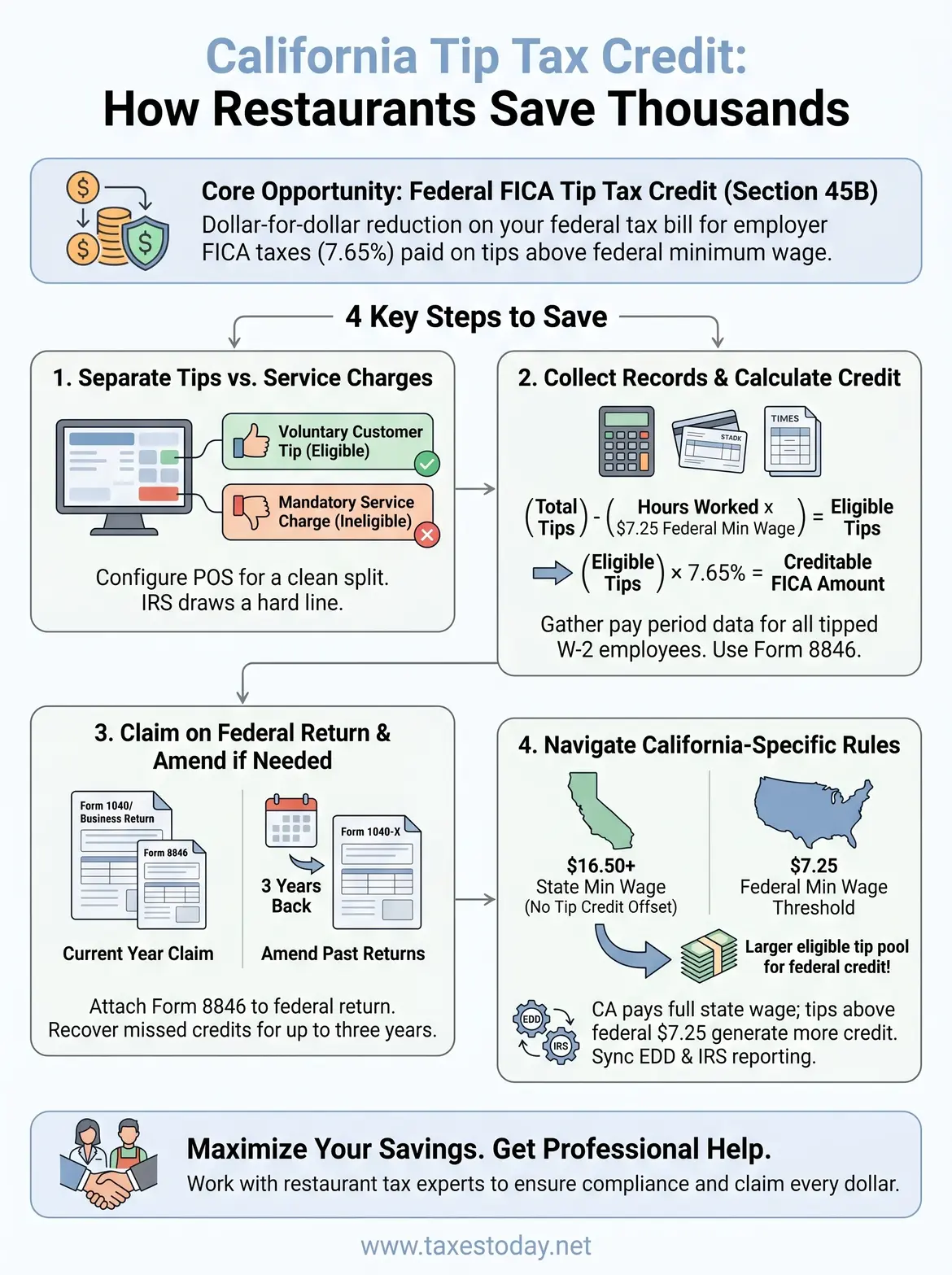
Step 1. Separate tips from service charges in your systems
The first thing to get right before you calculate anything is how your point-of-sale system categorizes incoming payments. The IRS draws a hard line between tips and service charges, and that distinction determines whether a payment qualifies for the Section 45B credit at all.
Why the IRS draws a hard line here
A voluntary gratuity qualifies as a tip when the customer controls the amount, the payment isn't mandatory, and the money flows directly to the employee. A mandatory service charge added automatically to the bill, like a 20% large-party fee, is treated as wages. You don't earn the Section 45B credit on wages, so misclassifying service charges as tips inflates your credit claim and creates IRS audit exposure. This is one of the most common mistakes that costs restaurant owners the credit entirely, which is a key part of understanding how restaurants can save thousands using the tip tax credit in California.
If your POS system lumps mandatory service charges into the same bucket as voluntary tips, your Section 45B credit calculation will be wrong from the start.
How to configure your POS for a clean split
Your POS system needs separate line items for voluntary customer tips and mandatory service charges. Most major restaurant platforms let you configure this inside the payment or gratuity settings. When you pull payroll reports, both categories should appear as distinct, labeled fields.
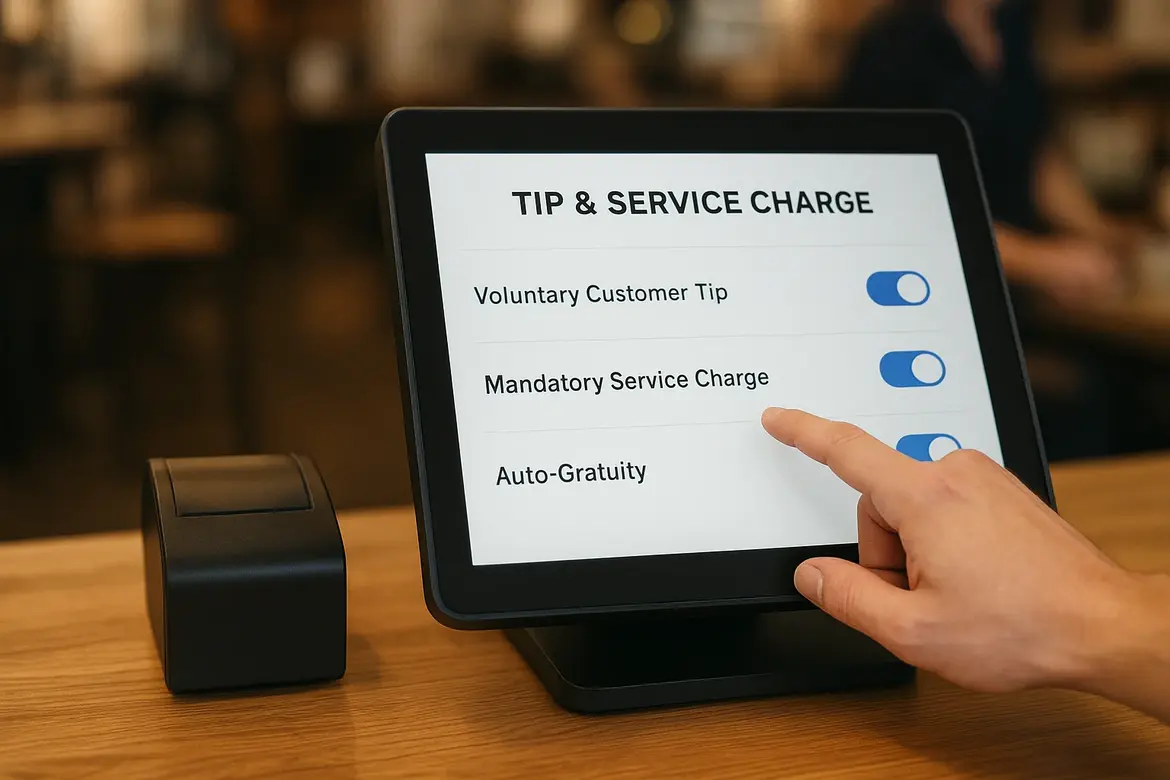
Here's what a clean payroll report breakdown looks like:
| Payment Type | IRS Treatment | Counts Toward 45B Credit |
|---|---|---|
| Voluntary customer tip | Tip income | Yes |
| Mandatory service charge | Wages | No |
| Auto-gratuity (large parties) | Wages | No |
Step 2. Collect the right records and calculate the credit
Once your POS system separates tips from service charges correctly, you need organized documentation before you touch any numbers. The IRS requires you to substantiate every dollar claimed on Form 8846, so pulling these records together early keeps your return clean and defensible.
The records you need before you calculate
You'll want to gather these for each pay period throughout the year:
- Total tips reported by each employee (from IRS Form 4070 or your POS reports)
- Hours worked per employee per pay period
- Base hourly wage paid to each tipped employee
- Employer FICA taxes paid on all reported tips (your 7.65% share)
- Payroll registers showing gross wages and tip income separately
Keeping these records organized by pay period, not just annually, makes the Form 8846 calculation straightforward and protects you if the IRS asks questions.
How to run the calculation
The formula is direct. For each employee, multiply their total hours worked by $7.25 (the federal minimum wage). Subtract that figure from their total reported tips. The leftover amount is the tip income eligible for the credit. Then multiply that eligible tip amount by 7.65% to get your creditable FICA taxes for that employee. Add up the totals across your entire staff for the year, and that final sum is what you report on Form 8846 and carry to your federal return.
| Calculation Step | Example (One Employee, Annual) |
|---|---|
| Total reported tips | $18,000 |
| Minimum wage offset (1,800 hrs x $7.25) | $13,050 |
| Eligible tip income | $4,950 |
| Credit amount (x 7.65%) | $378.68 |
Understanding how restaurants can save thousands using the tip tax credit in California comes down to running this calculation accurately across every tipped employee on your payroll, not just your highest earners.
Step 3. Claim the credit on your return and amend if needed
Once you have your Form 8846 calculation ready, you attach the form directly to your federal business tax return. For sole proprietors, that means your Form 1040 with Schedule C. For S-Corps or partnerships, the credit flows through to owners on Schedule K-1 and then onto each owner's individual return. The total credit amount from Form 8846 transfers to Form 3800, the General Business Credit form, which then reduces your final federal tax liability dollar for dollar.
How to file Form 8846 with your return
Form 8846 has four lines and takes under ten minutes to complete once your records are in order. Enter your total employer FICA taxes paid on tips, subtract any FICA paid on tips used to meet minimum wage, and the remaining figure is your credit. Attach the completed form to your return before you e-file or mail it.
Missing Form 8846 from your return doesn't eliminate the credit, but it does mean the IRS won't apply it automatically.
Amending a prior return to claim missed credits
If you didn't claim the Section 45B credit in a previous year, you can still recover that money. Understanding how restaurants can save thousands using the tip tax credit in California includes knowing the IRS allows amendments up to three years from the original filing deadline. File Form 1040-X for individual returns or the appropriate amended business return, attach a corrected Form 8846 with the original year's data, and submit supporting payroll records to back up your numbers.
Step 4. Follow California rules that affect your tip numbers
California's labor laws introduce variables that directly affect your Section 45B calculation, even though the credit itself is federal. Knowing where California diverges from federal standards protects your numbers and keeps your payroll reporting accurate before you transfer anything to Form 8846.
California does not allow a tip credit toward minimum wage
Unlike some states, California requires employers to pay the full state minimum wage regardless of how much an employee earns in tips. As of 2025, California's statewide minimum wage sits at $16.50 per hour, and fast food workers covered under the FAST Recovery Act face a $20 per hour floor. This matters because while California prohibits using tips as a wage offset, the Section 45B credit still uses the federal minimum wage of $7.25 for its threshold calculation, not the California rate. That gap between the two figures means your eligible tip income for the federal credit is larger than it would be in a lower-wage state, which is one of the reasons how restaurants can save thousands using the tip tax credit in California holds true in practice.

Because California sets no tip credit for wage purposes, you're already paying the full state minimum wage on top of tips, so more of your reported tips clear the federal $7.25 threshold and generate creditable FICA amounts.
How California payroll taxes interact with your tip records
California's Employment Development Department (EDE) requires you to withhold state income tax and report SDI contributions on tip income, just as you do for regular wages. Keep your state payroll filings and your federal FICA records synchronized. A discrepancy between what you report to the EDD and what you claim on Form 8846 raises a red flag during both state and federal reviews.
Next steps for a clean, claimable tip credit
You now have a complete picture of how restaurants can save thousands using the tip tax credit in California. The work comes down to three priorities: configure your POS to separate voluntary tips from mandatory service charges, pull organized payroll records for every tipped employee, and run the Form 8846 calculation correctly before you attach it to your return. If you missed the credit in prior years, amending those returns is still on the table, and the recovery can be substantial.
Getting these details right the first time saves you from audits, amended filings, and missed money. A qualified tax preparer who works with restaurant owners understands how California's payroll rules interact with the federal credit and where errors typically hide. If you want a professional to review your situation, calculate your credit, or amend a prior return, contact TaxesToday for restaurant tax help and keep more of what your business earns.