


10 Best Tax Preparation Companies to File With in 2026
Picking from the dozens of tax preparation companies competing for your refund is harder than it should be. Some push you toward expensive add-ons, others bury their pricing until the final screen, and a few simply don't have anyone qualified reviewing your return before it goes to the IRS. If you've been burned by a bait-and-switch fee or a preparer who missed an obvious deduction, you already know why this decision matters.
This guide breaks down the best tax preparation services available in 2026, covering full-service firms, DIY software, and hybrid options that let you file online with a real person checking your work. Whether you're a W-2 employee, a freelancer juggling 1099s, a small business owner, or filing as a non-resident, you'll see which providers actually fit your situation and where each one falls short.
We compared pricing, turnaround time, audit support, and the credentials of the people actually preparing your return, not just the marketing copy. By the end, you'll know which company deserves your tax documents this season, and which ones to skip.
1. TaxesToday.net for affordable virtual and in-person filing
TaxesToday.net tops this list because it solves the exact problem most filers run into: paying too much for too little expertise. The company is built around IRS-registered and CTEC-certified preparers with over 15 years of combined experience, and it serves clients both remotely across all 50 states and in person throughout Orange County, California, tax preparation areas, including Costa Mesa, Santa Ana, Irvine, and Newport Beach. That combination of licensed professionals and flexible service delivery is rare at this price point.
.webp)
How it works
You start by choosing virtual or in-person service. Virtual tax preparation clients upload documents through a secure portal, and a dedicated preparer reviews everything before filing electronically. Clients choosing in-person tax services in the Orange County area can sit down with a preparer directly, which helps when you're dealing with a first-time business filing or an IRS notice you don't fully understand. Either way, a credentialed preparer handles your return from intake to e-file, not a seasonal call-center employee reading from a script.
Who it's for
This service fits W-2 employees, married couples, and heads of household who want a straightforward filing without software guesswork. It's also a strong match for freelancers and 1099 contractors who need tax prep for self-employed filers on Schedule C, small business owners running single-member LLCs or S-Corps, and non-resident filers who need 1040NR or Form 8843 support for F-1, J-1, OPT, or CPT status. If you have back taxes to file, need an amended return corrected, or just want a second opinion on a return you prepared yourself, TaxesToday.net covers all of it under one roof.
The right tax preparer should cost less than the mistakes a bad one lets you make.
Pricing
Pricing starts at $99 for straightforward individual returns, with more complex filings (self-employment, small business, or non-resident returns) priced higher based on the forms required. You can see current rates and service tiers directly on the TaxesToday.net pricing page before committing to anything, which is more transparency than most competitors offer upfront.
Pros and cons
| Pros | Cons |
|---|---|
| Licensed, CTEC-certified preparers with 15+ years of experience | Primarily focused on California for in-person visits |
| Virtual and in-person options nationwide | No walk-in retail locations outside Orange County |
| Handles complex cases: 1099, LLC, S-Corp, non-resident, back taxes | Not a self-service DIY software option |
| Transparent starting price of $99 | Pricing rises with return complexity, as with any full-service preparer |
| Amended returns, extensions, and IRS notice support included |
Overall, this is the pick for anyone who wants a real person accountable for their return without paying big-firm prices.
2. IRS Free File and Direct File for free government filing
The IRS Free File program partners with several tax software companies to let eligible filers prepare and submit federal returns at no cost, while the newer IRS Direct File tool lets you file straight through the IRS itself without a third-party middleman. Both options exist because the government wants a genuinely free path to compliance, not a $0 landing page that upsells you at checkout. For simple returns, this is the cheapest legitimate option on this list.
How it works
Eligibility for Free File depends on your income; for 2026 filing, the threshold is expected to stay near $84,000 in adjusted gross income, matching prior years. You answer a short questionnaire on the IRS Free File site, get matched to a participating software partner, and file your federal return through that partner's interface, and it helps to know how to qualify for free federal filing before you start. Direct File, where available, skips the partner matching entirely and walks you through a guided federal filing process on an IRS-run platform, though it currently supports a narrower range of tax situations.
Who it's for
This fits filers with simple, single-source income: W-2 wages, standard deduction, maybe some interest income or student loan interest. It doesn't handle self-employment income, rental property, or complicated itemized deductions well, so freelancers and small business owners should look at other free or low-cost filing help instead.
Free filing only pays off if your return is actually simple enough to qualify.
Pricing
Federal filing is free for eligible filers under both programs. State returns aren't always included with Free File and may require a separate paid or free state option depending on your state and the partner software you're matched with.
Pros and cons
| Pros | Cons |
|---|---|
| Completely free federal filing for eligible income levels | Income and situation limits exclude many filers |
| No upsells from a government-run platform | Direct File availability varies by state |
| Backed directly by the IRS | No human preparer reviewing your return |
| Good for simple W-2 returns | State filing isn't always free |
3. TurboTax for guided do-it-yourself filing
TurboTax is the software most people think of first when they picture DIY tax prep, and it earns that reputation through a polished interview-style interface that translates tax jargon into plain questions. Owned by Intuit, it's built for filers who want to handle their own return but need constant hand-holding along the way. The trade-off is price: TurboTax consistently ranks among the most expensive tax preparation companies in the DIY category once you add state filing or live help.
How it works
TurboTax walks you through your return using a question-and-answer format, importing W-2 and 1099 data automatically from many employers and financial institutions. You can upgrade mid-filing to add a human reviewer through its Live product line, which pairs you with a credentialed preparer for an extra fee. The software flags potential deductions as you go, though it often nudges you toward pricier tiers to unlock them.
Who it's for
TurboTax suits filers who are comfortable navigating software independently but still want reassurance that they haven't missed something. It works well for W-2 employees with moderate complexity, like a mortgage or investment income, but self-employed filers often find TurboTax's Self-Employed tier price climbs fast.
Convenience software still charges convenience prices once your return gets complicated.
Pricing
Simple returns can sometimes file free, but most paid tiers range from roughly $69 to $219 for federal filing, plus separate state fees, before any add-on for live expert review.
Pros and cons
| Pros | Cons |
|---|---|
| Intuitive, guided interview format | Pricing climbs quickly with complexity |
| Automatic import of tax documents | State filing costs extra |
| Optional live expert review add-on | Upsells appear throughout the process |
| Strong mobile app support | No dedicated preparer relationship |
4. H&R Block for online filing with in-person backup
H&R Block carved out a spot on this list because it bridges DIY software and full-service prep better than almost anyone else in the category. You can start your return online at home, and if you hit a form you don't understand, you can walk into one of its thousands of retail locations and hand it off to a preparer instead. That flexibility makes it a solid middle-ground pick among tax preparation companies that primarily sell software.

How it works
You begin filing through H&R Block's website or app, answering guided questions similar to other DIY platforms. If your situation gets complicated, mid-return, you can switch to a paid Online Assist tier for live help, or drop off your documents at a physical office and let a preparer finish the job. The retail office network is the real differentiator here since it gives you a fallback option that pure software companies can't match, much like other tax companies near you with storefronts.
Who it's for
This fits filers who want to try filing themselves but aren't fully confident they can handle it alone, plus anyone who values having a physical office nearby if a question or IRS letter comes up later. It also suits people who moved recently and want continuity, since H&R Block operates in nearly every mid-sized city.
Software with a storefront behind it beats software with only a chat window.
Pricing
Online DIY tiers typically run from free for simple returns up to around $85 to $115 for federal filing, with state returns billed separately. In-person prep starts higher, often $150 and up depending on complexity.
Pros and cons
| Pros | Cons |
|---|---|
| Can switch from online to in-person mid-filing | In-person pricing isn't published upfront |
| Thousands of physical locations nationwide | Preparer skill varies by office and season |
| Live expert help available as an add-on | Add-ons increase cost quickly |
| Good for filers wanting a backup option | Not the cheapest DIY option available |
5. TaxAct for budget-friendly DIY filing
TaxAct positions itself as the value play among DIY tax preparation companies, undercutting TurboTax and H&R Block on price while still covering most common tax situations. It's been around since the 1990s, and it doesn't chase the polished interface of its bigger competitors. Instead, it leans on a straightforward question-and-answer format and a price tag that stays reasonable even as your return gets more complex.
How it works
You answer guided prompts that build your return step by step, and TaxAct imports prior-year data if you filed with them before, which speeds up returning users considerably. A built-in accuracy guarantee checks your entries for common errors before you submit, and the software offers a side-by-side comparison against last year's return so you can spot unexpected swings in your refund or balance due. Live help exists through a paid Xpert Assist tier, though it's less prominent than the equivalent offerings from TurboTax or H&R Block.
Who it's for
This fits budget-conscious W-2 employees, retirees with investment income, and even freelancers who want self-employment support without paying premium software prices. It suits filers comfortable reading a few extra screens in exchange for saving real money, rather than those who want affordable tax preparation services that fit their situation with a professional attached.
Paying less for DIY software only makes sense if it still covers your actual tax situation.
Pricing
Federal filing runs roughly $0 to $90 depending on the tier, with state returns typically adding $40 to $60. Self-employed filers land at the top of that range but still pay less than equivalent competitor tiers.
Pros and cons
| Pros | Cons |
|---|---|
| Lower pricing than TurboTax and H&R Block | Interface feels dated compared to competitors |
| Covers self-employment and investment income | Fewer free live-help options |
| Prior-year import speeds up filing | Customer support response times can lag |
| Accuracy guarantee included | No physical office backup |
6. FreeTaxUSA for free federal returns
FreeTaxUSA earns its spot among tax preparation companies by doing something rare in the DIY software space: it charges nothing for federal filing, no matter how complex your return gets. Self-employment income, rental property, itemized deductions, it's all included in the free federal tier. The catch is state filing, which carries a small flat fee, but even that stays cheaper than most competitors' cheapest paid tier.
How it works
You fill out your return using a form-based, question-and-answer hybrid that feels less polished than TurboTax but covers the same IRS forms. Prior-year returns import automatically if you filed with the service before, and a built-in accuracy check flags obvious errors before you submit. Live chat support with a tax professional is available through a low-cost Deluxe upgrade, which also unlocks priority support and audit assistance.
Who it's for
This fits self-employed filers, landlords, and anyone with a moderately complex return who doesn't want to pay for complexity the way TurboTax or H&R Block charge for it, though LLCs and S-Corps may still need small business tax preparation services. It also suits confident filers who don't need hand-holding but still want a professional-grade set of forms behind the scenes.
Free federal filing shouldn't mean a stripped-down version of your actual tax situation.
Pricing
Federal filing is $0 regardless of complexity. State returns cost around $15, and the optional Deluxe add-on with live chat and priority support runs about $8 more.
Pros and cons
| Pros | Cons |
|---|---|
| Free federal filing includes self-employment and rental income | Interface is less polished than TurboTax or H&R Block |
| Low flat state filing fee | No physical office or in-person backup |
| Accuracy guarantee included | Fewer educational resources for first-time filers |
| Affordable live chat upgrade available | No walk-away DIY guarantee beyond accuracy checks |
7. Jackson Hewitt for nationwide in-person help
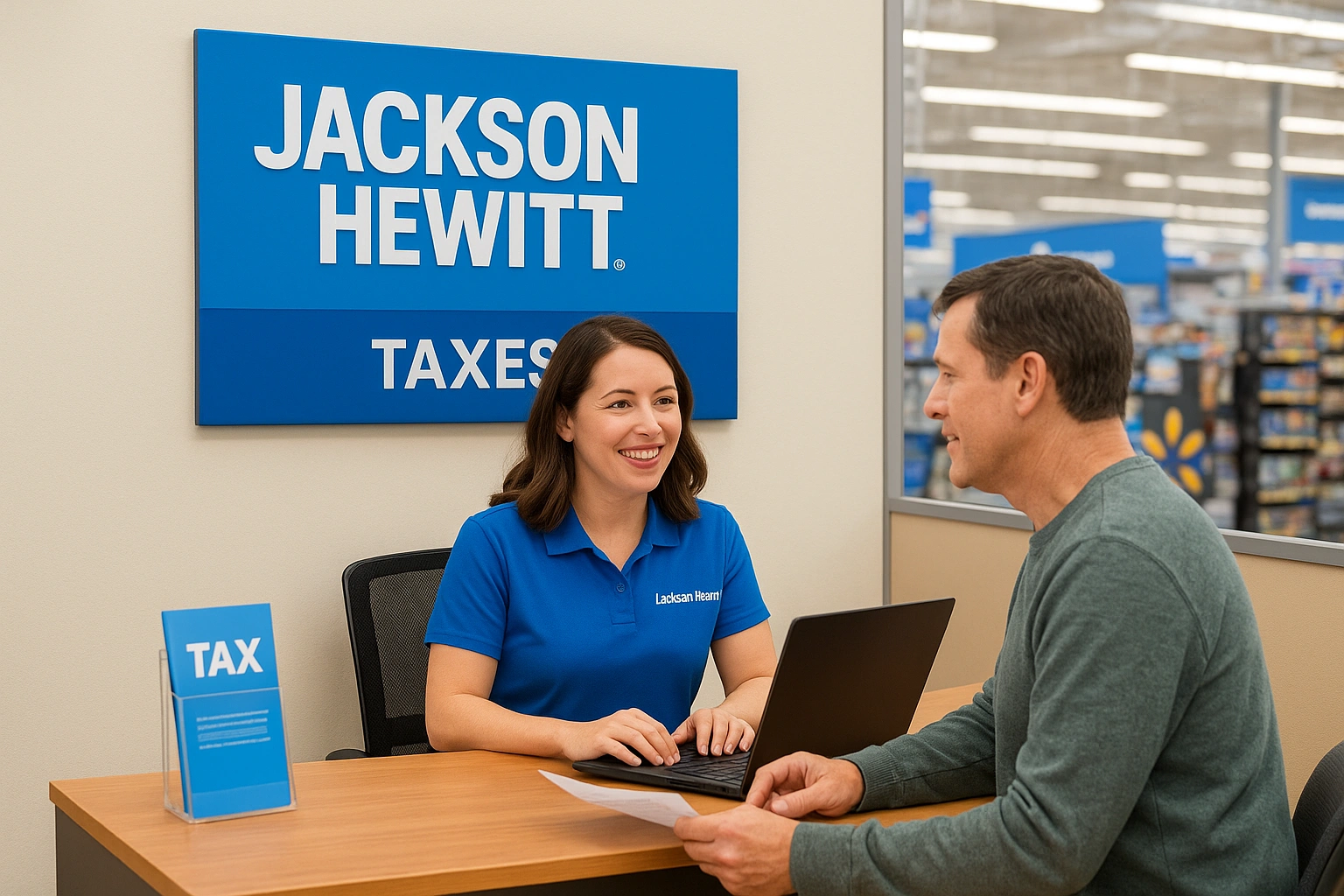
Jackson Hewitt built its business on walk-in convenience, with thousands of locations tucked inside Walmart stores across the country. Among tax preparation companies that prioritize face-to-face service, it's one of the few walk-in tax preparation locations that lets you drop off documents while grabbing groceries and pick up a finished return before you leave the parking lot. That kind of accessibility matters if you'd rather talk to a person than click through software screens.
How it works
Most clients walk into a Jackson Hewitt kiosk or storefront, hand over their W-2s and 1099s, and sit with a preparer who builds the return on the spot. A smaller online filing option exists too, letting you upload documents remotely if a physical visit isn't practical. The company also offers a flat-fee guarantee on some plans, so you know the total cost before the preparer starts working.
Who it's for
Jackson Hewitt suits shoppers and commuters who want tax prep folded into an errand they're already running, plus filers who feel more comfortable explaining their situation out loud than typing it into a form. It's less suited to filers with intricate business structures who need ongoing advisory support beyond filing season.
Convenience matters more than credentials for some filers, and Jackson Hewitt sells convenience well.
Pricing
Pricing varies by location and complexity, but simple returns often start around $150, with self-employed and itemized returns running higher. Some offices advertise flat-fee packages, though you should confirm the total before signing.
Pros and cons
| Pros | Cons |
|---|---|
| Thousands of in-store locations nationwide | Pricing isn't standardized across franchises |
| Same-day filing at many locations | Preparer experience varies by office |
| Flat-fee options at some locations | Limited support for complex business returns |
| Online filing available as a backup | Fewer year-round advisory services |
8. TaxSlayer for low-cost, confident filers
TaxSlayer targets filers who already understand their own tax situation and don't want to pay extra for hand-holding they won't use. Among tax preparation companies in the DIY space, it consistently posts some of the lowest prices for self-employed filers specifically, undercutting TurboTax and H&R Block by a wide margin on that tier. It won't win any design awards, but the forms are all there and the math checks out.
How it works
You work through a streamlined question-and-answer format that skips some of the extra explanations bigger competitors include, which speeds things up if you already know what a Schedule C or 1099-NEC is. Prior-year data imports if you filed with TaxSlayer before, and the Self-Employed tier adds year-round access to tax professionals for questions about estimated payments or deductions. There's no in-person option, so everything happens through the website or app from start to e-file.
Who it's for
This fits freelancers, gig workers, and small business owners who file every year and want low-cost software rather than a full-service preparer. It also suits confident W-2 filers who just want a cheap, no-frills return without upsells at every screen.
Cheap software works fine once you already know what your return should look like.
Pricing
Federal filing runs from $0 for simple returns up to around $63 for the Self-Employed tier, with state returns adding roughly $40 each. That Self-Employed pricing beats most best tax preparation services in the same category by a noticeable margin.
Pros and cons
| Pros | Cons |
|---|---|
| Lowest-cost Self-Employed tier among major DIY software | Fewer built-in explanations for tax terms |
| Year-round professional access on higher tiers | No physical office or in-person option |
| Fast filing for repeat, confident users | Interface feels bare-bones compared to rivals |
| Prior-year import available | Less hand-holding for first-time filers |
9. Liberty Tax for franchise and remote filing
Liberty Tax operates like a smaller, more flexible cousin of Jackson Hewitt and H&R Block, running a franchise network of storefronts alongside an online filing option for people who'd rather skip the office visit. Among tax preparation companies built on the franchise model, it stands out for letting you mix and match: start online, finish in person, or do the whole thing remotely if that's easier. That flexibility has kept it relevant even as bigger chains dominate the advertising space.
How it works
Franchise owners run each location independently, so you can walk into a local office and hand off your documents to a preparer, or use Liberty Tax's online software to file entirely from home. The online platform mirrors other DIY tools with a guided question format, while in-person offices offer the same document drop-off convenience as competitors. A virtual filing option connects you with a preparer remotely if you want a human involved without visiting a branch.
Who it's for
Liberty Tax suits filers who want a local, familiar office but also like having a remote backup available during busy weeks. It works for W-2 employees and moderately complex filers, though it's not the deepest bench for niche business or international situations.
A franchise model only works if the local office behind the sign actually knows what it's doing.
Pricing
Pricing varies by franchise location and complexity, with simple returns often starting near $150 and rising for self-employment or itemized filings. Online filing tends to run cheaper than in-person visits, though exact rates depend on the local office's fee schedule.
Pros and cons
| Pros | Cons |
|---|---|
| Combines in-person and online filing options | Pricing and quality vary by franchise |
| Local offices in many small and mid-sized towns | Less standardized experience than corporate-owned chains |
| Virtual filing available for remote clients | Fewer resources for complex business returns |
| Familiar, community-based storefronts | Online platform feels less polished than major competitors |
10. Local CPAs and enrolled agents for complex returns
Certified Public Accountants (CPAs) and enrolled agents (EAs) sit at the top end of the tax preparation companies spectrum, and for good reason: they're the only preparers with unlimited representation rights before the IRS. If your return involves multiple businesses, rental properties across state lines, stock options, or a prior audit still hanging over your head, a local CPA firm near you is the tier built for that complexity. You won't find flat-rate software here, but you will find someone who can actually argue your case if the IRS pushes back.
How it works
Hiring a tax preparer at this level usually starts with a consultation, either by phone or in person, where you lay out your full financial picture before any forms get touched. From there, the preparer gathers documents, builds your return, and often stays in contact year-round for estimated payments, entity structuring, or planning ahead of the next filing season. Enrolled agents are federally licensed specifically in tax matters, while CPAs typically cover broader accounting work, so the right choice depends on whether you need pure tax expertise or ongoing bookkeeping too.
Who it's for
This route fits business owners with multiple entities, investors managing complicated capital gains, and anyone facing an IRS audit or unresolved back tax issue who wants the best tax expert near them. It's overkill for a simple W-2 return, but for genuinely complex situations, it's often the only option that catches every deduction.
Complex returns need a preparer who can represent you later, not just file for you now.
Pricing
Fees vary widely by region and complexity, typically ranging from $200 for straightforward returns to $1,000 or more for multi-entity business filings.
Pros and cons
| Pros | Cons |
|---|---|
| Full IRS representation rights | Highest cost among preparation options |
| Handles the most complex returns confidently | Availability tightens close to deadlines |
| Year-round planning relationship | Pricing isn't standardized or published |
| Deep expertise in niche situations | Overkill for simple W-2 filers |
Finding the right fit for your 2026 taxes
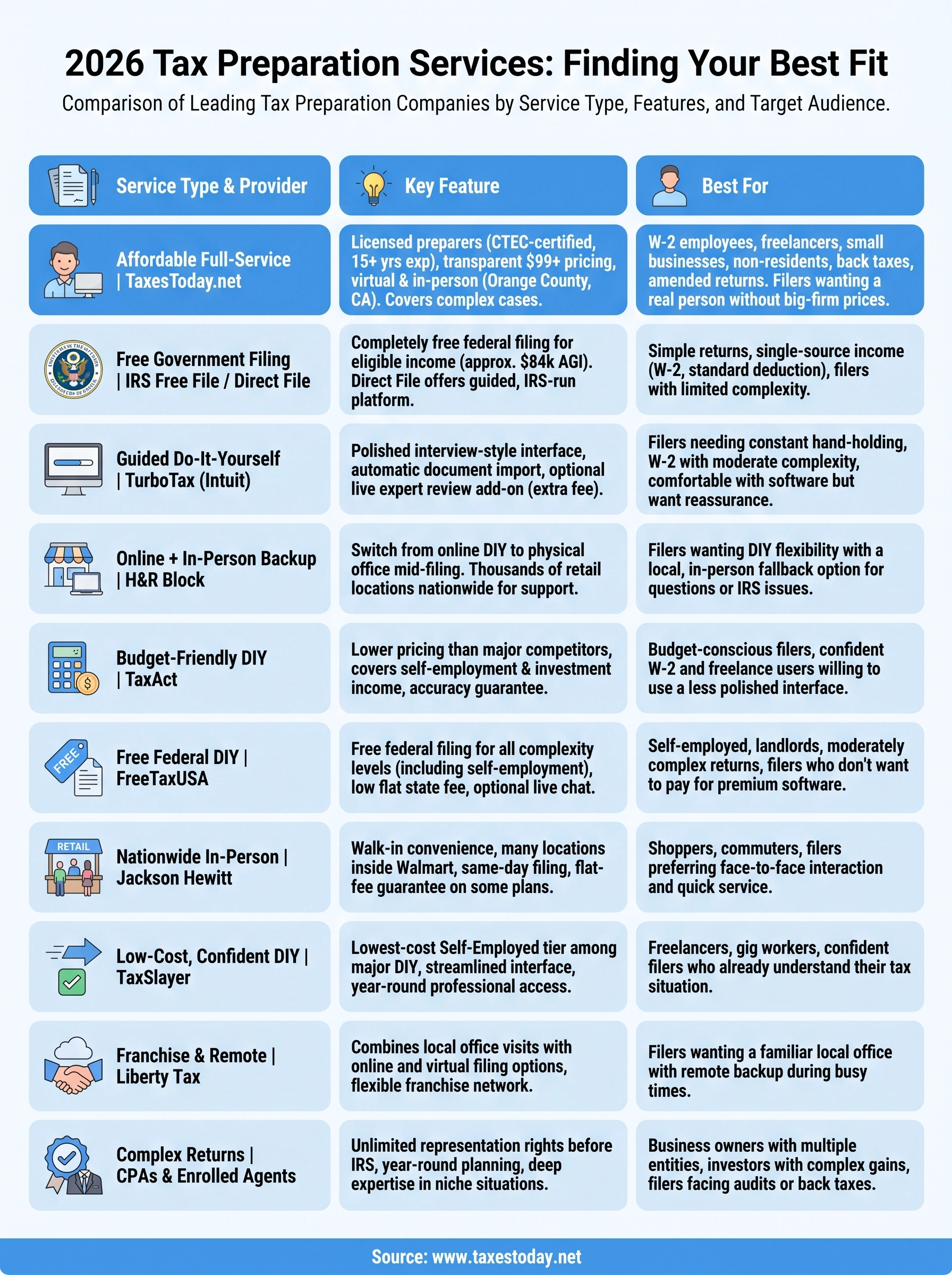
Every option on this list solves a different problem. Free File works if your return is genuinely simple. TurboTax and H&R Block suit filers who want software with training wheels. TaxAct, FreeTaxUSA, and TaxSlayer reward filers who already know their situation and just want it done cheap. Jackson Hewitt and Liberty Tax cover the walk-in crowd, and a CPA or enrolled agent earns their higher fee once your return gets genuinely complicated.
Most filers, though, land somewhere in between: too much complexity for free software, not enough for a $500 accountant retainer. That's the gap tax preparation companies like TaxesToday.net fill, pairing licensed, CTEC-certified preparers with pricing that starts at $99 and stays transparent whether you're a W-2 employee, a freelancer, or filing as a non-resident. Before you commit your documents anywhere else this season, see TaxesToday.net's $99 tax preparation and find out what accurate, affordable filing actually costs.